In a milestone announcement for cloud architecture and modern database management, Amazon Web Services (AWS) has officially declared the general availability of native vector search capabilities in Amazon DynamoDB. This major release represents a structural evolution for one of the world’s most trusted NoSQL key-value and document databases. By allowing developers to store vector embeddings directly alongside operational data, Amazon is eliminating the long-standing architectural friction of maintaining separate, dedicated vector databases and running complex, failure-prone synchronization pipelines.
For years, enterprises deploying modern artificial intelligence workloads—ranging from Retrieval-Augmented Generation (RAG) and agentic memory systems to high-performance recommendation engines and anomaly detection tools—faced a difficult trade-off. They could rely on DynamoDB for ultra-low-latency, massively scalable operational data processing, but they were forced to offload vector representations to external stores. This dual-database pattern introduced steep data movement costs, severe operational overhead, complex licensing fees, and difficult challenges in preserving predictable sub-millisecond latencies under heavy load.
The introduction of native vector search in DynamoDB changes this calculus entirely. DynamoDB now supports vector search with single-digit millisecond latencies at a 99%+ recall rate, designed to scale limitlessly to trillions of vectors without requiring any server provisioning, manual patching, or infrastructure maintenance. Operating on the same serverless infrastructure and predictable pay-per-request pricing model as standard DynamoDB tables, this new capability empowers developers to build intelligent, context-aware applications with unprecedented speed, cost-efficiency, and simplicity.
Detailed Chronology & Implementation Workflow
To understand the operational mechanics of vector search in DynamoDB, it is helpful to trace the technical workflow required to transform a traditional operational table into a semantically enabled database. The following step-by-step chronology outlines how development teams can integrate vector search into existing production environments, drawing from a typical online sporting goods catalog scenario.
Step 1: Preparing the DynamoDB Table
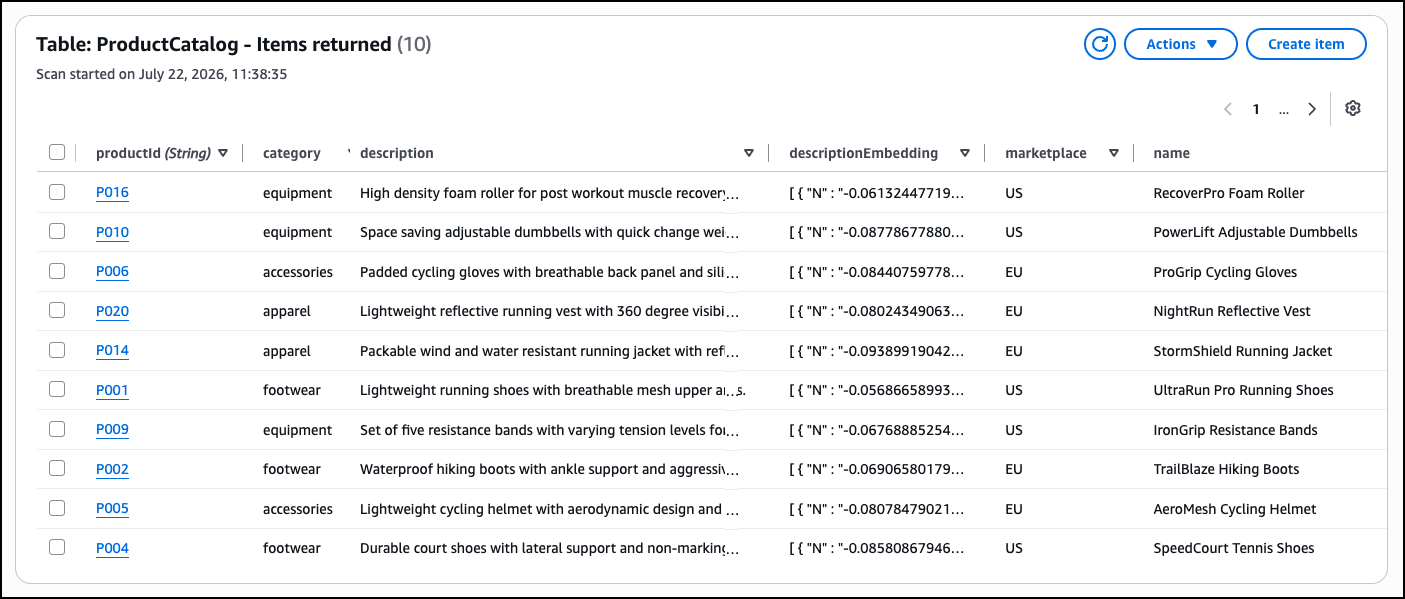
The foundational requirement for semantic search is the translation of unstructured or semi-structured data—such as product descriptions, user reviews, or support tickets—into machine-readable numerical representations known as vector embeddings. These embeddings capture the semantic meaning of text, ensuring that items describing conceptually similar concepts are mapped closely together within a multi-dimensional vector space.
Developers can generate these embeddings using any machine-learning model of their choice, such as Amazon Bedrock Titan Text Embeddings, Cohere Embed, or OpenAI text embedding models. Once generated, these vectors are injected directly into existing DynamoDB tables.
Crucially, DynamoDB utilizes its existing native List data type to store vector embeddings, where each element in the list is a Number representing a single floating-point value. For an established table like ProductCatalog, engineers can use a standard UpdateItem or PutItem API call to add a new attribute—for instance, descriptionEmbedding—without altering the rigid underlying table schema or migrating data to specialized storage engines.
Step 2: Creating the Vector Index
Once the embeddings reside within the table items, developers configure a specialized vector index via the AWS Management Console, AWS Command Line Interface (AWS CLI), AWS SDKs, or Infrastructure-as-Code (IaC) tools like AWS CloudFormation.
During index creation, several critical parameters must be defined:
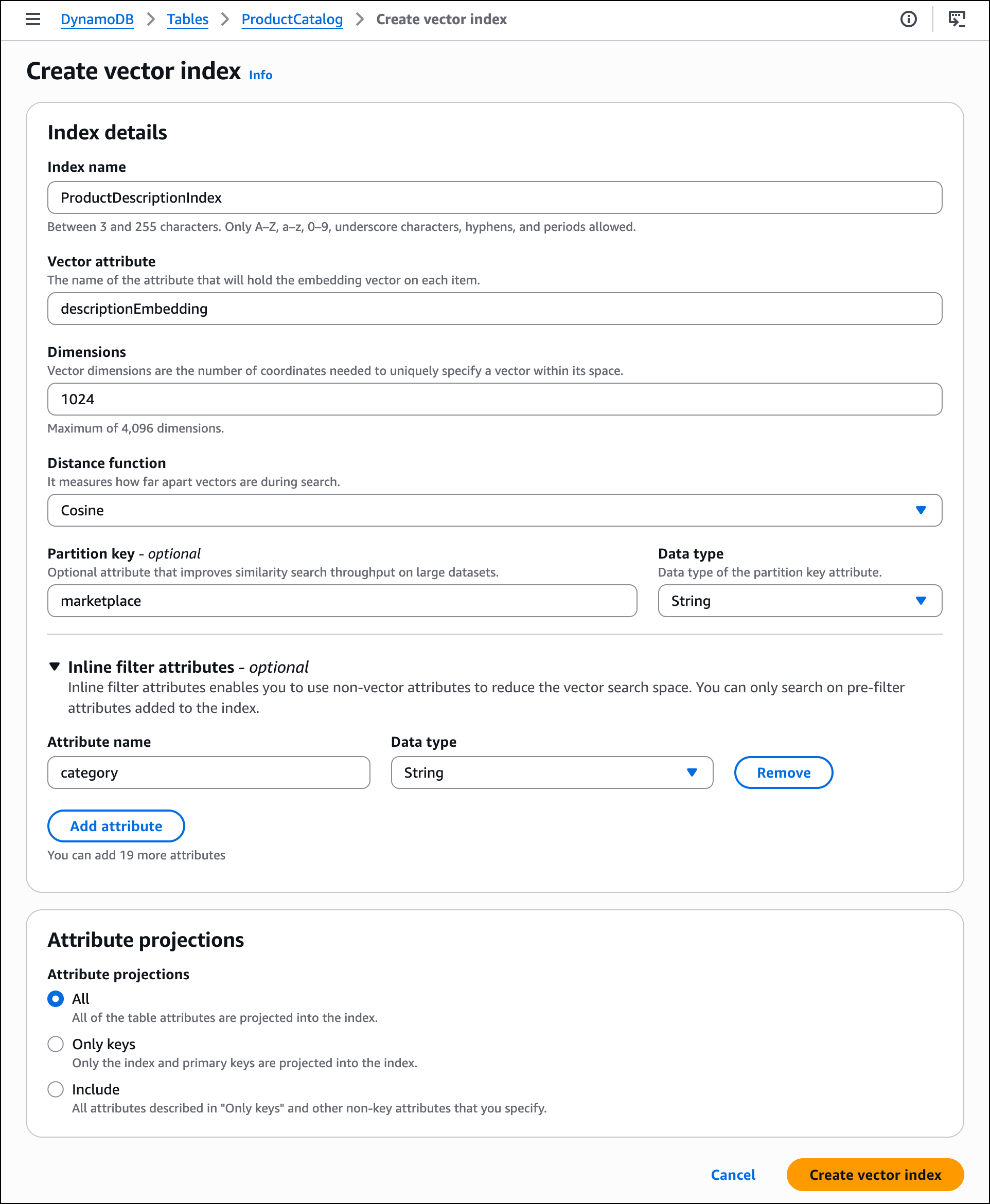
Index Name & Vector Attribute: Designating a unique identifier for the index and pointing it to the attribute storing the embeddings (e.g., ProductDescriptionIndex targeting descriptionEmbedding).
Dimensions & Distance Function: Setting the exact number of dimensions matching the output of the chosen embedding model, and selecting a distance metric—Cosine, Euclidean, or Dot Product—to evaluate vector proximity. Cosine distance, which measures the angle between vectors independent of magnitude, is exceptionally well-suited for natural language text similarity.
Partition Key Configuration: Assigning an optional operational attribute (such as marketplace) as the partition key for the vector index. This allows DynamoDB to intelligently distribute vectors across partitions, ensuring that queries can scope down to a specific subset of data (like a regional marketplace) without sweeping the entire index, thereby preserving predictable low latencies at scale.
Inline Filter Attributes: Specifying non-vector attributes (such as category) to act as real-time filters during query execution, allowing developers to cleanly combine exact-match categorical constraints with approximate nearest neighbor (ANN) searches.
Once initialized, the index transitions asynchronously to an active status, scaling horizontally and seamlessly as the underlying data grows without any storage limits.
Step 3: Executing Vector Search Queries
With the index active, applications can execute similarity searches via the newly introduced SearchVectors API.
The workflow begins by converting a natural language user query—such as "lightweight running shoes for summer"—into a query vector using the identical embedding model utilized during data preparation. The application then passes this query vector, alongside the desired Top-K result count (up to 100), optional partition key scopes, and inline filter conditions, into the search API.
DynamoDB evaluates the request against the vector index, instantly retrieving the most semantically relevant items ranked by similarity score, alongside all associated operational attributes (such as product name, SKU, and price) in a single, unified response.
Supporting Context & Metrics
The general availability of native vector search in DynamoDB arrives at a pivotal juncture in the enterprise artificial intelligence landscape. As organizations transition generative AI initiatives from experimental proofs-of-concept into mission-critical production environments, performance predictability, cost containment, and architectural simplicity have emerged as paramount concerns.
Architectural Advantages Over External Vector Stores
Historically, implementing semantic search required a bifurcated data architecture:
Operational Datastore: A transactional database (such as DynamoDB) managing user profiles, orders, and real-time operational states.
Dedicated Vector Database: A specialized database engine housing vector embeddings, requiring continuous synchronization via streaming platforms, change data capture (CDC) pipelines, or custom ETL jobs.
This dual-system pattern introduced profound engineering complexities. Maintaining synchronization between disparate systems invariably led to latency overhead, increased risk of data drift, duplicated operational expenditure, and complex security and compliance auditing. Furthermore, managing separate software licenses and scaling two distinct infrastructure tiers inflated cloud budgets.
By collapsing vector storage and operational data into a unified serverless engine, DynamoDB eliminates these failure points. Because vectors and transactional records share the same underlying infrastructure, enterprises benefit from:
Serverless Elasticity: Zero servers to provision, patch, or manage, with automatic scaling that responds instantly to fluctuating query volumes.
Pay-per-Request Economics: Eliminating idle capacity costs through DynamoDB’s serverless pricing model, ensuring organizations pay strictly for the compute and storage consumed.
Unified Latency Profiles: Delivering single-digit millisecond response times backed by a 99%+ recall accuracy rate, ensuring that AI-driven features meet strict enterprise SLAs.
Technical Specifications and Capabilities
DynamoDB’s vector search implementation is engineered to support demanding, hyperscale workloads with robust technical boundaries:
Dimensionality: Support for up to 4,096 dimensions, accommodating lightweight models as well as highly complex, frontier embedding architectures.
Distance Metrics: Comprehensive support for Euclidean distance, Cosine similarity, and Dot product calculations.
Filtering Capabilities: Advanced inline filtering that pairs semantic retrieval with exact-match operational criteria in a single query execution.
Scale and Scope: Built to handle trillions of vectors with unlimited horizontal storage scaling, partitioning strategies for multi-tenant or multi-region datasets, and zero-downtime maintenance windows.
Official Statements & Industry Impact
AWS leadership and engineering teams have emphasized that this launch addresses the core friction points voiced by developers building next-generation applications.
"For years, our customers have built incredible transactional applications on Amazon DynamoDB while pushing the boundaries of machine learning and generative AI," noted an AWS product engineering representative during the launch briefing. "With today’s general availability of native vector search, we are bridging these two worlds. Developers no longer need to compromise between the lightning-fast operational performance of DynamoDB and the semantic richness of vector intelligence. By bringing vectors directly into DynamoDB tables, we are removing the operational tax of data movement, slashing infrastructure complexity, and empowering every developer to build intelligent, context-aware applications instantly."
Industry analysts have echoed these sentiments, pointing out that database vendors are under mounting pressure to consolidate specialized data workloads into unified platforms. As applications increasingly rely on retrieval-augmented generation (RAG) to ground large language models in enterprise data, the ability to perform high-speed similarity searches alongside core transactional workflows is transitioning from an advanced luxury to a fundamental architectural requirement.
Future Outlook
The integration of vector search into Amazon DynamoDB signals a broader trend toward hyper-consolidation in cloud data architectures. As artificial intelligence deepens its integration into core business logic, the artificial boundary separating operational databases from analytical and vector stores is rapidly dissolving.
Looking ahead, AWS plans to expand the ecosystem surrounding DynamoDB’s vector search capabilities. Future roadmap discussions highlight deeper integration with advanced agentic orchestration frameworks, enhanced automation for embedding generation pipelines, and tighter synergies with AWS developer tools—such as the AWS MCP Server and AI coding assistant plugins—designed to help engineers rapidly prototype and deploy semantic applications.
For enterprises navigating the complex terrain of generative AI adoption, DynamoDB’s native vector search offers a clear path forward. By removing the operational overhead of auxiliary databases and lowering the barrier to entry for semantic search, AWS has equipped millions of developers with the tools necessary to build the next generation of intelligent, responsive, and infinitely scalable applications.