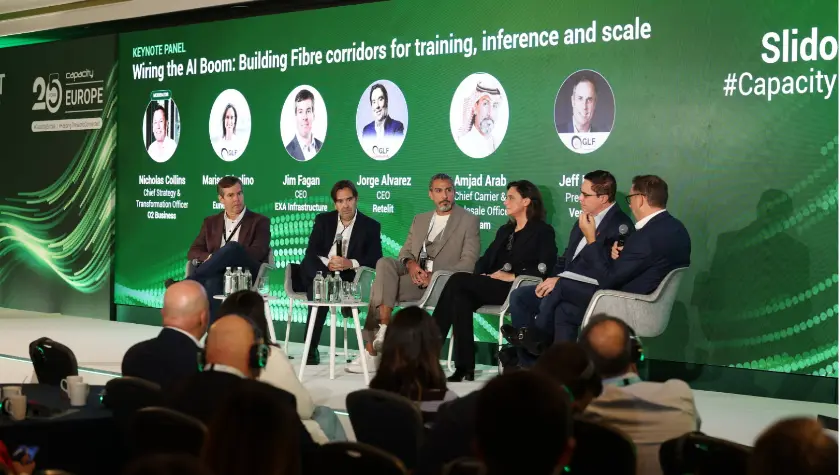
London, October 19, 2026 — From two-year generator queues to the fiercely contested battleground of UK fibre consolidation, the 25th anniversary of Capacity Europe painted a picture of a digital infrastructure industry experiencing profound growing pains. Held at the InterContinental London, The O2, from October 13 to 15, the landmark three-day event made one reality crystal clear: the constraints on AI demand—rather than the demand itself—have become the ultimate agenda-setters for the global telecommunications and data centre ecosystem.
While capital remains eager and hyper-scale artificial intelligence models continue to capture global headlines, the pragmatic conversations in London stripped away the tech-industry hype. Stakeholders faced down an unforgiving bottleneck trifecta: grid capacity delays, critical hardware shortages, complex geopolitical subsea dynamics, and a rising wall of community resistance.
Executive Overview: The Post-Hyphe Reality of Digital Infrastructure
Capacity Europe 2026 marked a watershed moment where the industry tacitly agreed that AI demand is no longer an open question; it is a foundational, unyielding given. Global capital expenditure on data centres has surged past the $800 billion mark this year and is rapidly tracking toward a staggering $1 trillion. Yet, as executives from across the digital value chain gathered in London, the collective anxiety shifted from how much compute we need to how we can physically build, power, and connect it fast enough.
The constraints are no longer financial. Instead, they are deeply physical, structural, and regulatory. A data centre without robust, low-latency connectivity is, as Digital Realty’s Paula Cogan bluntly stated, "simply a large fridge." As the industry wrestles with the physical realities of wiring a machine-dominated internet, the traditional rules of network planning, capital deployment, and geographic footprint expansion are being completely rewritten.
Detailed Chronology & Key Takeaways from Capacity Europe 2026
The conference distilled its core findings into ten defining takeaways that encapsulate the monumental shifts underway across the telecommunications, data centre, and subsea markets.
1. The Great Cross-Over: Machine Traffic Overtakes Human Demand
Colt Chief Strategy Officer Avijit Singh opened the event by highlighting a historic milestone: in June, machine-generated web requests surpassed human-generated traffic for the first time, hitting 57.4% compared to human traffic’s 42.6%, according to Cloudflare data. Singh projected that machine traffic could eclipse human traffic by a factor of 100 within five years.
This structural shift transforms underlying network dynamics. Traffic patterns are pivoting away from traditional north-south flows (cloud-to-user) toward intensive east-west data exchanges between autonomous AI agents and data centres. Consequently, operators must elevate network latency standards, resilience, and observability, while shifting cybersecurity paradigms toward verifying machine identities rather than human users. Furthermore, as AI agents increasingly negotiate contracts on behalf of users, operators are racing to establish "machine-ready" sales channels—making machine optimization the new search engine optimization (SEO).
2. The Inference Era and the Renaissance of the Edge
Speakers repeatedly emphasized that the AI narrative is pivoting from massive model training to widespread inference. Verizon’s Jeff Hulse referenced McKinsey data indicating that 2026 marks the first year where inference investments match training outlays. Valerie Cussac of Orange Wholesale corroborated that AI workloads are already actively saturating backbone networks.
This operational shift has revived the edge—not as a speculative concept, but as a critical geographical necessity. T Wholesale’s Dimitrios Rizoulis reported soaring European demand for edge locations. DE-CIX CEO Ivo Ivanov reminded attendees that every single millisecond of latency translates to roughly 80 kilometres of distance, mandating that physical AI applications sit within 100km to 150km of their supporting inference engines. With Meta noting that the industry’s historical retreat from edge deployments was a "major missed opportunity," regional hubs like Lisbon, Madrid, and Barcelona are rapidly evolving into a "distributed digital capital," stretching Europe’s data centre map far beyond the traditional FLAP-D (Frankfurt, London, Amsterdam, Paris, Dublin) markets.
3. Network Planning: The Peril of Late Integration
Network planning remains a persistent bottleneck. Digital Realty’s Paula Cogan warned that network connectivity is still frequently bolted on too late in the development cycle. Highlighting long-term coordination, Colt’s Joe Scattareggia noted that new fibre builds routinely require 12 to 18 months, while Equinix revealed it began plotting connectivity for a single North London campus five years prior to its launch.
Simultaneously, Exa Infrastructure CEO Jim Fagan highlighted a "fundamental shift" in enterprise demand, with Salam’s Amjad Arab estimating that AI workloads can demand up to 36 times more fibre than legacy applications. While regional demand is spreading rapidly into local markets and enterprise edges—prompting euNetworks CEO Marisa Trisolino to declare that "the whole network will be required"—panellists issued stark warnings against speculative overbuilding in metro markets where demand curves remain volatile.
4. Subsea Infrastructure and the Geopolitical Undercurrent
FLAG’s Paul Abfalter pointed to a glaring structural imbalance: compute investment is sprinting far ahead of the physical networks designed to link it, creating a severe underinvestment cycle in data centre-to-data centre long-haul capacity. Sparkle CEO Enrico Bagnasco added that rising geopolitical friction is actively throttling subsea cable deployment across vital corridors like the US and the Middle East.
Despite these headwinds, crucial new routes are emerging. Orange announced a joint venture with Equitix and MDM to construct Pisces, a 3,125km, 16-fibre-pair subsea system directly connecting Ireland, France, Spain, and Portugal while bypassing the UK. Concurrently, Exa completed critical new long-haul corridors linking Milan to Zurich and Paris to Vienna during the conference.
5. Sovereignty and the Infrastructure Pivot
Orange Wholesale CEO Michael Trabbia used his keynote to declare that the AI arms race has firmly graduated from model development to foundational infrastructure. Stressing that "you cannot talk about sovereignty without talking about physical infrastructure," Trabbia warned against the systemic vulnerability of depending on foreign-controlled networks. Orange is actively backing this philosophy with a 400MW data centre joint venture in France and an ambitious roadmap targeting 2.5 million kilometres of proprietary fibre by 2028.

6. The Supply Chain Squeeze: Generators and Transformers
Telehouse’s Ozgur Duzgunoglu laid bare the severity of hardware lead times: backup generators routinely demand a two-year wait, while high-voltage transformers take 12 to 18 months to arrive. Consequently, operators are forced to commit capital to equipment suppliers long before architectural designs are finalized. "We should be worried about capacity," warned Greenscale’s Miriam van Kooperen.
To counter these delays, operators like Start Campus have embraced a "procure first, design around it" operational mantra, translating procurement agility into time-saved metrics. Furthermore, skilled labour is emerging as the next critical pinch point. Industry experts anticipate severe shortages across mechanical, electrical, and plumbing (MEP) trades by 2029, particularly as builds expand into developing regional markets lacking native construction expertise.
7. Grid Timelines: The Power Uncertainty Crisis
While power availability remains the primary constraint, developers agree that the true enemy is uncertainty. One leading investor noted that while securing financing is effortless, grid operators frequently quote a 36-month connection timeline that stretches out to 48 months, forcing developers to carry unsustainable capital costs.
National Grid strategic demand director David Atkins stated that the UK transmission network operator is constructing three times more grid infrastructure in the current five-year window than in the previous one. Atkins emphasized that a mere 1% to 2% flexibility adjustment from data centres could unlock massive reserves of spare capacity, highlighting the upcoming three to six months as a pivotal window for connection reforms.
Globally, the wait times are even more punishing: Frankfurt connections can demand five to seven years, pushing operators toward alternative models. Hydrogen power provider GeoPura underscored this migration, noting that "the grid’s not your only option" as operators increasingly evaluate behind-the-meter energy strategies.
8. Winning Community Consent
Public pushback has emerged as a formidable roadblock. Digital Realty’s Cogan admitted that community friction occasionally makes her hesitate to discuss her profession, advocating for a European equivalent of America’s Infrastructure for America campaign to educate the public on the economic value of data centres. Telehouse’s Mark Pestridge echoed these concerns, pointing to a "massive gap between what we call digital dependence and digital understanding."
Proactive community engagement, however, can reverse hostile sentiment. Nomad Futurist’s Simon Allen highlighted a CyrusOne project in Milan where local opposition exceeding 70% flipped to over 70% support once the company transparently addressed environmental and infrastructural concerns. Greenscale CEO Daniel Thomas recommended that operators proactively commission and publish independent economic "ripple effect" studies to secure social license.
9. The UK Fibre Consolidation Battleground
The UK fibre market took centre stage during the Fibre Investment Stage, where nexfibre CEO Rajiv Datta launched a scathing critique of the Competition and Markets Authority’s (CMA) provisional findings regarding its £2 billion Netomnia acquisition. Datta characterized the regulator’s stance as "completely divorced from financial reality," arguing that the UK market cannot economically sustain three competing physical fibre networks in every postcode. "Having more networks does not make stronger challengers," he asserted.
Datta also cast doubt on rival contender CityFibre’s balance sheet—an assertion swiftly rejected by CityFibre, which pointed to robust organic growth and a fresh £900 million equity commitment from its shareholders. While both parties agree that industry-wide consolidation is inevitable, the fierce debate centers on who will steer it. The CMA’s definitive ruling is slated for December 15.
10. Financial Discipline and the Value of Bottlenecks
ING managing director Jeroen Kleinjan underscored that modern lenders demand strict metrics: tightly contracted cash flows, fully secured power allocations, and deeply experienced sponsors. "Value will accrue around bottlenecks," Kleinjan noted, pointing specifically to power access, strategic real estate, scarce subsea routes, and trusted interconnection nodes.
Simultaneously, macroeconomic pressures are forcing operational discipline. Mobile UK CEO Hamish MacLeod highlighted that UK mobile revenues have plummeted by roughly 30% while network traffic surged 40-fold, prompting LINX CEO Jennifer Holmes to warn that "value isn’t necessarily revenue." Eurofiber COO Eric Kuisch offered a disciplined financial counter-model, citing the company’s €2.2 billion refinancing as proof that investors heavily favour open-access B2B frameworks that secure recurring revenue prior to laying physical plant.
Supporting Metrics & Industry Data At-A-Glance
- 57.4% vs. 42.6%: Cloudflare data indicating that machine-generated web requests surpassed human traffic for the first time in June 2026.
- $800 Billion to $1 Trillion: Projected global capital expenditure on data centre infrastructure for 2026.
- 36x: The multiplier by which advanced AI workloads can surpass traditional enterprise applications in fibre consumption demands.
- 3,125km: The length of the newly announced Pisces subsea cable system linking Ireland, France, Spain, and Portugal.
- 2 Years: Average waiting period for crucial backup generator procurement across European markets.
Future Outlook: Navigating the Bottleneck Economy
As Capacity Europe 2026 drew to a close, the consensus across the digital infrastructure sector was unequivocal. The gold-rush era of unbridled, frictionless expansion has given way to a sophisticated "bottleneck economy."
Success over the next half-decade will not be defined merely by who possesses the most aggressive AI roadmap, but by who can master the intricate physical choreography of securing transformers, negotiating grid timelines, forging strategic subsea pathways, and earning social licenses from wary local communities. For operators, investors, and policymakers alike, the message from London is clear: the future belongs to those who can successfully wire the AI boom against the odds.