Executive Overview
For generations, the cultural consciousness has been haunted—and tantalized—by a singular, persistent promise: the flying car. From mid-century pulp science fiction to cinematic depictions of dystopian and utopian futures alike, personal airborne transport has stood as the ultimate white whale of consumer technology. Last week, that speculative horizon shifted once more when Elon Musk officially pulled back the curtain on Tesla’s long-delayed Roadster 2.
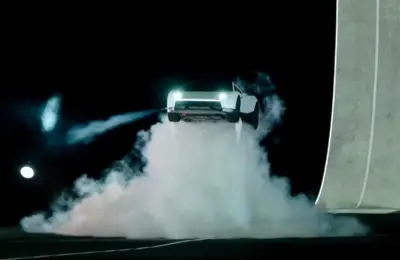
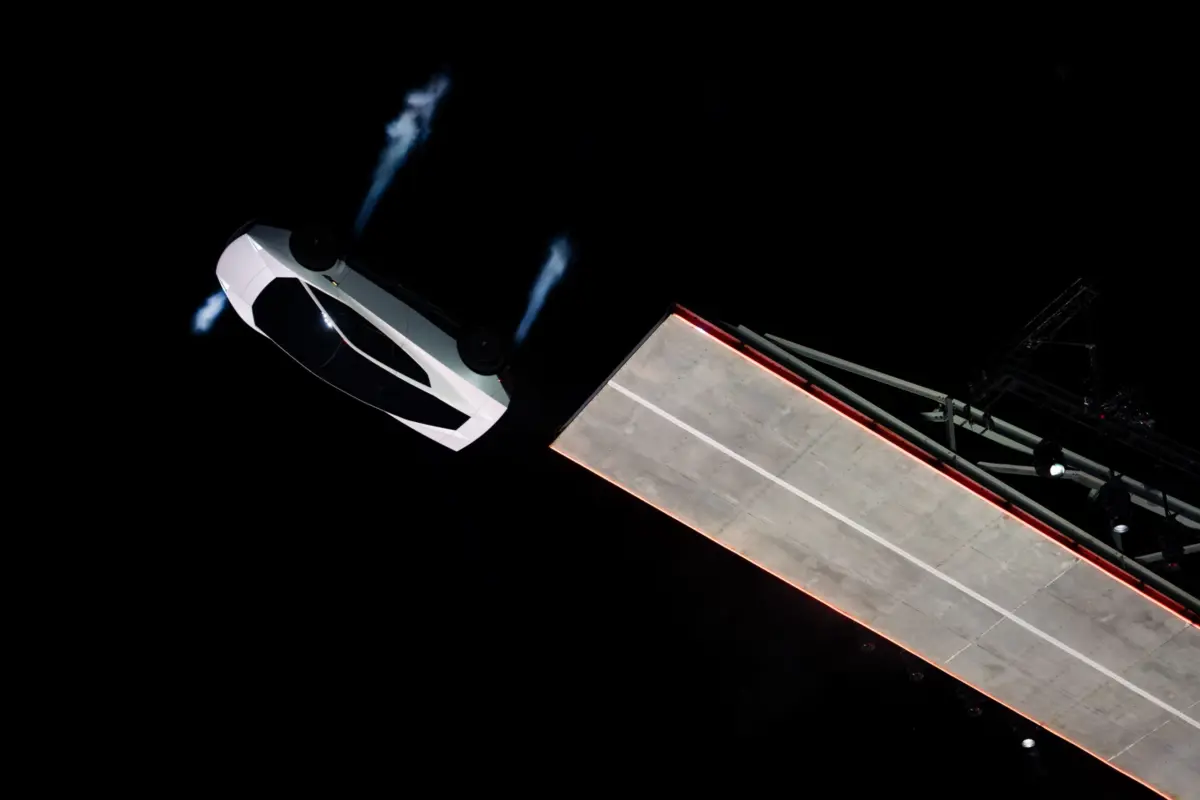
Yet, true to the theatrical and unorthodox nature of its creator, the vehicle delivered a masterclass in redefined expectations. It does fly, but not in the way aviation enthusiasts or urban planners might imagine. In a high-octane product reveal, a Roadster 2 prototype shattered conventional automotive boundaries by not only taking brief, ballistic hops into the air, but also defying gravity by driving vertically up a circular wall, remaining inverted Spider-Man-style, and executing a gravity-defying leap over an entire lineup of stationary Tesla vehicles—including a towering Tesla Semi truck.
These jaw-dropping demonstrations immediately triggered a dual narrative across global engineering, legal, and consumer spheres. First, a profound ethical and regulatory question emerged: Should human drivers ever be entrusted with the capacity to scale vertical architecture or pilot unguided personal aircraft? Given the persistent statistical struggles humanity faces while navigating relatively forgiving, two-dimensional asphalt roadways, the immediate answer from traffic safety advocates is a resounding no. This complex regulatory hurdle will undoubtedly keep legal scholars and the Federal Aviation Administration (FAA) occupied for decades.
The second question, however, belongs strictly to the realm of hard science. How did the Roadster 2 prototype achieve these seemingly impossible maneuvers? By stripping away the marketing hyperbole and applying foundational principles of physics, thermodynamics, and Newtonian mechanics, we can peer behind the curtain of Musk’s latest engineering spectacle. The answers reveal a sophisticated, albeit extreme, application of aerodynamic suction, compressed-gas rocketry, and the relentless laws of friction.
Detailed Chronology: The Anatomy of a Shocking Reveal
The unveiling of the Roadster 2 was anything but a standard automotive press conference. For years, automotive journalists and Tesla loyalists had tracked the vaporware timeline of the second-generation sports car, wondering if its promised specs—including mind-boggling acceleration metrics—would ever materialize. When the curtain finally dropped, the vehicle was not introduced through a standard spec sheet or a track lap time, but through a sequence of physics-defying stunts that left even seasoned engineers blinking in disbelief.
Phase One: The Vertical Defiance
The demonstration began with the Roadster 2 approaching a specialized, high-traction circular ramp. Rather than maintaining its trajectory along the horizontal plane, the vehicle surged upward, transitioning seamlessly onto a vertical wall. To the shock of the audience, the car did not immediately stall or plummet back to earth under the dead weight of gravity. Instead, it hugged the surface, navigating the vertical expanse and traversing the apex completely upside down.
While executing an inverted loop on a vertical wall is an absolute non-starter for daily suburban commuting, the engineering principles underlying this stunt hint at profound performance enhancements for standard, ground-bound supercars. At its core, the feat is a masterclass in manipulating static friction.
Phase Two: The Zero-to-Sixty Quantum Leap
Following the wall-climbing display, the presentation shifted to raw, unadulterated acceleration. Tesla claimed the Roadster 2 could achieve a 0-to-60 mph sprint in less than one second. In the context of traditional automotive engineering, this milestone is viewed as a brick wall imposed by the laws of physics. Conventional vehicles rely entirely on the tire-road interface to generate forward motion, rendering them permanently tethered to the maximum limits of static friction. To shatter this threshold, Tesla bypassed traditional tire-driven propulsion entirely, introducing compressed-air thrust systems reminiscent of aerospace rocketry.

Phase Three: The Leap Over the Fleet
The grand finale of the prototype demonstration featured the Roadster 2 coming to a brief halt before executing a vertical, rocket-assisted bound. The vehicle launched itself completely airborne, clearing an entire convoy of Tesla vehicles—culminating in a triumphant arc over a massive Tesla Semi truck that stands roughly four meters tall. The vehicle landed smoothly back on its wheels, completing a stunt that blurred the line between sports car and ballistic missile. Notably, throughout this airborne leap, the driver’s seat was occupied not by a human test driver, but by a humanoid robot, hinting at the severe physical tolerances required to survive the journey.
Supporting Context & Metrics: The Physics Behind the Miracles
To understand how a road car can defy gravity, stick to a ceiling, and launch itself over a semi-truck, we must turn to the foundational equations of classical mechanics.
1. Driving Up a Wall: Mastering Static Friction
When two surfaces interact—such as a vehicle’s rubber tires and a paved road—a microscopic interlocking of imperfections occurs, generating a force that prevents the surfaces from sliding relative to one another. This phenomenon is known as static friction.
The mathematical model governing this interaction states that the magnitude of the static friction force ($F_f$) is proportional to how hard the two surfaces are pressed together—a perpendicular vector known as the "normal force" ($F_N$)—multiplied by the coefficient of static friction ($mu$), which quantifies the textural characteristics of the interacting materials:
$$F_f le mu F_N$$
For high-performance rubber tires on dry asphalt, the coefficient of static friction typically hovers around 0.6 (though hyper-specialized racing compounds can push this toward 0.9). When a standard car attempts to climb an incline, the angle ($theta$) of the slope alters the gravitational vector ($mg$). As the incline steepens toward the vertical, the normal force ($F_N = mg costheta$) dwindles toward zero. Consequently, the maximum frictional force plummets. Calculations show that with a generous friction coefficient of 0.6, a normal car will inevitably slip once an incline exceeds approximately 31 degrees. Even under ideal laboratory conditions with a coefficient of 0.9, the absolute limit is roughly 42 degrees. A vertical wall is entirely out of the question.
To overcome this, the Roadster 2 artificially inflates the normal force. By integrating specialized fans beneath the chassis and employing flexible side skirts, the vehicle creates a localized low-pressure zone—effectively operating on the inverse principle of a hovercraft, functioning instead as a high-powered vacuum.
Assuming a target weight for the Roadster 2 of 1,700 kilograms and a ground-contact footprint of approximately 2 square meters, we can calculate the required pressure differential. Utilizing the fundamental pressure equation ($F = P times A$) alongside standard atmospheric pressure ($10^5 text Newtons per square meter$), engineering estimates reveal that the under-car pressure must drop to roughly 86 percent of atmospheric pressure to anchor the vehicle vertically against gravity. While seal degradation means the fans must run continuously, the physics are entirely sound.

Moreover, this suction technology translates directly to day-to-day driving performance. By artificially pushing the car downward, the effective normal force increases, allowing for exponentially faster acceleration, shorter braking distances, and cornering grip that vastly exceeds the car’s baseline mass.
2. 0 to 60 mph in Under One Second: The Rocket Paradigm
Why is a sub-one-second 0-to-60 mph time fundamentally impossible for a traditional car? Using our standard friction coefficient of 0.6, the maximum horizontal acceleration a tire can extract from the pavement is constrained to about $0.6g$ (roughly $5.88 text m/s^2$). Simple kinematic calculations reveal that at this maximum rate of acceleration, the fastest possible time to reach 60 mph (26.8 m/s) is approximately 4.56 seconds. Even with aerodynamic downforce kicking in at higher speeds, mechanical tire grip has a hard ceiling.
The Roadster 2 sidesteps this limitation by abandoning purely frictional propulsion in favor of compressed-air thrusters—utilizing the exact same physical principle that powers rocket engines and simple balloon-powered toy cars. When a compressed air tank is discharged, the expanding gas exerts force against the interior walls of the vessel while escaping through an exhaust nozzle.
According to Newton’s Third Law of Motion, for every action, there is an equal and opposite reaction. The force pushing the exhaust gas backward results in an identical, forward-directed reaction force acting upon the vehicle’s chassis. By utilizing a high-pressure cold-gas thruster system, the Roadster 2 generates thrust independently of tire-to-road friction, translating to instantaneous, rocket-like acceleration.
3. Flying Cars and the G-Force Threshold
The transition from ground vehicle to airborne jumper relies on this exact compressed-air mechanism directed downward. However, this introduces severe physiological constraints. Because the compressed air reservoir has a finite capacity, the thrust must be delivered in an aggressive, concentrated burst to generate enough upward momentum to clear a truck in a matter of seconds. High force equals high acceleration; high acceleration equals immense physiological stress for human occupants.
To quantify this, video analysis utilizing motion-tracking software provides a clear picture of the jump over the Tesla Semi. By tracking the vertical position of the Roadster 2 against the known 4-meter height of the truck, researchers can plot a position-versus-time graph. Fitting a quadratic function to the parabolic trajectory yields an estimated vertical acceleration of approximately $98 text m/s^2$.
This translates to an astonishing 10Gs of vertical acceleration—meaning the car exerts a force equivalent to ten times the gravitational pull on its occupants. While human fighter pilots and astronauts can endure 10Gs for brief periods under specialized anti-G training and G-suits, it is an intensely uncomfortable and hazardous experience for the uninitiated consumer. This staggering physical reality provides a compelling explanation for why Tesla wisely chose to place a humanoid robot in the driver’s seat during the public demonstration.
Official Statements & Industry Reactions
The automotive and aerospace communities have responded to the Roadster 2 unveiling with a mixture of awe, skepticism, and regulatory concern.

Tesla representatives have framed the vehicle not merely as a high-performance sports car, but as a technological bridge between terrestrial transport and next-generation mobility. During the post-reveal briefing, lead engineers emphasized that the incorporation of aerospace thruster technology and active aerodynamic suction represents "a paradigm shift in how we think about vehicle control authority." Musk himself took to social media to reiterate that the prototype showcases capabilities that render traditional supercar metrics obsolete, positioning the Roadster 2 as "the ultimate consumer-accessible physics experiment."
Independent aerospace engineers and safety advocates, however, have adopted a far more cautious tone. A spokesperson for the Surface Transportation Safety Coalition noted:
"While the engineering ingenuity displayed by Tesla is undeniably impressive, transforming civilian roadways into launching pads introduces catastrophic safety variables. The average driver lacks the spatial awareness, reflex conditioning, and physiological resilience required to manage multi-axis vehicular motion. Scaling vertical walls and executing ballistic leaps belong on a controlled test track, not the Interstate."
Federal regulators have similarly demurred. While the FAA currently exercises jurisdiction strictly over traditional aircraft, un-manned aerial systems, and commercial rocketry, the blurred lines of a vehicle capable of transient flight have sparked preliminary inter-agency discussions between the Department of Transportation and aviation authorities regarding how to classify and regulate consumer vehicles equipped with thrust-vectoring flight capabilities.
Future Outlook: Engineering Marvel or Silicon Valley Mirage?
As the dust settles on the Roadster 2 debut, the broader automotive landscape is left grappling with profound questions regarding the commercial viability of such technology.
On one hand, the integration of active aerodynamic suction and cold-gas thrusters offers undeniable performance dividends. Even if consumers never scale the side of an office building or leap over a commercial freight carrier, the trickle-down effects of these technologies on high-speed stability, braking efficiency, and emergency maneuverability could revolutionize hypercar safety standards. The ability to artificially increase tire loading via low-pressure ground-effect suction provides a mechanical safety net that conventional passive aerodynamics simply cannot match.
On the other hand, the practical hurdles facing a production-ready Roadster 2 remain immense. Energy density limitations for the high-pressure compressors, the acoustic toll of high-velocity air thrusters operating in urban environments, and the insurmountable regulatory walls surrounding low-altitude vehicular flight suggest that many of these extreme features will remain heavily restricted, optional, or track-only packages.
Ultimately, the Tesla Roadster 2 functions less as a blueprint for mass-market commuting and more as a high-stakes provocation. It challenges our assumptions about the boundaries between driving and flying, mechanics and rocketry, fantasy and reality. Whether it heralds a new era of personal mobility or remains an engineering curiosity, one thing is certain: the physics of the automobile will never be viewed in quite the same way again.