Executive Overview
For generations, popular culture has promised us a sky filled with flying cars—a Jetsons-esque future where morning commutes bypass gridlocked highways and take to the clouds. While decades of engineering hurdles have kept that promise firmly in the realm of science fiction, the automotive landscape experienced a seismic shift last week when Elon Musk officially unveiled the long-delayed Tesla Roadster 2 prototype. Featuring unprecedented performance metrics and jaw-dropping capabilities, the vehicle made global headlines not just for breaking the mold, but for seemingly breaking the laws of classical mechanics.
Beyond its sleek aesthetic and hyper-car specifications, the Roadster 2 prototype showcased a staggering repertoire of capabilities previously thought impossible for a ground vehicle. During its live demonstration, the car executed maneuvers that belong in a sci-fi blockbuster: scaling a vertical, circular wall to drive entirely upside down like a mechanical Spider-Man, rocketing from zero to 60 miles per hour in under a single second, and launching bodily into the air to hurdle an entire line of Tesla vehicles, including a full-sized Tesla Semi truck.
These physics-defying tricks immediately spark two distinct categories of inquiry. The first is regulatory and societal: Given that the average human driver already struggles immensely to safely navigate simple two-dimensional roadways, should we ever permit humanity to pilot vehicles capable of scaling vertical architecture and soaring through the urban atmosphere? That is a looming question for legislators, insurance underwriters, and the Federal Aviation Administration (FAA).
The second question is purely scientific: How on earth did the Roadster 2 prototype achieve these feats? By stripping away the marketing hype and applying foundational principles of physics, aerodynamics, and rocketry, we can analyze the exact forces at play. Far from being magic, Tesla’s latest engineering marvel relies on an aggressive exploitation of static friction, atmospheric pressure differentials, and compressed-air thrusters. However, as our mathematical analysis reveals, these incredible capabilities come paired with harrowing G-forces that help explain why a robot was sitting behind the steering wheel during the demonstration.
Detailed Chronology
The path to the Roadster 2 unveiling has been fraught with delays, skepticism, and staggering ambition, culminating in a watershed moment for high-performance electric vehicles.
The Long Road to the Roadster 2
When the original Tesla Roadster debuted in 2008, it proved to a skeptical world that electric vehicles could be fast, desirable, and viable. Nearly a decade later, in late 2017, Elon Musk surprised the automotive world by pulling the wraps off a second-generation Roadster concept, promising a zero-to-60 mph time of 1.9 seconds, a top speed exceeding 250 miles per hour, and an astonishing 620-mile range. Initially slated for production in 2020, the vehicle slipped through multiple years of internal reprioritization, as Tesla diverted its engineering capital toward scaling high-volume models like the Model Y and developing the long-awaited Cybertruck and Tesla Semi.
The Unveiling and the Demos
Fast-forward to last week’s high-profile unveiling event. Rather than simply rolling out a polished production version with minor spec bumps, Tesla leaned heavily into the theatrical, showcasing a working prototype outfitted with a specialized "SpaceX package" of cold-gas thrusters.
- The Vertical Wall Run: The demonstration began with the prototype navigating a high-speed approach before driving directly up a vertical, circular ramp. Rather than losing momentum and plummeting to the ground, the vehicle clamped itself to the surface, executing a full inversion overhead before safely descending.
- The Sub-Second Acceleration: Next came a blistering straight-line acceleration run. While traditional supercars measure their zero-to-60 times in the low two-second or high one-second range, the Roadster 2 reportedly cleared the benchmark in under one second, obliterating conventional tire-traction limits.
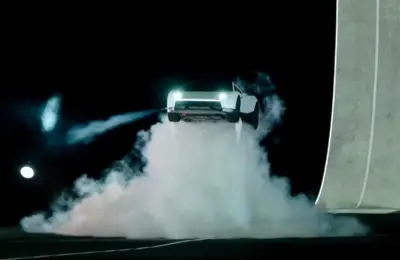
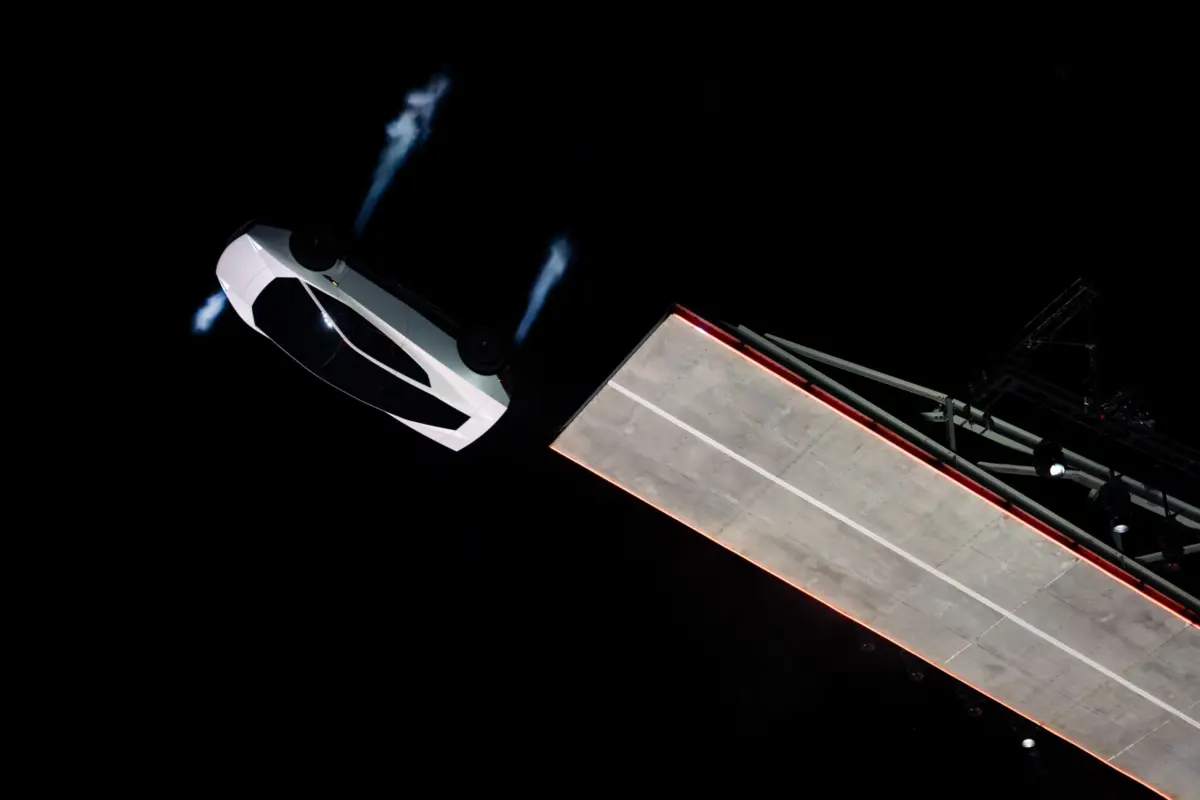
- The Leapfrog Jump: Capping off the presentation, the prototype utilized its onboard compressed-air system to lift off the ground entirely, executing a clean aerial leap over a parked Tesla Semi truck before landing squarely on its wheels and driving away.
Supporting Context & Metrics: A Physics-First Breakdown
To truly appreciate the engineering behind the Roadster 2 prototype, we must examine the physical forces governing its operation. The vehicle does not defy gravity through magic; rather, it manipulates friction, pressure, and momentum in ways traditional passenger cars never attempt.
1. Driving Up a Wall: Mastering Friction and Pressure
To understand how a car can drive up a circular ramp and remain glued to it upside down, we must first look at the mechanics of friction.

When two surfaces interact—such as rubber tires and asphalt—a force prevents them from sliding relative to one another. This is known as static friction ($mathbfF_f$). The magnitude of this force depends on two primary factors: how hard the surfaces are pressed together (the normal force, $mathbfF_N$) and the nature of the materials involved, represented by the coefficient of static friction ($mathbfmu$).
$$mathbfF_f le mathbfmu mathbfF_N$$
For a standard passenger car driving up an incline of angle $theta$, the component of gravitational force ($mathbfmg$) pulling down the slope increases as the angle steepens. Consequently, the normal force decreases, lowering the maximum possible static friction. For typical rubber on asphalt (where $mu approx 0.6$), the maximum incline a standard car can climb before slipping is roughly 31 degrees. Even with ultra-sticky racing compounds ($mu cap 0.9$), you cap out around 42 degrees. A vertical wall is entirely out of the question.
How Tesla Solved It: Active Downforce via Suction
To conquer a vertical wall, the Roadster 2 must artificially manufacture massive amounts of normal force. Tesla accomplishes this by integrating high-powered fans beneath the chassis. Working in tandem with specialized side seals and skirts, these fans exhaust air from underneath the vehicle, creating a low-pressure zone akin to an industrial vacuum cleaner.
Let’s run the numbers. Given a target vehicle mass of approximately 1,700 kilograms and a rough underside contact area of 2 square meters, we apply the foundational pressure formula:
$$mathbfF = mathbfP times mathbfA$$
Accounting for the external atmospheric pressure of approximately $10^5$ Newtons per square meter ($textN/m^2$), calculations indicate that the under-car pressure must drop to roughly 86 percent of atmospheric pressure to fully support the vehicle’s weight against gravity. While maintaining a flawless seal is notoriously difficult in dynamic real-world environments, continuous fan evacuation makes this suction entirely plausible.
Moreover, this suction technology translates to profound performance benefits during normal, right-side-up driving. By forcing the car downward, engineers drastically increase the normal force, supercharging tire-to-road friction. This yields exponentially faster acceleration, shorter braking distances, and cornering grip that makes traditional supercars look pedestrian.
2. Zero to 60 in Under One Second: The Limits of Tires
A traditional car accelerates by transferring torque from its electric motors or internal combustion engines through the tires to the road surface. Because this acceleration is strictly bound by the coefficient of static friction, physics imposes hard limits.

Using our standard coefficient of $mu = 0.6$, the absolute physical limit for a conventional car to reach 60 mph is roughly 4.56 seconds. Even with optimal tires, advanced aerodynamic downforce generated at speed, and all-wheel-drive configurations, traditional mechanical traction cannot push a car to 60 mph in under a second.
The Rocket Science Solution
To bridge this gap, the Roadster 2 abandons pure tire-friction reliance and borrows from rocketry: compressed air.
Consider a simple balloon-propelled toy car. As the stretched rubber forces air out through an exhaust tube, Newton’s third law dictates that for every action, there is an equal and opposite reaction. The force pushing the air backward generates an equal forward thrust on the balloon itself.
Rather than a deflating balloon, the Roadster 2 stores high-pressure compressed air in an onboard vessel. When released through rear-facing nozzles, this high-velocity gas expulsion bypasses tire-friction limitations, hurling the vehicle forward with brutal, instantaneous thrust.
3. Airborne Architecture: The Reality of "Flying"
When the Roadster 2 uses its compressed-air system to lift off the ground and clear a Tesla Semi, it technically qualifies as a flying car—albeit temporarily.
The primary limitation of this approach is energy density and duration. Compressed-air tanks hold a finite volume of gas; once expelled, system pressure drops rapidly, slashing thrust output. The demonstration jump lasted only a few seconds. A truly practical flying car requires sustained aerodynamic lift, not transient rocket bursts.
Furthermore, executing a sudden vertical leap requires extreme acceleration. By analyzing video footage of the jump—using the known 4-meter height of the Tesla Semi as a spatial reference point—we can track the vehicle’s vertical position over time using video analysis software.
Fitting a quadratic function to the position-time trajectory reveals a staggering vertical acceleration of roughly 98 meters per second squared, translating to approximately 10 Gs of vertical force acting on the vehicle and its occupants. While trained fighter pilots and astronauts can endure 10 Gs for short durations under specialized anti-G suits, doing so is deeply uncomfortable and carries severe physical risks for untrained civilians. This extreme G-force load offers a very clear explanation for why Tesla opted to place a humanoid robot behind the wheel for the demonstration rather than a living driver.
Official Statements & Industry Reception
The automotive and aerospace communities have reacted to the Roadster 2 unveiling with a mixture of awe, skepticism, and intense regulatory scrutiny.

Tesla representatives have championed the prototype as a bold reimagining of what personal transport can achieve when automotive engineering intersects with aerospace propulsion. In statements following the event, company engineers emphasized that the technologies developed for the Roadster 2—particularly the variable-pressure underbody suction and cold-gas thruster integration—serve as a testbed for future performance platforms.
Meanwhile, independent automotive analysts and safety advocates have expressed immediate concern regarding the commercial viability of such extreme features. Transport safety coalitions have questioned how regulatory bodies will classify a vehicle capable of generating 10-G vertical leaps or scaling public infrastructure.
Federal Aviation Administration (FAA) officials have remained tight-lipped regarding specific oversight frameworks for consumer vehicles equipped with rocket-assisted lift capabilities, though insiders suggest that any vehicle capable of achieving unmoored flight will inevitably trigger complex inter-agency jurisdictional debates between the National Highway Traffic Safety Administration (NHTSA) and aviation authorities.
Future Outlook
The Tesla Roadster 2 prototype stands as a magnificent, terrifying testament to modern engineering. By leaning aggressively into physics, Tesla has successfully blurred the line between sports car and spacecraft, proving that vertical wall-climbs and sub-second sprints are mathematically achievable outside of a Hollywood CGI studio.
However, the chasm between an impressive prototype demonstration and a street-legal production vehicle remains vast. Consumer adoption of a car featuring rocket thrusters and vacuum-sealed wall-climbing capabilities will depend heavily on resolving severe safety bottlenecks, chief among them the punishing G-forces experienced during aerial maneuvers and the practical realities of maintaining dynamic pressure seals on crumbling public roadways.
Whether the Roadster 2 ultimately reaches consumer driveways in its current, gravity-defying configuration or sees its wilder features toned down for regulatory compliance, one thing is certain: the conversation surrounding the future of personal mobility has fundamentally changed. The flying car era may still be finding its footing, but Tesla has officially ensured that the journey there will be nothing short of explosive.