Executive Overview
Federal law enforcement agencies are closing in on the upper echelons of the cybercrime underworld, following a dramatic escalation in high-profile attacks orchestrated by the notorious hacking collective known as ShinyHunters. In a stunning twist that has sent shockwaves through the cybersecurity industry, U.S. federal investigators pursuing the syndicate have identified senior executives at two prominent ransomware negotiation firms who allegedly maintained unusually close, illicit relationships with the extortionists.
According to sources close to the ongoing investigation, one U.S.-based executive went so far as to actively help operate shinywire[.]com, a now-defunct pressure website used by ShinyHunters to squeeze victims into paying massive cryptocurrency ransoms.
This widening federal probe underscores a murky, deeply troubled ecosystem where the lines between cyber defense and cybercrime have alarmingly blurred. As authorities sift through encrypted messaging logs, international arrests, and corporate litigation, the investigation exposes fundamental structural flaws and inherent conflicts of interest within the multi-million-dollar cyber extortion remediation industry.
Detailed Chronology: From the Netherlands to Canada and Jordan
The unraveling of the ShinyHunters syndicate began in earnest in September 2026, catalyzed by a coordinated international law enforcement dragnet that dismantled key operational pillars of the group.
The Fall of Pepijn van der Stap
On the evening of September 15, 2026, Dutch authorities executed a high-stakes raid, using flash-bang grenades to stun and apprehend convicted hacker and prime ShinyHunters suspect Pepijn van der Stap. Police successfully seized Van der Stap while he was actively logged into his Signal instant messaging account.
This split-second tactical advantage allowed investigators to harvest a goldmine of recent communications with frequent contacts—most notably, ransomware negotiators based in the United States and Canada. Sources close to the case revealed that Van der Stap’s Signal chats not only mapped out the internal mechanics of the hacking group but also contained chatter regarding a chilling murder-for-hire plot. Dutch media outlet RTL reported that the plot involved two targets abroad, with strong indications that Van der Stap issued the directives, though authorities stress there is no evidence the orders were ever carried out.

Rey and the FBI Breach
Van der Stap’s sudden arrest created an internal vacuum within ShinyHunters, which was quickly filled by “Rey,” identified last year as a teenage hacker from Amman, Jordan. Under Rey’s leadership, the syndicate ratcheted up its operations, culminating in a brazen cyberattack in late September 2026 against fbijobs.gov, the official recruitment website of the Federal Bureau of Investigation.
The hackers taunted federal authorities by threatening to publish sensitive stolen records, including employee medical and psychological files, Social Security numbers, home addresses, and specific unit specializations.
The assault on its own recruitment portal prompted the FBI to act with extraordinary velocity. On October 3, 2026, Reuters reported that Rey had been detained by Jordanian authorities and was actively cooperating with the FBI.
The Arrest of Edward Dubrovsky
The decrypted trail of Van der Stap’s Signal messages soon pointed investigators across the Atlantic. On October 9, 2026, the FBI arrested Edward Dubrovsky, a 54-year-old Canadian cybersecurity executive and co-author of a recent book on handling cyber extortion. Dubrovsky was charged in U.S. federal court with threatening to disclose hacked data and interfering with interstate commerce through extortion.
According to court records and reports from Politico, federal prosecutors have pushed for Dubrovsky to remain in custody pending trial, keeping case records heavily sealed. Investigators discovered that Dubrovsky had frequent conversations with Van der Stap, often possessing insider details about fresh ShinyHunters victims before the victim organizations themselves were even aware of the breach. Most damningly, federal investigators found that Dubrovsky knew ShinyHunters had exfiltrated highly sensitive data from FBI servers yet failed to notify the bureau prior to the syndicate’s public shaming campaign on Twitter/X.
Supporting Context & Metrics: The Extortion Machine and Industry Conflicts
Anatomy of "Shinywire"
The scope of the alleged conspiracy extends well beyond individual arrests. According to two sources close to the probe, federal investigators believe at least one executive at a prestigious U.S.-based consulting firm with over 1,000 associates played an active hand in operating shinywire[.]com.

Active from May 3 to October 16, 2026, the Shinywire platform listed nearly 100 organizations breached by ShinyHunters. The site functioned as a high-pressure digital storefront: it displayed samples of stolen files, demanded ransom payments, and explicitly warned that if victims failed to engage within seven days, their stolen proprietary data would be dumped onto the dark web via Tor-based shaming blogs.
A prime example cited by investigators involved Intuitive Surgical, an American medical technology giant breached in March 2026 via targeted phishing credentials. Despite paying ransoms in past high-profile incidents—such as the December 2024 PowerSchool breach, where ShinyHunters stole data on 62 million students and 9.5 million teachers—victims routinely discovered that paying cybercriminals offers zero guarantee of security. Following PowerSchool’s reported $2.85 million ransom payment, individual school districts were hit with secondary extortion demands using the exact same stolen records.
The Ghostbyte Connection and Corporate Infighting
The chaos surrounding Dubrovsky’s arrest also intersects with messy corporate warfare in the cybersecurity sector. Earlier this year, Dubrovsky filed a lawsuit in Ontario against Daniel Tobok, the former CEO of Cypfer, a prominent incident response firm with global reach. Dubrovsky claimed he was made "collateral damage" in a bitter campaign by Tobok to destroy him following a 2024 falling out. Tobok countered with allegations of unfair competition and unauthorized access to confidential information.
Deeper digging into historical threat intelligence provides an even stranger twist. Interviews with former colleagues revealed that years prior, Tobok was known to ransomware affiliates under the moniker Ghostbyte. In a 2018 Dharma ransomware incident, a compromised Canadian company was directed by Russian-speaking hackers to contact an IT representative via the email address [email protected] to secure guarantees of file deletion.
While Tobok has not responded to requests for comment, threat intelligence provider Constella Intelligence linked a frequently used personal email address belonging to Tobok ([email protected]) to online accounts bearing the "ghostbyte" username. Furthermore, the cryptocurrency wallet associated with the Dharma representative’s email processed 38 transactions totaling roughly 43 Bitcoin (valued at approximately $3.5 million today).
Inherent Conflicts of Interest
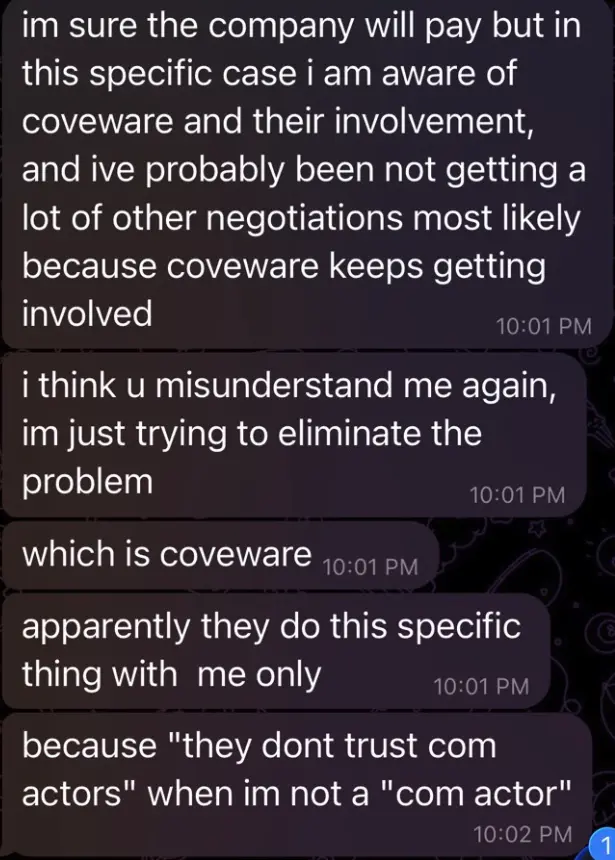
The scandal highlights a toxic financial incentive structure within the ransomware negotiation market. Major incident response firms like Coveware and Unit 221B have long urged victims not to pay ShinyHunters, warning that extortionists routinely retain, resell, or weaponize stolen data anyway. These warnings made Coveware a prime target for the hackers; leaked Telegram chats from April and May 2026 show ShinyHunters leaders bitterly complaining that Coveware was tanking their payment success rates and plotting to "eliminate the problem."

Conversely, many negotiation firms operate on a contingency model, charging a percentage of the final ransom payout. Mark Camillo, CEO of cyber insurance industry group CyberAcuView, noted that this practice creates a glaring conflict of interest. Negotiators operating on commission have a direct financial incentive to inflate ransom payments and secure quick deals rather than pushing back on threat actors.
This dynamic has increasingly caught the eye of the U.S. Department of Justice. In October 2026, the DOJ charged MonsterCloud CEO Zohar Pinhasi with wire fraud and conspiracy for allegedly secretly paying hackers $8 million behind his clients’ backs while billing them $19 million for remediation. Similarly, in July, Florida ransomware negotiator Angelo Martino was sentenced to 70 months in prison for feeding confidential client negotiation strategies to the Blackcat/ALPHV ransomware group to maximize payouts.
Official Statements and Corporate Responses
In the wake of these explosive developments, corporate entities caught in the crossfire have moved quickly to distance themselves.
Cypfer released a formal statement asserting that the company does not facilitate ransomware payments and had no prior knowledge of Dubrovsky’s arrest.
"We had no prior knowledge of Mr. Dubrovsky’s arrest," a Cypfer spokesperson stated via email. "CYPFER has not received any outreach from law enforcement and, to our knowledge, is not the target of any law enforcement investigation."
Cypfer further clarified that it operates entirely separate from CyberSteward (the firm tied to past PowerSchool negotiations) and noted its recent acquisition by the Apros Group, a holding company led by former FBI special agent Jason Hogg.

Meanwhile, federal prosecutors and law enforcement bodies have kept tight-lipped regarding the ongoing sealed indictments, though the sheer volume of cooperating witnesses—including detained Jordanian national "Rey"—signals that additional arrests are imminent.
Future Outlook: A Turning Point for Cyber Extortion
The takedown of the ShinyHunters infrastructure, combined with the unprecedented criminal prosecution of cybersecurity and negotiation executives, marks a watershed moment in the global fight against digital extortion.
For years, the multi-billion-dollar ransomware remediation industry operated in a regulatory grey zone, cushioned by non-disclosure agreements, insurance payouts, and corporate desires for quiet resolutions. The revelation that trusted defense executives may have crossed the line to actively collaborate with criminal syndicates—operating extortion portals and withholding vital breach intelligence from the FBI—shatters the illusion of professional self-regulation.
As the U.S. Department of Justice expands its crackdown on fraudulent negotiators and compromised intermediaries, the cybersecurity landscape faces a painful but necessary reckoning. Going forward, institutional clients, insurance providers, and lawmakers are expected to demand radical transparency, strict separation of incident response and negotiation services, and absolute accountability across the entire cyber defense ecosystem.