Executive Overview
For generations, popular culture has promised us a world of everyday flying cars—a sci-fi utopia where morning commutes effortlessly transition from asphalt ribbons to open, three-dimensional skies. While the realization of practical, long-range aerial personal transport remains largely an elusive dream, the automotive landscape has just taken a radically unconventional step forward.
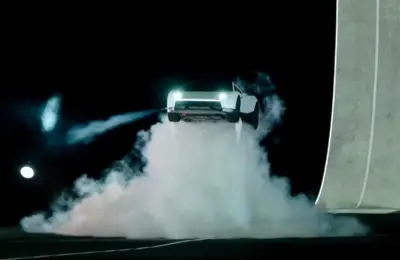
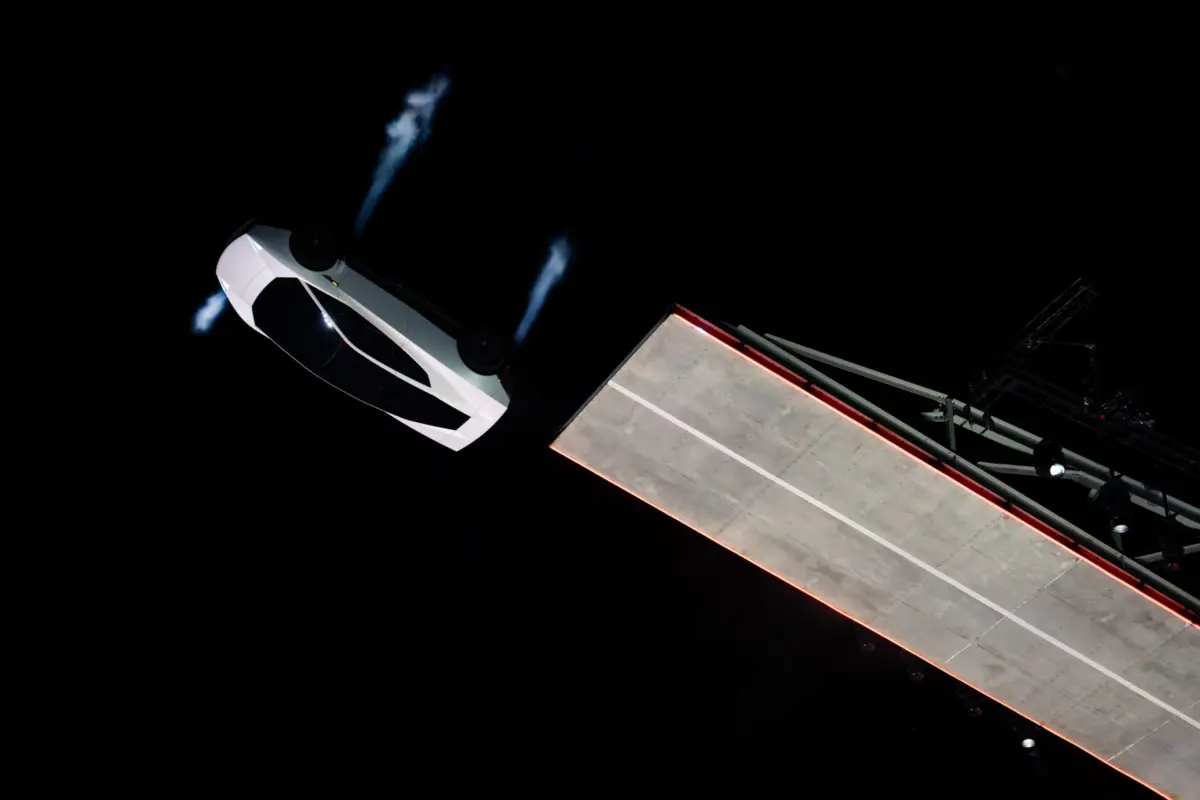
Last week, Elon Musk pulled back the curtain on Tesla’s long-delayed Roadster 2, showcasing an electric supercar outfitted with technology that blurs the line between automotive engineering and aerospace rocketry. Beyond its head-turning design and staggering output figures, the Roadster 2 prototype demonstrated physics-defying maneuvers that fundamentally challenge our understanding of vehicle dynamics. During its public reveal, the vehicle did not merely drive; it conquered gravity, scaling a vertical circular wall to remain suspended upside down like a mechanical Spider-Man, rocketed from zero to 60 miles per hour in under a single second, and cleared a vertical leap sufficient to jump entirely over Tesla’s commercial semi-truck fleet.
These gravity-bending demonstrations immediately provoke two distinct lines of inquiry. The first belongs to the domain of regulators, tort lawyers, and the Federal Aviation Administration (FAA): Should humanity ever be trusted to pilot vehicles capable of vertical wall-climbing and sudden airborne leaps when drivers already struggle with the basic mechanics of two-dimensional road navigation?
The second, more immediate question belongs to the realm of hard science: How, precisely, does a terrestrial vehicle execute such maneuvers without violating the fundamental laws of physics?
By examining the principles of classical mechanics, aerodynamics, and momentum conservation, we can decode the engineering wizardry behind the Roadster 2. Far from being mere marketing theatrics, the vehicle’s reliance on ground-effect suction and compressed-gas thrusters offers a fascinating glimpse into the future of ultra-performance engineering—while exposing the stark biological and physical limitations of bringing sci-fi tropes into the real world.
Detailed Chronology: The Evolution and Unveiling of the Roadster 2
To understand the magnitude of the recent Roadster 2 unveiling, one must contextualize its protracted development cycle. First announced as a concept in late 2017, the second-generation Tesla Roadster was initially promised for production by 2020, touted as an all-electric halo car that would deliver "smackdown to gasoline cars." However, persistent supply chain disruptions, shifts in corporate engineering priorities toward autonomous driving, and the scaling of high-volume models like the Model Y pushed the timeline back year after year.
As years turned into half-a-decade, skepticism mounted over whether the Roadster would ever materialize beyond a show pony. When Musk finally presented the updated prototype last week, it became clear that the delay was not merely a result of corporate stalling, but of a radical pivot in engineering ambition. Rather than focusing solely on traditional battery range and track times, Tesla integrated technologies derived from SpaceX—its sister aerospace enterprise—transforming the supercar into a hybrid of road-going EV and atmospheric thruster-craft.
The event unfolded in distinct, carefully choreographed stages:

- The Static Reveal: The vehicle was rolled onto the stage, featuring a sleeker, more aggressive aerodynamic profile than the 2017 concept, complete with integrated composite paneling designed to house specialized high-pressure air ducts.
- The Wall-Climbing Demonstration: To the shock of attendees, a prototype unit navigated a specially constructed cylindrical track, driving smoothly up a vertical interior wall and maintaining position completely inverted overhead.
- The Acceleration Sprint: The vehicle executed a stationary launch, achieving a blistering sub-one-second sprint to 60 mph accompanied by a sharp, compressed-gas discharge sound rather than the traditional whine of electric motors.
- The Leap-Frog Obstacle Clearance: In the climax of the presentation, the car utilized onboard thrusters to execute a vertical bound, cleanly clearing a parked Tesla Semi truck before landing under precise computer control.
Crucially, industry observers noted a telling detail: the driver’s seat during these extreme kinematic demonstrations was occupied not by a human test driver, but by a humanoid robotic frame—hinting at the extreme physical tolls these maneuvers would inflict upon biological occupants.
Supporting Context & Metrics: The Physics of the Impossible
To evaluate how the Roadster 2 achieves its physics-defying feats, we must break down the mechanics governing each trick: wall-climbing, instantaneous acceleration, and short-burst flight.
1. Conquering the Vertical Wall: Friction and Suction
Under standard conditions, a car’s interaction with the road is governed by static friction—the force that prevents two touching surfaces from sliding relative to one another. Mathematically, the magnitude of the static friction force ($F_f$) is defined by the equation:
$$F_f le mu F_N$$
Where $mu$ represents the coefficient of static friction between the tire rubber and the road surface, and $F_N$ is the "normal force"—the perpendicular force pressing the two surfaces together. For high-performance rubber tires on dry asphalt, the coefficient of friction typically maxes out around 0.6 to 0.9.
When a conventional car attempts to scale an inclined plane, the gravitational force ($mg$) splits into components parallel and perpendicular to the slope. As the angle of the incline increases, the perpendicular normal force decreases. Consequently, the maximum static friction drops. For a standard car with a friction coefficient of 0.6, the maximum stable incline is a modest 31 degrees. Even with elite racing tires pushing the coefficient to 0.9, the limit is roughly 42 degrees. A vertical wall is entirely out of reach.
To overcome this, the Roadster 2 utilizes an active aerodynamic system reminiscent of the legendary 1978 Brabham BT46B "fan car" in Formula 1. By deploying high-powered fans beneath the chassis alongside dynamic side skirts, the vehicle creates an intentional low-pressure zone—effectively operating like an inverted vacuum cleaner.
Assuming a target vehicle weight of 1,700 kilograms and a rough underside contact/seal area of 2 square meters, calculating the required pressure differential reveals that the fans must reduce the underbody pressure to approximately 86 percent of standard atmospheric pressure ($10^5$ newtons per square meter). While maintaining a perfect seal is impossible, continuous fan evacuation provides the necessary downward force, artificially inflating the normal force ($F_N$) and generating enough static friction to match the vehicle’s gravitational weight, gluing it securely to the vertical surface.

Beyond circus-trick wall driving, this ground-effect suction has profound real-world applications for standard right-side-up driving. By artificially pressing the car into the asphalt, the vehicle can achieve higher cornering speeds, drastically shorter braking distances, and instantaneous lateral grip that surpasses the limits of mechanical downforce alone.
2. Zero to Sixty in Under One Second: Rocket Dynamics
Traditional supercars achieve rapid acceleration by optimizing tire traction, motor torque, and weight distribution. However, even with an idealized friction coefficient, the laws of physics impose a strict ceiling on wheel-driven acceleration. At a friction coefficient of 0.6, the absolute physical limit for a traditional car going from 0 to 60 mph is roughly 4.56 seconds. Even advanced all-wheel-drive electric powertrains pushing traction limits struggle to dip far below the 1.5-second threshold without losing grip.
The Roadster 2 bypasses the limitations of tire-to-road friction by integrating a secondary propulsion system: compressed-gas cold-gas thrusters. Similar to how a toy rocket or an inflated balloon propels itself when air rushes out of a nozzle, the Roadster releases high-pressure gas stored onboard.
This relies directly on Newton’s Third Law of Motion: for every action, there is an equal and opposite reaction. When the vehicle’s internal valves open, compressed air is forced backward at high velocity. The force required to accelerate that mass of air backward exerts an equal and opposite forward force on the chassis of the car. By supplementing electric motor torque with directional pneumatic thrust, the vehicle achieves a sub-one-second 0–60 mph time, entering a performance category traditionally reserved for aerospace vehicles.
3. The Leap Over the Semi: Analyzing the G-Forces
The most theatrical element of the unveiling was the Roadster’s ability to leapfrog a Tesla Semi. This maneuver requires vertical thrust capable of lifting a 1,700-kilogram vehicle against gravity within a matter of seconds using limited compressed gas reserves.
Analyzing the jump via high-speed video tracking provides clear empirical data. By mapping the vertical position of the car frame relative to the known 4-meter height of the Tesla Semi truck across sequential video frames, engineers can plot a position-time parabola. Assuming constant vertical acceleration during the thrust phase, the data yields a staggering vertical acceleration estimate of approximately $98text m/s^2$, which translates to roughly $10text g$’s of force acting vertically on the vehicle.
Official Statements and Industry Reception
The automotive and aerospace communities have responded to the Roadster 2 unveiling with a mixture of awe and acute skepticism.
During the live presentation, Elon Musk framed the prototype not merely as an automobile, but as a technological bridge between terrestrial transport and next-generation mobility:

"We’ve spent decades promising the public flying cars and futuristic machines that never quite arrived. What we are showing today is not just a faster electric car; it is a fundamental reimagining of what vehicle dynamics can achieve when you break free from the constraints of simple rubber-on-road friction and incorporate aerospace engineering principles."
However, traditional automotive engineers have raised immediate concerns regarding safety, structural integrity, and regulatory compliance. Speaking on condition of anonymity, a senior powertrain engineer from a legacy luxury automaker noted:
"The physics demonstrated on stage are mathematically sound—ground-effect suction and pneumatic thrust can indeed produce those kinematic results. However, sustaining a $10text g$ vertical shock or mounting high-pressure composite air tanks inside a consumer vehicle introduces massive engineering, liability, and safety challenges. A compressed-air reservoir capable of launching a 1.7-ton car over a semi-truck functions essentially as a localized pressure bomb in the event of a high-speed rear-end collision."
Regulatory bodies, including the National Highway Traffic Safety Administration (NHTSA) and the FAA, have thus far declined to comment specifically on the prototype, though transportation analysts suggest that any commercial vehicle utilizing rocket thrusters or low-flying capabilities would occupy an unprecedented legal gray area, requiring dual certification for both highway use and low-altitude airspace navigation.
Future Outlook: Engineering Marvel or Silicon Valley Mirage?
As the dust settles on the Roadster 2 debut, the broader question remains: Will this vehicle ever transition from a heavily staged prototype to a commercially available production car, or will it join the pantheon of grandiose Silicon Valley vaporware?
The engineering hurdles are formidable. First, energy efficiency poses a profound challenge. Operating high-pressure pneumatic thrusters and continuous underbody vacuum fans consumes immense amounts of auxiliary energy, which would heavily penalize the vehicle’s driving range on standard roads. Second, the human physiological limit presents an insurmountable barrier for everyday consumers. Experiencing $10text g$’s of vertical acceleration—equivalent to the forces endured by fighter pilots during extreme combat maneuvers—is intensely disorienting, physically punishing, and hazardous to untrained civilian occupants. It is hardly a coincidence that Tesla utilized a humanoid robot behind the wheel during the demonstration; human spines are simply not engineered for routine urban leap-frogging.
Nevertheless, the Roadster 2 serves a vital function beyond commercial sales. It acts as an aggressive research and development testbed. Even if consumers never purchase a car that can scale a vertical building or jump over a semi-truck, the trickle-down technologies—such as advanced active ground-effect aerodynamics, ultra-responsive pneumatic traction control, and high-density composite air storage systems—will inevitably find their way into mainstream electric vehicles, enhancing safety, braking performance, and handling stability.
Ultimately, the Tesla Roadster 2 reminds us why the intersection of physics and automotive design remains endlessly captivating. While the dream of an accessible, everyday flying car may still be years away from practical reality, Tesla has successfully pushed the boundaries of terrestrial mechanics, proving that with enough pressure, velocity, and aerodynamic control, even gravity can be temporarily negotiated.