Executive Overview
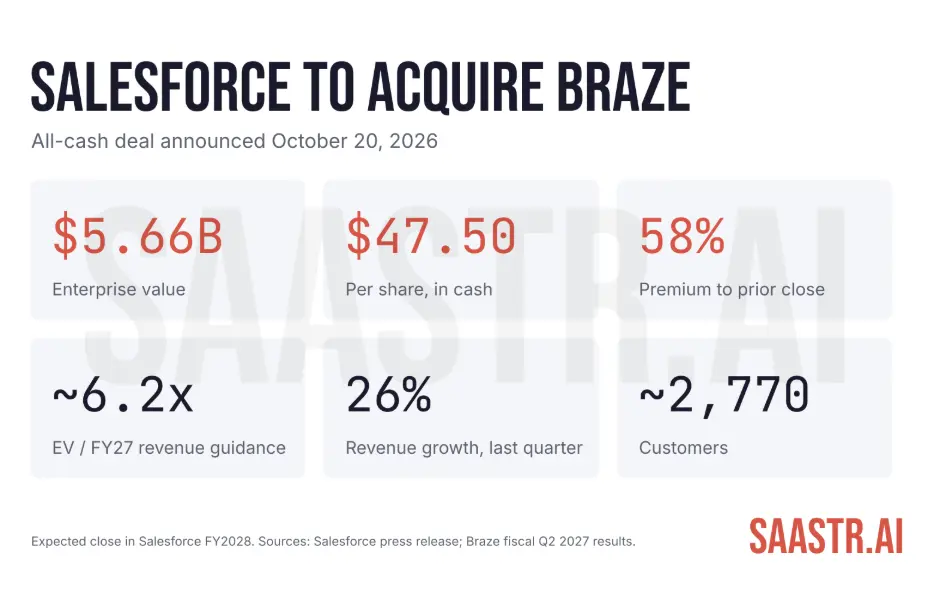
In a blockbuster move that underscores the widening valuation chasm between public tech markets and enterprise strategic buyers, Salesforce has announced its definitive agreement to acquire customer engagement platform Braze for roughly $5.66 billion in enterprise value. Under the terms of the transaction, Braze Class A stockholders will receive $47.50 per share in cash—representing a staggering 58% premium over the company’s closing price of $30.04 just prior to the announcement.
This landmark deal represents the crowning jewel of Salesforce’s aggressive 2026 acquisition spree, which has already seen the CRM giant scoop up companies like Contentful, m3ter, Fin, Listen Labs, and Loops. For Salesforce, the integration of Braze is designed to aggressively shore up its Marketing Cloud ecosystem, injecting world-class real-time mobile and in-app engagement capabilities into a platform historically optimized for enterprise email.
More importantly, the transaction serves as a vivid case study in modern SaaS valuations. While public investors discounted Braze—and the broader marketing technology category—due to fears of AI disruption and moderating growth, Salesforce viewed the asset through a strategic lens, paying a rich 6.8x trailing twelve-month revenue multiple. This comprehensive report breaks down the mechanics of the deal, the strategic rationale behind Salesforce’s play, and five critical takeaways for tech founders navigating today’s complex liquidity landscape.
Detailed Chronology: From Earnings Beat to Billion-Dollar Buyout
The path to one of the largest enterprise software acquisitions of 2026 was paved in just six weeks, characterized by a jarring disconnect between stellar operational execution and public market sentiment.
The September Earnings Shock
On September 8, Braze reported its fiscal quarter results, posting $227.2 million in revenue—a robust 26% year-over-year increase that beat Wall Street consensus estimates by roughly $6.9 million. The company additionally beat earnings-per-share expectations and raised its full-year guidance.
Yet, the market’s reaction was merciless. By the end of the trading week, Braze’s stock had cratered by 25.1%. Public investors fixated on moderating top-line growth rates and the fact that monetization from newly launched AI initiatives was not yet materially inflating overall revenue. Wall Street largely ignored the company’s dramatic margin expansion and record-shattering free cash flow, opting instead to price B2B software through a lens of fear: that AI agents would ultimately cannibalize seat counts and automated campaign workflows.
The Strategic Pivot and Quick Exit
Unbeknownst to public shareholders, Braze’s underlying business mechanics were strengthening rapidly, making it an increasingly attractive target for a cash-rich industry titan. While Wall Street punished the stock for single-digit decelerations in growth, enterprise buyers were calculating the immense value of Braze’s sticky customer base, robust data pipelines, and proprietary technologies.
Just six weeks after the post-earnings sell-off, Salesforce stepped in with an all-cash offer that valued Braze at nearly double its public trading multiple. Braze’s board of directors evaluated the public market’s 3.7x revenue valuation side-by-side with Salesforce’s 6.8x strategic bid—a massive 3.1-turn premium—and swiftly accepted.
Supporting Context & Metrics: Decoding the Numbers
To truly understand why Salesforce was willing to fork over $5.7 billion for Braze while public markets valued the entire category at a fraction of that multiple, one must examine the fundamental metrics governing the marketing software landscape.
Public Markets vs. Strategic Buyers: The Multiple Gap
Prior to the acquisition, the broader public B2B software median hovered at roughly 4.5x forward revenue. However, marketing-specific applications were experiencing severe multiple compression.
- Braze: Traded at 3.7x trailing revenue (prior to the buyout offer).
- HubSpot: Traded at ~3.1x trailing revenue (growing at 20%).
- Klaviyo: Traded at ~3.1x trailing revenue (growing at 26%).
- Adobe: Traded at ~3.8x trailing revenue.
- Monday.com: Traded at ~2.3x trailing revenue (growing at 22%).
- Sprinklr: Traded at a paltry 1.1x trailing revenue.
Public markets priced these companies conservatively, haunted by the existential threat of AI agents disrupting traditional contact- and message-based pricing models. Conversely, strategic buyers evaluate targets based on ecosystem synergy. Salesforce recognized that acquiring Braze’s 2,770 enterprise customers opened up immediate cross-selling vectors for Data 360 and Agentforce. Public investors simply do not price in those cross-sell synergies until they manifest on the balance sheet; strategic acquirers pay for them upfront.
Official Statements and Industry Implications
The integration of Braze into the Salesforce machine marks a strategic turning point for both organizations.

Bridging Salesforce’s Blind Spots
Historically, Salesforce Marketing Cloud has been an undisputed powerhouse in enterprise email marketing and traditional web journeys. However, its weakest links have consistently been real-time mobile push notifications and in-app engagement—precisely the domains where Braze built its empire.
Braze’s roster of roughly 2,770 high-value customers includes iconic consumer-facing brands such as Canva, Instacart, Venmo, Equinox, Urban Outfitters, and Dairy Queen. Many of these tech-forward, mobile-first consumer apps were notoriously difficult for Salesforce to capture as standalone accounts. By plugging Braze directly into Customer 360, Salesforce instantly fortifies its cross-channel personalization capabilities, offering brands a unified toolkit to reach hundreds of millions of consumers globally.
Leadership and Product Roadmap
Following the announcement, Braze CEO Bill Magnuson confirmed that Braze will continue building and operating under its own brand identity, rather than being completely dismantled and swallowed whole by the Marketing Cloud monolith.
For tech ecosystems, this structure is critical to watch. Tech leaders evaluating hybrid stacks—such as teams utilizing both Salesforce Marketing Cloud and auxiliary tools like Resend—will be monitoring whether Braze retains its product agility or becomes bogged down by legacy enterprise integration hurdles.
Five Crucial Learnings for Tech Founders
The Braze-Salesforce transaction offers a treasure trove of strategic insights for early-stage and growth-stage SaaS founders navigating today’s turbulent market conditions.
1. The Disconnect Between Wall Street and Strategic Buyers
Public markets in 2026 are highly reactive to deceleration and fearful of AI disruption, frequently pricing growing B2B apps as legacy software. However, strategic buyers operate on a different financial plane. If your public comps are stuck at a 3x revenue multiple, an IPO may undervalue your enterprise. A strategic buyer who desperately needs your proprietary data, distribution channels, or customer lists can—and will—pay nearly double that multiple. Founders must keep strategic M&A relationships warm long before they ever consider public market listings.
2. Operational Discipline Makes You Acquisition-Ready
In the quarters leading up to its acquisition, Braze proved that hyper-growth and fiscal discipline can coexist. The company grew its revenue by 26% year-over-year while restricting operating expense growth to just 6%. This deliberate hiring restraint—partially aided by AI automating operational workloads—resulted in a record-breaking quarterly free cash flow of $21.7 million and a war chest of $413.9 million in cash. Acquirers love cash-generative assets; cleaning up your operational efficiencies makes writing a multi-billion-dollar check much easier for a buyer.
3. Upmarket Motion and Net Retention Dynamics
Braze’s dollar-based net retention rate (NRR) settled at 110 overall (and 112% for large enterprise clients). Recognizing that organic expansion from existing cohorts alone could no longer drive hyper-growth, Braze aggressively pushed upmarket. Customers paying upwards of $500,000 annually surged by 28% to reach 361 accounts. Focusing intensely on enterprise-grade account acquisition creates a defensive moat that naturally attracts massive strategic suitors.
4. The Explosive Rise of Professional Services in the AI Era
One of the most fascinating underlying metrics in Braze’s final quarters as an independent company was the explosive growth of its professional services revenue. Services and other revenue more than doubled, leaping 136% year-over-year to hit $19.6 million (expanding from 5% to roughly 9% of total revenue). This trend reflects a broader truth across the B2B SaaS and AI landscape: enterprises are willing to pay handsomely for hands-on technical deployment, custom data integrations, and expert tuning to get AI agents and advanced decisioning engines properly operational.
5. Packaging and Monetizing Artificial Intelligence
Braze’s paid AI adoption rate reached roughly one-third of its largest enterprise customers within a few quarters, bolstered by the expansion of tools like AI Operator, which allows marketers to build complex customer journeys via conversational text prompts. Yet, Wall Street discounted these milestones because they did not immediately trigger an explosive inflection in overall top-line revenue growth. For founders, this highlights a critical packaging dilemma: embedding AI quietly into core product bundles makes its financial impact difficult to prove to investors. Treating AI as a distinct SKU with clear attach rates and revenue attribution makes its value impossible for the market—and acquirers—to ignore.
Future Outlook
The acquisition of Braze by Salesforce for $5.7 billion is likely the starting gun for a broader wave of consolidation across the marketing technology and customer engagement sectors. As public market investors continue to heavily discount software companies caught in the crosshairs of the AI transition, cash-rich enterprise giants will continue to scoop up undervalued, highly sticky assets at a premium.
For founders and executives, the playbook has fundamentally shifted. The era of loose spending and growth-at-all-costs is firmly in the rearview mirror. Today’s winners are those who master operational leverage, protect their free cash flow, aggressively target upmarket enterprise accounts, and build indispensable moats that strategic buyers cannot afford to live without.