

Executive Overview
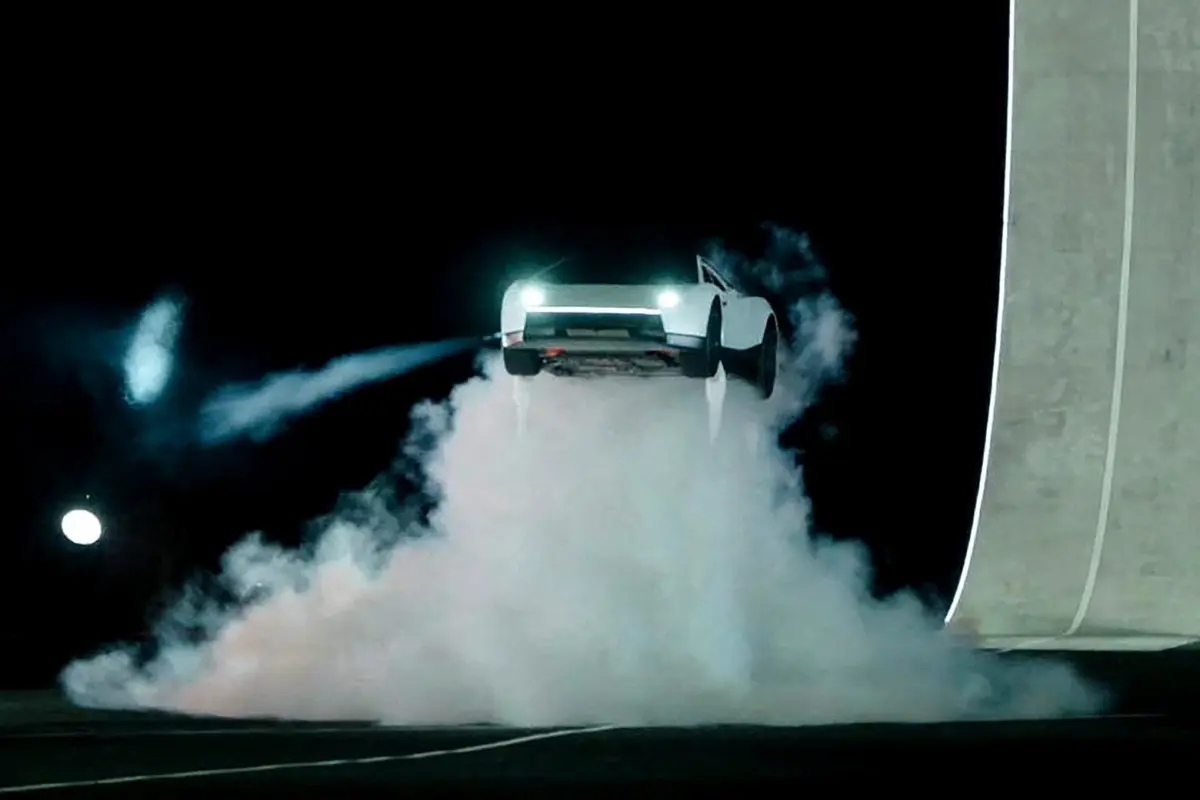
When Elon Musk took the stage in Texas on a Thursday evening to debut Tesla’s long-delayed new Roadster, he leaned into familiar theatrical territory. “What you see with your eyes, you will not believe!” he proclaimed to a roaring crowd. Musk promised that the vehicle would achieve the impossible: a mashup of a 1970s Lotus Esprit and an SR-71 Blackbird spy plane, capable of 0 to 60 mph in a blistering 0.8 seconds. More audaciously, he claimed the car would feature SpaceX-designed gas thrusters that could produce brief bursts of flight.
Yet, behind the viral spectacle of the demonstration—where the vehicle ascended a C-shaped ramp, used a downforce-generating fan system to hang upside down, and hopped over a row of parked Teslas—lay a far more calculated corporate maneuver.
This was not merely the unveiling of an unconventional sports car; it was a deliberate signal regarding the twilight of Tesla as an independent, traditional automaker. By prominently anchoring the event with SpaceX technology, Musk laid the groundwork for what financial analysts increasingly view as an inevitability: the mother of all corporate mergers between Tesla and SpaceX. As Tesla’s traditional electric vehicle (EV) margins compress, regulatory credits dry up, and global competition intensifies, the company is pivoting rapidly toward artificial intelligence, autonomous robotaxis, and humanoid robotics. A merger with SpaceX provides the financial runway, public markets clout, and structural flexibility required to fund Musk’s staggering, trillion-dollar techno-futuristic ambitions.
Detailed Chronology: From the Roadster Reveal to the Megamerger Horizon
The Texas Spectacle
The unveiling event was engineered for maximum viral impact. Tesla erected a massive C-shaped ramp designed to showcase the Roadster’s supposed aerodynamic and propulsion capabilities. After navigating the curve, the car utilized downforce-generating fans to remain affixed upside down before executing a controlled, thrust-assisted roll and touching down amid a billowing cloud of compressed air. It then bounded over a lineup of stationary Tesla vehicles.
While visually striking, the stunt echoed Musk’s penchant for high-stakes public relations campaigns, most notably the 2018 launch of his personal red Roadster into solar orbit atop a SpaceX Falcon Heavy rocket. However, beneath the carnival-barker presentation was a sobering industrial reality: this Roadster is slated to be the final manually drivable vehicle Tesla ever designs.
A History of Broken Timelines and Tiered Pricing
The new Roadster’s path to production has been notoriously protracted. When the vehicle was first teased in 2017, early believers plunked down $50,000 reservation fees (and up to $250,000 for the limited Founder Series). With the latest iteration, Tesla has introduced a convoluted, tiered pricing structure:
- Performance Trim: $50,000 base reservation/upgrade cost.
- Thrust Trim: $250,000.
- Rocket Trim (the "flying" variant): An undisclosed, invite-only sum.
Tesla has set an optimistic delivery target of 2028 for these vehicles. However, given Musk’s history of missing production deadlines, market analysts advise strict adherence to the principle of caveat emptor.
The Pivot Toward Autonomy and Robotics
Musk’s vision for Tesla no longer centers on selling consumer sedans and crossovers. The company’s immediate future rests on two pillars:
- The Cybercab: A dedicated autonomous vehicle featuring neither a steering wheel nor pedals, intended to operate as a ubiquitous, for-hire robotaxi fleet.
- Optimus Humanoid Robots: Automated laborers that Musk claims will eventually drive Tesla’s market capitalization from $1.4 trillion to an astronomical $25 trillion. Priced at a projected $30,000 apiece, these robots are envisioned to handle everything from manufacturing Cybercabs and mowing lawns to tending bars, caring for the elderly, and assisting in the extraterrestrial colonization of the moon and Mars.
The Looming SpaceX Acquisition
As Tesla pours billions into artificial intelligence, data centers, and heavy research and development, its identity as a pure-play EV manufacturer is dissolving. Wall Street has taken notice. Barclays analyst Dan Levy recently suggested that a merger between Tesla and SpaceX is “almost a done deal.” Under this rumored structure, SpaceX would acquire Tesla, allowing Tesla shareholders to swap their equity for SpaceX stock. The resulting mega-entity would command a valuation of approximately $3.5 trillion, uniting Musk’s terrestrial automation ambitions with his aerospace empire.
Supporting Context & Metrics
To understand why a Tesla-SpaceX merger is gaining traction, one must examine the shifting financial landscape of Tesla’s core automotive business.
The Numbers Behind the Shift
In 2025, Tesla achieved significant delivery milestones, shipping over 1.6 million manually drivable vehicles and generating roughly $95 billion in revenue, predominantly from automotive sales alongside solar and energy storage operations. Despite these impressive top-line figures, profitability is under severe strain.
- Stagnant Lineup: Tesla has not introduced an all-new, non-flying consumer vehicle since the Cybertruck debuted in 2019. Furthermore, the company has officially sunsetted production of its higher-margin luxury vehicles—the Model S sedan and Model X SUV—leaving the Model 3 sedan and Model Y crossover to shoulder the entirety of automotive revenue.
- Regulatory Credit Deficit: Historically, Tesla’s bottom line was heavily bolstered by the sale of zero-emission regulatory credits to legacy automakers. As government policies evolve and credits are phased out or altered, this lucrative revenue stream has sharply diminished.
- Global Headwinds: International markets have presented severe challenges. In Europe, aggressive competition from Chinese EV manufacturers has eroded market share, compounded by political friction stemming from Musk’s public support of right-wing political factions. Domestically, the expiration or reduction of federal consumer tax credits has cooled broader U.S. demand for electric vehicles.
The Capital Problem
Building out massive fleets of Cybercabs and scaling the production of Optimus robots requires capital expenditure on an unprecedented scale. Traditional automotive margins cannot support these ambitions, nor can they keep pace with heavyweights like OpenAI and Anthropic in the arms race for data-center infrastructure.
By merging with SpaceX—a private entity historically adept at securing massive capital infusions from public and private markets—Musk can effectively shield and subsidize Tesla’s costly structural transformation. Furthermore, the combined entity opens the door to speculative, sci-fi-adjacent infrastructure projects, such as SpaceX launching orbital data centers designed to harvest uninterrupted solar power in the vacuum of space.
Official Statements and Industry Perspectives
Reactions from the financial and automotive sectors have ranged from cautious skepticism to pragmatic acknowledgment of Musk’s long-term master plan.
-
Elon Musk (Tesla CEO), during the Texas Showcase:
“What you see with your eyes, you will not believe! This is going to be some crazy stuff.” Musk framed the Roadster’s SpaceX-derived thrusters not as a gimmick, but as the ultimate synthesis of terrestrial and aerospace engineering. He reiterated that the company’s era of traditional vehicle manufacturing is drawing to a close, asserting that physical car ownership will soon be eclipsed by autonomous fleets and humanoid labor. -
Dan Levy (Barclays Analyst), in recent market commentary:
Characterized a potential Tesla-SpaceX merger as an initiative that is “almost a done deal,” noting that combining the entities could occur before the end of 2026. Levy emphasized that such a move would provide the financial architecture necessary to absorb Tesla’s massive pivot toward A.I. and robotics while insulating the enterprise from cyclical downturns in the global automotive sector. -
Industry Insiders and Automotive Critics:
Longtime automotive observers have frequently questioned why Tesla chose to phase out lucrative luxury segments without expanding into high-margin, high-demand vehicle categories like large-scale family SUVs or conventional utility trucks. However, industry analysts increasingly conclude that Musk viewed traditional EV manufacturing merely as a bootstrapping mechanism—a means to establish global manufacturing expertise, build supply chains, and accumulate the capital required to build a fully automated, robotics-driven future.
Future Outlook
The convergence of Tesla and SpaceX into a single, monolithic corporate entity marks the definitive end of the first chapter of the modern electric vehicle revolution. Tesla proved to a skeptical global market that sustainable transport was commercially viable, capturing massive market share and forcing every legacy automaker to electrify their fleets.
However, as commodity margins tighten and the automotive landscape commoditizes, Musk is shedding the skin of a traditional car company. The Roadster reveal, with all its bombast, theatrical absurdity, and borrowed aerospace technology, was a smoke-and-mirrors masterpiece designed to point investors past current financial headwinds and toward a trillion-dollar horizon.
Looking ahead, the roadmap is clear:
- The Phasing Out of Manual Driving: Expect traditional steering-wheel-and-pedal vehicles to be systematically sidelined as Tesla transitions its manufacturing lines entirely toward autonomous Cybercabs.
- The Robotics Integration: The commercial viability of Optimus will become the primary metric by which Wall Street judges the company’s valuation, overshadowing traditional quarterly vehicle delivery reports.
- The Ultimate Megamerger: Anticipate formal moves toward the integration of SpaceX and Tesla, creating a diversified, galactic-scale enterprise capable of funding capital-intensive ventures ranging from terrestrial AI data centers to orbital solar energy arrays.
Ultimately, whether the new Roadster ever achieves commercial flight matters very little. It served its true purpose: capturing the world’s attention just long enough for Elon Musk to rewrite the rules of corporate destiny once again.




