Executive Overview
For decades, the standard playbook for scaling a Software-as-a-Service (SaaS) enterprise relied on incremental engineering cycles, human-driven product management, and user interfaces designed to capture human eyeballs. That playbook is rapidly expiring.
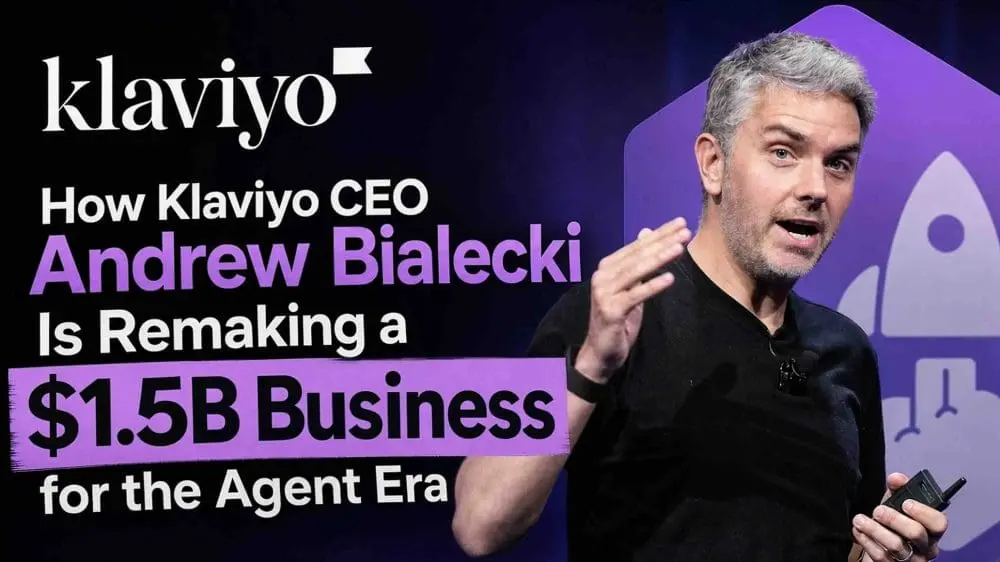
At the recent SaaStr AI conference, Klaviyo Co-Founder and Co-CEO Andrew Bialecki took the stage not to deliver a high-level vision deck, but to pull back the curtain on how a 2,300-person public company is systematically rebuilding its entire product architecture, internal workforce, and go-to-market motions around autonomous AI agents.
Klaviyo’s journey from an e-commerce email tool to an indispensable platform holding roughly 80% market share in the Shopify ecosystem is well-documented. Yet, the company is not resting on its laurels. Facing a post-SaaS reality, Klaviyo has initiated a total structural overhaul. By leveraging autonomous software development loops known as "Dark Factories," enforcing strict operational autonomy frameworks (the L1/L2/L3 Mandate), and reimagining software as headless infrastructure built for agent consumption, Klaviyo is offering a masterclass in how legacy-adjacent software can successfully transition into the agentic era.
This report provides an in-depth, investigative analysis of Klaviyo’s AI transformation, exploring the mechanics of their build systems, strategic takeaways for modern software founders, and the critical execution pitfalls that sink most enterprise AI initiatives.
Detailed Chronology: From E-Commerce Dominance to Agentic Architecture
To understand Klaviyo’s aggressive pivot toward AI agents, one must first understand the fundamental insight that propelled the company to its current dominance.
The Foundational Insight
Long before the current generative AI boom, Klaviyo won the B2B e-commerce sector by fundamentally shifting how merchants viewed analytics. Traditional email marketing platforms reported metrics like open rates and sent counts—abstract data points that forced merchants to guess ROI. Klaviyo integrated directly with e-commerce carts and platforms like Shopify to display hard cash revenue metrics: "This specific campaign made $18,372."
Merchants were so galvanized by this transparency that they posted screenshots of their dashboards on LinkedIn years later. This obsession with direct, measurable business outcomes captured an estimated 80% share of the Shopify ecosystem, setting the stage for one of the few successful tech IPOs of the 2023 cohort.
The Agentic Pivot
However, the software paradigm that won the last decade cannot win the next. Recognizing that all traditional dashboards and workflows must eventually be mediated or replaced by autonomous agents, Klaviyo launched Composer, a multi-agent marketing assistant.
The metrics surrounding Composer’s rollout signal a profound shift in software adoption:
- Explosive Growth: Composer surpassed 95,000 active users within its first month.
- High Engagement: Roughly 25% of these users return on a weekly basis.
- Surging Demand: Credit consumption for the agentic tool is growing at an impressive 30% week-over-week.
- Rapid Prototyping: Crucially, the very first working prototype of Composer was not built over months of traditional engineering sprints—it was autonomously constructed over a single weekend by a system of internal agents.
Supporting Context & Metrics: Financial Health and Operational Scale
Klaviyo’s pivot to agents is backed by robust financial performance, proving that enterprise transformation does not require sacrificing short-term stability.
- Q2 2026 Financials: Klaviyo reported $370.6 million in revenue for Q2 2026, representing a robust 26% year-over-year growth rate.
- Customer Base: The platform serves over 205,000 active customers, ranging from small-to-medium businesses (SMBs) to high-volume enterprises.
- Guidance Upgrade: Driven by strong adoption of core platform features and new agentic capabilities, management raised full-year guidance to a range of $1.526 billion to $1.534 billion.
These figures provide the financial runway necessary to fund deep, bleeding-edge R&D into agentic architectures without destabilizing core revenue streams.
Official Insights: Andrew Bialecki’s Seven Pillars of Agentic Transformation
During his SaaStr AI presentation, Bialecki outlined seven core principles that guide Klaviyo’s internal and external AI strategy. These principles challenge conventional wisdom across product management, engineering, and customer success.
1. The L1/L2/L3 Autonomy Mandate
Borrowing the conceptual framework used for autonomous driving, Klaviyo applied strict autonomy levels to every function within its 2,300-person organization. By the end of June, the entire company was mandated to operate at Level 3 (L3) autonomy—meaning AI systems handle complex, multi-step workflows while humans oversee, check, and validate outputs.
Bialecki’s pitch to employees was not about corporate efficiency; it was about career survival. He argued that very few knowledge workers will remain competitive if they do not learn to orchestrate teams of agents, decompose complex problems, and validate programmatic outputs. Consequently, a product manager who previously spent their days writing static wireframes and manual specs must now orchestrate L3 agent systems, fundamentally redefining corporate roles at scale.
2. Dark Factory: Agents That Build Agents
The term "Dark Factory" originates from lights-out manufacturing, where automated factories run without human intervention, requiring no lights. Klaviyo began building its internal Dark Factory last fall to solve a pervasive problem: unmaintainable, messy prompt-stacking.
The Dark Factory operates on a structured loop:
- Product Management: A prompt is submitted via a standalone repository or Slack. The system acts as a PM, writing detailed specifications.
- System Decomposition: The master agent breaks down the problem into distinct engineering subsystems.
- Contract Generation: The system establishes explicit contractual API interfaces between those subsystems.
- Subagent Execution: Specialized subagents build against each contract simultaneously.
For Composer, this decomposition automatically generated a trio of specialized agents: a Creative & Design Agent (integrating with Canva, Figma, and proprietary brand assets), an Orchestration Agent (determining targeted audience segmentation and timing), and an Analysis Agent (predicting campaign revenue outcomes). Bialecki emphasizes that clear contractual interfaces are what make human code review survivable, as reviewers evaluate structured architecture rather than tangled spaghetti code.
3. Tom Brady and the Coaching Layer
A foundational mental model at Klaviyo is treating base foundation models like exceptionally athletic middle or high schoolers: they possess broad capabilities across many domains, but lack elite, domain-specific mastery.
Comparing this to Tom Brady—who might have had a mediocre career if drafted to play baseball for the Montreal Expos, but became the greatest quarterback in history through rigorous coaching, film study, and specialized drills—Bialecki stresses the necessity of a coaching layer.
At Klaviyo, this coaching layer consists of two vital additions built on top of the model harness:
- Proprietary Feedback Signals: Continuous reinforcement loops derived from real-world e-commerce performance data.
- Scoring and Guardrails: Pre-output evaluation mechanisms that filter out subpar or misaligned responses before they reach the end user.
Without a domain-specific coaching layer, deploying a general model is equivalent to fielding an uncoached athlete against professional competition.
4. Your Agents Are Your Most Advanced Users
In traditional software, user sophistication follows a sharp power law: a small elite of power users utilize advanced features, while a long tail of novices barely scratches the surface. AI agents shatter this distribution by acting as advanced power users from day one.
Bialecki illustrates this with an example involving Google’s legacy AMP for email specification. Because building interactive web apps inside an email payload was too complex for most human merchants, Klaviyo’s platform could only offer a raw HTML editor, which few customers utilized.
When Composer encountered the limitation on day one, it independently determined that carousels and dynamic JavaScript calls could boost conversion rates. Crucially, the agent reported back to Klaviyo’s engineers: "I can improve conversion using the AMP spec, but you are missing the necessary APIs. Can you fix that for me?"
Agents treat experimentation as nearly free, running micro-tests across 1% of an audience instantly—a task humans endlessly procrastinate on due to administrative friction. Bialecki’s rule for product teams is simple: Treat your agents like your most demanding customer advisory board.
5. Agents Training Agents on the Customer Side
Enterprise software implementation often stalls when deploying complex solutions to SMB customers who cannot afford forward-deployed engineers (FDEs). Klaviyo solves this scalability bottleneck by having agents train the customer-facing agents.
The onboarding loop functions through systematic automation:
- The customer agent crawls the merchant’s past campaigns, historical data, and brand assets.
- It runs simulated tests internally against historical buyer personas.
- It identifies gaps, optimizes messaging, and tunes its performance parameters.
As a result, when a customer opens the agent product for the first time, they are not greeted with a blank slate; they receive an agent already trained on five to ten of their specific use cases, achieving a 50% to 70% resolution rate out of the gate. Bialecki’s core go-to-market thesis is absolute: If an agent product requires a heavy implementation cycle and cannot deliver immediate value on day one, it is dead on arrival.
Furthermore, Bialecki views external agents not merely as narrow customer service bots, but as proto-web servers. Users will increasingly interact with businesses via URLs, natural language, or AI assistants like Claude, bypassing traditional web interfaces entirely.
6. Great APIs Can Rescue Dated Software
For B2B founders managing aging codebases, Bialecki offers an encouraging epiphany: software is no longer something humans log into; software is infrastructure, and infrastructure is built for developers through APIs.
Companies like Twilio and Salesforce demonstrate that embracing a headless architecture allows external systems and agents to query data in real time, bypassing legacy user interfaces entirely. Klaviyo is actively building toward a signup experience where a user can input their email or phone number, state that they are launching a business, and have their entire e-commerce infrastructure, data storage, and marketing engine provisioned entirely via background APIs without ever touching a visual screen.
7. Codified Taste and the Slop Problem
A major risk of AI-accelerated development is the "slop problem": when fifty product managers can each generate fifty half-baked features per month, volume replaces quality, drowning the enterprise in intellectually interesting noise.
To prevent this degradation, Klaviyo codified its corporate taste. The company dumped years of product critique notes, Zoom meeting transcripts, and design feedback into a dedicated database. Before any AI-generated feature reaches human review, it must clear an automated bar defined by this taste database: What has historically worked? What constitutes excellence? What design patterns are forbidden?
This living document democratizes institutional knowledge, ensuring that high standards are accessible to all engineers and agents, rather than remaining trapped as tribal knowledge inside executive boardrooms.
The 5 Fatal Mistakes Software Teams Are Making
Bialecki outlined five recurring failure patterns that sabotage companies attempting to transition into the agentic era:
- Letting Agents Touch Production Systems Too Soon: Granting unbridled write access to agents without rigorous sandboxing, tool restrictions, and staging environments inevitably leads to catastrophic database failures. Debugging must happen in isolated environments, never in production.
- Stopping at the Demo: Building a prototype that works for a controlled 30-second demo is only 20% of the battle. Agents must be subjected to automated load testing and validation to ensure they perform reliably across hundreds of thousands of diverse enterprise accounts.
- Shipping Raw Foundation Models: Launching a commercial product powered by an unadapted, raw foundation model—devoid of proprietary feedback loops, scoring layers, or domain-specific coaching—guarantees commoditization and poor user retention.
- Maintaining Fuzzy Inter-Team Interfaces: Humans tolerate ambiguity and schedule meetings to resolve organizational friction. Agents require rigid, contractual clarity. Successful companies must map out job functions into strict programmatic contracts before attempting to scale them with AI.
- Building Exclusively for Human Log-Ins: Continuing to view software strictly through the lens of human-operated screens leads to underinvesting in robust APIs, rendering the product invisible to the autonomous agents that are rapidly becoming the primary consumers of enterprise software.
Future Outlook: The Headless, Agent-First Enterprise
Klaviyo’s strategic trajectory provides a clear preview of the enterprise software landscape over the next five to ten years. As Bialecki demonstrated at SaaStr AI, the competitive moat of tomorrow will not belong to companies with the slickest human interfaces, but to those with the cleanest infrastructure, the most rigorous taste-codification frameworks, and the most sophisticated Dark Factory build loops.
For software founders and engineering leaders, the mandate is clear: dismantle legacy operational assumptions, treat agents as your most demanding power users, and transform your product into headless, API-first infrastructure. In the agentic era, the lights in the factory may be turning off, but for companies willing to adapt, the future has never been brighter.