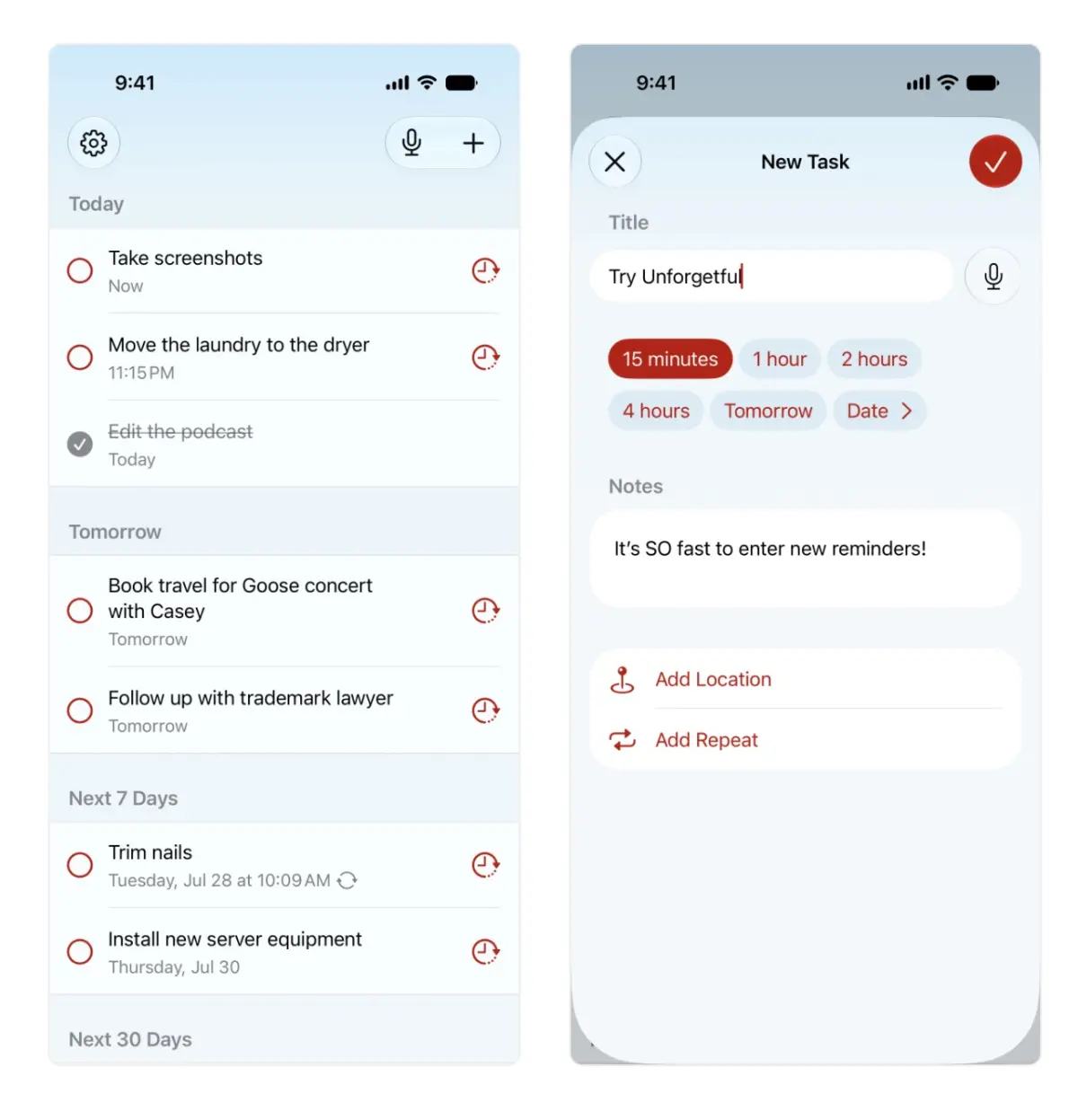
In the highly competitive landscape of iOS and macOS productivity software, task managers generally fall into two categories: hyper-complex databases designed for project managers, or minimalist lists that are easily ignored. On August 14, 2026, veteran indie developer Marco Arment—celebrated for creating Instapaper, pioneering the podcast client Overcast, and serving as Tumblr’s original chief technology officer—released his latest utility, Unforgetful.
Unforgetful is a premium, specialized task-management client designed specifically for chronic procrastinators and individuals who struggle with "notification blindness." Rather than building a proprietary, siloed cloud database, Arment has engineered Unforgetful to sit directly on top of Apple’s native Reminders database. This architectural decision allows users to leverage the systemic advantages of Apple’s ecosystem—such as hands-free task creation via Siri—while completely bypassing the native Reminders user interface, which many users find uninspiring or easy to ignore.
Priced at $19.99 per year, Unforgetful targets a distinct demographic: users who find themselves trapped in a continuous cycle of snoozing and accidentally dismissing critical alerts. By redesigning the mechanics of task notifications, scaling snooze intervals, and enforcing absolute persistence, the application attempts to solve the psychological bottlenecks of task execution.
+-------------------------------------------------------------+
|                     APPLE SILO INTEGRATION                  |
|                                                             |
|   [ Siri Voice Input ]  --->  [ Apple Reminders Database ]   |
|                                           |                 |
|                                           v                 |
|                               [ Unforgetful Engine ]        |
|                                           |                 |
|        +----------------------------------+----------------+|
|        |                                                   ||
|        v                                                   v|
|  [Persistent Alerts]                             [Scaled Snoozing]  |
|  Never stops nudging                             Prevents cognitive |
|  until task is marked done                       overload freeze    |
+-------------------------------------------------------------+
Detailed Chronology
The genesis of Unforgetful stems from a long-standing tension between hardware-level convenience and software-level friction within the Apple ecosystem.
The Siri Paradox: For years, Apple has refined its voice assistant to handle quick, contextual inputs. For developers and power users alike, instructing Siri to "remind me to water the plants at 4:00 PM" has remained the most frictionless way to log a task.
The UX Friction Point: Despite the ease of input, the destination of those inputs—the native Apple Reminders app—has suffered from design paradigms that fail to accommodate human psychology. For users with attention-deficit traits or heavy cognitive loads, the native app’s notifications are remarkably easy to dismiss permanently with a misplaced swipe, leading to forgotten obligations.
The Development Phase: Recognizing this gap, Arment quietly began developing a client that could act as a highly specialized "front-end" for the iOS and macOS Reminders databases. The objective was not to build another heavy GTD (Getting Things Done) system like Things or OmniFocus, but rather an "attention engine" designed to enforce accountability.
The Launch (August 14, 2026): Arment officially unveiled Unforgetful to the public. Operating on a cross-platform license across iOS, iPadOS, and macOS, the app was positioned not as a competitor to Apple’s infrastructure, but as a symbiotic replacement for its user interface.
Supporting Context & Product Mechanics
To understand why Unforgetful represents a significant departure from standard task managers, one must examine its core mechanics and the psychological theories underpinning its design.
1. The Native Database Integration (EventKit API)
Most third-party task managers require users to migrate their data to proprietary cloud servers. This creates platform lock-in and breaks native integration with system-level features like Siri. Unforgetful utilizes Apple’s local EventKit/Reminders database APIs.
This hybrid architecture yields several operational advantages:
Zero-Migration Friction: When a user downloads Unforgetful, there is no import process. The app instantly populates with the user’s existing reminders.
Siri Compatibility: Users can continue using Siri to dictate tasks on their Apple Watch, HomePod, or iPhone. The task is written directly to Apple’s database, and Unforgetful immediately intercepts and manages it.
Risk-Free Trial: If a user decides to discontinue their $19.99/year subscription, their data is not trapped in a proprietary format; it remains perfectly preserved in Apple’s native Reminders database.
2. Overcoming Notification Blindness via Persistent Alerts
The primary failure point of traditional reminder systems is the "one-and-done" notification. If an alert fires while a user is driving, in a meeting, or otherwise occupied, they will often swipe it away to clear their screen, effectively erasing the task from their short-term memory.
Unforgetful solves this by treating notifications as persistent states rather than transient events.
Until a task is explicitly marked as completed or deleted, Unforgetful will continue to fire notifications. This persistence mimics the urgency of an alarm clock rather than a passive text message, ensuring that critical tasks cannot be quietly swept under the rug.
3. Intelligent, Scaled Snoozing
Standard task managers offer rigid snooze intervals (e.g., "Snooze for 15 minutes" or "Snooze until tomorrow"). For procrastinators, this often leads to a phenomenon known as Cognitive Overload Freeze. When multiple snoozed tasks fire simultaneously, the user is presented with a wall of notifications, causing them to panic and dismiss them all.
Unforgetful introduces scaled snoozing. The application dynamically adjusts snooze intervals as a task is repeatedly deferred.
First Snooze: Short interval (e.g., 15 minutes) to keep the task fresh in the mind.
Subsequent Snoozes: The app scales the interval upward, dynamically spacing out tasks to prevent a sudden cascade of overlapping notifications.
Clutter Prevention: The algorithm prevents multiple tasks from firing at the exact same moment, flattening the notification curve and allowing the user to focus on one item at a time.
4. Radical Feature Minimalism
In stark contrast to enterprise productivity tools, Unforgetful intentionally omits advanced organizational features. There are:
No tags or labels
No project folders or nested sub-tasks
No complex smart lists or custom perspectives
No collaborative shared workspaces
By stripping away the overhead of "organizing" work—which procrastinators often use as a form of productive procrastination—Unforgetful forces the user to focus purely on execution. If a user requires advanced metadata or complex project planning, Arment openly directs them to continue using Apple’s stock Reminders or more complex third-party tools.
Official Statements
In his launch announcement, Marco Arment articulated his personal frustration with Apple’s default software design, framing Unforgetful as a highly opinionated solution to a widespread user experience issue:
"Siri, for all of its faults, has always been very good at creating tasks in Apple’s Reminders app… The Reminders app, though, doesn’t fit me at all. I don’t like how it looks, how it works, or how it’s organized. Hell, I don’t even like its icon. There’s nothing about it I like. So I never open it."
Arment went on to detail the specific edge cases where native Reminders fails the neurodivergent or easily distracted user:
"If I forgot to include a time when setting a reminder, I’d miss getting a notification, so the task never got done. Or I would accidentally dismiss a reminder instead of snoozing it, losing the reminder altogether. Unforgetful is designed to make it impossible to lose your tasks."
Future Outlook
The launch of Unforgetful highlights an ongoing trend in the Apple developer ecosystem: the rise of highly specialized, single-purpose premium utilities.
                                 THE INDIE UTILITY SPECTRUM

     Low Friction / Low Utility                             High Complexity / High Overhead
     [ Apple Stock Reminders ] <====== [ UNFORGETFUL ] ======> [ Things 3 / OmniFocus ]
         (Easily Ignored)             (Persistent, Simple)         (Requires Active Management)
The Economics of the $19.99/Year Subscription
While some consumers react negatively to subscription models for utility apps, the $19.99/year price point has become the baseline for sustainable indie development. Unlike venture-backed startups that must chase hyper-growth, solo developers like Arment require a stable, recurring revenue stream to offset ongoing API maintenance, operating system compatibility updates, and customer support costs.
Because Unforgetful leverages local APIs and native Apple databases, its cloud infrastructure costs are minimal. This lean architecture ensures that the application can remain profitable and active for years, avoiding the sudden shutdowns that frequently plague venture-funded productivity platforms.
The Threat of "Sherlocking"
In the Apple ecosystem, "Sherlocking" occurs when Apple sherlocks a third-party developer’s idea by building those exact features directly into the next version of iOS or macOS. However, Unforgetful’s highly opinionated, aggressive notification system makes it largely immune to this threat. Apple’s default apps must be designed for the lowest common denominator—millions of users who would find persistent, un-dismissible alerts incredibly annoying.
By catering specifically to the demographic of procrastinators, ADHD brains, and power users who need to be nudged repeatedly, Unforgetful occupies a protective niche. It stands as a testament to the viability of the modern indie developer model: identifying a subtle psychological failure in system-level software and building an elegant, uncompromising escape hatch.