

Executive Overview
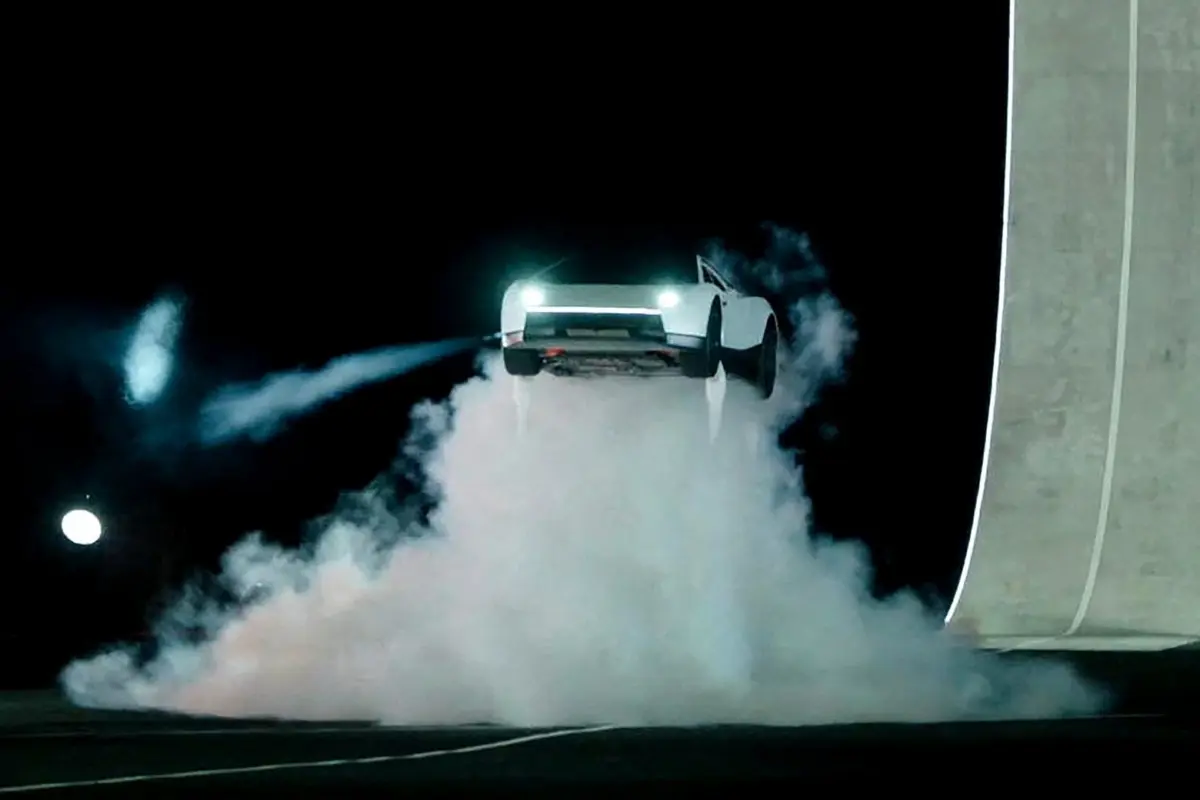
In the high-stakes theater of modern technology, spectacle is rarely just entertainment; it is strategy. When Elon Musk took the stage in Texas to unveil the long-awaited, repeatedly delayed Tesla Roadster—a vehicle boasting a 0-to-60 mph time of 0.8 seconds and equipped with SpaceX-derived gas thrusters capable of producing brief, dramatic bursts of flight—the automotive world gasped. Musk promised "some crazy stuff," leaning into the carnival-barker persona that has defined his career as a visionary disruptor.
Yet, beneath the pyrotechnics, the compressed-air landing clouds, and the viral social media clips lies a far more profound corporate maneuver. The "flying car"—which is technically capable of brief elevation rather than sustained flight—is not the dawn of a new era of personal aerial transit. Rather, it is a brilliantly orchestrated misdirection.
Industry analysts, financial institutions, and market insiders are increasingly viewing the Roadster spectacle as a conceptual and strategic bridge signaling the twilight of Tesla as a traditional automotive manufacturer. The writing is on the wall for a historic, unprecedented corporate convergence: the absorption of Tesla into a massive, multi-trillion-dollar SpaceX-Tesla megamerger. By embedding SpaceX engineering directly into Tesla’s marquee product launch, Musk has provided the clearest indicator yet of his ultimate endgame—paving the way for a unified galactic enterprise focused on autonomous robotaxis, humanoid robotics, artificial intelligence, and deep-space colonization.
Detailed Chronology: From the Roadster Reveal to the Megamerger Horizon
To understand how Tesla arrived at this crossroads, one must examine the timeline of broken promises, shifting corporate identities, and technological pivots that have characterized Musk’s leadership over the past decade.
1. The Genesis of the Roadster Paradox (2017–2018)
The saga of the second-generation Tesla Roadster began in late 2017, when Musk first teased the vehicle, prompting true believers and early adopters to plunk down $50,000 standard reservations and up to $250,000 for the limited Founder Series. At the time, the vehicle was framed as the ultimate halo car for an electric vehicle (EV) manufacturer looking to prove that battery power could decisively outperform internal combustion engines.
Barely a year later, in 2018, Musk executed one of the most brilliant public relations stunts in corporate history: he launched his own cherry-red Tesla Roadster into space atop a SpaceX Falcon Heavy rocket. While that car entered a perpetual solar orbit, the terrestrial version languished in development hell, repeatedly pushed back as Tesla prioritized the mass production of the Model 3 and Model Y.
2. The Strategic Pivot to Autonomy and Robotics (2019–2024)
As the years pressed on, Tesla’s product roadmap shifted dramatically away from traditional consumer vehicles. The introduction of the polarizing Cybertruck in 2019 marked the last time Tesla debuted an entirely new, non-autonomous consumer vehicle platform. Instead, capital and engineering talent were aggressively redirected toward artificial intelligence, Full Self-Driving (FSD) software, the Cybercab (a steering-wheel-free robotaxi), and the Optimus humanoid robot program.
Musk began positioning Tesla not as a car company, but as an AI and robotics juggernaut. He claimed that Optimus robots—slated to sell for around $30,000 apiece—would eventually push Tesla’s market capitalization to an astronomical $25 trillion, relieving humanity of physical labor, assembling vehicles, and even assisting in the extraterrestrial colonization of the Moon and Mars.
3. The Texas Spectacle and the SpaceX Integration (2025–Present)
The recent Texas event effectively closed the book on Tesla’s identity as a conventional EV manufacturer. By showcasing a Roadster featuring SpaceX cold-gas thrusters, downforce fans, and radical aerodynamic capabilities, Musk symbolically blurred the operational lines between his two most prominent companies.
According to recent disclosures, Tesla has structured the new Roadster lineup into increasingly exotic tiers: a $50,000 "Performance" trim, a $250,000 "Thrust" version, and an invite-only, ultra-exclusive "Rocket" trim equipped with the thruster technology. Deliveries are nominally slated for 2028, though seasoned market watchers maintain a healthy dose of skepticism regarding the timeline. More importantly, the prominent integration of SpaceX aerospace technology into a Tesla automotive showcase laid the groundwork for what Wall Street insiders predict will be a definitive corporate marriage before the end of the decade.
Supporting Context & Metrics: The Financial Pressures Behind the Curtain
While Musk paints a picture of an inevitable, AI-driven utopia, the operational reality of Tesla’s core automotive business tells a story of mounting pressure, shrinking margins, and strategic exhaustion.
The Declining Economics of Mass-Market EVs
For all of its cultural footprint, Tesla delivered more than 1.6 million manually drivable vehicles in 2025, generating approximately $95 billion in revenue, primarily from its automotive sector alongside solar and energy storage initiatives. However, the profit margins on these vehicles are contracting rapidly.
Several macroeconomic and competitive factors have converged to squeeze Tesla’s automotive dominance:
- Intense Global Competition: The rapid rise of aggressively priced Chinese automakers—particularly in European markets where political friction and Musk’s public stances have occasionally dampened consumer enthusiasm—has eroded Tesla’s overseas market share.
- Loss of Regulatory and Tax Credits: Governments have systematically rolled back the lucrative regulatory credits that previously padded Tesla’s balance sheet to the tune of billions of dollars. Simultaneously, the reduction or elimination of federal EV tax credits has softened overall consumer demand in the United States.
- Product Stagnation: Having effectively sunset the high-priced Model S sedan and Model X SUV, Tesla’s high-volume manufacturing output relies almost exclusively on the aging Model 3 and Model Y lines. The company has failed to enter lucrative segments such as large-scale family SUVs or traditional pickup trucks, missing out on high-margin profit pools.
The Capital Requirements of the AI Era
Transitioning an industrial manufacturing footprint from human-driven EVs to autonomous Cybercabs and millions of Optimus units requires staggering amounts of capital. Furthermore, keeping pace with competitors like OpenAI and Anthropic in the construction of massive artificial intelligence data centers demands cash reserves that far exceed standard automotive cash flows.
This financial chasm explains why a Tesla-SpaceX merger is gaining serious traction among financial analysts. Investment banking projections—such as those articulated by Barclays analyst Dan Levy—suggest that a transaction could see SpaceX acquire Tesla through a stock swap, creating a combined corporate entity valued at an unprecedented $3.5 trillion to $4.5 trillion. Under this umbrella, SpaceX’s formidable capacity to raise public capital could effortlessly underwrite Tesla’s radical pivot toward robotics and orbital data centers.
Official Statements and Analyst Perspectives
The narrative surrounding the Roadster reveal and the prospective megamerger has elicited intense reactions from financial analysts, industry veterans, and corporate spokespeople alike.
"What you see with your eyes, you will not believe! This is not just a car; it is the physical manifestation of what happens when aerospace engineering meets ground-bound electric propulsion. We are building the future, and it is going to be wild."
— Elon Musk, CEO of Tesla and SpaceX
Wall Street, however, is looking past the rhetoric to evaluate the balance sheets. Financial analysts note that the traditional automotive business model—selling moderately priced electric sedans to retail consumers—has proven far more difficult and less lucrative than Musk initially anticipated.
A prominent aerospace financial analyst, speaking on condition of anonymity, observed:
"Elon realized years ago that the traditional car business is a margin trap. By folding Tesla into SpaceX, he creates a vertically integrated technological behemoth that bridges terrestrial robotics, global autonomous transport, and interplanetary rocketry. The Roadster was simply the shiniest toy he could use to make Wall Street swallow the bitter pill of Tesla’s automotive retreat."
Future Outlook: The Dawn of a Trillion-Dollar Mega-Entity
As we look toward the horizon of 2030 and beyond, the implications of this impending convergence are profound. The traditional era of Tesla as a standalone car company is officially drawing to a close.
What Comes Next?
- The Final Generation of Human-Driven Cars: Musk has explicitly stated that the new Roadster will likely be the last manually drivable vehicle Tesla ever produces. Future consumer-facing vehicular assets will belong entirely to the autonomous Cybercab ridesharing fleet.
- The Robotics and AI Scaling: Capital freed up or secured via the SpaceX-Tesla fusion will be funneled directly into the mass production of Optimus humanoid units, designed to dominate industrial manufacturing, domestic labor, and hazardous environments.
- Orbital Infrastructure: Perhaps the most radical component of the combined company’s future roadmap involves SpaceX’s plans to launch high-performance data centers directly into orbit, harvesting uninterrupted solar power to fuel the relentless training cycles of Tesla’s artificial intelligence models.
Ultimately, the 2025 Roadster unveiling will be remembered not as the launch of a flying car, but as the brilliant, theatrical smoke signal for a corporate restructuring unlike anything the modern economy has ever witnessed. Whether this galactic mega-entity succeeds in colonizing Mars, dominating global transport, and reshaping human labor remains to be seen. One thing, however, is certain: Elon Musk has successfully captured the world’s attention, ensuring that investors and critics alike will watch with bated breath as the grand illusion transforms into corporate reality.




