Executive Overview
When the legendary grunge band Soundgarden penned their psychedelic anthem "Black Hole Sun" in the mid-1990s, they captured a surreal, apocalyptic piece of poetic imagery that existed entirely within the realm of science fiction and artistic license. Yet, nearly three decades later, empirical reality has once again outpaced human imagination.
In a landmark study published in the journal Nature, an international team of astrophysicists has officially chronicled the discovery of a staggering, unprecedented cosmic hybrid: a "black hole star." Roughly the physical size of our entire solar system, this mysterious entity glows with a brilliant, baleful red light from the deepest recesses of space and time.
The groundbreaking findings are the direct result of observations made by the James Webb Space Telescope (JWST)—an orbiting technological marvel that continues to systematically dismantle and rewrite humanity’s foundational textbooks on cosmology. For decades, standard astrophysical models dictated a strict binary in the cosmic ecosystem: celestial bodies were either nuclear-fusion-powered stars burning brightly across galaxies, or they were gravity-dominating black holes silently consuming everything in their paths.
The identification of this object—cataloged as *MoM-BH-1**—blows that neat dichotomy wide open. Researchers focused their lenses on some of the most distant, ancient observable phenomena in the universe, uncovering what appears to be a star in disguise. Spectral analysis reveals that while the object emits light mimicking the characteristics of a giant star, its true nature is far more radical. Astronomers suspect they are looking at a ravenous black hole completely shrouded within an extraordinarily dense, hyper-luminous cocoon of gas.
If confirmed, this "black hole star" hypothesis will not only solve a persistent cosmological puzzle regarding the origins of supermassive black holes in the early universe, but it will also force scientists to reevaluate the dynamic physical processes that governed the cosmos mere moments after the Big Bang.
Detailed Chronology: Unraveling the Mystery of the Cosmic Red Spots
To understand the magnitude of this discovery, one must journey backward through space and time to an era when the universe was in its absolute infancy. The central signal analyzed in the Nature paper originates from an epoch when the cosmos was a mere 660 million years old—a blink of an eye in a universe that now spans nearly 14 billion years of history.
The JWST Breakthrough and the Red Spot Phenomenon
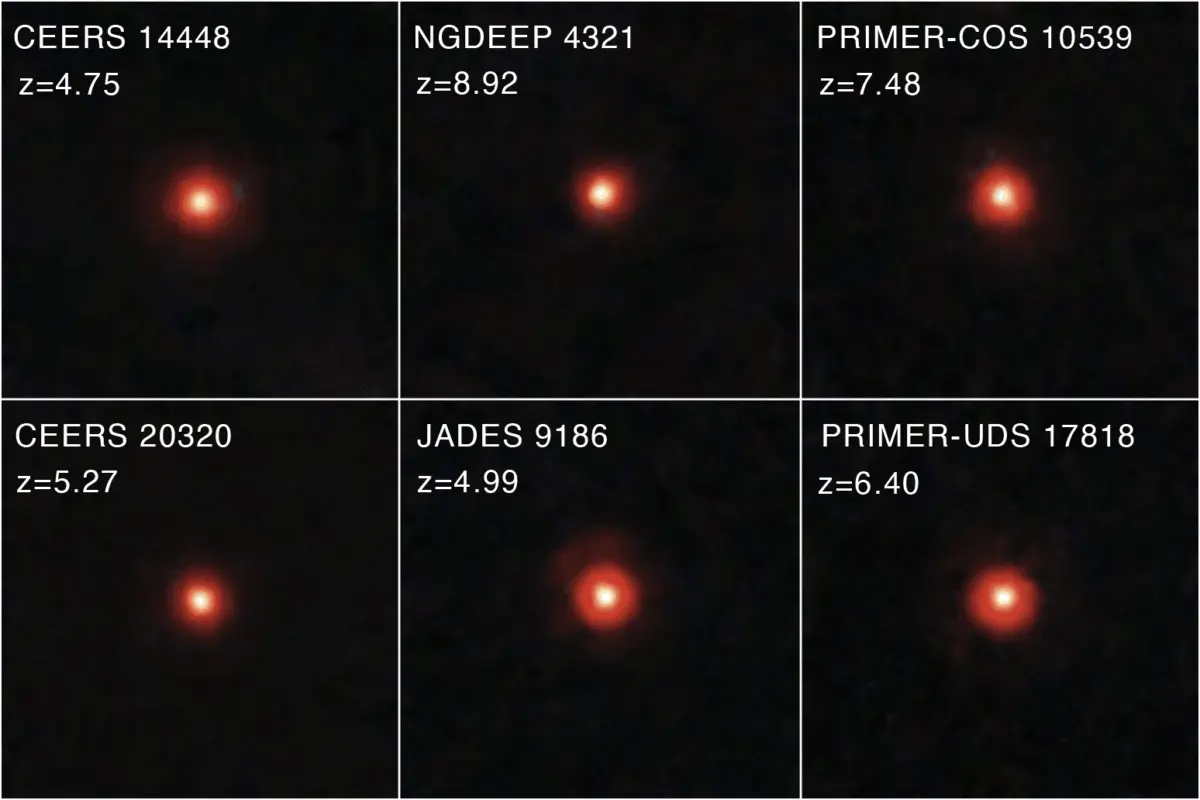
Since beginning its scientific operations, the James Webb Space Telescope has repeatedly stunned astronomers by peering deeper into the universe than any instrument before it. Among its most baffling and frequent discoveries are "little red dots"—compact, intensely crimson signatures scattered across the early universe. These objects refused to fit neatly into any existing categories of deep-space phenomena. They were too bright to be normal early galaxies, yet their spectral profiles defied conventional stellar classification.
In their search for answers, researchers targeted one of these anomalous red spots to perform deep spectroscopy, breaking down its emitted light into component wavelengths to read its chemical and physical signature. What they found was an object that initially appeared to be a gigantic, hyper-advanced star. However, closer inspection revealed anomalies that violated the known laws of stellar physics.
The Anatomy of MoM-BH*-1
Named *MoM-BH-1**, the observed phenomenon possesses physical traits that immediately flagged it as something entirely alien to modern astronomy:
- Energy Output Exceeding Nuclear Limits: The object emits roughly 100 billion times more energy than any standard star could possibly produce through nuclear fusion alone. For an object existing during the chaotic formative eras of the early universe, this luminosity is exceptionally anomalous.
- The Spectral Drop-Off: A portion of the object’s emitted light abruptly and catastrophically disappears. While normal stars can cause specific absorption lines when their outer atmospheres filter certain wavelengths of light, the intensity of this drop-off in MoM-BH*-1 is magnitudes too extreme to be explained by stellar atmospheric absorption.
- The Gas Cocoon Hypothesis: Researchers concluded that an immense, extraordinarily dense envelope of gas must be acting as a massive filter, absorbing specific high-energy light before it can escape into the wider expanse of space.
Synthesizing these clues, the research team arrived at the black hole star hypothesis. At the very center of MoM-BH*-1 sits a growing black hole actively devouring surrounding matter, converting gravitational potential energy into a torrent of radiation. Surrounding this gravitational abyss is a massive envelope of gas. As the titanic energy generated by the accretion disk pushes outward, it filters through this dense gas blanket. In the process, the radiation is modified, acquiring deceptive optical characteristics that trick distant observers into mistaking the entire system for starlight.
Supporting Context & Metrics: Challenging Standard Cosmology
The implications of MoM-BH*-1 stretch far beyond a single quirky celestial object. They directly address one of the most agonizing paradoxes currently plaguing modern astrophysics: the "impossibly early" supermassive black holes.

The Supermassive Black Hole Growth Problem
Standard astrophysical models dictate that black holes grow slowly over billions of years by consuming stars, gas, and merging with other black holes. However, the JWST has repeatedly found supermassive black holes containing the mass of billions of suns existing when the universe was only a few hundred million years old. Mathematically, under standard physics, there simply hasn’t been enough time since the Big Bang for these black holes to have grown this large through conventional feeding habits.
This is where the black hole star model offers a revolutionary lifeline. If primordial black holes formed inside massive, dense envelopes of gas early in cosmic history, they could feed at rates previously thought impossible, shielded and fueled by their stellar-sized gas cocoons.
| Metric / Parameter | Observable Data / Estimate | Significance |
|---|---|---|
| Cosmic Age at Emission | ~660 Million Years Post-Big Bang | Places the object firmly in the epoch of reionization and early structure formation. |
| Physical Size | Comparable to our Solar System | Demonstrates extreme spatial compaction relative to its phenomenal output. |
| Energy Luminosity | ~100 Billion Times Solar Output | Exceeds the maximum theoretical energy output of standard nuclear-fusion stars. |
| Spectral Feature | Extreme Light Absorption Drop-Off | Indicates the presence of a hyper-dense surrounding gas envelope. |
Exploring Alternative Hypotheses
Before converging on the black hole star theory, the scientific community weighed several alternative explanations for the JWST’s puzzling red spots:
- Compact Starburst Galaxies: Galaxies hyper-dense with newly formed, short-lived massive stars. While plausible for some regions, this fails to explain the extreme spectral absorption lines seen in MoM-BH*-1.
- Dust-Obscured Quasars: Traditional active galactic nuclei hidden behind thick veils of cosmic dust. However, the specific light signatures of the red spots do not entirely match typical low-redshift quasar templates.
- Exotic Dark Matter Interactions: Theoretical models involving novel particle physics, though these remain difficult to substantiate without further empirical data.
The black hole star hypothesis bridges the gap between active galactic nuclei and stellar systems, offering a unified physical framework that explains both the intense energy output and the deceptive optical signatures of these early cosmic anomalies.
Official Statements & Expert Perspectives
The publication of the paper in Nature has ignited intense debate and excitement across the global astronomical community. Researchers involved in the analysis emphasize that while the hypothesis is robustly supported by current JWST data, it represents entirely uncharted territory for theoretical physics.
"We are looking at a regime of the universe that we simply did not have the technological capability to probe until very recently," noted one of the lead researchers on the project. "What the James Webb Space Telescope is showing us is that the early universe was not just a scaled-down version of our current cosmos; it was a bizarre laboratory where physical processes operated on scales and with intensities that challenge our fundamental understanding of gravity, radiation, and matter."
Other astrophysicists have highlighted the musical coincidence of the discovery, noting the eerie cultural resonance between Soundgarden’s prophetic 1994 lyrics and the physical reality now being mapped out in peer-reviewed literature. While Chris Cornell’s lyrics were metaphorical—pleeease ("Black hole sun, won’t you come, and wash away the rain")—astrophysicists are now utilizing the phrase quite literally to describe objects where the boundaries between stars and black holes completely dissolve.
Independent astronomers not directly affiliated with the study have praised the rigorous spectral breakdown provided in the Nature paper. Commenting on the implications for galaxy evolution models, specialists point out that if black hole stars are common in the early universe, astronomers will need to rewrite simulations tracking how galaxies and their central black holes co-evolve.
Future Outlook: The Next Frontier in Observational Astronomy
The identification of MoM-BH*-1 is merely the opening salvo in what promises to be a multi-year campaign to decode the true nature of the early universe’s red spots. As the James Webb Space Telescope continues its mission, pointing its golden hexagonal mirrors deeper into the cosmic web, researchers are outlining the next crucial steps for validation and expansion:
- Expanded Spectroscopic Surveys: Astronomers plan to target dozens of other "little red dots" identified by the JWST to determine whether MoM-BH*-1 is a singular cosmic oddity or a widespread population of objects that dominated the universe during its first billion years.
- Advanced Computer Simulations: Theoretical physicists are already constructing high-resolution magnetohydrodynamic simulations to model how a black hole and a massive gas envelope can stably coexist at solar-system scales without immediately collapsing or blowing themselves apart.
- Synergy with Future Observatories: Researchers are looking ahead toward upcoming ground-based and space-based instruments—such as the Nancy Grace Roman Space Telescope and extremely large ground telescopes—that will be able to cross-reference JWST data with infrared and X-ray observations, searching for high-energy radiation leaking from beneath these gaseous disguises.
Conclusion
The discovery of the "black hole star" serves as a humbling reminder of how little we truly know about the vast, ancient machinery of the cosmos. As humanity peers further back toward the ignition point of the universe, the traditional boundaries separating distinct cosmic phenomena continue to blur. Whether viewed through the lens of visionary rock lyricists or cutting-edge space telescopes, the universe remains a place of profound mystery—proving once again that reality is often far stranger, and far more wondrous, than fiction.