Executive Overview
The automotive dashboard has officially transformed into the newest frontier for generative artificial intelligence. With the latest update to its iOS application, Anthropic has brought Claude—its flagship AI assistant—to Apple CarPlay. This integration makes Claude the fifth major third-party conversational AI chatbot to enter the CarPlay ecosystem, arriving hot on the heels of Meta AI’s rollout earlier in the week.
Anthropic’s entry marks a significant milestone. As one of the last major holdouts among premier AI labs to secure a spot on Apple’s in-car interface, Claude’s integration underscores a broader industry shift: drivers no longer want to rely solely on legacy voice assistants like traditional Siri for complex in-cabin queries. Instead, they increasingly demand access to advanced Large Language Models (LLMs) capable of deep contextual reasoning, hands-free brainstorming, and seamless multi-turn dialogue while behind the wheel.
This rapid expansion of third-party AI tools inside vehicles is unfolding against the backdrop of Apple’s own sweeping platform evolutions. Ever since Apple introduced native support for conversational and category-specific apps in CarPlay via iOS 26.4, software developers have raced to adapt their architectures for the dash. Now, as the tech giant prepares for the official public rollout of iOS 27—which brings next-generation Siri AI features deeply embedded into the operating system—the aftermarket and native app landscape for drivers is more competitive, and crowded, than ever before.
Detailed Chronology: The Race to the Dashboard
The race to integrate generative AI into Apple CarPlay has accelerated at a dizzying pace throughout 2026. What was once a strictly curated, media-and-navigation-focused dashboard environment has rapidly morphed into a sandbox for conversational intelligence.

The Foundation: iOS 26.4 Opens the Gates
The groundwork for this vehicular AI revolution was laid quietly with the release of iOS 26.4. Prior to this software iteration, Apple maintained rigid restrictions on the types of applications permitted to interface with CarPlay, largely limiting third-party software to audio streaming, messaging, navigation, and EV charging tools.
With iOS 26.4, Apple introduced explicit, system-level support for conversational apps. This category update specifically paved the way for AI chatbots to tap into CarPlay’s audio output, microphone routing, and simplified, driver-optimized user interfaces. Developers immediately recognized the potential of capturing an entirely new segment of daily-commuter attention, transforming hours spent in traffic into productive or exploratory touchpoints with their favorite AI models.
A Flurry of Competitors: ChatGPT, Perplexity, and Grok
As soon as the regulatory hurdles cleared, the artificial intelligence sector rushed to stake its claim. OpenAI’s ChatGPT was among the first to market, followed quickly by Perplexity and xAI’s Grok. These early entries established the standard UI paradigms for conversational AI on the road: large, distraction-minimized touch targets, simple voice activation prompts, and chronological lists of recent queries that could be resumed or reviewed safely.
However, the real momentum intensified in the late summer of 2026. Just days before Claude’s debut, Meta AI officially joined the CarPlay ecosystem, signaling that social and multi-modal ecosystem giants were eager to compete directly with foundational model developers on the dashboard. Meta’s inclusion left Anthropic as the most notable prominent holdout among the industry’s tier-one AI heavyweights—a status that changed abruptly with the rollout of the latest iPhone app update.
Claude Steps Into the Car
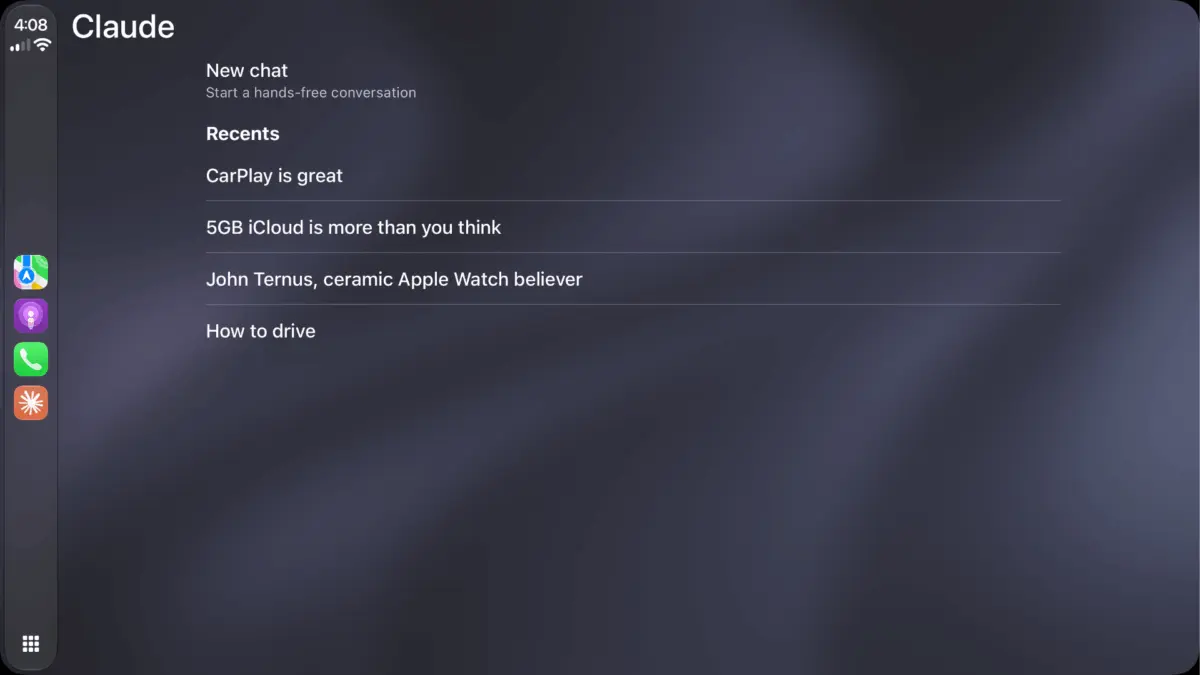
According to reports originating from early testers and tech publications like MacRumors, the latest version of the Claude iPhone app brings native, fully integrated CarPlay support.
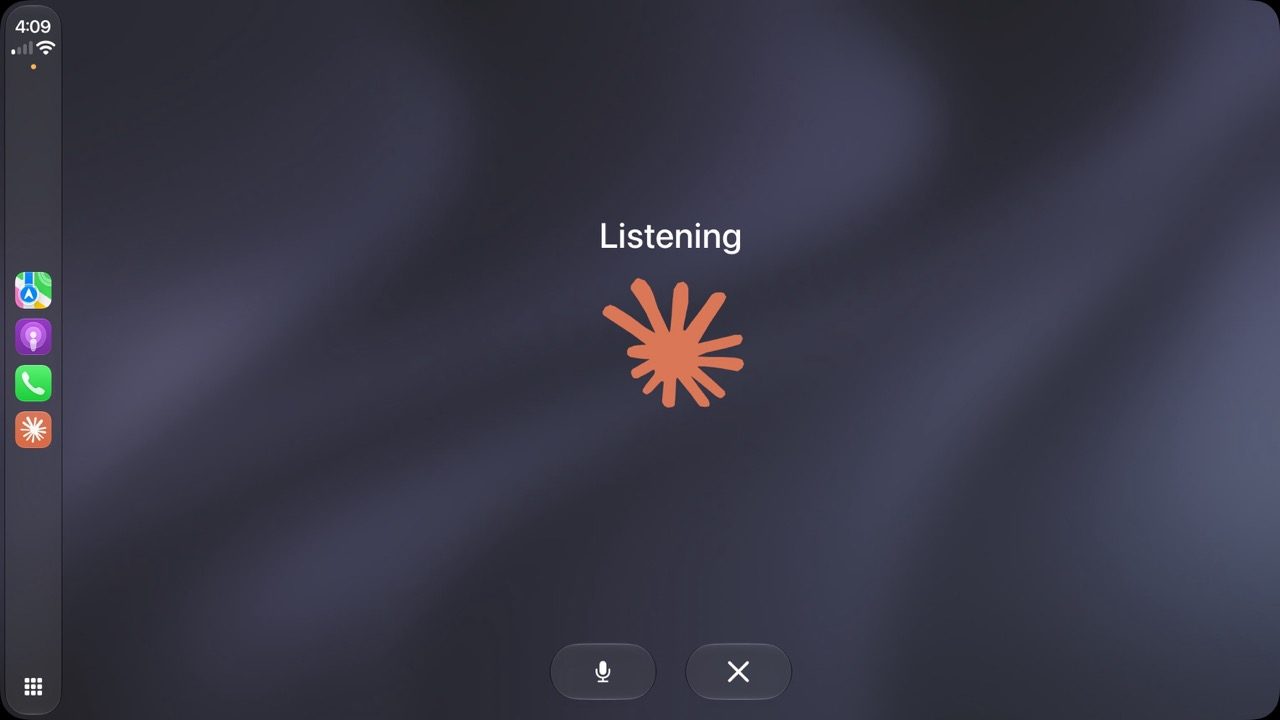
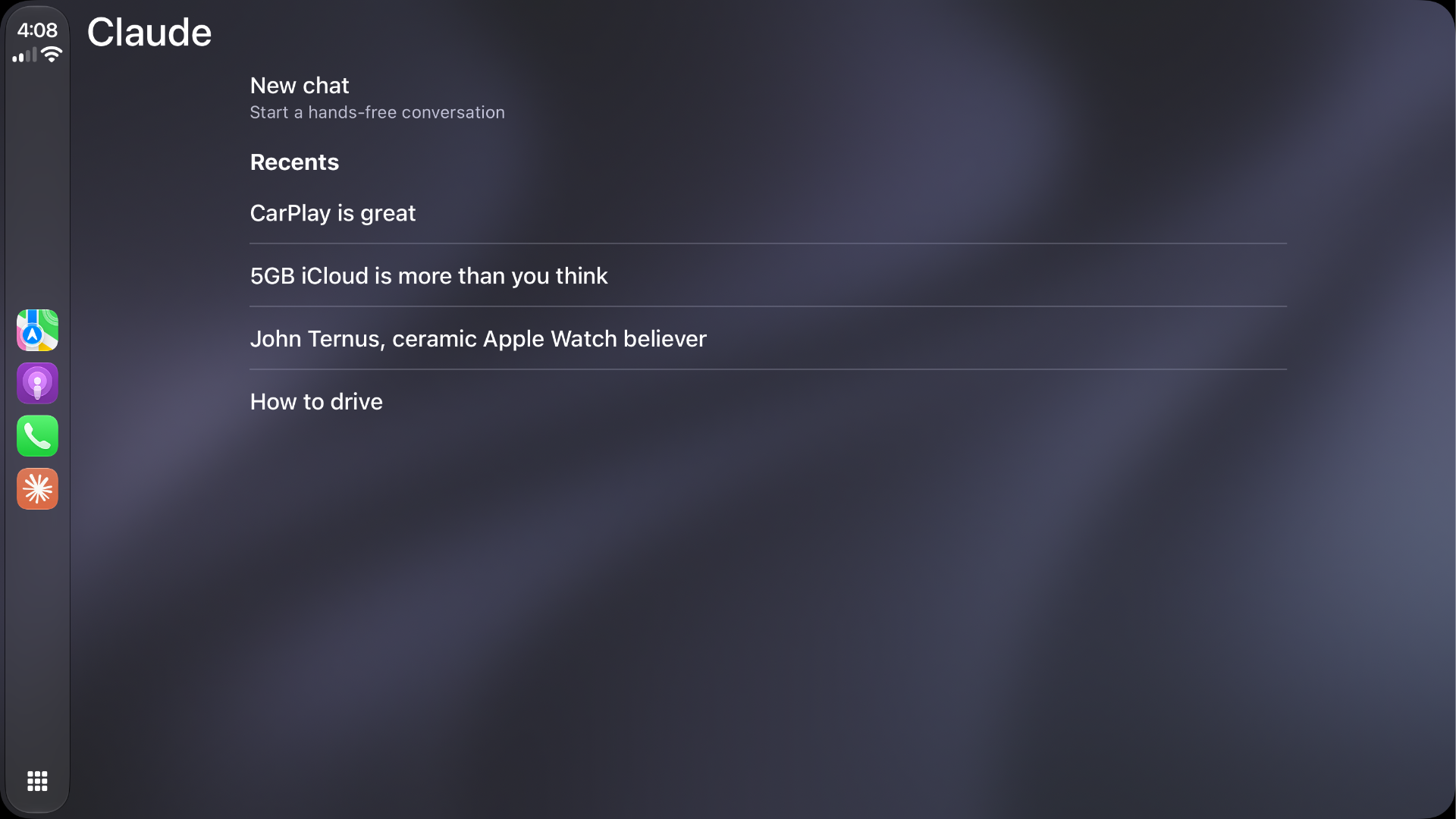
When users connect their iPhones to a CarPlay-enabled head unit and launch Claude, the interface greets them with a clean, driver-safe layout. The application displays a chronological list of recent chat sessions, allowing drivers to quickly tap and resume complex threads initiated earlier on their desktop or mobile devices. Alternatively, drivers can leverage Claude’s advanced voice function to spin up entirely new, hands-free conversational queries. Whether drafting an email template mentally during a morning commute, brainstorming outline ideas for a meeting, or solving complex logic puzzles, drivers now have Anthropic’s safety-tuned reasoning engine directly at their fingertips—or, more accurately, at the tip of their tongue.
Supporting Context & Metrics: The Shift in In-Car UX
To fully understand the significance of Claude’s arrival on CarPlay, one must examine the broader evolution of In-Vehicle Infotainment (IVI) systems and the shifting expectations of modern consumers.
The Consumer Demand for Contextual AI
Historically, in-car voice assistants were notorious for their rigidity. Systems built into vehicles—and even early iterations of smartphone-tethered assistants like Siri and Google Assistant—relied heavily on strict syntactic triggers. Saying the wrong phrase or stumbling over a command would result in a frustrating "I didn’t catch that" loop, forcing drivers to look away from the road and interact dangerously with physical touchscreens.
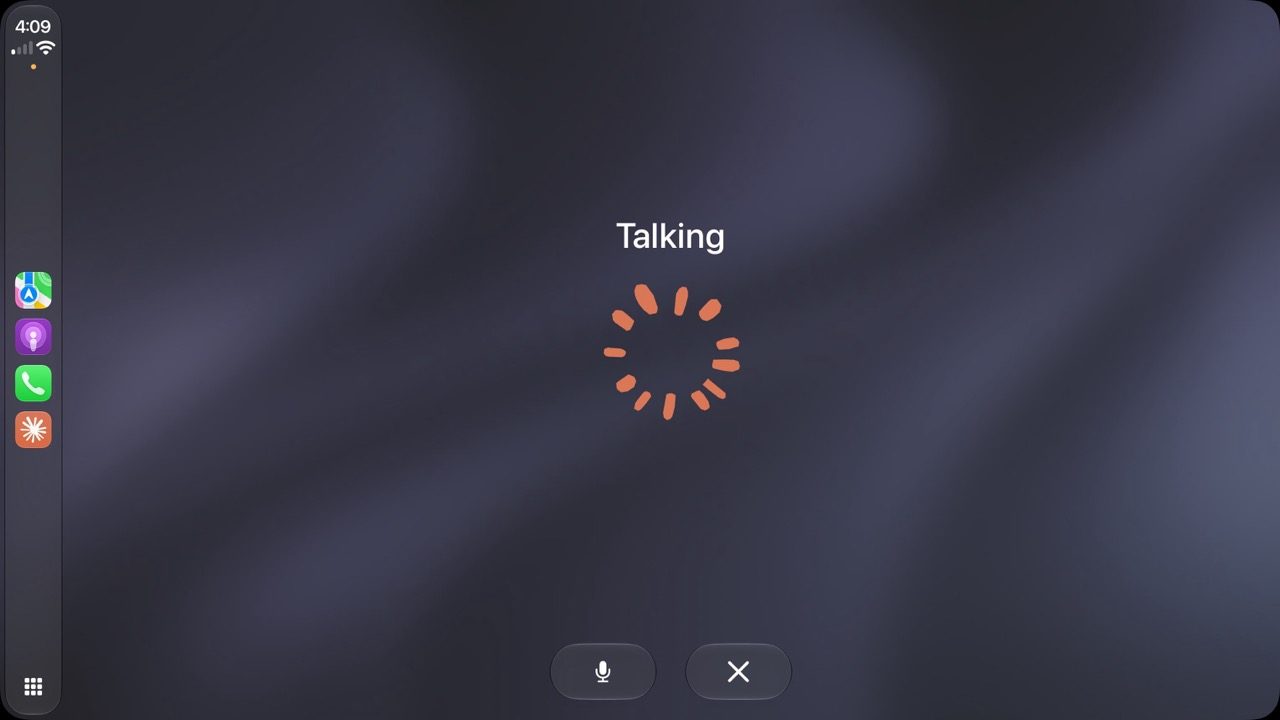
Generative AI models have fundamentally disrupted this paradigm. By leveraging advanced natural language processing (NLP), models like Claude, ChatGPT, and Meta AI can interpret colloquial, unstructured human speech. If a driver muses aloud, "I need to figure out a polite way to tell my client that the project timeline has shifted by three days because of supply chain delays," a legacy assistant would fail entirely. In contrast, an LLM-powered CarPlay app can synthesize a polished, professional response in seconds, reading it aloud and allowing the driver to iterate through voice commands safely.
The CarPlay Ecosystem Landscape
To contextualize Claude’s integration, consider the current roster of conversational AI applications officially supported on Apple CarPlay:
- ChatGPT (OpenAI): The pioneer of the current wave, offering robust multi-turn voice and text history integration.
- Perplexity: Focused on real-time conversational search, ideal for drivers looking up trivia, news updates, or localized information on the fly.
- Grok (xAI): Bringing real-time data integration and a distinct conversational style to the dashboard.
- Meta AI: Offering broad multimodal integration and deep ties into social and consumer utility features.
- Claude (Anthropic): The new entrant, prized for its advanced coding, nuanced writing, rigorous safety guardrails, and deeply analytical reasoning capabilities.
- Siri AI (Apple): The native system-level intelligence debuting widely with iOS 27.
The Hardware and Software Synergy
CarPlay is no longer merely a secondary screen mirroring a phone; it has become an extension of the user’s entire digital life. With millions of vehicles worldwide featuring wired or wireless CarPlay connectivity, app developers view the dashboard as prime digital real estate. However, developing for CarPlay requires strict adherence to Apple’s Human Interface Guidelines (HIG) regarding driver distraction. Applications must minimize cognitive load, eliminate complex visual reading tasks while the vehicle is in motion, and rely heavily on audio-first interactions. Anthropic’s implementation successfully navigates these constraints, presenting minimal text lists while prioritizing its high-fidelity voice chat capabilities.
Official Statements & Industry Perspectives
While Anthropic has historically maintained a product-focused, understated approach to software rollouts, industry analysts and platform watchers have been vocal about the strategic implications of these recent developments.
In discussions surrounding the iOS 26.4 API updates, developers noted that Apple’s decision to open CarPlay to conversational apps was a calculated move to prevent third-party AI stagnation. Rather than attempting to block competing models from entering its ecosystem, Apple has instead chosen to foster an open environment—even as it prepares to launch its own heavily integrated Siri AI suite with iOS 27.
Industry analysts point out that this dual approach benefits consumers immensely. "Apple knows it cannot build a one-size-fits-all AI assistant that satisfies every specialized professional or creative workflow," noted one prominent automotive tech researcher. "By allowing companies like Anthropic, OpenAI, and Meta to build native CarPlay apps, Apple ensures that its platform remains the ultimate hub for digital consumers, regardless of which underlying AI model they prefer for their daily tasks."
Furthermore, safety advocates have closely monitored the influx of generative AI into the cabin. While conversational interfaces are vastly safer than manually typing on a smartphone screen, researchers emphasize that cognitive distraction remains a critical concern. Anthropic’s emphasis on voice-first interaction design—modeled closely after its advanced audio conversation features—is seen as a positive step toward mitigating screen-based distraction, though experts continue to urge drivers to use discretion when engaging with complex reasoning tasks behind the wheel.
Future Outlook: The Road Ahead for In-Car AI
As we look toward the remainder of the decade, the integration of Claude into Apple CarPlay is merely a stepping stone toward a deeply integrated, highly autonomous driving and cabin experience.

The iOS 27 Paradigm Shift
The immediate horizon is dominated by the impending public release of iOS 27. Currently cycling through its final beta phases ahead of its official launch this month, iOS 27 introduces systemic AI capabilities across the entire iPhone and CarPlay ecosystem via the long-awaited rollout of Siri AI.
How third-party apps like Claude will coexist with deeply integrated native system intelligence remains one of the most compelling questions in mobile software development. Will users predominantly lean on Siri for deep iOS integration (controlling vehicle climate, checking local fuel prices, sending native text messages), while invoking Claude or ChatGPT for specialized tasks like creative writing, code review, or deep-dive brainstorming? Early indications suggest a hybrid future, where specialized apps serve as modular tools accessible via the CarPlay dashboard alongside system-level assistants.
The Next Frontier: Vehicle Hardware Integration
Looking further ahead, the boundary between smartphone-tethered interfaces like CarPlay and native vehicle operating systems is beginning to blur. As automotive manufacturers increasingly adopt Android Automotive OS or build proprietary Linux-based systems, Apple is pushing hard with its next-generation CarPlay initiative—designed to take over every screen in the vehicle, from the central infotainment cluster to the digital instrument gauge behind the steering wheel.
Within this hyper-advanced vehicular architecture, the presence of models like Claude will likely expand beyond simple conversational audio apps. Future iterations could see AI assistants deeply integrated with vehicle telemetry, diagnosing check-engine lights in plain English, analyzing real-time route efficiency based on driving style, or managing cabin comfort dynamically through natural conversation.

Conclusion
Anthropic’s integration of Claude into Apple CarPlay represents more than just a routine software update; it is a testament to the inexorable march of generative artificial intelligence into every facet of modern life. As drivers embark on their daily commutes, they now do so with some of the world’s most advanced intellectual engines riding shotgun. Whether navigating city traffic or mapping out a complex creative project from the driver’s seat, the modern vehicle has officially become an intelligent, connected extension of the digital mind.