August 2024 Viral Phenomenon Analysis
By Staff Internet Culture & Technology Correspondent
Executive Overview
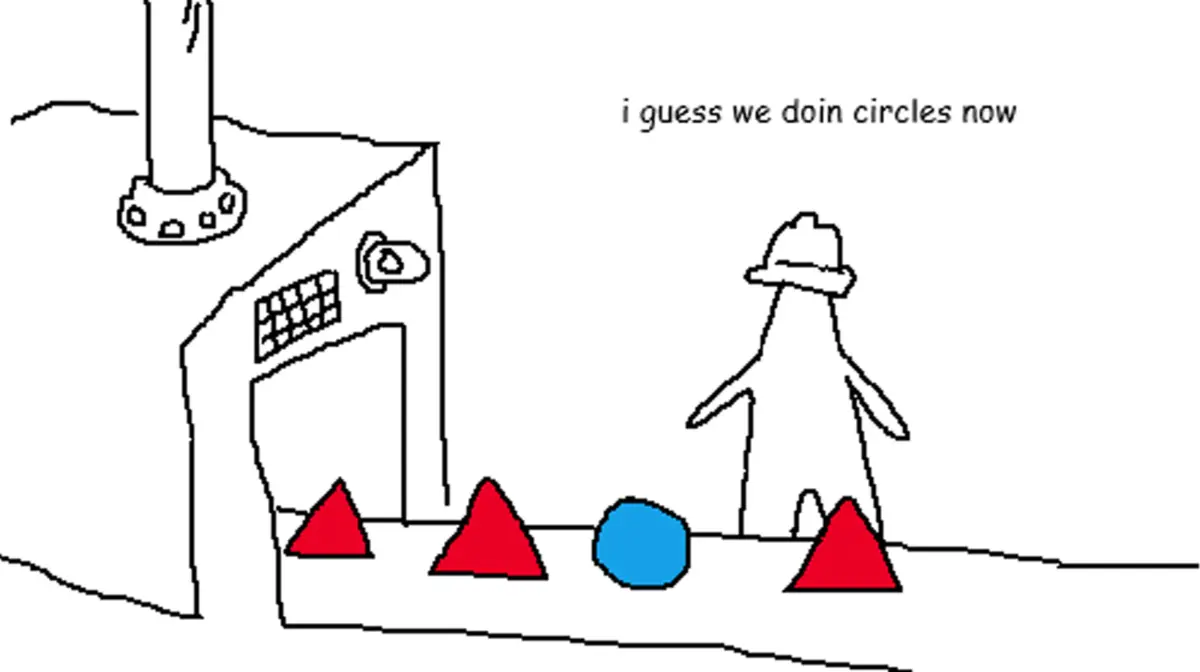
In the vast, unpredictable landscape of internet meme culture, viral phenomena often emerge from the most mundane of conceptual foundations. In August 2024, a modest two-panel MS Paint webcomic posted to Twitter (rebranded as X) by user @MeatMarket__ unlocked a profound, collective cultural nerve. Titled colloquially by the internet as "A Circle?? In the Triangle Factory??" or "I Guess We Doin Circles Now," the cartoon depicts two factory workers experiencing a dramatic paradigm shift on an assembly line: a blue circle unexpectedly rolls down a conveyor belt designed strictly for red triangles.
The first worker reacts with Victorian-esque melodrama, picking up the anomaly and declaring, "A circle?? In the triangle factory?? How queer!! I’ve never seen such a thing—I must inquire about this further with my supervisor post-haste!" The second worker, standing beside him with glazed eyes and profound burnout, merely stares at the shape and remarks, "I guess we doin circles now."
Far from remaining a passing novelty, this simple juxtaposition of institutional anxiety versus radical workplace apathy exploded into a massive, multi-tiered exploitable meme. Within weeks, the internet transformed the "Triangle Factory" into an expansive corporate lore machine. It morphed from a niche webcomic into a universal corporate satire, utilized by video game fandoms, tech subcultures, and everyday workers to lampoon unpredictable corporate pivots, brand identity crises, and the crushing weight of modern professional alienation.
This retrospective examines the rapid genesis, structural mechanics, viral proliferation, and cultural staying power of the "Triangle Factory" meme, charting its rise from a single sketch to a defining digital artifact of 2024 labor sentiment.
Detailed Chronology: From MS Paint Sketch to Global Trend
Phase 1: The Spark (August 16, 2024)
The phenomenon began on August 16, 2024, when X user @MeatMarket__ uploaded a rudimentary, hand-drawn MS Paint comic. Framed around the simple question, "Which one are you?", the comic contrasted two archetypal responses to systemic disruption:
- The Over-Invested Bureaucrat: The worker who treats minor procedural anomalies as world-shattering ontological emergencies, driven by a misplaced sense of duty to corporate protocol.
- The Resigned Realist: The worker who has suffered too many unannounced corporate restructurings to care, capturing the essence of millennial and Gen Z burnout through the deadpan phrase, "I guess we doin circles now."
The original tweet struck an immediate chord, capturing over 246,000 likes in its first three days online. The phrasing and stark, unpolished visual style acted as a blank canvas for an internet hungry for ways to articulate systemic absurdity.
Phase 2: Immediate Proliferation and Voiceovers (August 16–17, 2024)
Within hours of the initial post, the creator economy of X sprang into action. Users did not merely retweet the image; they brought the characters to life. On August 16th, user @SuzySnoozie posted a theatrical voiceover of the comic, which quickly accumulated over 21,000 likes.
Simultaneously, the exploitable format took off. Creators began altering the dialogue, introducing mid-level management figures into the narrative. On August 17th, user @girlmeat5557 shared an iteration featuring a bespectacled manager informing the exhausted worker, "Management says we have to start making circles," yielding over 100,000 likes in under 48 hours. The lore was actively building itself: the factory was no longer just a static setting; it was a crumbling enterprise grappling with supply-chain anomalies.
Phase 3: Escalation of Lore and Shape Expansion (August 18, 2024)
As the meme entered its first full weekend, digital artists pushed the narrative boundaries of the factory setting. On August 18th, user @Scooblee1 introduced a chaotic plot twist: a green square emerging from the "circle maker" conveyor belt, provoking the exhausted worker to utter a bewildered "man what the f—."
This sparked an arms race of surreal escalation. Later that same day, user @TheAll3ycat posted an iteration featuring a factory safety board reading "DAYS WITHOUT [Green Square Symbol]: 0," framing the introduction of new geometric entities as recurring workplace hazards. By the end of the weekend, the meme had successfully migrated off X, capturing significant engagement via reposts on Instagram meme pages and Reddit subcommunities like r/me_irl and r/okbuddyretard.
Phase 4: Corporate Satire and Brand Integration (Late August 2024)
By the final week of August 2024, the abstract geometry of triangles and circles evolved into direct corporate commentary. Fandoms and consumers began substituting the geometric shapes for real-world products manufactured by historically unpredictable or wildly diversified conglomerates.

A watershed moment occurred on August 23rd when X user @Brownie_Fury targeted the multinational manufacturing giant Yamaha. In the re-skinned comic, the factory worker watches in real-time as pianos, golf carts, and outboard marine motors tumble down the assembly line, culminating in the cry of pure exhaustion: "i hate this fucking company." The post garnered over 213,000 likes in four days.
Soon after, Facebook user Dz Penalber applied a similar lens to General Electric (GE), shifting the worker’s tone to ironic adoration ("Man I love this company"). From video game developers changing core gameplay loops to industrial manufacturers pivoting business models, the "Triangle Factory" became the definitive shorthand for the modern corporate pivot.
Supporting Context & Metrics: Decoding the Appeal
To understand why a stick-figure comic about shapes generated millions of impressions, one must analyze the cultural intersection of labor psychology, digital semiotics, and contemporary meme architecture.
The Psychology of Modern Workforce Apathy
The dynamic between the two workers mirrors psychological responses to organizational change management. Modern corporate structures are notorious for frequent, top-down pivots—often referred to as reorganizations, agile transformations, or strategic realignments—that frequently disrupt daily operations.
- The "How Queer" Archetype: Represents the legacy employee, middle manager, or corporate loyalist who still believes that rules, standard operating procedures, and institutional hierarchies matter. Their panic is inherently comedic because seasoned workers know that leadership rarely provides logical explanations for sudden shifts.
- The "I Guess We Doin Circles Now" Archetype: Represents the modern laborer’s ultimate coping mechanism: radical detachment. Faced with systemic demands that make zero operational sense (such as producing circles in a facility built explicitly for triangles), the worker drops all resistance. There is no energy left to fight management; there is only passive acceptance of the absurd.
Quantitative Impact Metrics
While exact platform-wide impressions are difficult to aggregate due to cross-platform sharing, baseline metrics from primary source posts demonstrate unprecedented velocity:
- Original Post (@MeatMarket__): ~246,000+ likes (August 2024).
- Management Intervention Variant (@girlmeat5557): ~100,000+ likes within 48 hours.
- Yamaha Conglomerate Variant (@Brownie_Fury): ~213,000 likes over a four-day span.
- Global Reach: Replication across X, TikTok (via voiceovers and animated renditions), Instagram Reels, and dedicated Reddit threads.
Sociological & Industry Implications
The cultural resonance of the "Triangle Factory" meme extends far beyond fleeting internet humor; it serves as a fascinating mirror of contemporary labor relations and brand perception.
1. The Democratization of Industrial Critique
Historically, labor satire took the form of editorial cartoons, satirical films (such as Charlie Chaplin’s Modern Times), or classic literature. Today, digital natives utilize rapid-fire MS Paint exploitables to voice identical anxieties regarding alienation, automation, and capricious executive oversight. The factory floor has become a universal metaphor for any white-collar office, retail floor, or tech startup experiencing chaotic shifts in business strategy.
2. Corporate Complicity and the Meme Economy
Unlike brands that aggressively protect their intellectual property or issue cease-and-desist letters, the beauty of the "Triangle Factory" lies in its decentralized, open-source nature. Because the template is purposefully crude, it invites iteration rather than passive consumption. Brands themselves occasionally navigate these waters cautiously, though the meme’s underlying sentiment—that modern companies frequently pivot blindly without infrastructural support—keeps corporate marketing departments largely on the sidelines, watching consumers affectionately roast conglomerate diversification.
Future Outlook: The Legacy of the Shape Factory
As the digital ecosystem continues its relentless churn, internet memes frequently burn bright before fading into obscurity. However, certain formats achieve structural permanence, embedding themselves into the vernacular of internet users for years to come.
The "Triangle Factory" format possesses several qualities ensuring its long-term viability:
- Infinite Scalability: The template can adapt to any industry—be it software development, automotive manufacturing, media streaming, or higher education. Wherever sudden, unexplained pivots occur, the shape factory remains relevant.
- Linguistic Versatility: The phrase "I guess we doin [X] now" has entered everyday internet slang as a flexible reaction to unexpected news, cultural shifts, or awkward lifestyle adjustments.
Ultimately, the meme endures because it offers a comforting, shared laugh in the face of modern confusion. Whether facing a new corporate software rollout, an unexpected career pivot, or the introduction of a "green square" into daily routines, the digital citizenry has found its universal mantra. When the systems around us cease to make logical sense, we do not panic; we simply sigh, look down the conveyor belt, and accept the new reality: I guess we doin circles now.