Executive Overview
Cloud computing has always been defined by velocity, scale, and a relentless drive toward modernization. However, behind the massive global infrastructure of Amazon Web Services (AWS)—spanning tens of thousands of corporate servers, millions of enterprise workloads, and complex architectures—lies a vital human element: the developer. On July 9, 2025, AWS launched an ambitious initiative designed specifically for this global community of developers, architects, and technologists: the AWS Builder Center.
One year later, the platform has evolved from a nascent community hub into an expansive, feature-rich ecosystem. What began as a centralized space featuring basic Wishlist voting, user community profiles, and a developer toolbox has matured into an all-encompassing technical environment. Today, the Builder Center boasts integrated sandbox environments, interactive technical workshops, community-created "Spaces," and a comprehensive Builders’ Library.
To mark this milestone, AWS leadership published a series of retrospective analyses and detailed feature timelines. Notably, Rick Suttles released an exhaustive feature timeline chronicling the steady stream of updates shipped over the past twelve months. Concurrently, AWS Chief Evangelist Jeff Barr published a holistic retrospective highlighting the platform’s exponential growth, exceptional engagement metrics, and community milestones.
Among the wave of celebratory announcements, the most significant technical release of the anniversary week is the introduction of Sandbox Environments. This capability fundamentally lowers the barrier to entry for hands-on cloud education, offering developers friction-free, temporary AWS accounts to test, learn, and experiment. As the AWS Builder Center steps into its second year, it stands as a testament to how modern cloud providers can successfully nurture, educate, and empower their most valuable asset: the builder.
Detailed Chronology: A Year of Rapid Evolution
To understand the current maturity of the AWS Builder Center, one must examine its evolutionary trajectory over the past year. The platform’s journey from a bare-bones community experiment to a polished technical ecosystem was driven by an aggressive release cadence.
The Foundation (July 2025)
When the Builder Center officially went live on July 9, 2025, its immediate goal was to establish a centralized digital living room for AWS enthusiasts. It launched with core collaborative features:
- Wishlist Voting: Allowing users to submit, discuss, and vote on feature requests.
- Community Profiles: Enabling developers to showcase their expertise, contributions, and certifications.
- The Developer Toolbox: A curated set of utilities designed to streamline cloud workflows.
Mid-Term Expansion and Gamification (Late 2025 – Early 2026)
As the user base expanded into the hundreds of thousands, AWS introduced structural enhancements to encourage deeper engagement and organization. The platform rolled out Spaces, empowering community members to spin up hyper-focused interest groups and collaborative sub-communities.
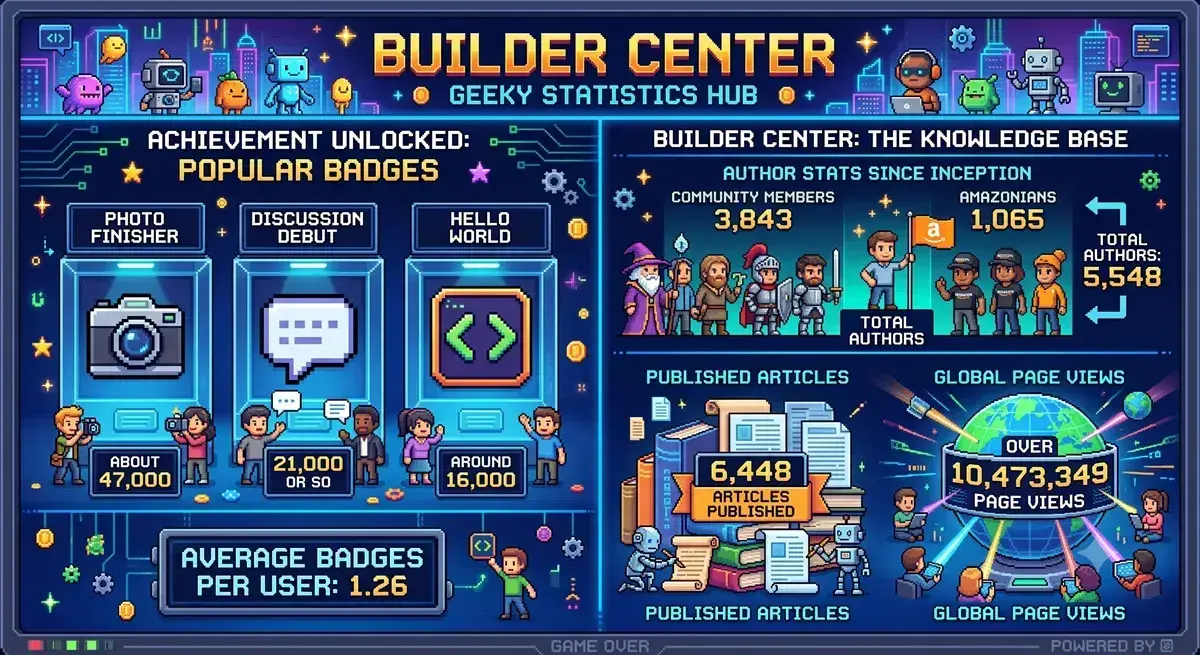
To drive user participation and reward continuous learning, AWS introduced a Badge and Streak system in March 2026. This gamification layer quickly transformed passive readers into active contributors, rewarding consistent publishing, workshop completion, and community engagement. Furthermore, the platform integrated advanced content management tools, including article series, view-count tracking, saved item bookmarking, and dedicated student status verifications to support academic cloud learners.
The Anniversary Peak (July 2026)
Marking its one-year anniversary, the platform reached a new technical peak. The feature timeline published by Rick Suttles cataloged a staggering array of platform capabilities. Among them, the AWS Capabilities by Region tracker emerged as an indispensable utility, indexing over 1,500 distinct AWS services distributed across 37 global Regions.
Additionally, the platform expanded its educational infrastructure by launching workshops equipped with granular category and complexity filters. Availability notifications, flexible sign-in options supporting both GitHub and Amazon credentials, and the flagship Sandbox Environments rounded out a landmark anniversary week.
Supporting Context & Metrics: Measuring Impact Through Data
In the world of cloud architecture, metrics matter. Jeff Barr’s one-year retrospective provided a transparent, data-driven look at how the global developer community has embraced the AWS Builder Center since its inception. The numbers paint a picture of an intensely active, highly engaged technical ecosystem.
Content Creation and Reach
- 5,548 Authors: Over five thousand unique technical writers have shared their expertise on the platform.
- 6,448 Published Articles: A vast library of tutorials, migration guides, and architectural deep-dives has been generated by the community.
- 10.4 Million Page Views: Collective readership across all published content has crossed the ten-million mark, demonstrating the platform’s immense utility as an educational resource.
Gamification and Community Governance
- 99,226 Badges Earned: Since the official rollout of the badge and streak system in March 2026, nearly 100,000 digital credentials have been claimed by active learners and contributors.
- 565 Community Wishes Submitted: The Wishlist voting system has proven to be an effective bridge between product engineering and end-users. Out of 565 submitted feature requests, 10 have already been fully shipped, with another 20 firmly placed on the near-term product roadmap.
Standout Community Contributions
The democratization of publishing on the Builder Center has given rise to extraordinary technical writing. Three standout articles dominated the platform’s readership metrics over the past year, reflecting the diverse interests of modern cloud engineers:
- "Building an AWS Study Buddy with MCP + Strands Agents SDK"
Authored by Dineshraj Dhanapathy, this article captured the imagination of the AI-forward developer community, rocketing past 50,000 views. The piece details how to integrate cutting-edge machine learning frameworks and model context protocols to build interactive, cloud-native educational assistants. - "Migrating an EOL Linux Server to AWS in 8 Hours with Kiro"
Written by Chris Miller, this pragmatic, high-urgency migration guide pulled in over 45,000 views. Addressing a universal enterprise pain point—migrating end-of-life operating systems under tight deadlines—Miller provided a masterclass in operational efficiency. - "AIdeas: NeuroVoice – Multimodal AI for Early Screening of Neurological Diseases"
Pushing the boundaries of cloud computing into healthcare technology, Yash Aggarwal’s article amassed over 38,000 views. The piece explores how multimodal artificial intelligence models can be deployed on AWS infrastructure to assist in the early detection of complex neurological conditions.
Official Statements and Architectural Breakthroughs: Sandbox Environments
The centerpiece of the one-year anniversary announcements is the introduction of Sandbox Environments, detailed by Rick Suttles. For years, one of the most persistent friction points in cloud education has been the barrier to hands-on experimentation. Traditional cloud tutorials require learners to configure personal billing accounts, enter credit card details, carefully monitor resource costs to avoid accidental charges, and meticulously clean up resources post-workshop.
Sandbox Environments on the AWS Builder Center eliminate these barriers entirely.

How Sandboxes Work
- Frictionless Provisioning: When a user launches a sandbox to complete a workshop exercise, the platform automatically provisions a free, fully functional AWS account on-demand.
- Zero Financial Risk: Because the accounts are managed and temporary, developers do not need personal AWS accounts, credit cards, or billing setups.
- Automated Lifecycle Management: Each sandbox environment remains active for a strict duration of 8 hours. Once this window closes, the account and all associated provisioned resources are automatically de-provisioned and wiped clean, ensuring zero residual cost or security exposure.
- Controlled Access: To ensure equitable access across the global community, users can maintain one active sandbox at a time, with a provisioning quota of one sandbox per week.
By removing financial anxiety and administrative overhead, AWS has effectively democratized advanced cloud training. Developers can now dive straight into complex, multi-tier architectural exercises without hesitation.
Future Outlook: The Next Horizon for AWS Builders
As the AWS Builder Center transitions from its inaugural year into its sophomore phase, the roadmap ahead is clear. The platform has successfully proven that developers crave more than just documentation; they want community, recognition, frictionless testing environments, and a direct voice in product development.
The integration of 20 pending Wishlist items into the near-term roadmap indicates that AWS is actively listening to its user base. Furthermore, the continued expansion of the Builders’ Library, localized community Spaces, and specialized regional capability trackers suggests that the platform will only grow more sophisticated.
For the individual builder, the Builder Center represents a unique professional nexus. It is simultaneously a publishing house for cloud thought leadership, an interactive classroom equipped with instant sandboxes, and a collaborative forum where developers from every corner of the globe can solve complex infrastructure challenges together.
As Esra Kaya Bali noted in her reflective sign-off celebrating the community’s summer rhythm—balancing building, learning, and recharging—the AWS Builder Center provides the ideal digital workshop for those who refuse to stop inventing. Whether migrating legacy Linux servers, building multimodal AI healthcare applications, or experimenting within a zero-risk 8-hour sandbox, builders now have a permanent home designed to scale right alongside their ambitions.