Executive Overview
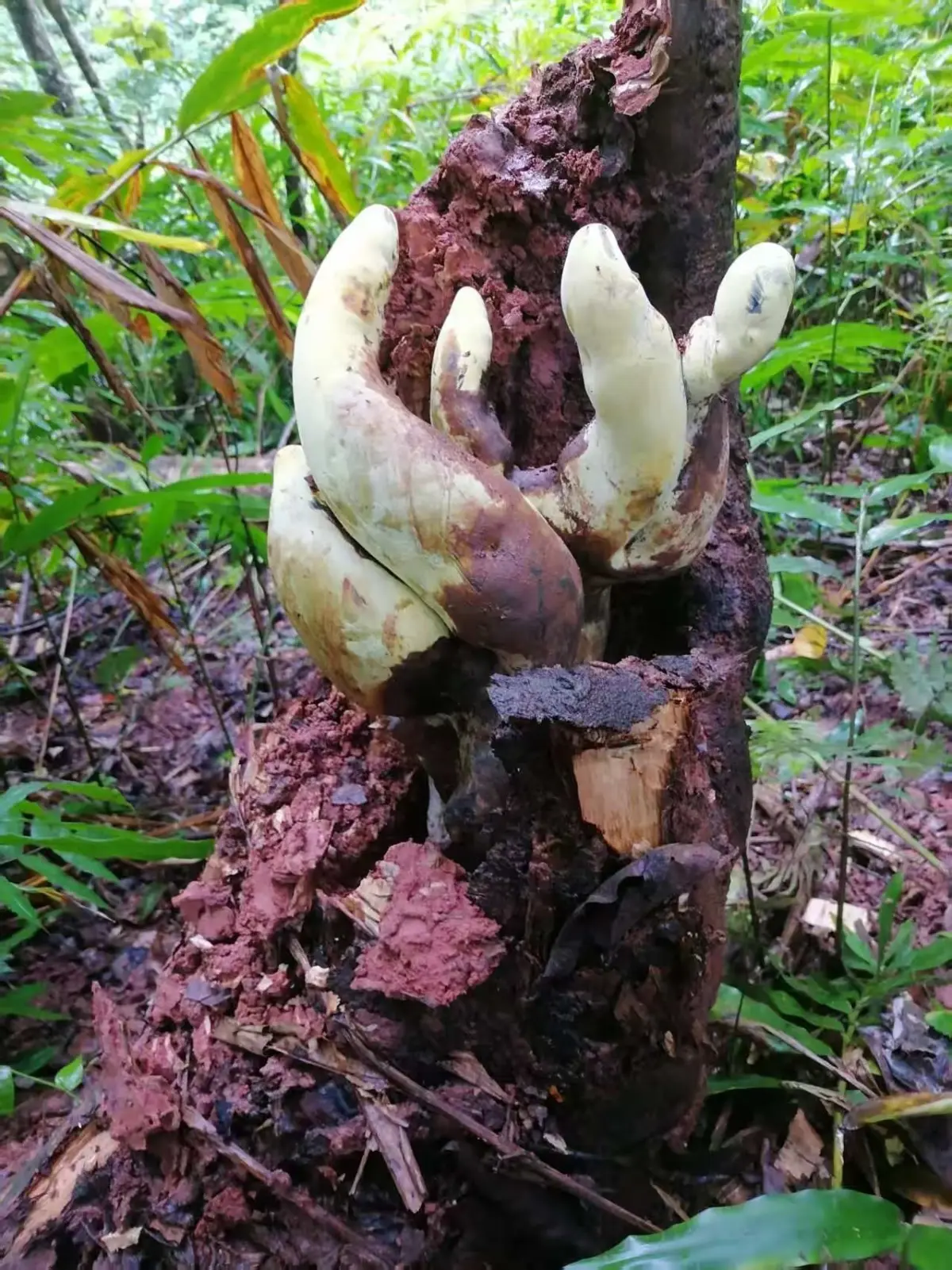
Deep within the biodiversity-rich expanse of China’s Yunnan Province, researchers have uncovered a monumental and entirely unprecedented addition to the global fungal taxonomy. Eschewing the conventional micro-scaling associated with many newly identified organisms, this botanical oddity demands attention through sheer physical presence. Shaped strikingly like a massive hand emerging directly from the forest floor, the organism has been formally christened Dianjunus rex.
Described in a landmark study by a research team from the Kunming Institute of Botany—operating under the umbrella of the prestigious Chinese Academy of Sciences—D. rex represents far more than a physical anomaly. It constitutes an entirely new biological family within the Ascomycetes, the largest phylum in the fungal kingdom, which already counts more than 64,000 documented species. Standing up to 20 inches tall and weighing nearly 5 pounds, the fungus produces some of the largest, most massive fruiting bodies ever recorded for its taxonomic class.
Yet, the significance of D. rex extends far beyond its monumental proportions. Through advanced genomic sequencing and molecular clock analysis, scientists have traced the evolutionary lineage of this titan back approximately 65 million years. This places its genetic divergence squarely at the boundary of the Cretaceous period—the exact geological epoch marked by the catastrophic mass extinction event that wiped out the dinosaurs.
By challenging existing assumptions regarding fungal genetics, evolution, and ecological survival strategies, D. rex opens a transformative window into the deep history of life on Earth and underscores just how little humanity truly understands about the subterranean and forest ecosystems of East Asia.
Detailed Chronology
To understand the magnitude of the Dianjunus rex discovery, one must retrace the meticulous, multi-phase scientific expedition undertaken by mycologists in southwestern China.
The Expedition into the Nanban Rainforest
The journey began during routine field surveys conducted by a team led by Indunil C. Senanayake, an associate professor at the Kunming Institute of Botany. Venturing deep into the Nanban tropical rainforest—a region renowned for its dense canopy, high humidity, and staggering biological richness—the researchers encountered anomalous structures erupting from the soil.
Rather than standard mushroom caps and stems, these organisms manifested as massive, whitish fruiting bodies clustered near the root systems of decaying trees. Over the course of their field investigations, the team cataloged specimens exhibiting a diverse array of structural configurations, ranging from cylinders and spindles to cupped, palm-like shapes. As these organisms matured, they developed distinct, finger-like branches, presenting a bizarre visual silhouette reminiscent of a skeletal hand breaking through the earth.
Initial Physical and Morphological Analysis
Upon transporting the collected specimens back to the laboratory, the research team documented their physical properties with rigorous precision. Upon exposure to indoor air conditions, the fruiting bodies dried out with remarkable rapidity. Internal examinations revealed a dense, sponge-like interior varying in hue from stark white to pale yellow, entirely devoid of any strong or distinctive odor or taste—a stark contrast to culinary fungi, though researchers were quick to caution against amateur culinary experimentation.
Macroscopically, the above-ground portions of the fruiting bodies were found to be blanketed in a fine, white, powdery layer of fibers. As the fungi aged and matured, these fibers underwent a dramatic chromatic shift, turning a deep dark yellow. Conversely, the subterranean portions of the organism—those anchored directly within the soil—remained smooth and pitch black, highlighting a clear morphological division optimized for both underground survival and above-ground reproduction.
Genomic Sequencing and the Molecular Clock
The true scientific breakthrough, however, occurred at the microscopic and molecular levels. By sequencing the DNA of D. rex, the team constructed a "molecular clock"—a sophisticated computational model that measures the accumulation of genetic mutations over time to estimate when species diverged from a common ancestor.
The results were astonishing. The molecular clock data indicated that D. rex split from its nearest known evolutionary relatives approximately 65 million years ago. This temporal benchmark coincides precisely with the Cretaceous-Paleogene (K-Pg) extinction event—the cataclysmic asteroid impact and subsequent environmental collapse that eradicated roughly 75 percent of all plant and animal species on Earth, including non-avian dinosaurs. While T. rex and D. rex never shared a contemporaneous moment in Earth’s history, the environmental aftermath of the disaster created an unprecedented ecological landscape, setting the stage for the rise of specialized decomposers.
Supporting Context & Metrics
The discovery of Dianjunus rex forces a sweeping re-evaluation of fungal evolution, genetics, and the hidden mechanics of tropical forest ecosystems. To contextualize this finding, scientists must look closely at the unique biological framework of Ascomycetes and the geographic treasure trove that is Yunnan Province.
The Ascomycete Megaclass
Unlike Basidiomycetes—the phylum that encompasses most familiar grocery-store mushrooms featuring distinct caps, gills, and centralized stems—Ascomycetes utilize a fundamentally different reproductive strategy. They do not form traditional caps. Instead, they generate complex structures known as fruiting bodies (or ascocarps) designed to forcibly eject or release microscopic spores into the atmosphere.
While the Ascomycete phylum is staggeringly large, housing over 64,000 cataloged species ranging from microscopic yeasts to cup fungi and truffles, none approach the sheer structural mass and volume exhibited by Dianjunus rex. Growing up to 20 inches in height and approaching the 5-pound mark, D. rex stands as an absolute outlier in its phylum, pushing the physical limits of how large an Ascomycete fruiting body can grow without a traditional woody or fibrous support stem.
The Genetic Paradox of D. rex
Perhaps the most perplexing mystery surrounding D. rex lies within its genome. When the research team performed genomic analyses to understand how the fungus processes organic material, they expected to find a robust arsenal of genes dedicated to decomposition. After all, large fruiting bodies require immense amounts of cellular building blocks and energy, which are typically sourced by breaking down complex plant polymers like cellulose and lignin.
To the scientists’ profound surprise, D. rex possesses only about half the number of decomposition-related genes found in its closest known relatives that similarly feed on dead plant matter. This genomic deficit creates an apparent biological contradiction: how can an organism with a reduced suite of decaying genes fuel the massive energetic expenditures required to construct a 20-inch, 5-pound fruiting body?
Lead researcher Indunil C. Senanayake has proposed a compelling hypothesis to resolve this paradox. Although field samples were discovered exclusively in proximity to dying and decaying trees, Senanayake suggests that D. rex may live a "double life." The fungus could potentially exist as an endophytic or symbiotic organism—living quietly and harmlessly inside healthy, living trees for the majority of its life cycle. Once the host tree begins to die or succumb to environmental stress, the fungus may shift its metabolic strategy, rapidly capitalizing on the dying tissues to amass the massive surplus of energy required for its spectacular above-ground reproductive explosion.
Spore Dispersal and the Cost of Size
Building a structure of such monumental proportions is an evolutionary gamble that requires a high return on investment. In the dense, humid understory of a tropical rainforest, releasing microscopic spores close to the ground can render reproduction inefficient, as falling leaves, dense undergrowth, and lack of adequate air currents can trap spores locally.
By towering above surrounding plants and fallen debris, the massive fruiting bodies of D. rex gain a distinct aerodynamic advantage. This elevated positioning facilitates wind-mediated spore dispersal, allowing the organism’s genetic material to travel greater distances across the forest floor. However, because such an architectural undertaking demands a massive energy investment, evolutionary biologists emphasize that this strategy would only evolve in environments where the long-term reproductive benefits vastly outweighed the high metabolic costs of construction.
Yunnan: A Global Biodiversity Hotspot
The emergence of D. rex also shines a spotlight on the extraordinary ecological richness of Yunnan Province. While mycologists have already documented an impressive 6,000 distinct fungal species within the region’s varied microclimates, experts estimate that this number barely scratches the surface. Given the province’s complex topography, ranging from tropical lowlands to alpine forests, researchers believe that Yunnan could easily harbor upwards of 100,000 fungal species waiting to be discovered, cataloged, and understood.
Official Statements
The unveiling of Dianjunus rex has generated considerable excitement within the international scientific community, prompting formal statements from the lead researchers and institutional bodies involved in the discovery.
In an official press release issued by the Kunming Institute of Botany, lead author Indunil C. Senanayake emphasized the broader implications of the finding for global biodiversity research:
"The discovery illustrates how much fungus biodiversity remains to be discovered in East Asian forests," Senanayake stated. He noted that the identification of an entirely new biological family—possessing no known close living relatives—highlights the profound gaps that still persist in modern taxonomic catalogs, even in regions subjected to extensive scientific survey work.
Reflecting on the evolutionary timeline uncovered by the team’s molecular clock analysis, Senanayake pointed out the resilience and adaptability of fungi across geological epochs:
"Large quantities of dead plant material became available following the K-Pg mass extinction event, which could have provided unprecedented ecological opportunities for fungi and other organisms capable of decomposing such matter. Yet, the unique genomic profile of D. rex suggests that these organisms have evolved sophisticated, highly specialized survival strategies that go far beyond simple saprophytic consumption."
Furthermore, institutional representatives from the Chinese Academy of Sciences highlighted the critical need for continued habitat preservation in regions like the Nanban tropical rainforest. As climate change, habitat fragmentation, and human encroachment threaten delicate tropical ecosystems, undiscovered lineages like D. rex face the risk of extinction before science even registers their existence.
Future Outlook
The formal classification of Dianjunus rex marks the end of an intensive multi-year investigative study, but it simultaneously opens an expansive new chapter in mycological research. The discovery poses profound questions that will drive scientific inquiry for years to come.
Unlocking the "Double Life" Hypothesis
The primary objective for Senanayake and his colleagues moving forward is to rigorously test the hypothesis that D. rex leads a dual existence as both an endophyte in living trees and a decomposer in dying wood. Future research will involve long-term field monitoring of healthy forest trees in the Nanban rainforest, coupled with targeted tissue sampling and environmental DNA (eDNA) metabarcoding. By tracking the presence of D. rex genetic signatures within living plant tissues, researchers hope to definitively map the organism’s full lifecycle and metabolic transitions.
Broadening the Search for Relatives
Because D. rex currently stands alone as the sole representative of an entirely new biological family, mycologists are eager to determine whether it is an evolutionary relic—a sole survivor of an ancient lineage—or if it has undiscovered contemporary relatives hiding in other tropical and subtropical regions of East and Southeast Asia. Expeditions are currently being planned to survey neighboring forest reserves in Yunnan and adjacent countries to search for morphological or genetic lookalikes.
Conservation Implications
Ultimately, the discovery of D. rex serves as a stark reminder of the fragile, interconnected nature of ancient forest ecosystems. Fungi play indispensable roles as nutrient cyclers, carbon sinks, and ecological stabilizers, yet they remain severely underrepresented in global conservation policies. As researchers continue to peel back the layers of Yunnan’s subterranean biodiversity, organisms like Dianjunus rex stand as monumental testaments to the resilience of life on Earth—and a compelling call to protect the remaining wild canopies that shelter them.