Executive Overview
In an aggressive push to anchor its ecosystem within the future of digital medicine, Apple has officially unveiled a groundbreaking research study aimed at decoding how everyday consumers interact with artificial intelligence in healthcare. Developed in tandem with OpenEvidence—a premier clinical AI platform trusted by medical professionals and powered by peer-reviewed literature from publications like The New England Journal of Medicine—the initiative introduces a dedicated research application designed to gather critical qualitative and quantitative data.
At its core, the project seeks to understand how AI tools can be made more effective, user-friendly, and actionable for the general public. Apple is aiming to recruit up to 200,000 participants across the United States. To facilitate this massive undertaking, the company has released a specialized companion app on the App Store, inviting eligible iPhone users to pose health-related queries, review AI-generated responses, and actively rate their accuracy and utility.
Crucially, this research arrives at a pivotal juncture in the consumer technology landscape. While generative AI tools have proliferated rapidly, their application in high-stakes fields like medicine remains fraught with challenges, ranging from hallucinated facts to overly dense medical jargon. By pairing its robust hardware ecosystem with OpenEvidence’s clinically grounded data models, Apple is attempting to bridge the gap between complex medical science and consumer-accessible insights.
Furthermore, the tech giant is emphasizing strict data privacy and regulatory prudence. Apple has explicitly stated that the research app operates independently of Siri and Apple Intelligence, and that participant data will remain confidential, shielded from being repurposed to train foundational AI models. As digital health continues to evolve, this initiative could fundamentally redefine how individuals navigate their personal wellness journeys using artificial intelligence.
Detailed Chronology and Technical Framework
The rollout of the Health AI Usage Study represents months of quiet infrastructure development within Apple’s health and engineering divisions. While rumors of deeper clinical integrations have swirled for years, this study marks one of Apple’s most transparent, large-scale consumer research deployments to date.
The Mechanics of the Study
The initiative revolves around a newly launched, specialized application currently available on the iOS App Store. To ensure the integrity of the data collected, Apple has established strict eligibility criteria for potential participants:
- Age and Location: Participants must reside within the United States and be at least 21 years of age.
- Hardware Requirements: Given the intensive processing demands and advanced software environment required for secure, high-end data handling, participants must own an iPhone 15 Pro or a later model.
- Software Prerequisites: Devices must be running advanced software environments, specifically iOS 26 and up, ensuring compatibility with Apple’s latest security protocols and user-interface paradigms.
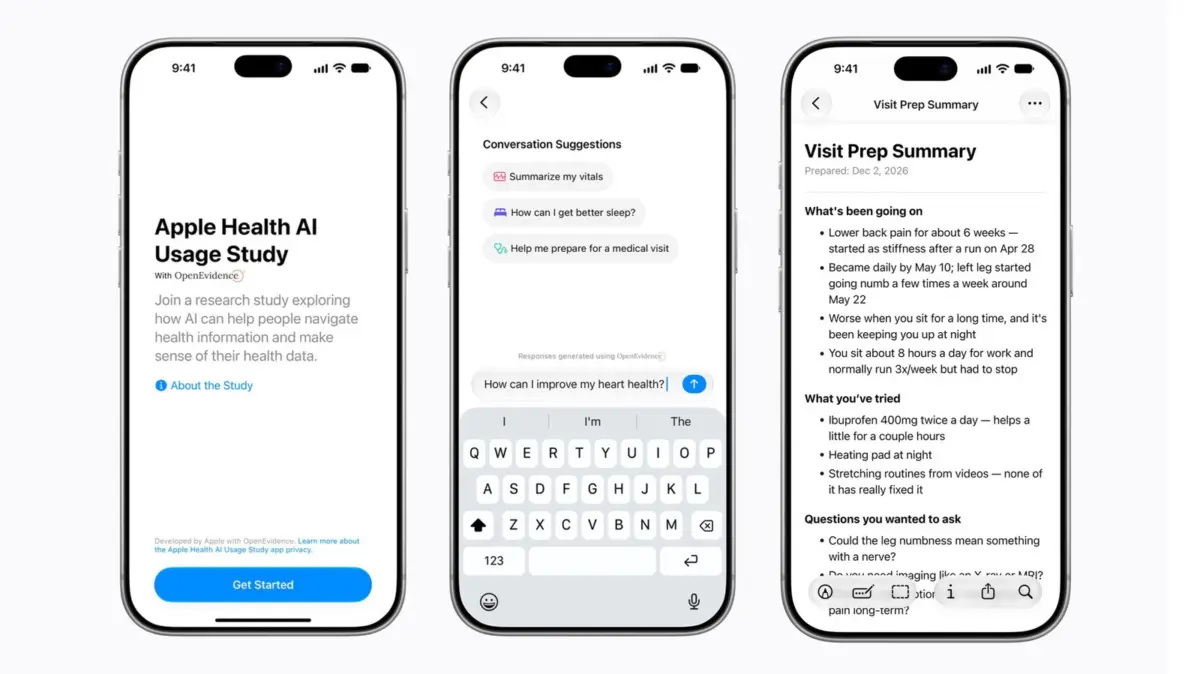
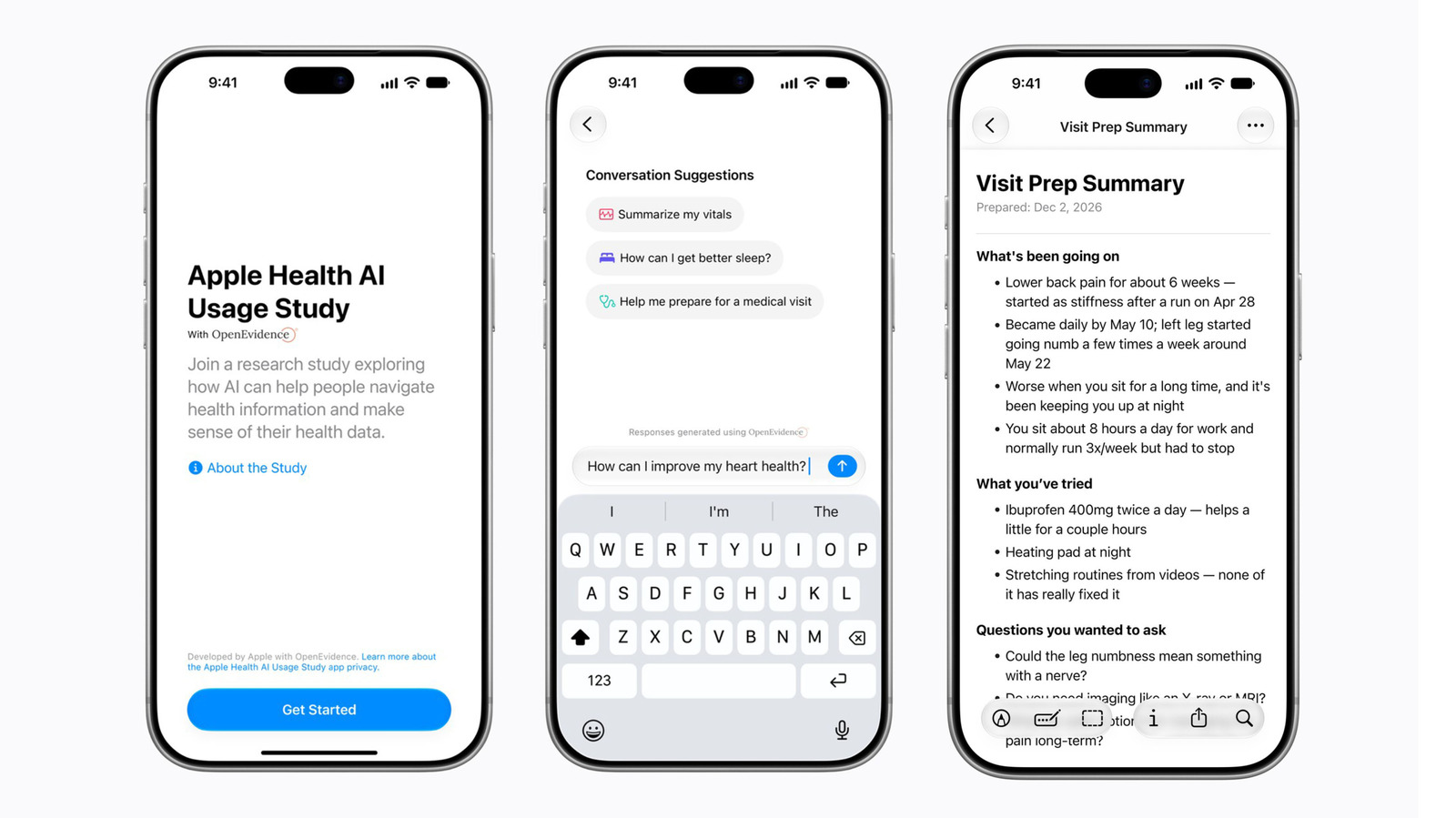
Once onboarded, participants are introduced to a text-based interface where they can input natural-language medical questions. Screenshots provided by Apple indicate prompt structures such as, "How can I improve my heart health?" or inquiries regarding specific lifestyle modifications and symptom management.
Integrating HealthKit for Context
One of the study’s most innovative features is its optional integration with Apple HealthKit. Participants can choose whether to grant the research app access to their historical and real-time health metrics. This includes:
- Activity Levels: Daily step counts, active energy burned, and exercise minutes.
- Sleep Quality: Comprehensive sleep stage tracking, duration metrics, and consistency indicators.
- Lab Results: Digitized clinical blood panels and diagnostic test results securely stored within the Health app.
By feeding these contextual data points into the research framework, the study aims to determine whether AI tools can provide more personalized, context-aware responses when paired with a user’s actual physiological baseline. Rather than offering generic, one-size-fits-all medical advice, the system strives to ground its feedback in the user’s specific physical reality.
The Response Pipeline
When a user submits a query through the app, the system generates a response designed to bypass medical obfuscation. Instead of overwhelming the user with clinical jargon, the AI provides straightforward, digestible explanations. Crucially, every response is accompanied by direct links to peer-reviewed clinical sources and medical literature curated through OpenEvidence.
Users are then prompted to rate the response. These ratings—measuring clarity, perceived usefulness, and overall satisfaction—form the backbone of the dataset that Apple and its clinical partners will analyze to refine future health-focused AI iterations.
Supporting Context & Metrics: The Intersection of AI and Consumer Health
To fully grasp the magnitude of Apple’s latest initiative, one must examine the broader landscape of digital health and the persistent hurdles facing artificial intelligence in clinical environments.
The Promise and Pitfalls of Conversational AI in Medicine
Over the past three years, large language models (LLMs) have demonstrated an uncanny ability to pass medical board examinations and summarize complex scientific papers. However, translating these capabilities into consumer-facing tools has proven notoriously difficult. Common pitfalls include:
- Hallucinations: AI models occasionally invent plausible-sounding medical facts, drug interactions, or treatment protocols, posing severe risks to consumer safety.
- The "Jargon Barrier": Traditional medical literature is written by clinicians, for clinicians. Raw AI outputs often fail to translate clinical probability into actionable, empathetic advice for laypeople.
- Lack of Personal Context: A generic answer to "What is a normal blood pressure?" is vastly different for an elite 22-year-old marathon runner versus a sedentary 65-year-old managing hypertension.
OpenEvidence: A Clinically Grounded Partner
By partnering with OpenEvidence, Apple is attempting to mitigate these systemic risks. Unlike standard consumer chatbots that pull information from unverified corners of the open internet, OpenEvidence is specifically architected for clinical validation. It draws its data exclusively from high-grade medical journals, peer-reviewed studies, and established clinical guidelines.
This grounding ensures that the foundational information feeding the study’s responses is anchored in evidence-based medicine rather than speculative online forums or poorly sourced blog posts.
Scalability and Sample Size
Apple’s target of 200,000 participants is exceptionally ambitious for a clinical and behavioral research study of this nature. Historically, medical studies involving continuous digital tracking and qualitative surveys struggle with high attrition rates. By leveraging the seamless onboarding mechanisms of the iOS ecosystem—combined with the immense installed base of iPhone 15 Pro and newer devices—Apple is uniquely positioned to achieve statistical significance at a scale that traditional academic medical centers could take decades to replicate.
The demographic diversity and sheer volume of interactions generated by 200,000 users will provide researchers with an unprecedented dataset detailing how diverse populations seek, interpret, and act upon medical information.
Official Statements and Industry Perspective
Apple executives have been careful to frame the study not as a commercial product launch, but as a foundational scientific endeavor aimed at establishing long-term trust and clinical rigor.
“[We] believe responsible innovation starts with scientific rigor and clinical grounding,” stated Dr. Sumbul Desai, Apple’s Vice President of Health and fitness, in an official company statement. “Insights from this study will help advance the broader scientific conversation and ensure that as technology evolves, we continue building trusted tools that genuinely support people wherever they are on their health journey.”
Dr. Desai’s remarks underscore a critical strategic pivot for Silicon Valley tech giants. As regulatory scrutiny over health data privacy intensifies globally—particularly in regions like the European Union and under evolving Federal Trade Commission (FTC) guidelines in the United States—technology companies are finding it increasingly necessary to anchor their consumer features in verifiable scientific methodologies.
The Privacy Firewall
Recognizing the deep consumer anxiety surrounding the intersection of artificial intelligence and sensitive health data, Apple has taken aggressive steps to firewall participant information.
- No Siri or Apple Intelligence Integration: Apple has explicitly confirmed that the research app operates entirely outside the boundaries of Siri and the broader Apple Intelligence ecosystem. It is a standalone, purpose-built sandbox for research.
- Strict Confidentiality Guarantees: Participant data will not be commercialized, shared with unauthorized third parties, or—most importantly—used to train broader foundational AI models.
- Data Minimization: While users can opt to share HealthKit data for enhanced context, the choice remains entirely voluntary, reinforcing Apple’s long-standing marketing narrative that "privacy is a fundamental human right."
Future Outlook: Where Consumer Health Technology is Headed
The Health AI Usage Study is much more than a short-term data-gathering exercise; it is a crystal ball reflecting the future trajectory of personal technology and preventative medicine.
1. The Shift Toward Proactive, Contextual Healthcare
For decades, consumer health technology has been largely reactive or observational. Devices like the Apple Watch have excelled at tracking metrics—heart rates, blood oxygen levels, electrocardiograms, and sleep cycles—and alerting users when anomalies occur. However, the interpretation of those metrics has traditionally been left to the user, often resulting in unnecessary anxiety ("cyberchondria") or delayed medical consultations.
By integrating conversational, clinically grounded AI tools that understand a user’s specific HealthKit history, the future of the iPhone ecosystem points toward contextual synthesis. Imagine a near-future scenario where your device not only detects an unusual dip in your physical recovery and sleep metrics but can also engage in a nuanced, validated dialogue to help you prepare actionable questions for your primary care physician.
2. Regulatory Compliance and Clinical Validation
As AI tools creep closer to diagnosing and treating medical conditions, regulatory bodies such as the U.S. Food and Drug Administration (FDA) are tightening their oversight. By collaborating with platforms like OpenEvidence and conducting massive, transparent institutional studies, Apple is proactively building a compliance buffer. Demonstrating that consumer AI tools can be evaluated, rated, and safely navigated by everyday users provides a formidable blueprint for future regulatory clearance.
3. Redefining Patient-Doctor Dynamics
Ultimately, the proliferation of AI in health is not designed to replace the clinician, but to reshape the patient-doctor relationship. When patients arrive at a medical appointment armed with clear, peer-reviewed insights rather than speculative internet searches, the nature of clinical consultations changes dramatically. Physicians can spend less time debunking misinformation and more time co-creating personalized care plans with well-informed patients.
Conclusion
Apple’s new Health AI Usage Study marks a watershed moment for digital wellness. By acknowledging the current limitations of generative AI in medicine—and systematically working to solve them through rigorous clinical partnerships, strict privacy safeguards, and massive user participation—Apple is laying the groundwork for a safer, smarter, and infinitely more accessible healthcare future. As the first wave of participants begins downloading the app and testing its capabilities, the tech industry will be watching closely to see how effectively Silicon Valley can marry technological innovation with medical science.