For the past decade, the prevailing gospel of modern software startups went something like this: build a remarkable product, publish it to the internet, and let the code speak for itself. In this idealized, product-led growth (PLG) utopia, marketing departments could essentially be reduced to an active founder Twitter account, and traditional sales teams were viewed as an archaic relic of enterprise software’s past—something companies resorted to only when their products weren’t good enough to sell themselves.
That narrative, however, is undergoing a profound and public reckoning.
Recently, Replit founder and CEO Amjad Masad shared a confession that is quietly echoing through boardrooms across Silicon Valley: "I thought I hated sales culture. By the end of this year, more than half my company will be salespeople."
Masad’s realization is far from an isolated incident. Across the B2B software landscape—from legacy tech giants to the newest wave of artificial intelligence darlings—a hard truth is setting in: while self-serve funnels and freemium models can launch a company into orbit, gravity eventually takes over. Eventually, almost everyone adds a sales team.
Executive Overview: The Great B2B Realignment
The tension between product-led purism and enterprise sales necessity has defined the trajectory of modern SaaS. Founders, particularly technical leaders rooted in engineering, frequently enter the market with a visceral aversion to "sales culture." They view outbound pipelines, cold calling, and commission structures as "icky" or counterintuitive to pure product innovation.
Yet, market dynamics rarely care about philosophical preferences. When organic adoption reaches a critical threshold—spurred by employees bringing tools into legacy enterprises—the demand structure changes. Procurement departments appear. Security reviews are mandated. Multi-tiered legal terms require negotiation.
As prominent venture investor Jason Lemkin points out, skipping the sales team often means merely deferring it. Companies may scale to $50 million, $100 million, or even $500 million in Annual Recurring Revenue (ARR) before finally building out a formal sales organization, but the wall is coming.
This article explores the mechanics of this inevitable transition, examining how historical giants like Slack and Yammer navigated the shift, how today’s AI wave is rewriting the playbook, and why postponing the inevitable often creates a steeper mountain to climb.
Detailed Chronology: From Accidental Inbound to Engineered Outbound
1. The Threshold Ladder: Then and Now
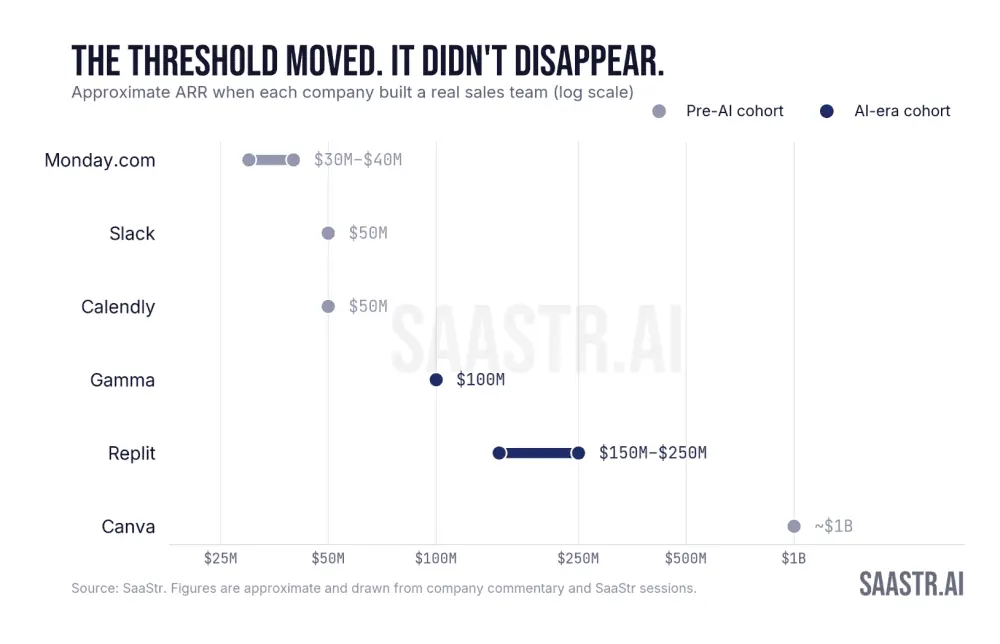
In the pre-AI era of SaaS, companies like Twilio, Slack, Box, Stripe, and Canva rode bottom-up adoption waves to impressive heights before introducing formal sales structures. The threshold where a company typically hit the "sales wall" hovered around $30M to $50M in ARR.
In the current ecosystem, driven by rapid AI deployment and hyper-efficient self-serve loops, that threshold has roughly tripled. Companies like Gamma and Lovable have scaled to staggering heights—with Gamma hitting $100M ARR and Lovable touching $400M ARR—with shockingly lean internal headcounts and heavily automated funnels.
Yet, even for these AI-native poster children, the wall has not disappeared; it has simply moved north of $100M ARR. The demand absorbed when these companies finally staff up is massive, representing months or years of pent-up enterprise friction.
2. The First Sales Team Wears a Different Title
The genesis of a sales organization almost never arrives with an official announcement. Instead, it creeps in through the back door.
At the inaugural SaaStr Annual in February 2015, Slack was sitting at roughly $30M ARR without having hired a single traditional sales rep. When asked if a company could reach $100M without a sales team, then-CEO Stewart Butterfield famously explained that Slack utilized "account managers" rather than outbound sales reps. Their primary job wasn’t aggressive pitching; it was "midwifing the sale"—navigating vendor review processes, security policy analysts, and corporate legal teams for buyers who had already decided they wanted the product. There were no commissions, and no outbound prospecting.

Fast forward to Replit in 2026, and the story rhymes perfectly. Inbound enterprise emails began flooding in, asking how to properly procure and license the software across entire organizations. A single employee was left handling these complex conversations on top of three other jobs.
Whether you call them account managers, customer success liaisons, or "midwives of the sale," the reality remains uniform: enterprise procurement on the back of bottom-up adoption requires human negotiation. If a founder waits for a conscious "moment" to start selling, they are likely already late, operating with an ad-hoc, overburdened internal group managing deals badly in their spare time.
Supporting Context & Metrics: The Financial Reality of Scale
To understand why the sales transition is mandatory, one only needs to examine public market financials and private capital surveys.
An analysis of GAAP sales and marketing (S&M) expenditures as a percentage of revenue among public software leaders reveals a clear divergence dictated by business models. Companies operating on seat-based pricing or complex enterprise deployments naturally anchor their S&M spend at higher thresholds (often a third or more of revenue).
Crucially, low-S&M poster children are seeing their spending tick upward. Atlassian, historically celebrated for its negligible direct sales team and reliance on reseller channels, has watched its go-to-market spending grow significantly faster than its overall revenue. Even with subscription ARR in the billions and deep penetration across the Fortune 500, the company recognized that un-monetized demand was sitting inside accounts they had already won—demand that required human intervention to capture.
Private market data confirms this macro trend. According to SaaS Capital’s annual survey of over 1,000 private B2B companies, median spending on selling costs sits at 15% of ARR, while support and customer success consume another 9%. Equity-backed companies spend dramatically more on go-to-market motions than their bootstrapped counterparts, proving that external capital inherently brings the obligation to build a structured revenue engine.
Official Statements and Industry Insights: The AI Paradigm Shift
The arrival of generative AI has fundamentally altered the shape of sales organizations, even if it hasn’t reduced their ultimate necessity.
Anthropic, a company widely associated with self-serve enterprise AI, experienced a dramatic scaling phase, growing its startup sales team from under 10 people to over 150 within 18 months, while closing million-dollar contracts that could never be finalized through a simple digital checkout flow. Anthropic’s commercial leaders noted that their massive influx of new enterprise logos—over half originating from self-serve funnels—still required robust human infrastructure to scale safely and deliver a premier customer experience.
Similarly, Vercel COO Jeanne DeWitt Grosser shared at SaaStr AI that while intelligent agents successfully automated lower-level lead qualification—slashing a 10-person function down to a fraction of its size—the human talent was simply reallocated to higher-value roles. Quotas rose, complex deals expanded, and the sales function shifted closer to consultative partnership than traditional pitching.
Data from Emergence Capital corroborates this structural mutation: while lower-value, repetitive SDR and BDR roles experienced widespread headcount contractions due to AI automation, demand for high-value Account Executives, Sales Engineers, and Professional Services personnel accelerated. The deterministic, repetitive parts of prospecting are being absorbed by software; complex deal execution, security alignment, and relationship retention are not.
Future Outlook: Navigating the Inevitable Transition
For technical founders delaying the inevitable, the cost of procrastination compounds rapidly:
- The First Hire Becomes Harder: Recruiting a seasoned sales leader into a mature company with zero sales culture, no forecasting discipline, and a founder on record rejecting sales is a formidable challenge.
- Operational Debt Accumulates: Infrastructure that supports a scalable sales motion—clean account data, CRM attribution, and usage telemetry—is vastly easier to implement early. Deferring it forces companies to build their operational foundation under immense time pressure.
- Yielding High-Intent Leads: Every quarter an inbound pipeline goes understaffed is a quarter where high-intent buyers receive substandard support, opening the door for agile competitors with responsive sales representatives.
Ultimately, conversion for technical founders rarely happens through theoretical arguments or management books. As Amjad Masad discovered, founders are typically converted by witnessing a single, crucial deal won—a deal that would have otherwise slipped through the cracks—through the direct, personal application of relationship-driven sales.
The debate is no longer about whether a B2B software company will build a sales team. The only variable that remains is when—and whether that transition will be executed strategically or in a frantic scramble to catch up with demand.