Executive Overview
The landscape of software engineering has reached a critical inflection point. For decades, the bottleneck of digital production was human implementation—the manual, keystroke-by-keystroke translation of logic into syntax. Today, artificial intelligence coding agents have completely inverted that dynamic. Generative models can synthesize thousands of lines of code in seconds, shifting the primary constraint from how fast we can write code to how precisely we can define what code needs to be written.
This paradigm shift has birthed the concept of "vibe coding"—a colloquialism coined by Andrej Karpathy in early 2025 to describe an experimental style of development where human programmers interact with AI agents using loose, conversational prompts, largely ignoring the underlying codebase. While vibe coding excels for weekend prototypes and throwaway scripts, it collapses under the immense structural weight of enterprise-grade production software.
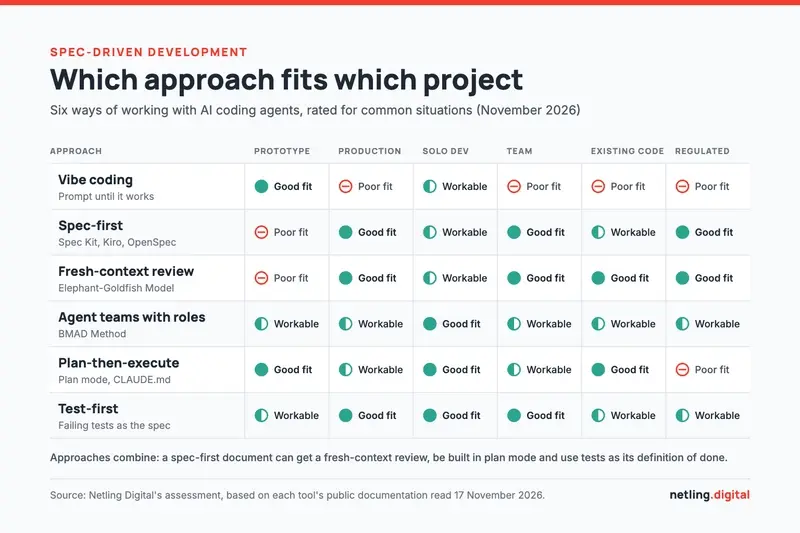
Enter Spec-Driven Development (SDD) and the emerging architecture of the AI Software Factory. By establishing a rigorously defined, written specification before an AI agent generates a single line of production code, SDD bridges the perilous gap between human intent and machine execution. As of late 2026, the software industry has rapidly standardized around five distinct approaches to specification-driven workflows—ranging from spec-first toolkits and fresh-context review models to role-based agent teams, context engineering, and test-first frameworks.
This report provides an investigative deep dive into the methodologies, tooling ecosystems, and organizational shifts defining the AI software factory, offering a comprehensive blueprint for engineering teams navigating the post-vibe coding era.
Detailed Chronology: The Evolution from Ad-Hoc Prompts to Structured Factories
The trajectory of AI-assisted software development has moved at a blistering pace, transforming from chaotic chat interfaces into highly structured, automated delivery pipelines.

Early 2025: The Dawn of "Vibe Coding"
In February 2025, AI pioneer Andrej Karpathy introduced the term "vibe coding." At a time when LLMs were growing increasingly capable at localized code generation, developers discovered they could build fully functioning applications simply by guiding an agent through conversational iteration. The developer acted as a director, curating the "vibe" of the application while the AI managed the implementation details.
While celebrated for rapid prototyping, software architects quickly realized the dark side of vibe coding: undocumented technical debt, cascading hallucinations, opaque state management, and an acute "expectation gap" where ambiguous prompts resulted in brittle, unmaintainable systems.
Late 2025: The First Wave of Spec-First Tooling
Recognizing the limitations of unstructured prompts, the developer tooling ecosystem pivoted rapidly toward structure. Throughout the latter half of 2025, open-source maintainers and enterprise platforms began releasing specialized frameworks designed to force upfront planning. Tools like GitHub’s experimental utilities, Kiro, and early iterations of spec-first compilers emerged. Industry thinkers, such as Thoughtworks’ Birgitta Böckeler, began categorizing these tools into distinct maturity tiers: spec-first, spec-anchored, and spec-as-source.
April–September 2026
: The Institutionalization of Rigor
By mid-2026, the industry moved past raw experimentation into systematic engineering governance.
- April 2026: Engineering leader Dave Rensin published a seminal essay arguing that the design document must become the primary artifact owned by humans, introducing the conceptual foundation for separating drafting intelligence from review intelligence.
- September 2026: Google open-sourced the Elephant-Goldfish Model (EGM) under an Apache 2.0 license, providing a concrete mechanism to combat AI confirmation bias through isolated, multi-agent code reviews. Concurrently, methodologies like the BMAD Method formalized role-playing agent teams to simulate full cross-functional software studios.
November 2026: The AI Software Factory Standardized
As of late 2026, the phrase "AI software factory" has transitioned from vendor marketing hype to a recognized operational model. Modern development environments—exemplified by advanced integrations in Claude Code, specialized CLI tools, and automated testing pipelines—now enforce that every task intake begins with a reviewed specification, verified by automated unit tests, and signed off by a human architect.

Supporting Context & Metrics: Why Vibe Coding Breaks Down in Enterprise Environments
To understand why Spec-Driven Development has become mandatory for professional engineering organizations, one must examine the precise failure points of unstructured vibe coding when applied to complex systems.
The Four Pillars of Failure in Unstructured AI Coding
- Context Drift and Hallucination Decay: As conversations with an AI agent grow longer, the context window fills with conversational noise, corrections, and abandoned ideas. Without a stable, written specification anchoring the session, the agent’s probability of hallucinating deprecated patterns or conflicting logic increases exponentially.
- The Verification Blindspot: When code is generated via unstructured prompts, human reviewers face an uphill battle. Reviewing raw code without a known baseline of intended behavior forces developers to reverse-engineer the agent’s rationale from the diff, severely degrading code review efficacy.
- Architectural Coherence: Individual AI prompts are inherently myopic. They optimize for local maximums—making the current function work—while ignoring global architectural boundaries, design systems, and security postures.
- Maintenance Nightmares: Code generated without explicit requirements documentation creates a knowledge silo trapped inside historical chat logs. When a bug emerges six months later, subsequent engineers have no reference point to determine whether the behavior was intentional or accidental.
The Five Dominant SDD Approaches (As of November 2026)
| Approach | Primary Mechanism | Optimal Use Case | Key Vulnerability |
|---|---|---|---|
| 1. Spec-First Toolkits (GitHub Spec Kit, Kiro, OpenSpec) | Generates explicit requirements, technical designs, and task lists before writing code. | Medium-to-large features requiring strict stakeholder sign-off. | High administrative overhead ("ceremony"); agent drift from generated specs. |
| 2. Fresh-Context Review (EGM) | Separates the "Elephant" (context-rich drafting agent) from "Goldfish" (fresh review agents). | Complex architectural decisions and legacy codebase remediation. | Consumes significant token budgets; requires rigorous human triage of feedback. |
| 3. Agent Teams with Roles (BMAD Method) | Simulates cross-functional teams (PM, UX, Architect, Dev) using specialized prompts. | Greenfield products lacking initial Product Requirement Documents (PRDs). | Subagents share underlying model weights; personas mimic expertise rather than creating it. |
| 4. Plan-Then-Execute & Context Engineering | Interactive planning loops combined with tightly curated context tokens (CLAUDE.md). |
Day-to-day feature development on familiar codebases. | Relies heavily on developer discipline to save and maintain plans. |
| 5. Test-First (Failing Tests as Spec) | Red-green-refactor loops where strict failing test suites define the exact boundaries of success. | Algorithmic tasks, data transformations, calculations, and bug fixes. | Tests capture functional behavior, missing high-level intent, UX, and architectural goals. |
Official Perspectives and Industry Analysis
The convergence toward spec-driven workflows is backed by rigorous analysis from leading technology advisory and engineering institutions.
According to a buyer’s guide published by Unblocked, the economic bottleneck of software engineering has fundamentally relocated: "The bottleneck moves upstream to specification and verification." Rather than eliminating human effort, the AI software factory requires a reallocation of human capital toward defining exact requirements and verifying machine output.
BCG Platinion, in their strategic insights on the agentic software factory, echo this sentiment, emphasizing that software creation is transforming from a manual construction process into an engineering management discipline. Humans no longer act as master builders laying bricks; they act as chief architects setting rigid constraints and inspecting automated output.
Furthermore, industry thought leaders emphasize that the tooling layer is intentionally decoupled from the underlying methodology. As Birgitta Böckeler noted in her foundational evaluations for Thoughtworks, while specific software utilities (such as Spec Kit, Tessl, and Kiro) evolve on a weekly basis, the core principles of spec-driven design—separating intent from implementation—remain immutable.

Future Outlook: The Horizon of Autonomous Engineering
As we look beyond late 2026, the evolution of Spec-Driven Development points toward fully autonomous, closed-loop software factories. The friction points visible today—such as managing token consumption in multi-agent review models and balancing administrative overhead with delivery speed—are actively being smoothed out by native IDE integrations and advanced reasoning models.
Key developments shaping the immediate future include:
- Living Specifications and Automated Drift Detection: Future toolchains will continuously compare production code against living specifications in real-time, automatically generating drift reports and surfacing architectural discrepancies before pull requests are even opened.
- Deterministic Verification Engines: The integration of formal verification methods and automated mutation testing directly into agent workflows will ensure that generated code strictly adheres to mathematical and logical invariants defined in the spec.
- Democratization of Enterprise Architecture: By lowering the barrier to writing comprehensive, rigorous technical specs, junior engineers and technical product managers will wield the leverage of senior system architects, mediated safely by autonomous verification guardrails.
Conclusion
Spec-Driven Development is not a regression into rigid, bureaucratic Waterfall methodologies; rather, it is the maturity model of the AI era. By treating the written specification as the primary source of truth, engineering teams can harness the blistering speed of artificial intelligence without sacrificing code quality, security, or maintainability. Whether adopting lightweight plan-mode loops or deploying multi-agent fresh-context review models, the path forward is clear: define the intent with absolute precision, let the AI build the implementation, and maintain human sovereignty over the final review.