Executive Overview
The powerful cultural reckoning of the #MeToo movement has fundamentally transformed how society addresses sexual misconduct, initially focusing its lens on high-profile, white-collar industries like Hollywood, politics, and elite newsrooms. However, a systemic shadow has long persisted away from the glaring spotlight of executive suites—deep within the blue-collar machinery of corporate America, including sprawling customer service hubs and call centers.
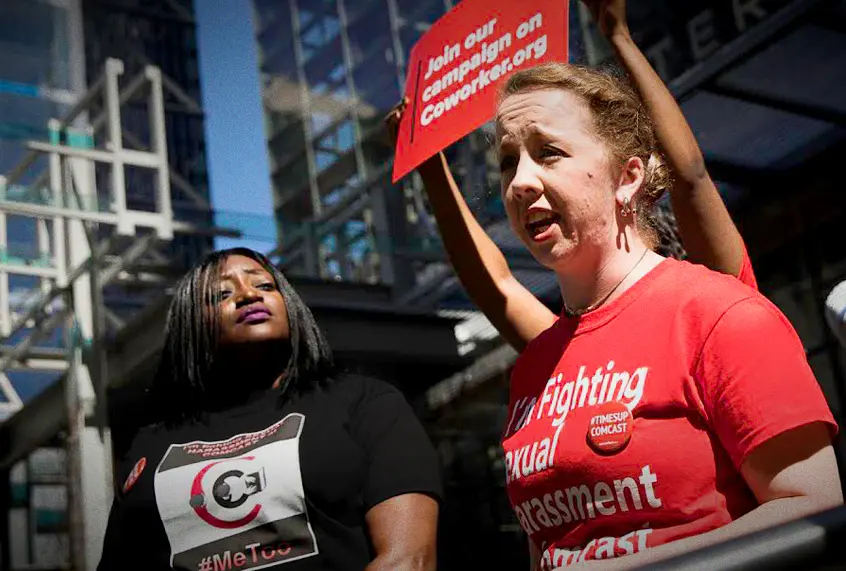
At telecommunications giant Comcast, former call center workers are pulling back the curtain on a deeply rooted culture of harassment, intimidation, and alleged institutional retaliation. Led by former employees Laterrica Perry and Rylinda Rhodes, a growing coalition of current and former workers, customers, and allies delivered a petition bearing over 4,000 signatures to Comcast’s corporate headquarters in Philadelphia.
The petition demands that Comcast CEO Brian Roberts take decisive action to eradicate workplace sexual harassment and protect employees who step forward. Yet, rather than finding a supportive environment, these women claim they were subjected to systemic retaliation, culminating in severe psychological trauma, financial hardship, and, ultimately, termination. As corporate executives refuse to meet with the petitioners, the fight against workplace abuse at Comcast exposes the vulnerable intersection of blue-collar labor, marginalized workers, and systemic corporate indifference.
Detailed Chronology of Events
The struggle for accountability at Comcast is built upon a painful accumulation of personal grievances, protracted human resources investigations, and institutional stonewalling.
Rylinda Rhodes: The 2012 Dispatch Center Ordeal
Rylinda Rhodes’ nightmare began years before the phrase "#MeToo" became a global rallying cry. Working as a dispatch representative at Comcast between 2007 and 2012—spanning four different call centers—Rhodes experienced what she described as pervasive verbal and physical sexual harassment.
The situation escalated dramatically on August 1, 2012, when a male coworker brazenly entered her office and groped her breasts. When Rhodes formally reported the incident, the fallout was swift and punishing. Instead of protecting her, management marginalized her, and she was forced to take short-term medical leave to seek talk therapy for the resulting trauma. While Comcast ostensibly investigated her claims, management advised her to apply for other jobs within the company. On the exact day of her termination in August 2012, Comcast officially cited health reasons as the pretext for her firing. Left feeling isolated, ashamed, and powerless—partially because supervisors had gaslit her into believing she was "too sensitive"—Rhodes spent years processing the humiliation before finding the strength to speak out publicly.
Laterrica Perry: The Memphis Sales Center Nightmare
Flash forward to July 2017: Laterrica Perry, then a 30-year-old sales representative at a Comcast facility in Memphis, Tennessee, faced a similarly harrowing ordeal. Perry submitted an anonymous report to Comcast Human Resources, complete with damning digital evidence—including text messages and phone records—documenting her supervisor’s unwanted sexual advances and inappropriate commentary.
Rather than stepping in to protect Perry, HR dragged its feet, waiting until October 2017 to finally fire the supervisor. During those intervening months, Perry alleges that her boss actively retaliated against her for spurning his advances. She was denied vital sick time and a standard letter of recommendation, while her professional reputation within the company was systematically dismantled.
The psychological toll was devastating. Perry was diagnosed with post-traumatic stress disorder (PTSD) directly linked to the toxic work environment. The severity of her condition forced her onto continuous disability leave through March 2018, causing a steep, unsustainable drop in her income. To make ends meet, she was forced to take a painful hardship withdrawal from her 401(k) retirement account.
The Final Blow and the Petition Delivery
As Perry focused on her medical recovery—engaging in regular therapy sessions and psychiatric care—she received her final notice from Comcast on April 30, 2018. While waiting for a formal separation package explaining her status, she received an abrupt email stating the company had proceeded with her termination.
While COBRA health insurance and retirement account transition papers arrived, the explanation for her sudden dismissal was entirely absent. Recognizing this as the culmination of corporate retaliation, Perry joined forces with Rhodes and another former employee to travel to Philadelphia on May 2, 2018. Together, they attempted to deliver a Coworker.org petition—signed by over 4,000 people, including dozens of former employees—directly to executive leadership. Comcast executives flatly refused to meet with them.
Supporting Context & Metrics: The Blue-Collar Harassment Crisis
The struggles faced by Perry and Rhodes are far from isolated incidents; they highlight a broader, underreported crisis within blue-collar and customer-service environments.
While public attention has largely fixated on wealthy actresses, high-ranking politicians, and elite broadcast anchors—such as the high-profile scandals involving fired Today show host Matt Lauer and veteran NBC News anchor Tom Brokaw at Comcast-owned NBCUniversal—the everyday realities of corporate laborers are starkly different.
Data from the Equal Employment Opportunity Commission (EEOC) reveals that between 2005 and 2015, approximately 1,200 charges of sexual harassment were filed within the information industry alone, a sector that encompasses major telecommunications providers like Comcast.
Unlike white-collar professionals who may have access to high-priced legal representation or public PR teams, call center workers—many of whom are women of color—frequently labor under rigid performance metrics, precarious scheduling, and immense power imbalances. For these workers, reporting harassment carries an immediate, terrifying risk: the loss of livelihood, health insurance, and financial stability. When corporate HR departments prioritize shielding the company from liability over protecting victims, vulnerable employees are left stranded in toxic environments where speaking out serves as a fast-track to termination.
Official Statements and Corporate Posture
Faced with mounting public pressure and digital activism, Comcast has leaned heavily on standard corporate defense mechanisms.
When Jezebel first broke the investigative story regarding Perry and Rhodes in February 2018, Jenni Moyer, Senior Director of Corporate Communications at Comcast, issued a boilerplate defense of the company’s workplace culture:
"Sexual harassment, or harassment of any kind, is not tolerated at Comcast. The company was founded on a foundation of respect, integrity and trust. We have strong policies against sexual and other forms of harassment and encourage employees to report any harassing behavior. Any allegation of harassment is taken very seriously."
Despite these soaring corporate talking points, the lived experiences of employees tell a vastly different story. The refusal of Comcast executives to meet with the delegation of former workers in Philadelphia speaks volumes about the disconnect between public relations messaging and internal accountability. For victims who trusted the company’s internal reporting mechanisms, the corporate response felt less like a safe harbor and more like an institutional cover-up designed to silence dissent.
Future Outlook: A Movement Beyond the Boardroom
Despite the roadblocks, institutional resistance, and personal hardships endured by its organizers, the campaign against Comcast’s workplace culture has achieved a profound cultural victory: shattering the isolation that keeps victims silent.
Reflecting on the delegation’s trip to Philadelphia, Rylinda Rhodes maintained an optimistic outlook, viewing the protest as an undeniable success. "It’s still a win. It lets them know people are watching and coming forth," Rhodes stated. "It’s also for the ones that are still suffering. To know they are not alone. We are just getting started. All women should have the freedom to be their authentic self and not a scared version because of sexual harassment."
Rhodes noted that launching her public campaign in November 2017 prompted numerous other women to reach out to her directly, sharing harrowing parallel stories of abuse within corporate call centers. By offering words of empowerment, she has helped transform her private trauma into a public lifeline for others.
Laterrica Perry remains more skeptical regarding whether Comcast will voluntarily reform its internal practices. Yet, she harbors no regrets about stepping forward. Drawing inspiration from the broader #MeToo movement, Perry views her painful ordeal as a vital mission to grant agency to the disenfranchised.
"What I’m doing is giving a voice to the voiceless," Perry reflected. "I’m also empowering people to step forward and say if something happens to them, whether it be at Comcast or any other corporation… That’s my silver lining." Looking ahead, Perry plans to dedicate her efforts to building resource networks, educating workers on how to formally report harassment, and guiding victims through the treacherous post-reporting landscape.
Ultimately, the courage displayed by these former Comcast employees serves as a stark reminder that the fight against workplace harassment cannot be won solely in Hollywood boardrooms or elite newsrooms. True institutional change requires holding corporate giants accountable at every level of employment—ensuring that blue-collar workers, customer service representatives, and marginalized women are never again forced to choose between their financial survival and their fundamental human dignity.