Executive Overview
For over a decade, iOS users relying on WhatsApp have shared an unspoken dependency with Apple’s iCloud. Whether restoring chats onto a replacement device or preserving years of precious media, memories, and professional communications, iCloud has served as the sole gatekeeper for keeping iPhone chat histories secure off-device. Now, that paradigm is shifting dramatically.
Meta-owned WhatsApp has officially begun rolling out its own first-party native backup service to select beta testers on iOS, bypassing iCloud entirely for users who opt in. First spotted by industry publication WABetaInfo earlier this year as a project in development, the feature has graduated from closed code to an active, testable reality via the TestFlight ecosystem.
This move represents a monumental pivot in how cross-platform messaging titans manage user data. By introducing proprietary cloud storage, WhatsApp is taking direct control of its infrastructure
, opening new monetization avenues through paid storage tiers, and offering users an alternative to Apple’s often restrictive free iCloud storage limits (which famously remain capped at a meager 5GB for the standard tier).
However, freedom from iCloud comes with its own unique set of parameters, security mandates, and subscription models. This report explores the mechanics of WhatsApp’s new native cloud backups, analyzes the tier structures, examines security measures like mandatory end-to-end encryption, and evaluates what this means for the broader mobile ecosystem.
Detailed Chronology: From Rumor to Reality
The journey toward a standalone WhatsApp backup infrastructure has been methodical and closely monitored by the tech community. To understand the gravity of the current iOS rollout, it is helpful to retrace the timeline of how this feature evolved from a backend whisper into a user-facing reality.
July 2026: The Initial Discovery
Rumors first began swirling in mid-July 2026 when WABetaInfo uncompiled early versions of WhatsApp code, discovering references to a proprietary cloud storage service designed specifically to circumvent reliance on Apple’s iCloud. At the time, the infrastructure was entirely dormant. Even beta testers could not access or interact with the feature.
However, code analysis revealed structural hints about the service’s design:
- Plans for a dedicated free storage allotment (peed at 2GB).
- Upgradable paid plans for power users carrying heavy media archives.
- Strict, uncompromised end-to-end encryption architecture managed entirely on WhatsApp’s servers rather than Apple’s cloud infrastructure.
Late 2026: The TestFlight Rollout Begins
Fast forward a few months, and the feature has crossed the threshold from abstract concept to functioning code. Select WhatsApp beta testers running the latest TestFlight builds on iOS are now greeted with a new prompt within the Chat Backup settings menu. Instead of automatically defaulting to iCloud, users are being presented with a clear dichotomy: stick with Apple’s ecosystem or transition directly to WhatsApp’s native cloud storage infrastructure.
According to deployment logs analyzed by testers, the feature is remarkably mature. The app’s underlying framework in the latest public App Store releases has also been updated to be fully compatible with this functionality. This suggests that Meta is laying the groundwork for a swift, server-side activation that could potentially bypass the need for a mandatory public App Store update when the feature officially launches globally.
Mechanics, Setup, and Security Framework
Transitioning chat archives away from Apple’s ecosystem requires a delicate balance of user convenience and bulletproof security. WhatsApp’s implementation of its native cloud backup achieves this by leaning heavily into strict cryptographic protocols while integrating modern authentication tools like passkeys.
How the Switch Works
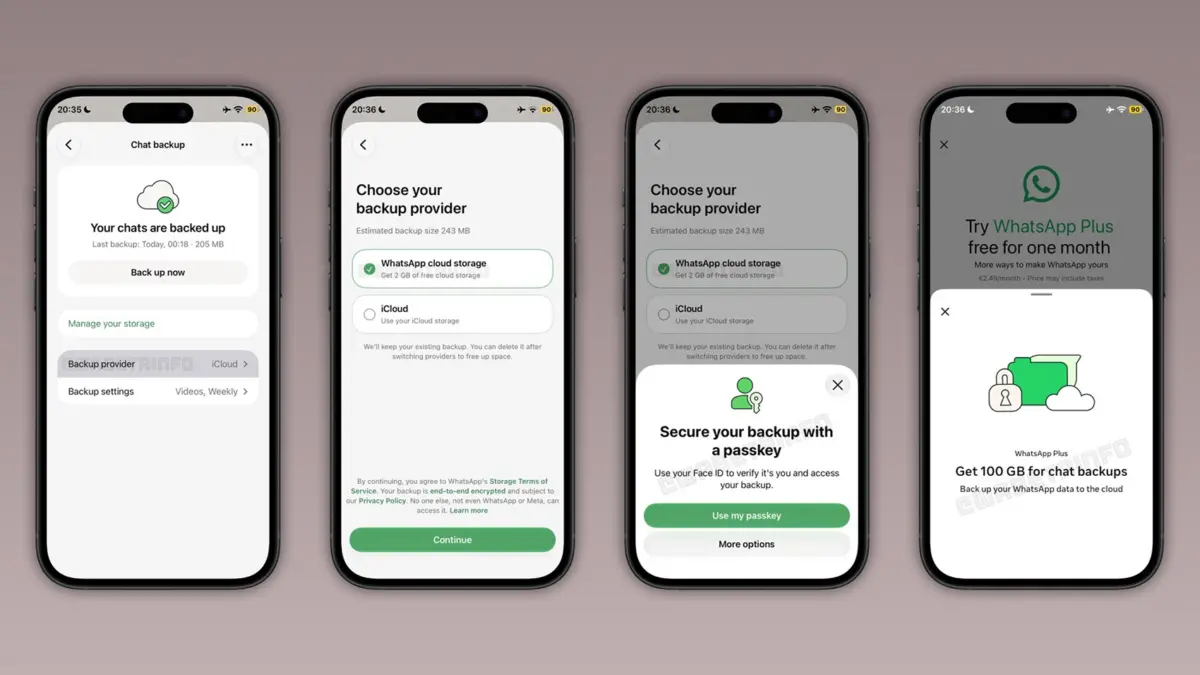
To migrate from iCloud to WhatsApp’s native servers, users navigate to the standard Chat Backup screen within the app’s settings. Here, a newly introduced provider selector prompts the user to choose their preferred storage host.

Opting for WhatsApp’s cloud storage initiates a mandatory setup sequence. Unlike iCloud backups—where encryption has historically been optional or managed via Apple’s Advanced Data Protection settings—WhatsApp has baked absolute security into the core of its first-party architecture. Users cannot opt out of encryption.
Encryption and Passkeys
Because WhatsApp’s servers will be holding sensitive personal chat histories, data must be rendered unreadable even to the platform administrators. During the setup wizard, users are required to secure their backups using one of two primary methods:
- The 64-Digit Encryption Key: A traditional, highly secure cryptographic string generated for users who prefer manual control over their security keys.
- Passkeys (Recommended Default): For a more streamlined experience, WhatsApp actively promotes the use of passkeys. This allows users to authenticate and secure their data seamlessly using biometric measures (Face ID or Touch ID) and device-level credentials without needing to manually copy and paste an intimidating string of numbers.
Subscription Expiration and Data Retention
Unlike iCloud, which maintains your backups indefinitely as long as your Apple ID is active and paid storage bills are met, WhatsApp’s third-party cloud service operates under strict retention guidelines for expired accounts or abandoned subscriptions.
According to documentation surfaced in the beta builds, if a user allows a paid backup subscription to lapse, WhatsApp retains the stored data on its servers for a grace period of precisely four months. If the subscription is not renewed within this window, the backup is purged permanently from WhatsApp’s servers, meaning the data cannot be recovered. Users are strongly advised to keep their billing information up to date to prevent catastrophic data loss.
Supporting Context & Metrics: Storage Tiers and Ecosystem Limitations
One of the most compelling aspects of WhatsApp’s native backup solution is its pricing and storage tier structure. For years, users have bumped up against Apple’s restrictive 5GB free iCloud limit, which forces families and heavy media sharers to upgrade to iCloud+ just to keep their WhatsApp data from failing to back up.
The Storage Hierarchy
Screenshots from the current beta build outline a tiered storage model designed to cater to everyone from casual texters to enterprise-level media hoarders:

- Free Tier (2GB): Every user who switches to WhatsApp’s native backup service receives 2GB of complimentary cloud storage. While this is less than Apple’s 5GB free iCloud tier, it is specifically dedicated only to WhatsApp data, whereas Apple’s 5GB must be shared across device backups, photos, notes, and documents.
- WhatsApp Plus Subscriptions: Users requiring more room can upgrade through WhatsApp-specific premium tiers. Current beta indicators point to a 100GB tier tailored for individuals with massive video and photo archives.
- Meta One Integration: For power users embedded deeply in the broader Meta ecosystem, higher-tier plans—such as Meta One subscribers—will unlock staggering amounts of storage, scaling up to 4 TB depending on the specific tier selected by the user.
Cross-Platform Realities: The Catch
Despite the excitement surrounding this feature, there is a critical limitation that users must keep in mind: cross-platform portability is currently unsupported.
Backups stored natively on WhatsApp’s servers cannot be used to seamlessly restore chat histories across different operating systems. If you decide to ditch your iPhone and switch to an Android device (or vice versa), WhatsApp’s native cloud backup will not help you bridge the gap. For cross-platform migration, users will still be required to use WhatsApp’s built-in, local device-to-device chat transfer tool. This restriction suggests that while WhatsApp is building its own cloud infrastructure, the underlying database formats may still retain OS-specific encryption wrappers or architectural traits tied to iOS and Android file systems.
Official Statements and Industry Implications
While Meta has not yet published a formal press release announcing the global rollout of native backups—preferring to let the beta ecosystem test the waters first—the strategic motivations behind this move are transparent to industry analysts.
For years, tech giants have sought to reduce their reliance on platform gatekeepers like Apple and Google. By hosting chat backups on its own infrastructure, WhatsApp achieves several corporate and technical objectives:
- Reduced Dependency on Apple: By migrating users away from iCloud, WhatsApp mitigates issues related to iCloud storage failures, Apple system outages, and consumer friction caused by full free-tier storage alerts.
- New Revenue Streams: Transforming chat backups into a subscription-based product opens up recurring revenue directly for Meta, capturing dollars that previously went straight to Apple or Google via iCloud+ and Google One upgrades.
- Unified Cross-Platform Experience: Long-term, establishing a proprietary cloud storage backbone lays the groundwork for a unified, OS-agnostic backup ecosystem where user data lives with WhatsApp rather than the device manufacturer.
Privacy advocates have generally welcomed the news regarding mandatory end-to-end encryption. In an era where cloud-stored data is frequently targeted by subpoenas, hackers, and data brokers, ensuring that zero-knowledge encryption is non-negotiable sets a high standard for first-party cloud services.
Future Outlook
As WhatsApp continues to stress-test its first-party backup infrastructure with iOS beta testers via TestFlight, a broader public rollout appears increasingly imminent. Because the foundational code is already present in recent public App Store builds, the feature could transition from a closed beta test to a global toggle at any moment via a simple server-side switch.

However, several questions remain unanswered as we look toward the future:
- When will Android users get it? While the feature is currently rolling out on iOS, an equivalent Android rollout leveraging WhatsApp’s servers instead of Google Drive is widely expected to follow, bringing parity to both major mobile operating systems.
- How will pricing compare to Apple and Google? As final pricing structures for the 100GB and Meta One 4TB tiers crystallize, consumers will weigh whether paying Meta directly for WhatsApp-specific storage is more economical than paying Apple or Google for general cloud storage.
- Will cross-platform restoration arrive later? Solving the iOS-to-Android backup barrier remains the holy grail of instant messaging convenience. Whether WhatsApp’s native cloud storage will eventually evolve to support seamless cross-platform restoration is a development worth watching closely.
For now, iOS users who find themselves constantly battling iCloud storage limits have a compelling alternative on the horizon—provided they are willing to embrace mandatory encryption and a dedicated subscription model for their digital memories.