Executive Overview
The global technology markets have spent the better part of 2026 reeling from a phenomenon dubbed the "SaaSpocalypse." In early February 2026, roughly $1 trillion in enterprise software market value vanished almost overnight as institutional investors grew increasingly panicked over the potential displacement of traditional software-as-a-service (SaaS) business models by autonomous artificial intelligence agents. By some metrics, cumulative losses in the enterprise tech sector soon swelled toward $2 trillion.
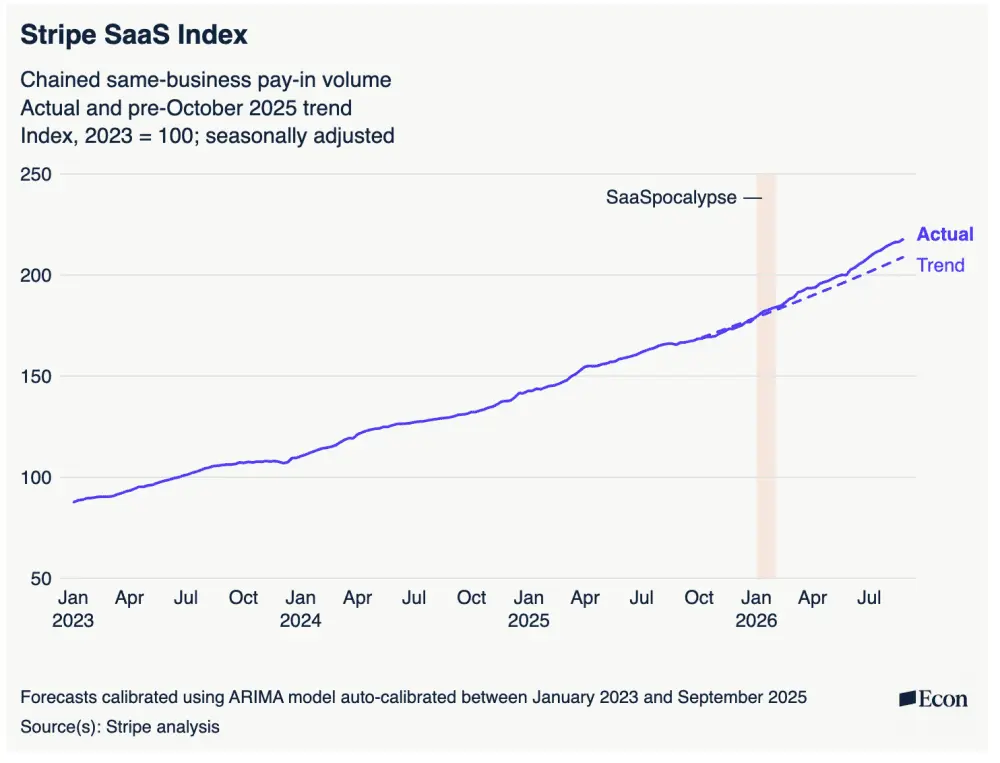
Amidst this atmospheric panic, Stripe Economics—led by Ernie Tedeschi—published a landmark weekly data brief introducing the Stripe SaaS Index. Leveraging real-time payment flows rather than lagging quarterly earnings reports, the index arrived with a provocative conclusion: while the SaaSpocalypse inflicted catastrophic carnage on public stock prices, it barely grazed actual underlying software revenue. According to Stripe’s findings, B2B software revenue has climbed back to roughly pre-sell-off levels, growing at over 30% year-over-year and hovering approximately 4% above historical trendlines.
For founders, venture capitalists, and market strategists, this initially sounded like a resounding sigh of relief. However, a deeper investigative look into the methodology reveals a stark disconnect. The Stripe SaaS Index tracks a fundamentally different cohort of companies than the massive enterprise giants whose market caps collapsed. Furthermore, by excluding failed companies, bypassing AI-native platforms, and capturing nominal price increases rather than net margins or seat volume, the data stretches far beyond what its core metrics can logically support.
This article provides an authoritative, deep-dive analysis into the Stripe SaaS Index, exploring what real-time payment flows can—and cannot—tell us about the health of the broader software ecosystem, and what founders must consider before popping the champagne.
Detailed Chronology: The Rise, Fall, and "RenaiSaaS" Debate
To understand the current debate over software revenue health, one must retrace the volatile trajectory of the markets across late 2025 and 2026.
The Early 2026 Valuation Meltdown
For years, the public markets priced enterprise SaaS on the assumption of predictable, long-term, seat-based expansion. However, as generative AI architectures matured from experimental novelties into robust, agentic workflows capable of executing multi-step business processes autonomously, market sentiment shifted aggressively.
By early February 2026, the cracks became chasms. Investors began pricing in a terrifying scenario: if AI agents do the work previously done by human workers, companies will no longer need hundreds or thousands of software seats. Valuation multiples compressed rapidly across the board. The IGV software ETF and other key benchmarks suffered historical contractions. Nearly $1 trillion evaporated in weeks, with total losses compounding toward $2 trillion as Wall Street recalibrated its five-to-ten-year cash flow projections for legacy enterprise software.
The Stripe Economics Intervention
Enter Stripe Economics. Seeking to bypass the noise of quarterly earnings calls, management guidance adjustments, and emotional Wall Street sentiment, Ernie Tedeschi and his team decided to look at the bedrock of modern digital commerce: real money changing hands.
The resulting Stripe SaaS Index analyzed weekly revenue patterns across an average of roughly 72,000 non-AI B2B software businesses throughout 2026. The core thesis of the report—affectionately or cautiously termed a "RenaiSaaS"—argued that the fundamental demand for B2B software remained remarkably resilient. The public markets had panicked, but the everyday cash inflows running through payment rails suggested that customers were still buying software at a robust clip.
Yet, as industry analysts like Sridhar Ramaswamy and various venture capital observers quickly pointed out, the narrative of a clean, unblemished "RenaiSaaS" glosses over critical structural nuances embedded deep within Stripe’s data architecture.
Supporting Context & Metrics: Unpacking the Methodology
While the Stripe SaaS Index offers unprecedented visibility into digital commerce, its design features several inherent limitations that founders and investors must navigate carefully.
1. The Self-Serve vs. Enterprise Divide
The single largest methodological gap lies in the composition of the sample. The vast majority of the $2 trillion that disappeared from the public markets belonged to massive enterprise software giants—companies with dedicated field sales teams, sprawling annual contracts, rigid procurement cycles, and invoices settled via multi-million-dollar bank wires. Very little of that tier-one enterprise
revenue ever touches Stripe’s payment rails.
Conversely, the 72,000 businesses tracked by the Stripe sample are predominantly self-serve, card-on-file, product-led growth (PLG) B2B companies. While this makes the Stripe index a phenomenal, high-frequency early indicator of health for the long tail of the software ecosystem, it evaluates an entirely different economic animal than the public giants whose valuation multiples collapsed. The index proves that small-to-midsize self-serve software is healthy; it cannot answer whether traditional enterprise apps will retain their pricing power as autonomous agents erode seat-based models.
2. Survivorship Bias and the "Missing" Failures
Another crucial consideration involves how the index handles corporate mortality. The flagship Stripe index chains week-over-week growth strictly for businesses that are actively present in both weeks. This design choice prevents sudden fluctuations from new merchant onboardings or large account departures from skewing the overarching trend, and it caps extreme anomalies.
However, this is a classic "same-store" index design. If a B2B software company quietly winds down its operations, goes bankrupt, or drops its revenue to zero, it simply falls out of the calculation rather than registering as a 100% negative data point. If the long-term structural threat of AI is that traditional software companies will quietly wither away and be replaced by automated workflows, a same-store index is structurally blind to that attrition. It measures the survivors cleanly while leaving the casualties off the ledger.
3. The AI Exclusion and the Young Firm Vanguard
Crucially, the primary Stripe index explicitly isolates non-AI software to gauge the baseline health of traditional tech. Yet, the core driver of the 2026 market sell-off was never a sudden drop in aggregate tech consumption; it was the existential threat of budget reallocation toward AI-native alternatives.
Interestingly, Stripe’s auxiliary data hints at a profound generational shift. By utilizing proxies for AI adoption—such as Model Context Protocol (MCP) requests and agentic CLI usage—the data reveals a striking trend. While mature firms led on these adoption proxies by 5 percentage points at the beginning of 2026, that gap rapidly closed. By April, the dynamic flipped entirely: young, emerging firms are now roughly 4 percentage points more likely to exhibit advanced AI and agentic infrastructure signals. The cohort growing the fastest is heavily overlapping with the cohort building for the agentic future, offering little comfort to legacy incumbents standing still.
4. Growth Concentration and Geographic Divergence
A surface-level review of the weighted index shows growth sitting comfortably at over 30% year-over-year and 4% above trend. However, an unweighted median index tells a markedly different story, exposing a significant slowdown that began in late 2025 before staging a sharp, concentrated recovery.
This divergence highlights a familiar dynamic: a small cluster of elite winners is pulling the statistical average upward, while the median, typical software business has merely clawed its way back to baseline trendlines.
Geographically, the data splits along similar lines. U.S. software growth slowed in 2025, accelerated through the market sell-off, and has continued an upward trajectory. Meanwhile, regions like the United Kingdom peaked in the summer of 2025 and have experienced a cooler, more subdued recovery pattern.
5. Nominal Growth, Price Increases, and Margin Blindness
Stripe’s reporting comes with an explicit caveat: pay-in volume measures gross top-line inflows. It misses offline invoicing, underlying operating costs, customer acquisition costs, and gross margins.
Furthermore, the index is entirely nominal. In an inflationary and rapidly shifting tech environment, price increases masquerade as organic growth. Throughout late 2025 and 2026, a vast number of B2B software vendors quietly raised list prices or introduced mandatory, paid AI-tier add-ons. Under this dynamic, a company can easily post 20% revenue growth even as its underlying seat count declines, simply because the price per account increased. While this strategy can artificially prop up top-line metrics for a couple of years, it is precisely the kind of fragile equilibrium that public market investors feared back in February.
Official Statements and Industry Discourse
The release of the Stripe SaaS Index ignited immediate, high-stakes discourse across the tech community. Industry leaders weighed in heavily on social platforms and private forums to contextualize what the numbers truly represent.
Ernie Tedeschi and the Stripe Economics team maintained a measured perspective, emphasizing that while strong revenue numbers prove the doom-saying was premature in the short term, they do not inherently render the market’s underlying anxieties irrational. Public market valuations price cash flows looking five to ten years into the future. Robust revenue collections in 2026 merely confirm that the cliff hasn’t arrived yet; they do not guarantee that structural displacement won’t materialize further down the road.
Prominent SaaS investor and commentator Dave Kellogg, alongside tech voices like Sridhar Ramaswamy, echoed these cautionary notes. Ramaswamy’s widely shared critique summarized the community consensus: "Interesting data, but conclusions go way beyond what the data supports. Failed companies are missing, and growth in Stripe payments isn’t the same as SaaS revenue growth. Most importantly, AI disrupting SaaS…" remains the elephant in the room that payment rails cannot measure.
Strategic Implications: Four Crucial Decisions for Founders
Navigating an environment defined by robust short-term payment data and existential long-term technological shifts requires disciplined leadership. Founders and executive teams should extract four key directives from the Stripe SaaS Index debate:
- Do Not Confuse Top-Line Inflows with Strategic Immunity: A healthy self-serve payment volume does not insulate your company from secular shifts. If your product relies heavily on traditional seat-based pricing models that are vulnerable to agentic automation, strong Q3 cash flows are a temporary reprieve, not a permanent shield.
- Scrutinize Your Pricing Power vs. Usage Metrics: If your recent growth is being driven entirely by price hikes or forced tier upgrades while active user engagement or seat counts flatline, you are borrowing growth from the future. True long-term resilience requires demonstrating indispensable utility in an automated workflow.
- Accelerate Agentic Native Integration: The Stripe data clearly shows that young, agile firms are outpacing legacy incumbents in adopting advanced agent infrastructure and developer proxies like MCP requests. Founders must aggressively integrate native AI capabilities into their core products rather than treating AI as an overpriced peripheral add-on.
- Plan for Long-Horizon Cash Flow Realities: Public markets look years ahead. Even if your immediate collection metrics look pristine, build conservative financial models that account for potential compression in net revenue retention (NRR) as enterprise buyers reallocate budgets toward autonomous software solutions.
Future Outlook
The "SaaSpocalypse" versus "RenaiSaaS" debate serves as a vital reality check for the technology sector. It reminds us that macroeconomic sentiment and real-world commercial activity can temporarily decouple, creating zones of extreme volatility and false security.
As we look toward the remainder of the decade, real-time payment data like the Stripe SaaS Index will remain an invaluable high-frequency compass, illuminating the immediate financial health of the self-serve software economy. However, the ultimate verdict on the future of enterprise software will not be written by weekly credit card processing volumes. It will be decided quarter by quarter in public company net revenue retention reports, in enterprise procurement renewals, and—most importantly—in the speed with which software companies successfully transform from tools used by humans into platforms managed by agents.
Founders who mistake a resilient short-term payment bounce for a permanent immunity to technological evolution do so at their own peril. The smart money is using this window of operational stability not to celebrate, but to rebuild.