Executive Overview
For founders and venture capitalists who cut their teeth in the pre-AI era, the foundational rules of enterprise scaling have radically shifted. Conversations across Silicon Valley boardrooms and accelerator demo days inevitably return to a single, pressing inquiry: Is the legendary "T2D3" growth model officially dead? Are growth rates of 100% annually considered insufficient? More importantly, must every modern enterprise technology company inherently be an artificial intelligence player to secure institutional backing?
Distilling thousands of pitch decks, fund portfolios, and market rounds over the past 24 months yields an unvarnished reality check. Today, the defining threshold for raising venture capital is explicit: Startups must scale from $1M to $100M in Annual Recurring Revenue (ARR) within five years or less. While achieving this feat faster remains universally preferred, hitting this specific cadence is now the baseline price of admission for institutional capital.
Understanding this threshold requires looking closely at what the rule does not mandate. It does not demand that a company reach $1M ARR overnight. Early-stage capital remains notably patient. Seed rounds continue to be priced primarily on the strength of the founding team, the product wedge, and early qualitative signals; taking up to three years to discover product-market fit is generally accepted. Furthermore, rapid growth is not treated as a solitary metric in a vacuum. Core health indicators such as net retention, gross margins, and burn multiples are still subjected to rigorous due diligence. However, the order of operations has flipped: these metrics are scrutinized after a company’s growth rate clears the bar, serving as validations rather than substitutes for sluggish expansion.
The venture clock officially starts ticking the moment a company crosses $1M ARR. From that exact milestone, founders operate on a strict, five-year countdown.
+---------------------------------------------------------------------------------+
|                         THE NEW VENTURE CAPITAL TIMELINE                        |
|                                                                                 |
|   [ $0M - $1M ARR ]  ===>  [ $1M ARR ]  =======>  [ $100M ARR ]                  |
|    Patient Capital          The Clock Starts         5-Year Window              |
|    (Team & Wedge)           (151% CAGR Target)       (Institutional Bar)        |
+---------------------------------------------------------------------------------+
Detailed Chronology: The Demotion of T2D3 and the Rise of 151% Compounding
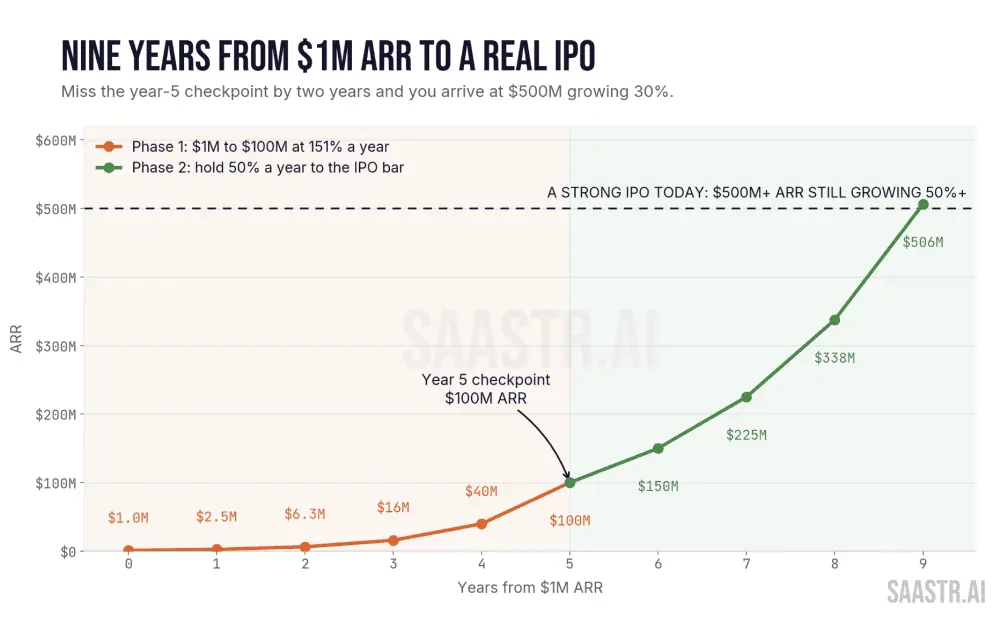
To comprehend what a "$1M to $100M in 5 years" trajectory demands on a granular level, look at the mathematics. Achieving a 100x increase in revenue over a five-year span requires compounding growth at an average rate of 151% year-over-year.
Compare this requirement against the canonical venture growth path introduced a decade ago by Neeraj Agrawal of Battery Ventures: T2D3 (Triple, Triple, Double, Double, Double).
- Year 1: Triple ($1M $rightarrow$ $3M)
- Year 2: Triple ($3M $rightarrow$ $9M)
- Year 3: Double ($9M $rightarrow$ $18M)
- Year 4: Double ($18M $rightarrow$ $36M)
- Year 5: Double ($36M $rightarrow$ $72M)
Historically, T2D3 was the gold standard. Interestingly, T2D3 actually outpaces the 151% compound model through the first three years because tripling early on outpaces a steady 151% ramp. However, it ultimately falters in the final stretches, finishing at $72M ARR by Year 5—falling roughly 28% short of the modern benchmark.
Consequently, T2D3 is not extinct; rather, it has been systematically demoted. The aspirational playbook of 2016 has become today’s bare minimum. To keep pace, modern founders must either beat T2D3’s timeline by an entire year or launch their explosive growth run from a higher baseline (such as $1.4M ARR) instead of $1M.
Supporting Context & Metrics: Working Backward From the IPO Market
Crucially, this aggressive growth bar is not an arbitrary invention dreamt up by venture capitalists seeking hyper-returns. Instead, it is dictated entirely by public market exit mechanics, with every private financing stage pricing downward from that terminal endpoint.
The Public Market Realities
According to Sapphire Ventures’ Software x AI market reports, current Initial Public Offering (IPO) calculus demands that companies achieve $400M to $500M+ in clean revenue, maintain a minimum of 20%+ growth at scale, display positive free cash flow (or a verifiably credible path toward it), and present a defensible, robust AI narrative. For a strong IPO—where aftermarket trading succeeds and the preceding private valuation round acts as a firm valuation floor rather than a fragile ceiling—the real financial target is $500M+ in revenue growing at 50% or more.
Consider the historical precedent of Figma’s public market debut. Figma priced its IPO at $33 per share, valuing the design software giant at approximately $19.3 billion. This valuation was underpinned by $749M in 2024 revenue growing at 48% (translating to roughly $1B of ARR at listing), paired with 91% gross margins and a Q1 2025 net income of $44.9M. On its very first day of public trading, the stock surged, closing near a $47 billion market cap.
Yet, public markets remain unforgiving. When Figma reported its inaugural public quarter showing a revenue growth rate of "only" 41%, public investors promptly shaved roughly 20% off the company’s market cap the following day. A profitable business generating $1 billion in revenue while growing at 41% was still penalized for deceleration.
The Nine-Year Arc to $500M ARR
Mapping out the subsequent ladder reveals the sheer scale of the journey:
- Reach $100M ARR by Year 5.
- Maintain a 50% compounding growth rate from that point onward.
Under this model, achieving a $500M+ ARR business growing at 50% takes roughly nine total years from the initial $1M milestone. Miss the Year 5 checkpoint by even two years, and a company arrives at $500M growing at a modest 30%—producing a fundamentally sound business that translates into a thoroughly mediocre, underperforming public offering.

Multiple Compression Drives the Bar Higher
The primary catalyst behind this inflated revenue bar is not a shift in operating ambitions, but a drastic contraction in valuation multiples.
Even the fastest-growing enterprise software companies (those boasting 25%+ revenue growth) currently trade at roughly 8.3x Next Twelve Months (NTM) revenue, falling well below their 10-year historical average of 10.8x. Broad enterprise software indices have suffered severe drawdowns from historic peaks. Unlike previous software downturns that tracked broader macroeconomic declines in the Nasdaq, the current contraction is structural, driven by a reassessment of long-term software monetization.
Applying this math to a potential exit reveals the compounding damage:
- At a 10.8x multiple, a company generating $400M in revenue commands a $4.3B valuation.
- At an 8.3x multiple, that same $400M revenue stream yields a valuation of just $3.3B.
- To reclaim a $4.3B valuation in a compressed multiple environment, that exact same business must now generate $520M in revenue.
This valuation adjustment cascades down through every financing stage. Series C investors underwriting a projected $4 billion exit now require roughly 30% more revenue at the finish line than they did a decade ago. They push this requirement down to Series B, which in turn pressures Series A founders.
Official Statements and Industry Insights
Venture capital leaders have been increasingly vocal about these shifting realities. Jason Lemkin, founder of SaaStr, summarized the modern sentiment with characteristic bluntness:
"Let me summarize venture capital today: All That Matters is Growth. Do gross margins matter? No. Does it matter if revenue recurs? No. Does customer concentration matter? No."
While hyperbole designed to spark debate, Lemkin’s commentary highlights a genuine structural shift: in an overheated, AI-dominated market, investors are prioritizing velocity above all else.
This environment is further illuminated by Carta’s early 2026 data, which revealed that the median Series A bar for AI startups has surged to approximately $3.5M ARR—roughly 3.5x higher than the ~$1M threshold seen just three years prior. Median AI Series A rounds are now commanding between $13M and $15M in capital injections on pre-money valuations spanning $75M to $250M. Strikingly, over 60 cents of every venture dollar tracked during this period was funneled directly into artificial intelligence enterprises.
When a fund acquires a 15% to 20% stake at Series A on a nine-figure valuation, dilution through subsequent Series B, C, and D rounds typically leaves the initial investor holding a 7% to 10% position at exit. For that concentrated position to return a meaningful multiple on a standard $60M micro-cap or mid-sized fund, the portfolio company must ultimately scale into a multi-billion-dollar enterprise. At an 8x revenue multiple, a multi-billion-dollar valuation necessitates $400M to $600M in recurring revenue—reaffirming that the $1M-to-$100M-in-5-years rule is an inescapable mathematical mandate.
Future Outlook: Exceptions, Strategic Pivots, and the Road Ahead
While the five-year, $100M ARR mandate governs the vast majority of B2B SaaS and AI applications, discerning founders must understand where this rule bends, how private equity is rewriting exit strategies, and how to navigate the road ahead.
Where the Rule Breaks
- Deep Tech and Infrastructure: Infrastructure plays and highly technical categories warrant longer runways. If a core technology architecture takes three years just to build and field-test, and initial contracts command seven-figure price tags, sophisticated institutional investors will underwrite a slower ramp to $100M against an exponentially larger terminal market size (akin to the trajectories of Databricks and Snowflake).
- Consumption-Based Models: Usage-based businesses report consumption revenue rather than traditional ARR, yielding different financial shapes. A consumption-driven company can appear completely flat for three consecutive quarters before experiencing a step-function surge the moment a major enterprise client moves a core workload into production. Applying rigid ARR benchmarks to consumption metrics yields flawed conclusions.
- Exceptional Retention: High net retention can buy a company breathing room. Securing a Series B with $12M ARR growing at 55% is entirely feasible if the company boasts a 135% Net Retention Rate (NRR) and a 12-month Customer Acquisition Cost (CAC) payback period. Conversely, identical growth paired with a 98% NRR will frequently face rejection. Growth and retention trade against each other at the margin—though not by much, and never indefinitely.
Private Equity vs. Venture Capital Exits
The dichotomy between venture-backed software and private equity listings highlights the changing nature of exits. Consider enterprise software providers filing for public listings with substantial revenue bases (such as $500M+ in annual revenue) growing at modest rates (e.g., 24%), backed by robust cash flows. While these represent exceptional businesses by any operational standard, many are increasingly led by private equity sponsors rather than venture capitalists.
Buyout funds operate on fixed timelines with limited partner distribution schedules. Conversely, a venture-backed company compounding revenue at 40%+ can afford to wait, raise private capital, or utilize continuation vehicles. However, with the traditional venture-backed B2B software IPO window experiencing prolonged friction, sponsor-owned names are increasingly leading public market calendars. For companies settling into a 24% growth profile, private equity or growth equity financing models often prove far more appropriate than venture capital.
Actionable Advice for Founders
- Under $1M ARR: Disregard these metrics entirely. Early-stage founders must focus intensely on customer discovery and finding product-market fit. Forcing premature growth before a genuine product wedge is validated remains the fastest path to self-destruction.
- Just Crossed $1M ARR: Mark the calendar. Exactly five years from that milestone, the business must support a $100M ARR operation. Founders must determine within 18 months whether their go-to-market motion compounds at an aggressive 150% or a more moderate 60%. These represent fundamentally different companies requiring vastly different capital structures.
- At $10M to $30M ARR Growing at 40% to 60%: Founders navigating this tier experience the most painful zone in modern B2B software—sitting comfortably above market medians, yet falling short of hyper-growth venture benchmarks. Rather than spending nine months enduring dozens of mismatched investor pitches, founders should deliberately evaluate alternative capital pathways, including growth equity, strategic minority investments, or steering the company toward default-alive profitability on internal cash flow.
- Tracking on the 151% Curve: Secure capital aggressively. With institutional liquidity concentrating heavily within top-tier AI and high-growth assets, the market premium for proven hyper-growth execution remains at an all-time high.
Ultimately, whether adapting to the hyper-accelerated velocities driven by generative AI—such as engineering tools scaling from $1M to $100M in record-breaking windows—or building durable, capital-efficient infrastructure plays, modern founders must master the intersection of disciplined financial metrics and aggressive market timing. The rules of venture capital have evolved; those who adapt to the new mathematical reality will define the next decade of enterprise technology.