Executive Overview
For the past two decades, oceanographer Daniel Rudnick has monitored the hidden metrics of the Pacific Ocean, compiling data from beneath the surface to map the subtle shifts of marine ecosystems. Yet, the data flooding his monitors over the last few months has left even seasoned researchers stunned. Driven by a powerful, surging super El Niño, the waters off the California coastline are experiencing an unprecedented marine heat wave that is actively re-writing local climate records. This thermal anomaly is not merely a surface-level phenomenon; it reaches hundreds of feet deep, disrupting delicate marine life, fueling atmospheric rivers, and pushing sea levels to historic heights as the state enters its rainy season.
The convergence of this natural climate cycle with long-term, human-driven global warming has created a compounding crisis. Marine scientists describe the ongoing events as literally "off the charts," forcing agencies to recalibrate their measuring equipment because existing color-coded temperature maps can no longer adequately display the sheer intensity of the heat. From record-shattering subsurface temperatures in Monterey Bay and San Diego to bizarre meteorological events like twin waterspouts swirling over the San Francisco Bay, the Pacific Ocean is sending an undeniable signal: the traditional baselines of marine stability have broken down.
Detailed Chronology: How the Pacific Heated Up
To understand the scope of the current crisis, scientists trace a multi-year sequence of events that transformed the Eastern Pacific into a thermal basin. The timeline of this extraordinary marine anomaly highlights a compounding effect of natural variability and persistent greenhouse gas warming.
The Buildup: A Simmering Ocean (January 2025 – August 2025)
Long before the current super El Niño reached its peak intensity, California coastal waters were already running a fever. Beginning in January 2025, a persistent marine heat wave settled over the coastline. By August 2025, surface temperatures in localized pockets of the Pacific off Southern California spiked to an alarming 8 degrees Fahrenheit above historical averages. This prolonged baseline warming laid a dangerous foundation, ensuring that any subsequent weather pattern would land on an already-overheated ecosystem.
The Arrival of the Super El Niño (Fall 2025)
As autumn approached, the tropical Pacific transitioned decisively into an El Niño phase, rapidly intensifying into a "super" classification that rivaled or exceeded the historic 2015–2016 event. The primary driver behind this sudden infusion of thermal energy came in the form of Kelvin waves—slow-moving, massive underwater waves that traverse the Pacific from west to east.
These Kelvin waves carry immense reservoirs of warm water across the ocean basin. As they arrive near the American continent, they depress the ocean’s thermocline—the critical transition layer where water temperatures sharply drop as depth increases. According to climate scientists, this mechanism effectively "turned off the air conditioner" for the deep ocean, allowing heat to pool and penetrate downward rather than mixing safely into the abyss.
Subsurface Boiling and Winter Extremes (Late 2025 – Early 2026)
By late October, the impacts were visible far beneath the waves. In Monterey Bay, monitoring equipment recorded a staggering 64.72 degrees Fahrenheit (18.18 degrees Celsius) at a depth of 200 feet, obliterating previous historical milestones. Further south, data captured near San Diego revealed an even more extreme subsurface reading at the same depth: 77 degrees Fahrenheit—an extraordinary 21.3 degrees Fahrenheit above normal for that depth.
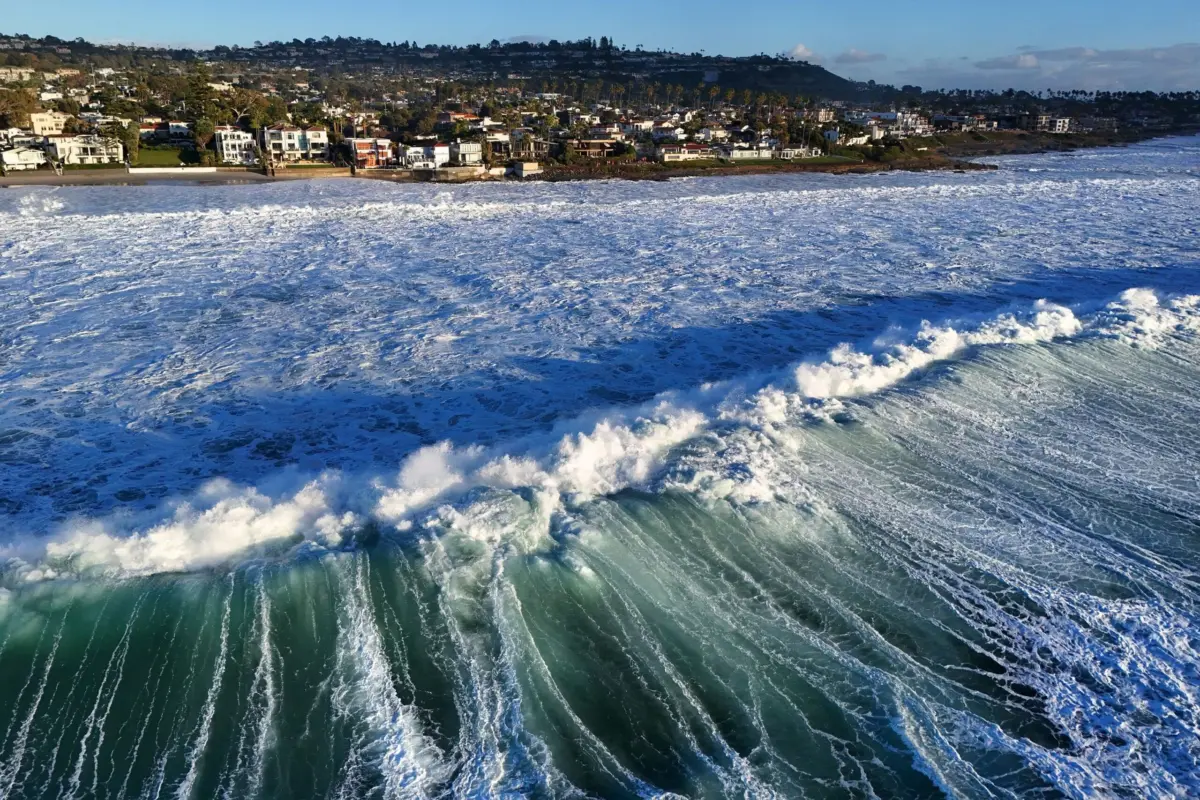
These hidden thermal reserves translated directly into surface-level chaos. By early 2026, the combination of elevated water temperatures and the physical expansion of water (steric height) drove coastal sea levels to record highs. Powerful storms battered the coast, producing waves exceeding 30 feet that registered unmistakably on regional seismographs, while urban centers from San Francisco to Burbank saw hourly rainfall records toppled.
Supporting Context & Metrics: The Science Behind the Anomaly
The mechanics of this event rely heavily on specialized technology and decades of baseline climatological data. Understanding the sheer scale of the anomaly requires looking directly at the numbers and the tools used to capture them.
The Role of Underwater Gliders
Daniel Rudnick and his colleagues at the Scripps Institution of Oceanography at UC San Diego rely on autonomous underwater drones known as gliders. These torpedo-shaped robotic vehicles dive thousands of feet below the surface, systematically crawling up and down to sample salinity, dissolved oxygen, and temperature metrics.
When analyzing the latest data streams, Rudnick discovered that his standard visualization models failed. The color-coded anomaly charts—traditionally using shades of red to indicate warmer water and blue for colder water—required manual readjustment. The maximum red thresholds on the legacy scales were simply not intense enough to represent the extreme heat recorded hundreds of meters below the surface.
Quantitative Breakdown of the Crisis
- 1.8 Degrees Fahrenheit: The amount the oceans off Southern California have warmed since the 1970s due exclusively to human-caused climate change.
- 8 Degrees Fahrenheit: The peak temperature deviation above average recorded in localized coastal California waters during the August 2025 marine heat wave.
- 21.3 Degrees Fahrenheit: The astonishing temperature anomaly recorded at a depth of 200 feet off San Diego, pushing subsurface waters to 77°F.
- 30+ Feet: The maximum height of storm-driven coastal waves that triggered regional seismographs along the California shoreline.
The Physics of Steric Sea Level Rise
Sea level rise is traditionally associated with melting polar ice caps and glaciers. However, a significant driver of the coastal flooding witnessed along California during this event is steric height—sea level changes driven entirely by thermal expansion. As water molecules absorb heat, they expand and take up more physical space. Combined with Kelvin waves physically holding warm water against the continental shelf rather than allowing it to disperse offshore, this thermal expansion created prolonged coastal flooding advisories across San Francisco and surrounding bays.
Official Statements and Expert Perspectives
The unprecedented nature of the data has prompted widespread analysis and commentary from leading climate scientists and oceanographers across the state.
-
Daniel Rudnick (Scripps Institution of Oceanography):
"I looked back at our data to make sure that I’m not making a mistake and it’s correct—and it is. The heat we get from El Niño stacking on top of the heat we already have, that’s the thing that makes this most unusual… It’s fair to say it’s off the charts."
-
Daniel Swain (UC Agriculture and Natural Resources):
"This is a bunch of things that have had to come together to make this even physically possible. And even then, it’s kind of astonishing. It isn’t like there’s some heater in the deep ocean suddenly. It’s just that we’ve turned off the air conditioner and we’re allowing the surface waters to warm… The air temperatures are somewhat winter-like right now, but the water ain’t. It’s an indicator that things aren’t as they usually are in this part of the world."
These expert assessments emphasize that the current crisis is not a random weather fluctuation. It represents a compounding vulnerability where the background noise of anthropogenic global warming has elevated baseline ocean temperatures to a point where natural oscillations like El Niño can unleash hyper-charged, destructive impacts.
Future Outlook: A New Normal for the Pacific?
As the current super El Niño eventually begins to wane, researchers are left with troubling questions regarding the resilience of West Coast marine ecosystems and coastal infrastructure. Marine heat waves of this magnitude exert catastrophic pressure on local fisheries, kelp forests, and marine mammals that rely on nutrient-rich, cold upwellings to survive. When deep waters remain anomalously warm, nutrient cycles break down, starving the base of the marine food web.
Furthermore, the meteorological anomalies witnessed during this event—such as the rare twin waterspouts that formed over San Francisco Bay when cold winter air brushed across unnaturally warm coastal waters—provide a preview of future weather patterns. As global temperatures continue to rise, the interaction between atmospheric storm tracks and super-heated ocean basins will likely become more frequent and volatile.
For scientists like Rudnick and Swain, the mission moving forward is clear: continue monitoring the depths with advanced autonomous fleets, refine predictive models to account for non-linear climate compounding, and prepare coastal communities for a future where historical weather baselines no longer apply. The Pacific Ocean has entered uncharted thermal territory, and the consequences will reverberate far beyond the California coast for years to come.