Executive Overview
The global food system is facing an unprecedented stress test. The planet is currently in the grip of a “super” El Niño—a monumental, climate-altering event of historic proportions that has shriveled critical waterways, collapsed aquaculture systems, and scorched crops across the tropics. While the phenomenon is a natural component of the Earth’s climate
cycle, its current intensity has outpaced historical models. Tropical Pacific sea-surface temperatures have surged to unprecedented heights, and climatologists warn that the worst impacts are yet to materialize as the event peaks.
International organizations tasked with monitoring global hunger are sounding urgent alarms. According to projections from the World Food Programme (WFP), this super El Niño threatens to thrust an additional 49 million people into acute food insecurity by the end of 2027, inflating the global total to a staggering 274 million. This looming humanitarian catastrophe is unfolding against a uniquely volatile backdrop: global aid budgets are deeply pinched, and ongoing geopolitical conflicts have severely disrupted vital logistics networks for fuel, fertilizer, and grain.
Experts describe the current predicament as a "triple whammy" of soaring fertilizer expenses, crippling energy costs, and sweeping tropical droughts. Although overall global production of staple cereals like maize, rice, and wheat is projected to fall only slightly short of historical records, regional disparities and shattered distribution chains mean that food will not reach the populations that need it most. As the world confronts this compounding crisis, the unfolding events offer a sobering preview of how fragile global agriculture remains in an era of intensifying climate disruption.
Detailed Chronology: How the Crisis Developed
The seeds of the 2026 food security crisis were sown months before the first meteorological warnings captured public attention. The El Niño–Southern Oscillation (ENSO) operates on an irregular multi-year cycle, swinging between warm El Niño phases and cool La Niña phases, interspersed with neutral periods. However, the current cycle has exhibited an alarming anomaly: it is the third "strong" El Niño event to strike within a compressed span of just 11 years. Some researchers suggest that human-induced climate change is increasing the frequency of these extreme events, though the exact mechanisms remain heavily debated within the scientific community.
The timeline of the current crisis accelerated rapidly through the calendar year:
- Late Winter (February): Geopolitical instability in the Middle East severely escalated. Following a U.S. and Israeli strike on Iran, marine traffic through the critical Strait of Hormuz ground to a near standstill for months. The disruption choked global oil transport, sent energy prices soaring, and pinched the supply of synthetic fertilizers—largely manufactured using hydrogen sourced from cheap natural gas. The Middle East accounts for roughly a quarter of the world’s fertilizer production, leaving farmers worldwide scrambling for inputs.
- Spring and Early Summer: Meteorological data began confirming the terrifying velocity of the developing El Niño. By August, tropical Pacific sea-surface temperatures had broken previous historical records. Fisheries felt the shock instantly: Peru’s multi-billion-dollar anchovy industry—vital for global livestock and aquaculture feed—was forced to close prematurely as warming waters starved plankton populations. By September, global fishmeal output plummeted to half of the previous year’s levels.
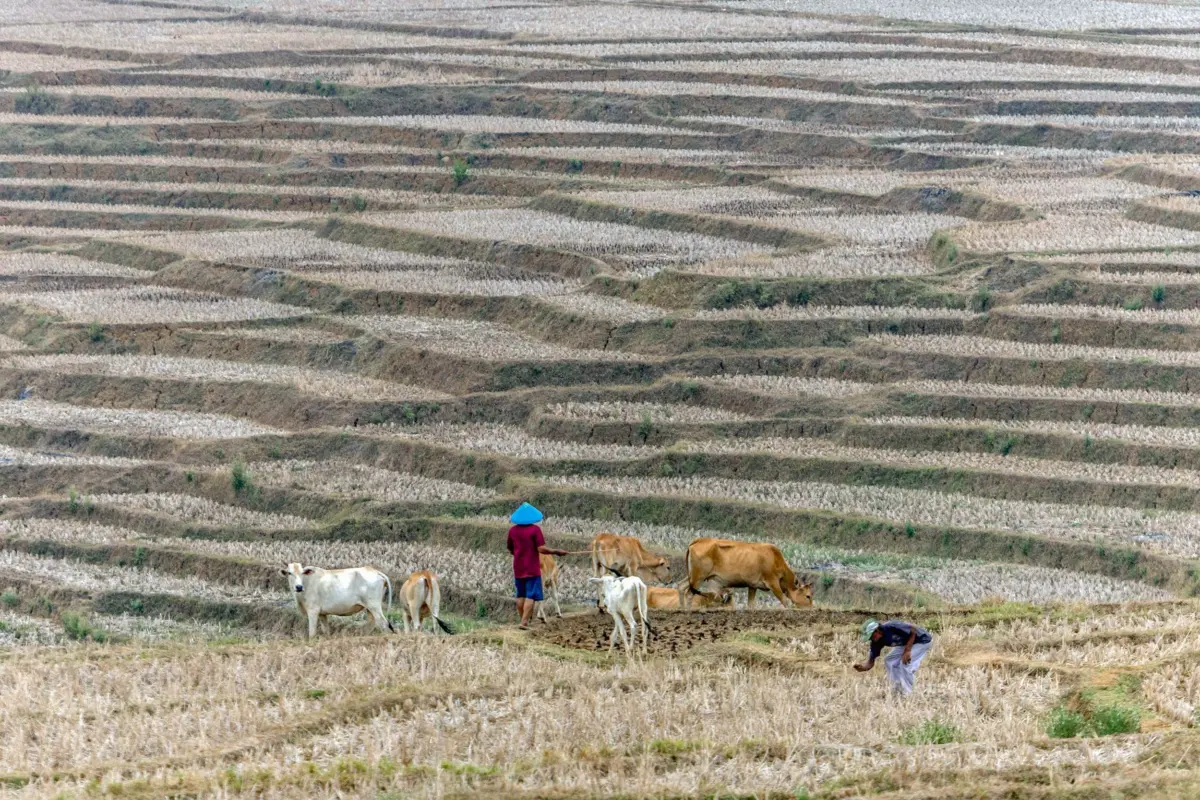
- Mid-Year (Summer to Fall): The impacts cascaded across agricultural belts worldwide. In Indonesia, severe droughts dried up the Kapuas River, forcing palm oil mills to halt purchases from local farmers. In Cambodia, a severely delayed monsoon season parched rice paddies. Central America endured record summer temperatures alongside severe drought, threatening the region’s crucial second planting cycle. Meanwhile, Panama declared a national state of emergency as falling water levels restricted vessel traffic through the Panama Canal, choking the transit of global food shipments.
- Late Autumn (October Onward): Warming in the mid-tropical Pacific hit 3.5 degrees Celsius, obliterating the previous record of 2.75 degrees Celsius and pacing toward an unprecedented peak of nearly 4 degrees Celsius. Climatologists noted that this intensity makes the current event functionally comparable to a "Godzilla-sized" variant of historical patterns, with cascading impacts threatening to ripple through global supply chains well into 2027 and 2028.
Supporting Context & Metrics: The Science of El Niño and Agricultural Vulnerability
To understand the severity of the current crisis, one must examine the mechanics of the El Niño–Southern Oscillation. During an El Niño phase, unusually warm waters pool in the tropical Pacific Ocean, weakening prevailing trade winds and altering global patterns of atmospheric pressure. This shift triggers a domino effect across global weather systems, bringing severe drought to traditionally moist tropical regions—including parts of the Amazon, Australia, and Sub-Saharan Africa—while occasionally unleashing torrential rains elsewhere, such as in parts of the United States.
While both phases of the ENSO cycle disrupt agriculture, a prominent 2014 study published in Nature Communications demonstrated that El Niño affects a significantly larger proportion of the globe’s harvested land than La Niña. The study revealed that El Niño events tend to boost global soybean production by up to 5 percent due to favorable rainfall shifts in certain regions, but suppress global yields of maize, rice, and wheat by up to 4 percent.
At the regional level, however, the statistical averages are far more dramatic. For instance, since 1980, South Africa’s maize output has averaged roughly 28 percent below normal during El Niño years.

Stanford agricultural economist David Lobell notes that these localized shocks carry outsized weight because global food markets are already operating on razor-thin margins. "When markets are tight, then if there’s a drought somewhere, that’s a much bigger deal," Lobell explains. Average global food prices have trended upward for two decades, driven by compounding climate shocks.
Compounding these weather anomalies are structural economic vulnerabilities. A farmer facing an impending El Niño drought must make difficult decisions:
- Reduced Inputs: Unable to afford skyrocketing fertilizer prices driven by energy shocks, the farmer applies fewer nutrients to the soil.
- Acreage Reductions: Anticipating poor yields, the farmer plants less land and slashes seasonal labor hiring.
- Logistical Breakdown: If a harvest does materialize, the local river used for transport may be dried up, and regional ports may be damaged or bottlenecked by conflict.
- Livestock Collapse: Pastures wither, leaving cattle and draft animals without feed.
- Long-Term Degradation: Prolonged drought allows saltwater to infiltrate coastal aquifers, forcing communities to ration dwindling freshwater supplies while regional hydropower generation sputters.
Despite these harrowing localized realities, macro-level global production forecasts present a nuanced picture. According to the Famine Early Warning Systems Network (FEWS NET) and data from the United States Department of Agriculture (USDA), worldwide production of maize, wheat, and rice for the 2026–2027 season is projected to drop just 2.7 percent below the previous year’s figures—still marking the second-largest annual crop harvest on record.
"Globally, food supply is not of high concern," says FEWS NET advisor Amy Ostrander. "The concerns are production changes in some specific regions, such as Southern Africa, and food access." In short, systemic failures in distribution, soaring inflation, and localized production collapses mean that abundance in one part of the world offers little comfort to populations facing famine in another.
Official Statements and Expert Analysis
The convergence of meteorological extremes, economic shocks, and geopolitical conflict has prompted dire warnings from international leaders and scientific authorities.
Zeke Hausfather, a climatologist with Berkeley Earth, highlights the compounding nature of the current threat: "It’s a triple whammy of high fertilizer costs, high energy costs, and now massive droughts across the tropics. It’s not a great story." Commenting on the unprecedented ocean temperatures recorded in late 2026, Hausfather adds, "That’s scary. Broadly speaking, the more powerful the El Niño, the more powerful its effects on weather events, including droughts."
Richard Choularton, director of climate and resilience for the World Food Programme in Rome, emphasizes the deadliness of overlapping crises: "The confluence of drought and conflict drives some of the worst outcomes we see." Choularton points out that humanitarian organizations are increasingly ill-equipped to bridge the widening gap between need and available resources. During the 2022 drought in Somalia, the WFP successfully assisted 10 million people; under similar climate conditions today, severe funding shortages mean the organization can afford to reach fewer than one million individuals.
Meanwhile, international bodies have mapped out the highest-risk geographies. An analysis by the United Nations Food and Agriculture Organization (FAO) concludes that El Niño–prompted droughts will hit populations hardest in:
- The Sahel region of Africa
- Southern Africa
- South and Southeast Asia
- Central America’s Dry Corridor and the Caribbean
On the ground, humanitarian agencies are racing to deploy preemptive defenses. Because meteorologists can forecast El Niño developments nearly a year in advance—unlike sudden, erratic weather events—organizations have a unique window to protect vulnerable communities. The WFP has expanded its forecast-based financing programs, utilizing cash transfers and distributing tools like airtight grain storage silos (such as over 3,000 silos provided to farmers in Guatemala) to protect harvests from pests and moisture. By October, these early warning and assistance programs had reached roughly 28 million people across 15 countries.

However, these vital programs face a severe capital constraint. Global humanitarian aid funding plummeted by 30 percent in 2025 compared to its 2022 peak, and budgets continue to contract. Without adequate cash reserves, agencies struggle to pre-position emergency food supplies or secure long-term transport contracts ahead of impending climate disasters.
Future Outlook: Beyond 2026 and the Shadow of Climate Change
As the world navigates the immediate trauma of the 2026 super El Niño, scientists are already looking ahead to the long-term systemic consequences—and the portents are troubling.
Historically, the peaks of strong El Niño events are followed almost invariably by record-shattering global average temperatures. The anomalously hot years of 1998, 2016, and 2024 all followed immediately behind El Niño peaks in the preceding years. Climatologists project that while 2026 is exceptionally warm, 2027 will likely emerge as a globally historic, record-shattering year for heat.
Beyond the immediate cycle, underlying anthropogenic global warming continues to exert a permanent drag on agricultural productivity. Research published by Stanford’s David Lobell indicates that aggregate global yields of wheat, barley, maize, rice, and soybean are already roughly 5 percent lower today than they would be in a counterfactual world without human-induced climate change.
"To a lot of people, that sounds like a small number," Lobell observes. "But the kind of shocks that we talk about can be far smaller than that. It doesn’t take much of a supply shift to have an important effect on people’s lives."
While the localized weather anomalies driven by El Niño differ in geography from the permanent pressures of global warming, the current crisis serves as a critical diagnostic test for human civilization. It exposes the structural strengths—and fatal weaknesses—of modern agricultural supply chains.
Ultimately, the central question facing policymakers, economists, and agricultural scientists is not simply whether communities can survive a single anomalous weather event, but how much adaptation is possible when the baseline conditions of the planet’s climate continue to deteriorate. As Lobell notes: "That’s one of the big questions: How much can you adapt when the conditions are bad?"
Until global leaders reconcile the dual pressures of escalating climate instability and shrinking humanitarian aid commitments, the ghost of food insecurity will continue to loom large over an increasingly volatile world.