Executive Overview
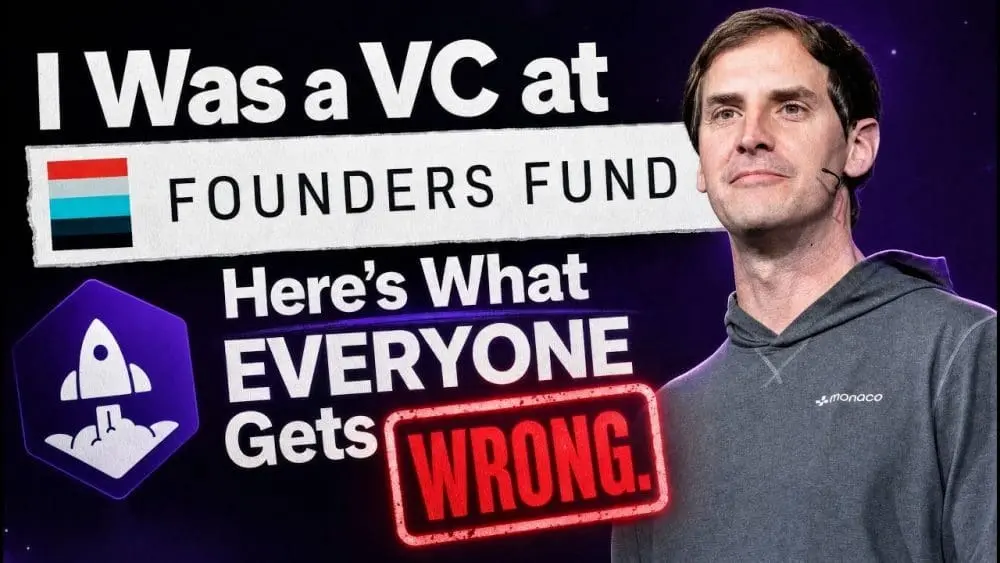
The intersection of artificial intelligence and Go-To-Market (GTM) software is currently experiencing a massive gold rush. As foundational models drop in cost and accelerate in capability, software startups are springing up overnight, promising to automate everything from prospecting to closing. Yet, according to Sam Blond—former Brex sales scaling maestro, Founders Fund partner, and co-founder of AI-native revenue platform Monaco—most of these startups are building on shaky foundations.
Having reviewed hundreds of pitches during his tenure at Founders Fund, Blond observed a persistent industry-wide delusion: founders building narrow point solutions disguised as companies, or chasing solutions in search of problems. Drawing from his unique vantage point on both sides of the venture capital table, Blond ultimately decided to put his theories into practice. Alongside his co-founders, he launched Monaco, an AI-native revenue platform for startups that managed to secure both its Series A and Series B rounds in the span of roughly four months.
At the recent SaaStr AI event, Blond delivered a masterclass dissecting the modern GTM landscape. His core thesis is both a warning and a roadmap: while AI drastically outperforms humans in specific, data-heavy operational tasks—such as Total Addressable Market (TAM) building, enrichment, and pipeline maintenance—it cannot replace foundational customer intimacy or creative brand-building. Furthermore, Blond argued that the traditional, piecemeal "tool-overload" era of B2B software is dead, replaced by the resurgence of the all-in-one platform enabled by rapid AI development cycles.
This article explores Blond’s comprehensive framework for navigating the AI GTM shift, examining his critique of startup traps, the exact line where human labor beats machine automation, and Monaco’s aggressive, monthly-cadence marketing strategy that turned a specialized B2B software company into a cultural talking point.
Detailed Chronology
The Venture Capital Vantage Point
Sam Blond’s journey to founding Monaco was forged in the trenches of hyper-growth. After scaling sales operations at fintech behemoth Brex, Blond transitioned to the investor side as a partner at Founders Fund. Because of his operational background in sales, a disproportionate share of AI GTM startups pitching the fund ended up on his calendar.
Reviewing hundreds of prospective companies gave Blond a panoramic view of the ecosystem’s systemic flaws. He noticed that founders were repeatedly falling into the same operational traps, leading to an over-saturation of superficial applications that failed to capture genuine enterprise value.
Recognizing an opening in the market for a unified, intelligent revenue platform, Blond transitioned from investor to operator once again. Partnering with elite technical talent, he co-founded Monaco. By leveraging their collective enterprise experience and the unprecedented velocity of AI-driven code generation, Monaco compressed its development timeline. The company built an expansive suite of capabilities—ranging from email sequencers and database providers to call recorders—in under 18 months, securing its Series A and Series B institutional financing rounds in a breathtaking four-month window.
Dissecting the Two Fatal AI Startups Traps
During his SaaStr AI presentation, Blond categorized the vast majority of the AI GTM startups he evaluated at Founders Fund into two distinct buckets of failure:
- The Feature Disguised as a Company: This trap occurs when a startup builds a tool so narrow that its functionality rightfully belongs as a native feature inside an existing system of record. Blond cited the hypothetical example of a startup designed solely to take unstructured call-recording text and populate CRM fields. While the workflow efficiency is undeniable—sparing human reps from tedious data entry—it is not a venture-scale company. It is a feature that CRMs or call-recording software will eventually absorb.
- The Solution in Search of a Problem: Popularized during the early days of generative AI, these are companies building technologically fascinating capabilities that no one actually requested. Blond pointed to startups that automatically generate a weekly AI video recap for sales reps, grading their performance and offering coaching tips. While novel on paper, market validation was entirely missing. When founders retreat to the classic Henry Ford defense ("customers don’t ask for it because it doesn’t exist yet"), Blond notes it is typically a red flag indicating a fundamental failure to conduct rigorous customer discovery.
Before writing a single line of code for Monaco, Blond and his co-founders conducted hundreds of deep-dive customer interviews to ensure they were falling into neither trap.
Supporting Context & Metrics
The Death of Tool Overload and the Rise of the AI-Native Platform
To understand why Monaco’s architecture represents a paradigm shift, one must examine the state of early-stage tech stacks. In conversations with hundreds of early-stage founders leading teams of roughly 12 people (including just one or two sales reps), Blond encountered a universal pain point: crippling tool overload.
A typical early-stage startup was forced to piece together a fragmented mosaic of best-of-breed software:
- A standalone CRM
- A third-party data provider
- An email sequencer
- A call recorder
- Various enrichment and prospecting tools
These teams frequently admitted they did not know how to properly utilize half the tools they were paying for, nor could they measure true ROI. Best-of-breed won the previous software cycle simply because building everything from scratch took too long and cost too much capital. No single company could afford to simultaneously build a CRM, database, sequencer, and analytics engine.
AI fundamentally changed the economics of software development. Monaco’s ability to build a comprehensive revenue platform in under 18 months proves that small teams can now ship what previously required hundreds of engineers and years of legacy development. This technological deflation makes the unified, all-in-one platform economically viable once more.
Architectural Timing: From Reactive to Proactive
Blond draws a direct historical parallel between the current AI wave and the structural shifts of past software eras. Just as Salesforce disrupted on-premise legacy systems like Siebel by capitalizing on the cloud transition, today’s AI-native platforms are unseating reactive SaaS giants.
Platforms like Salesforce, HubSpot, and Attio were architected to be reactive. A human user must log in, click buttons, type notes, and manually update fields for the system to register activity.
Conversely, Monaco was built from the ground up to be proactive. Autonomous agents execute tasks in the background before the user even opens the application. When a sales professional logs in, the user interface simply displays the actions the AI agents have already successfully completed on their behalf. Blond emphasizes that legacy, pre-AI architectures cannot simply be patched or retrofitted; they must be built from scratch to truly harness agentic workflows.
Official Statements & Industry Insights
Where AI Definitively Beats Humans in GTM
Blond’s operational philosophy is clear: if an organization spends human hours on tasks where artificial intelligence is already superior, it is structurally uncompetitive. He outlines six core GTM functions that should be completely offloaded to AI:
- TAM Building: The traditional model of human researchers crawling the web, filtering lists, exporting to spreadsheets, and manually prospecting on LinkedIn is obsolete. AI executes this mapping instantaneously and with higher fidelity.
- TAM Scoring: Using Monaco as an example—selling to a target market of 20,000 to 30,000 startups—not all accounts represent equal value. Variables like geographic location, headcount velocity, funding stage, and business model must be weighed. While a RevOps professional traditionally spent weeks building these models in spreadsheets, modern teams can define scoring logic in a prompt and apply it across an entire database within 48 hours.
- Data Enrichment: Autonomous agents continuously enrich every single account within the Total Addressable Market without human intervention.
- Signal Detection: At Brex, human reps manually combed through funding newsletters every morning to email newly capitalized startups. Today, AI detects funding announcements, executive hires, product launches, and website traffic spikes in real time, automatically routing these signals into active outbound sequences.
- Automated Multi-Channel Outbound: Outbound messaging—powered by scored TAMs and real-time signals—should run fully automated across email and LinkedIn channels. Human intervention is restricted exclusively to managing replies, overcoming nuanced objections, and booking meetings.
- Pipeline Maintenance: Opportunity creation, stage progression, CRM hygiene, and follow-up logging should derive organically from call transcripts and email threads. Manual data entry (e.g., clicking "+ New Opportunity" or dragging deals across pipeline stages) represents an inefficient waste of human capital.
The Irreplaceable Human Domain
Despite his zealous advocacy for automation, Blond is equally explicit about where artificial intelligence falls short:
- Relationship Building and Complex Enterprise Sales: Upmarket buyers purchasing complex software platforms (such as Monaco or NetSuite) do not want to negotiate with an AI avatar. They require human validation, strategic consultation, and complex trust-building.
- Creative and Operationally Complex Campaigns: Automated outbound creates a sea of sameness across competitive landscapes. To break through the noise, brands require human creativity and complex logistical execution—such as conceptualizing a viral marketing stunt or booking a banner plane to fly over a major industry conference.
The Founder’s Fallacy: Outsourcing GTM Entirely
One of the most pervasive mistakes technical, product-oriented founders make is believing that platforms like Monaco allow them to completely abdicate GTM responsibilities and retreat solely into product development.
Blond strongly warns against this mindset. AI does not remove the founder from Go-To-Market strategy; rather, it removes operational friction, freeing the founder to spend more time talking directly to customers. Product-market fit is discovered through human empathy and customer interaction, not hidden behind an automated code editor.
Future Outlook: Brand Momentum and the 30-Day Playbook
In a hyper-competitive software market where every competitor has access to the same automated outbound tooling, product differentiation alone is often insufficient. To capture market share, Monaco institutionalized a rigorous brand-building cadence: executing one major, unforgettable initiative every single month.
Inventing Momentum: The Monaco Invitational
When organic calendar milestones were sparse, Monaco actively engineered its own cultural moments. Recognizing that their name naturally evoked the world of high-stakes gaming, the company launched the Monaco Invitational—a high-end poker tournament featuring a $100,000 prize pool and an exclusive industry party in San Francisco.
This initiative generated immense organic press, social media buzz, and community goodwill. Blond stresses that these brand moments operate on a compounding, non-linear formula: $1 + 1 + 1$ does not equal $3$; it equals $4$. The splash of San Francisco billboards amplified the impact of the poker tournament, which in turn supercharged their presence at SaaStr, ultimately paving the way for a smooth Series B financing round.
The Tactical Execution Framework
Monaco’s repeatable monthly brand cadence operates on a strict operational timeline:
- Brainstorming and Concept Validation: Identifying high-impact, memorable stunts that break industry molds.
- Economic Justification: Evaluating expenses pragmatically. As Blond famously noted regarding their viral SaaStr stunt—flying a custom banner plane over the conference—while not every startup can afford aviation marketing, spending $15,000 on a banner plane to complement a $100,000 sponsorship represents a minor 15% budget increase that guarantees maximum share-of-voice and attendee mindshare.
- Execution and Compounding: Deploying stunts (such as money machines, live magicians, poker tables, and aerial banners) to ensure the brand dominates the physical and digital conversation.
Conclusion
Sam Blond’s playbook at Monaco signals a mature evolution in the AI software sector. The era of building superficial point solutions or hiding behind automated outbound is rapidly closing. Future market leaders will be defined by founders who deeply understand their target categories, leverage AI to eliminate administrative friction, remain relentlessly close to their enterprise customers, and execute creative, bold marketing strategies that cut through the digital noise. As the paradigm shifts from reactive software to proactive autonomous agents, the rules of scaling a B2B startup have been entirely rewritten—and Monaco is leading the charge.