Executive Overview
Managing containerized applications at scale on cloud architecture is frequently hampered by an operational tax: ingress networking configuration. For platform engineering teams operating on Amazon Elastic Container Service (Amazon ECS), spinning up a new microservice has historically meant enduring a repetitive, error-prone cycle of manual configuration.
For every new service deployed, teams have been required to provision and meticulously wire together Application Load Balancers (ALBs), AWS Certificate Manager (ACM) SSL/TLS certificates, AWS WAF web access control lists (web ACLs), and granular security groups. Furthermore, this infrastructure cannot merely be set and forgotten; platform teams must continuously maintain alignment between these perimeter components and the underlying workloads as services scale horizontally, undergo updates, or experience operational shifts.
This heavy per-service administrative burden directly impacts engineering velocity, slowing down software delivery pipelines. Worse still, it introduces a fertile ground for configuration drift, where disparate services across an organization drift away from compliance baselines, resulting in security gaps or fragile routing topologies.
To fundamentally alter this paradigm, Amazon Web Services (AWS) has announced the official launch of Amazon ECS Gateway. Designed as a brand-new, account-level resource, ECS Gateway completely reimagines ingress networking for containerized workloads. By dynamically provisioning and managing the requisite networking infrastructure on behalf of platform operators—with all underlying resources instantiated directly within the user’s AWS account—ECS Gateway abstracts away the tedious scaffolding of application networking. It establishes a definitive separation of responsibilities between platform engineers and application developers, optimizing infrastructure costs, securing traffic flows, and returning deployment velocity to modern software organizations.

Detailed Chronology: The Evolution of ECS Ingress and the Birth of the Gateway
The Traditional Paradigm and Its Friction Points
To understand the significance of ECS Gateway, it is vital to examine how container ingress has evolved. In the early days of container orchestration, platform teams relied on standard AWS CloudFormation templates, Terraform modules, or custom automation scripts to provision a dedicated Application Load Balancer for nearly every microservice, or at best, complex manual target group associations.
As microservices architectures scaled from tens of services to hundreds or thousands, this model began to buckle under its own weight.
- Deployment Delays: Application teams could not simply write code and push it to production; they had to wait for infrastructure pipelines to provision certificates, configure listeners, and set up load balancers.
- Cost Inefficiencies: Dedicating resources—or heavily managing fractional resources—across fragmented load balancing tiers created ballooning cloud bills.
- Operational Overhead: Every security patch, certificate rotation, or WAF rule update required synchronized updates across hundreds of independent resource stacks, heavily increasing the risk of human error and configuration drift.
Conceptualizing the Account-Level Resource
Recognizing these systemic bottlenecks, AWS engineering teams set out to build a native solution that shifts ingress management from an imperative, per-service chore to a declarative, platform-level capability. The conceptual framework of ECS Gateway relies on treating the gateway as a top-level, account-scoped administrative entity that can span multiple clusters, dynamically reacting to the lifecycle of container deployments.
Rather than forcing application teams to understand the nuances of target groups, listener rules, and certificate ARNs, ECS Gateway introduces a clean interface where infrastructure is automatically spun up upon service connection and systematically torn down when workloads are decommissioned.

The Architectural Blueprint: Behind the Scenes
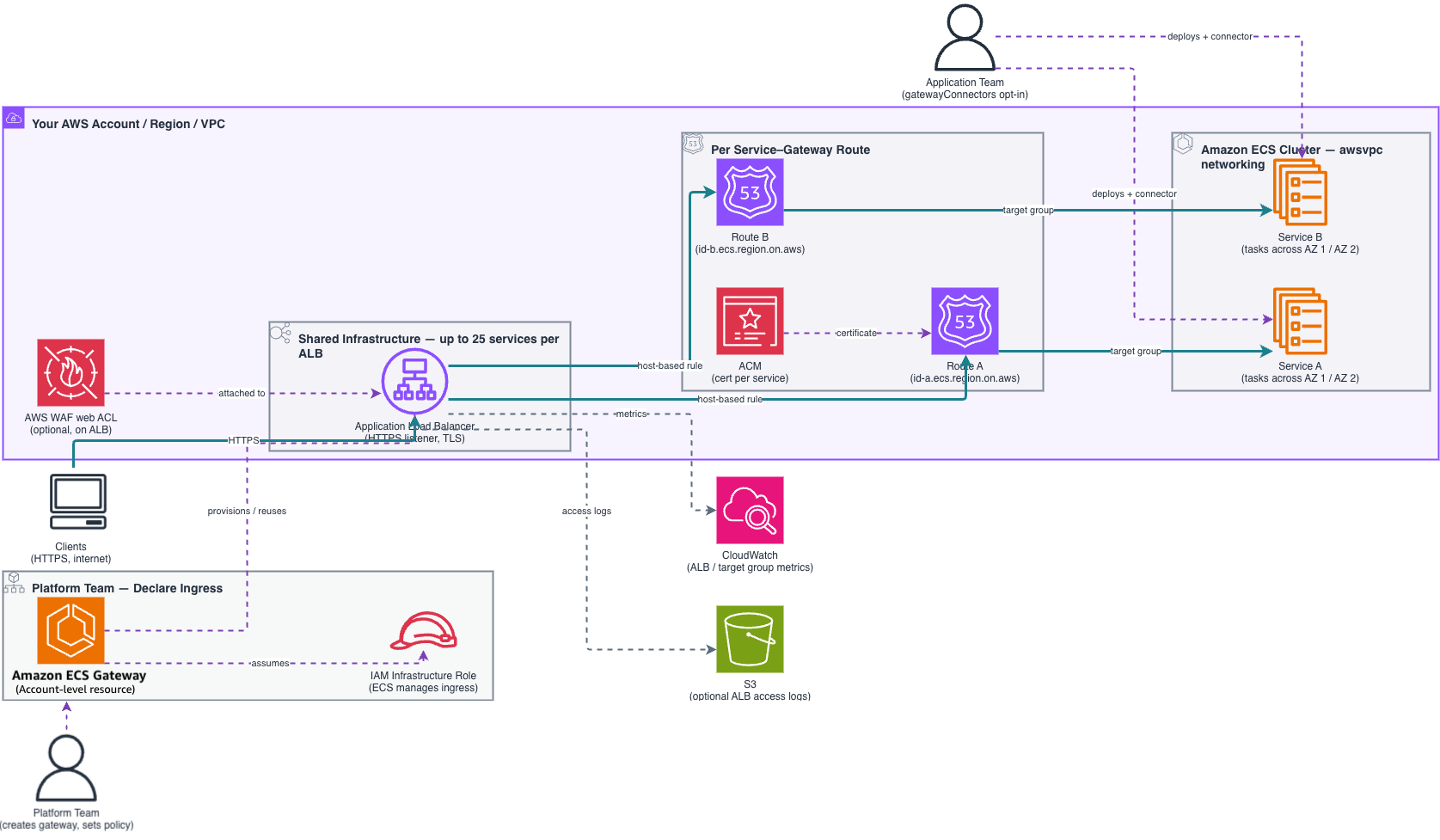
At its technical core, ECS Gateway leverages sophisticated many-to-many relationships between gateways, clusters, and load balancers:
- Cluster and Gateway Mapping: A single ECS Gateway can be associated with up to 10,000 distinct ECS clusters. Conversely, an individual cluster can support up to five distinct gateway associations. This architectural flexibility allows platform teams to segment traffic effortlessly—maintaining separate public and private gateways for the same cluster, or sharing a unified gateway across multi-environment clusters.
- Dynamic ALB Sharing and Host-Based Routing: ECS Gateway implements host-based routing via ALBs, permitting up to 25 unique microservices to share a single Application Load Balancer. This dramatically optimizes infrastructure costs by maximizing load balancer connection capacity.
- Automated Lifecycle Management: Amazon ECS manages the entire operational lifecycle of the underlying infrastructure. When the first service connects to a gateway, ECS automatically provisions the initial ALB. As services scale and approach capacity limits, ECS seamlessly provisions additional ALBs up to a user-defined maximum limit (
maxAlbCount). When services are removed, the underlying infrastructure scales down in lockstep. - Per-Service Provisioning: Upon successful deployment, ECS assigns the service to an available ALB and provisions the isolated per-service components: an ACM certificate for secure transport, a unique DNS hostname providing a ready-to-use endpoint instantly, listener rules routing traffic to the specific target group, and a dedicated service security group locked down to accept inbound traffic exclusively from the ALB security group.
Supporting Context & Metrics: Implementation and Operational Mechanics
Adopting ECS Gateway is designed to integrate smoothly into existing AWS workflows, supporting both console-based operations and automated Infrastructure-as-Code (IaC) or CLI deployments.
Getting Started via the AWS Console and CLI
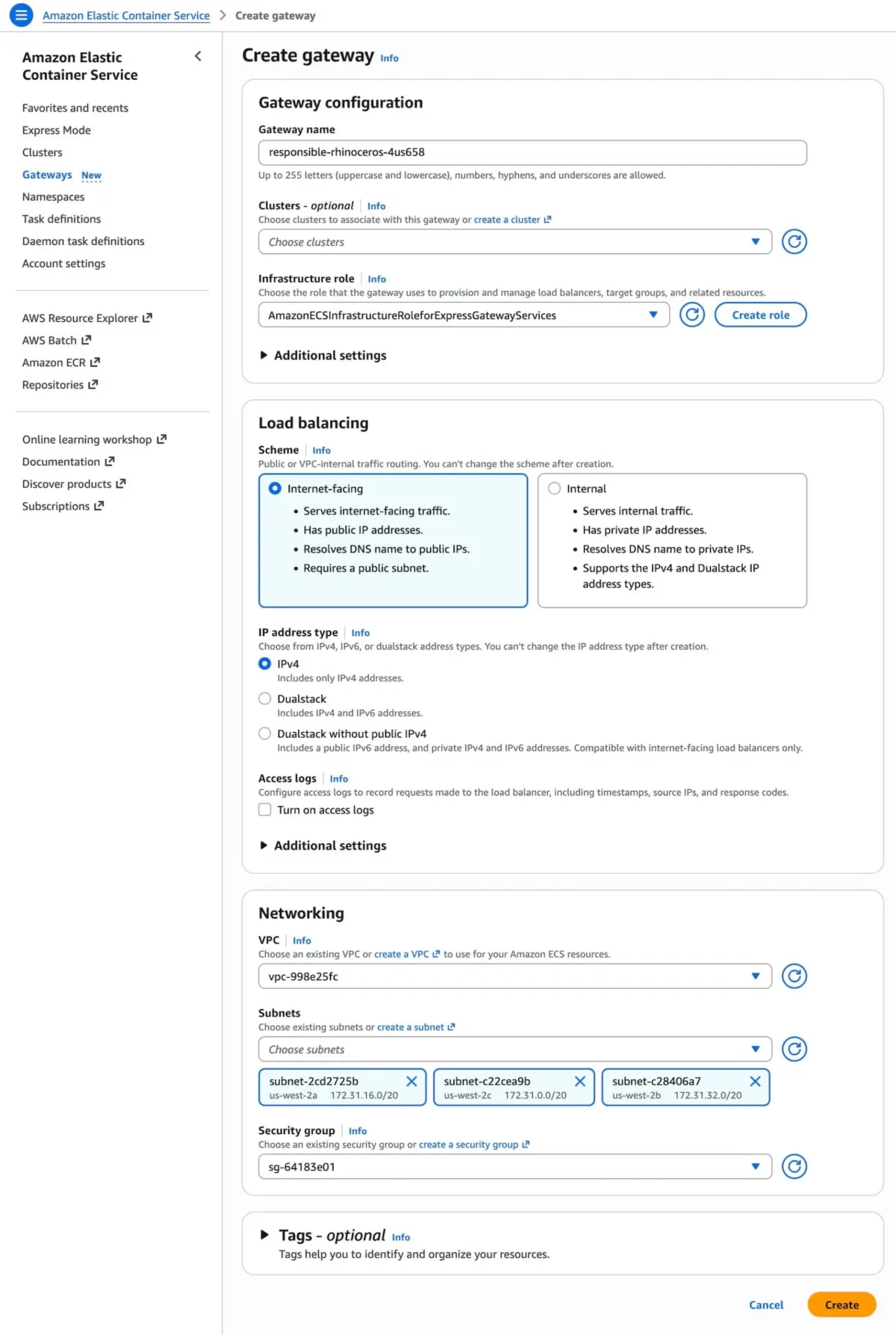
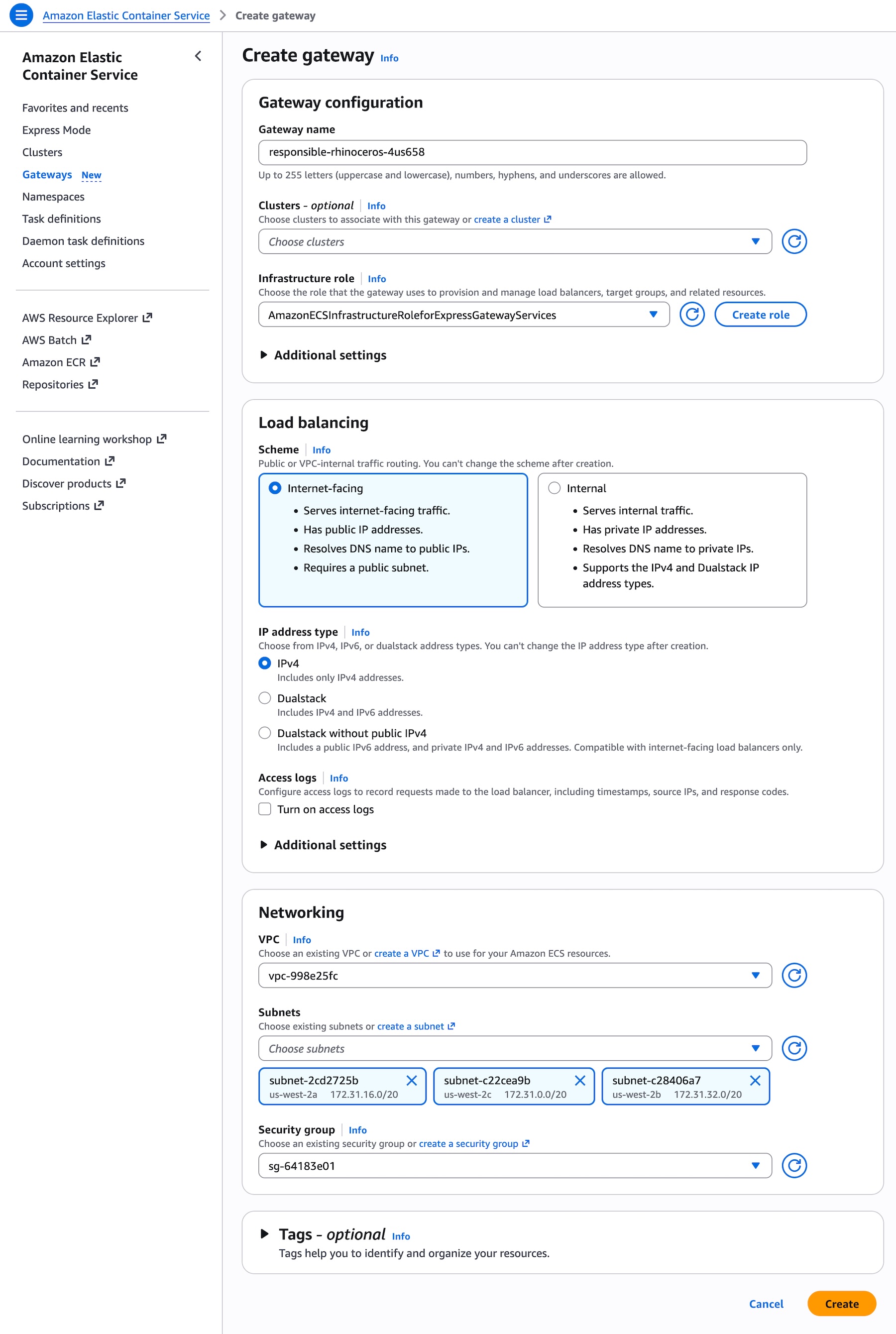
Platform teams begin by navigating to the ECS console to create a gateway, establishing an Infrastructure Role—an AWS Identity and Access Management (IAM) role that ECS assumes to provision and manipulate networking assets (ALBs, security groups, certificates) safely within the account.
Alternatively, automation-first teams can leverage the AWS Command Line Interface (AWS CLI) by executing the CreateGateway command:
aws ecs create-gateway
  --name my-team-gateway
  --infrastructure-role-arn arn:aws:iam::123456789012:role/ECSGatewayRole
  --configuration '
    "HostSharedAlb":
      "networkConfiguration":
        "subnets": [
          "subnet-080779f9bd887757a",
          "subnet-03d5b2fead6bc6258",
          "subnet-0861210a397d31252",
          "subnet-06539e194023cb77a"
        ],
        "ipAddressType": "ipv4"
      ,
      "scheme": "internet-facing"

  '
Once established, the gateway can be linked to designated clusters using the AssociateGatewayWithCluster API:
aws ecs associate-gateway-with-cluster
--gateway my-team-gateway
--cluster arn:aws:ecs:us-east-1:123456789012:cluster/my-cluster
Incremental Adoption for Legacy Services
For organizations with mature, sprawling production environments, "rip-and-replace" architectural migrations are rarely feasible. AWS has engineered ECS Gateway with incremental adoption in mind. If an organization operates an existing ECS service with its own legacy load balancer configuration, platform teams do not need to orchestrate a disruptive cutover.
Instead, teams can call UpdateService to inject a gateway connector alongside existing configurations. Both ingress pathways remain active concurrently, allowing engineers to thoroughly validate the stability, routing behavior, and security posture of the ECS Gateway connection before safely decommissioning the legacy load balancer infrastructure.
aws ecs create-service
  --cluster my-cluster
  --service my-api-service
  --task-definition my-api-service:1
  --gateway-connectors '[ "portName": "api", "filters": "accessTypes": ["PUBLIC"], "healthCheck": ... ]'
Official Statements and Industry Perspectives
The introduction of Amazon ECS Gateway marks a philosophical shift in how cloud-native infrastructure is governed. By bridging the eternal divide between developer autonomy and platform governance, AWS is addressing pain points that have frustrated enterprise platform engineers for years.
"When platform teams manage containerized applications at scale on Amazon ECS, configuring ingress networking for each service often becomes a bottleneck," noted platform architecture specialists at AWS during the feature unveiling. "With Amazon ECS Gateway, we are shifting the burden of infrastructure choreography away from developers and custom scripts, embedding intelligence directly into the orchestration layer. Platform teams define the guardrails, and ECS handles the complex orchestration automatically."
Industry analysts have similarly lauded the release, pointing out that as enterprises grapple with the rising complexity of microservices, developer experience (DevEx) has become the primary metric of engineering efficiency. By reducing the number of moving parts required to expose a secure, load-balanced container endpoint, AWS is significantly lowering the barrier to entry for robust cloud architectures.
Furthermore, integration with modern tooling—such as the AWS MCP Server and associated AI coding tool plugins—allows engineering organizations to create, query, and manage ECS Gateway resources programmatically via conversational AI and automated workflows, signaling a leap forward in AI-assisted cloud operations.
Future Outlook: The Next Wave of Container Networking
As cloud-native ecosystems continue to mature, the boundary lines between application code, infrastructure provisioning, and security compliance are increasingly dissolving. The release of Amazon ECS Gateway points toward a future where infrastructure is entirely demand-driven, reactive, and invisible to the application developer.
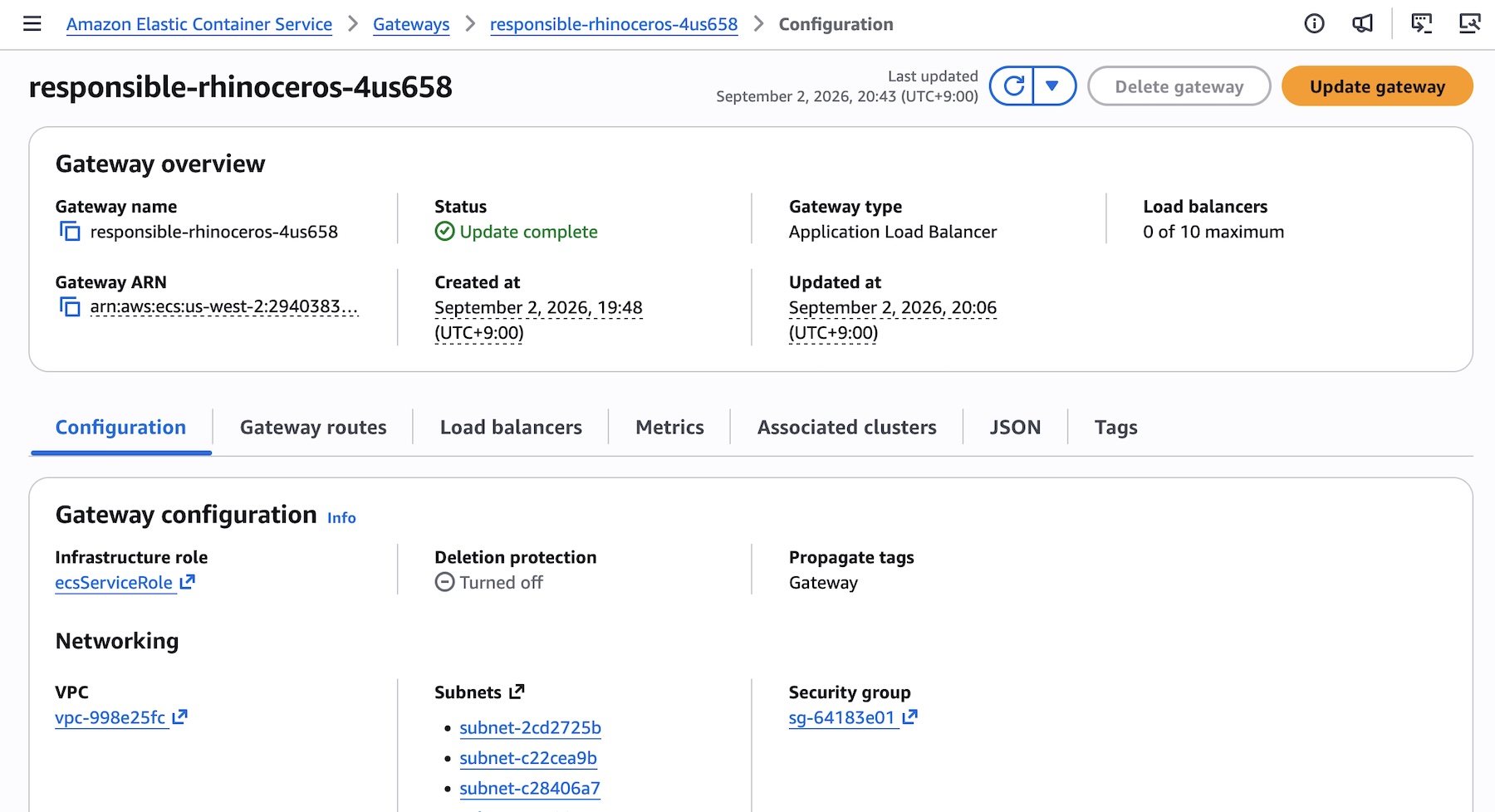
Looking ahead, we can anticipate several evolutionary paths for this technology:
- Deepened Mesh and Edge Integration: As service meshes and advanced edge routing protocols proliferate, features akin to ECS Gateway will likely expand deeper into multi-region disaster recovery scenarios and advanced traffic-shaping topologies (such as canary and blue/green routing orchestrated entirely at the gateway level).
- Expanded Governance Policies: Enterprises will demand even more granular policy controls, allowing security teams to enforce mandatory WAF configurations, strict mutual TLS (mTLS) enforcement, and automated compliance auditing directly through gateway templates.
- Pervasive AI Orchestration: With the integration of AI-driven control planes via Model Context Protocol (MCP) servers, developers will increasingly rely on natural language prompts to spin up secure, fully networked container services without touching raw JSON templates or CLI syntax.
Availability and Pricing
Amazon ECS Gateway is available starting today across all commercial AWS Regions where Amazon ECS is supported.
Crucially, ECS Gateway carries no additional software service charge. Organizations pay solely for the underlying AWS infrastructure provisioned dynamically within their accounts when services connect to a gateway. This includes standard Application Load Balancer hourly rates, CloudWatch logs and metrics consumption, AWS Certificate Manager certificate fees, and standard data transfer charges.
Platform engineers looking to reclaim deployment velocity, eliminate configuration drift, and slash operational overhead can begin provisioning their first gateways immediately via the Amazon ECS console.