Executive Overview
Decades after its final syndicated run concluded on December 31, 1995, Bill Watterson’s Calvin and Hobbes remains an untouchable titan of the comics medium. Spanning a decade of daily and Sunday newspaper layouts, the series chronicled the rich internal and external lives of Calvin—a precocious, anarchic six-year-old boy—and Hobbes, his pragmatic, sharp-witted plush tiger (who magically transformed into a living, breathing feline companion whenever adults were out of sight).
Watterson accomplished something rare in the history of syndicated cartooning: he maintained complete artistic control, refused corporate merchandising, and walked away at the absolute height of his creative powers. Within his body of work lies a masterclass in pacing, visual storytelling, and philosophical inquiry. While fans and critics alike have debated the finest overarching storylines, individual daily strips, or breathtaking Sunday layouts for years, a deeper analytical challenge remains. What is the single greatest panel—a single framed micro-moment measuring less than two inches tall—in the history of the strip?
To locate this high-water mark, an arbiter must weigh four essential pillars of Watterson’s artistry: humor, philosophical depth, genuine adventure, and visual duality. The search ultimately leads to a profound November 9, 1994 panel that encapsulates the very soul of the strip: a testament to human absurdity, wrapped in the quiet beauty of the autumn woods, featuring the two characters who defined a generation of readers.
Detailed Chronology: The Anatomy of a Masterpiece
To understand why a single panel from late 1994 stands as the pinnacle of Watterson’s career, one must retrace the chronological evolution of the strip and evaluate the various contenders that routinely surface in comic scholarship.
The Foundation: Dynamic Duos and Slapstick Origins
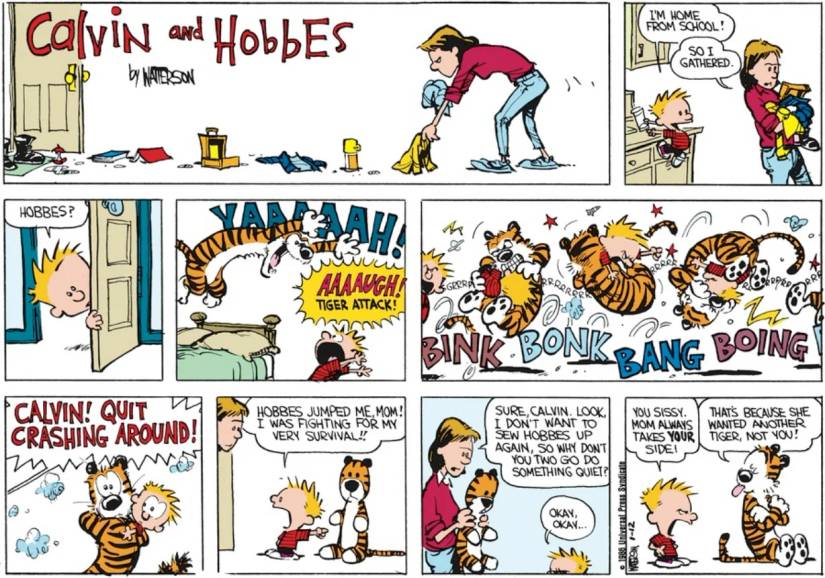
When Calvin and Hobbes debuted on November 18, 1985, its initial focus leaned heavily on dynamic kinetic movement and interpersonal friction. Early strips established the rhythm of Calvin’s daily existence: schoolyard daydreams, battles with his babysitter Rosalyn, and, most famously, Hobbes’ high-velocity ambushes.
Panels featuring Hobbes pouncing on Calvin—such as the iconic sequence from January 12, 1986—showcase Watterson’s brilliant knack for physical comedy and cartoon physics. In these moments, Calvin is instantly transformed from a defiant philosopher into a sprawling mass of flailing limbs and mud. While these comedic panels are undeniably hilarious, they represent only one half of the coin. A purely slapstick panel fails to capture the existential weight that eventually became the heartbeat of the strip.
Expanding the Mind: Cosmic Nihilism and Childhood Wonder
As the strip matured through the late 1980s and early 1990s, Watterson pushed the boundaries of what a newspaper comic strip could achieve. Calvin frequently found himself gazing into the night sky or sitting atop a snow-covered hill, grappling with profound, cosmic questions about mortality, human insignificance, and the vastness of the universe.
These panels often featured a stark shift in tone. Watterson utilized minimalist backgrounds or overwhelming expanses of black space to emphasize how small a six-year-old boy is in the grand scheme of creation. Yet, panels dedicated strictly to internal philosophical monologues sometimes lacked the crucial element of companionship; they were frequently solitary meditations rather than shared discoveries.

The Weight of Adventure and Naturalism
Conversely, Calvin and Hobbes was fundamentally an adventure series. Whether the duo was navigating the prehistoric jungles of Calvin’s imagination, plunging down a snowy hill in a rusted red wagon, or exploring the actual woods behind Calvin’s suburban home, physical movement was vital.
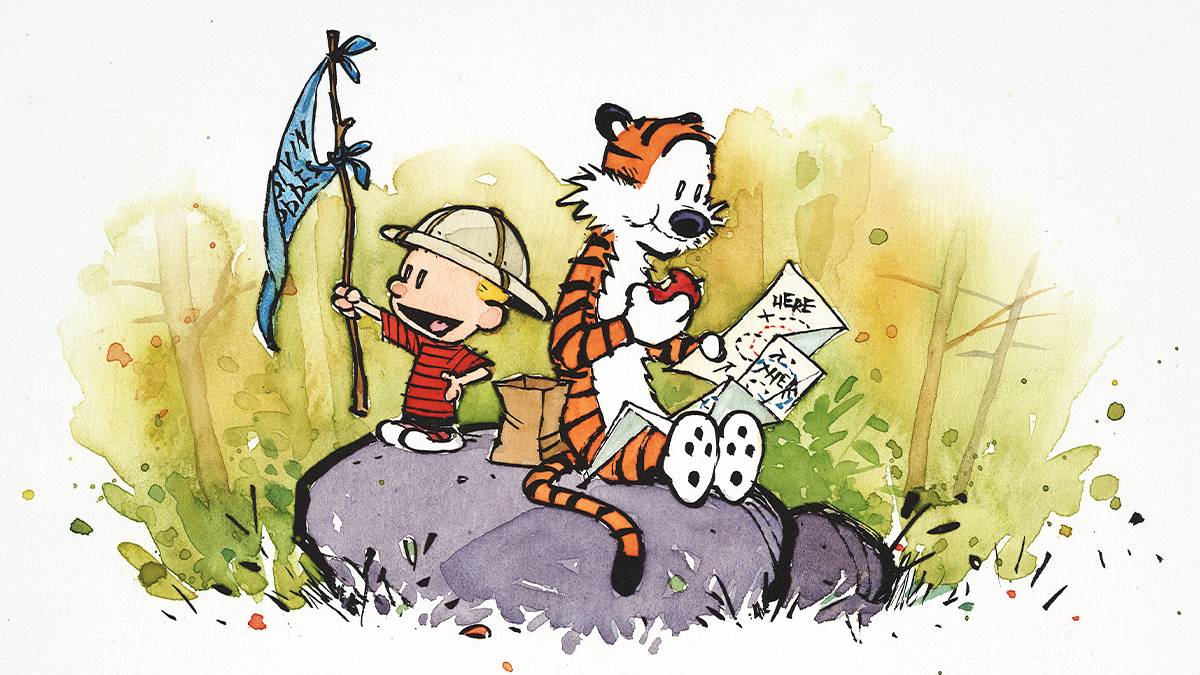
The wooded backyard excursions carry a special significance within Watterson’s bibliography. They served as a direct manifestation of his own deep reverence for the natural world and his increasingly vocal critique of suburban sprawl and environmental destruction. In these forest sequences, Watterson’s artistic duality shone brightest. He combined the simple, cartoony, almost rubbery character designs of Calvin and Hobbes with breathtaking, painterly backgrounds of dense foliage, shafts of sunlight, and meticulously inked tree bark. Paradoxically, the stark contrast between the simplified characters and the hyper-detailed environment never felt disjointed; instead, it grounded their fantastical reality.
Supporting Context & Metrics: The Winning Contender
Weighing the criteria—duo-centric framing, philosophical resonance, environmental texture, narrative self-sufficiency, and dry wit—eliminates many of the usual suspects.
Consider, for instance, the emotionally devastating storyline involving Calvin finding an injured baby raccoon. While profoundly tender, those panels are devoid of comedy and fail to capture the spirit of adventure. Consider also Watterson’s legendary Sunday strips, where he routinely shattered the traditional grid structure, letting panels bleed into one another, turning the page into a swirling vortex of dinosaurs, spaceships, or winter wonderlands. While gorgeous, judging a single panel within a structural layout can feel like pulling a single brushstroke out of a Rembrandt painting; it relies entirely on the architectural triumph of the surrounding Sunday page.
This brings us directly to November 9, 1994.
+-------------------------------------------------------------------------+
|                                                                         |
|   "Sometimes I think the surest sign that intelligent life exists       |
|    elsewhere in the universe is that none of it has tried               |
|    to contact us."                                                      |
|                                                                         |
|                                     [Calvin & Hobbes sitting quietly]   |
|                                                                         |
+-------------------------------------------------------------------------+
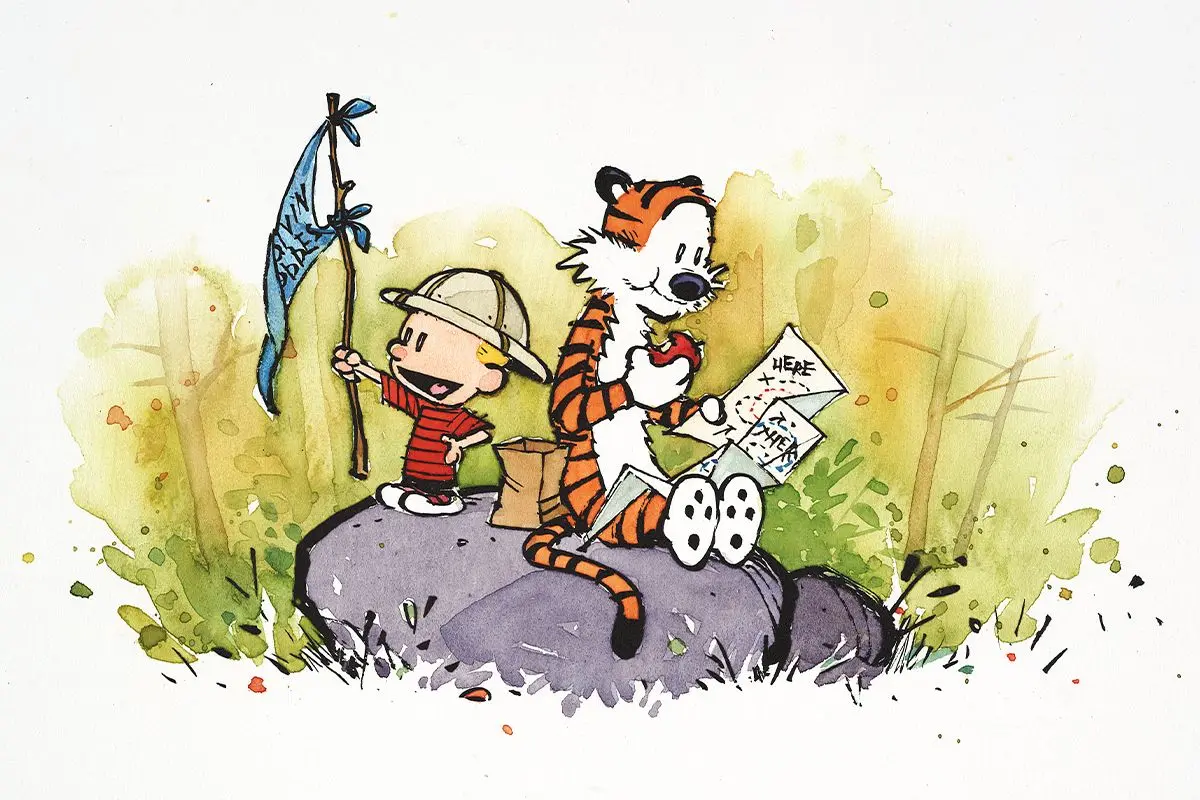
Within this single, self-contained panel, Watterson achieves complete harmony. Set against a lush, atmospheric backdrop of the forest, Calvin and Hobbes sit side-by-side, their backs turned or their faces obscured, perfectly embodying shared contemplation.
The accompanying dialogue is a masterclass in misdirection and gentle misanthropy: "Sometimes I think the surest sign that intelligent life exists elsewhere in the universe is that none of it has tried to contact us."
It is simultaneously laugh-out-loud funny and devastatingly profound. It distills humanity’s collective existential dread and cynical self-awareness through the mouth of a six-year-old boy sitting in the dirt with a stuffed tiger. It requires no setup, relies on no prior narrative context, and captures the essence of Watterson’s worldview in a single frame.
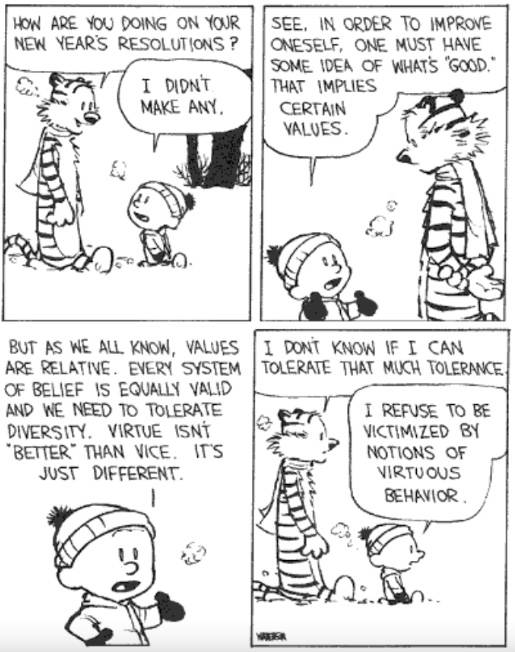
The Runner-Up: The Final Panel
No discussion of Calvin and Hobbes iconography is complete without examining the final panel of the final strip on December 31, 1995. Depicting Calvin and Hobbes launching off a snowy slope on their sled into a pristine, white expanse—with the parting words, "Let’s go exploring!"—it remains one of the most emotionally resonant images in pop culture history.
However, from a purely analytical standpoint, that final panel benefits heavily from retrospective emotional weight. We love it because we know it is the end. Furthermore, it is not particularly funny. Watterson’s genius throughout the decade was his ability to balance high-brow philosophical melancholy with biting, absurd humor. The November 9, 1994 panel maintains that crucial comedic element while still achieving artistic and philosophical transcendence.
Official Statements and Archival Legacy
While Bill Watterson has famously maintained a reclusive public profile since the conclusion of the strip—granting only rare interviews and occasionally surprising the art world with unannounced projects (such as his 2023 graphic novel The Mysteries)—his thoughts on the medium are well-documented in books like The Calvin and Hobbes Tenth Anniversary Book.
In his written reflections, Watterson repeatedly emphasized the struggle to keep a daily comic strip fresh while maintaining a high standard of hand-drawn illustration. He fought tirelessly with newspaper syndicates to preserve larger panel sizes, arguing that visual breathing room was essential for humor to land and for emotional beats to resonate.
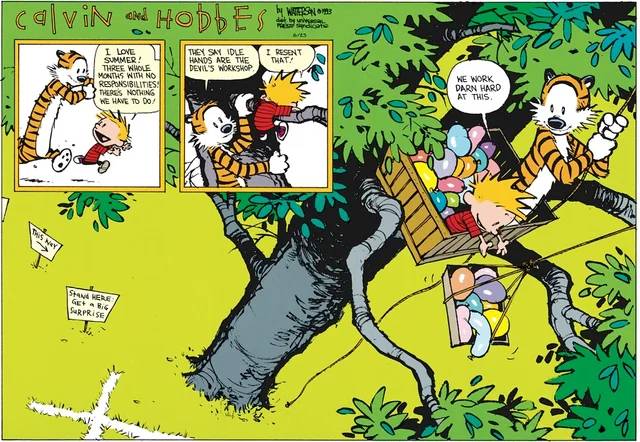
Cartooning historians and contemporary comic artists frequently cite Watterson’s work as the gold standard of newspaper syndication. Cartoonist Stephan Pastis (Pearls Before Swine) has frequently noted how Watterson pushed the medium to its absolute limits, proving that comics could function simultaneously as high art and low comedy. The November 9, 1994 panel serves as the physical manifestation of that philosophy: a testament to what can be communicated when brilliant writing meets uncompromising draftsmanship.
Future Outlook: The Enduring Cultural Footprint of Watterson’s Vision
As physical newspapers continue to decline in circulation and the daily comics page shifts further into digital archives, the cultural footprint of Calvin and Hobbes has only expanded. Collected anthologies like The Complete Calvin and Hobbes occupy prime real estate on bookshelves worldwide, introducing successive generations of children and adults to the adventures of the boy and his tiger.
The enduring debate over what constitutes the "best" panel, strip, or storyline proves that Watterson’s creation is not a static artifact of the late 20th century, but a living, breathing literary landscape. Readers project their own childhood memories, philosophical growth, and cynicism onto Calvin’s snowy hillsides and sunlit woods.
Ultimately, the November 9, 1994 panel stands as an enduring monument to Watterson’s genius because it respects the intelligence of its audience. It acknowledges that life is strange, humanity is flawed, the universe is terrifyingly vast, and the best way to process it all is to sit in the dirt with your best friend, look out at the trees, and share a dry laugh about the quiet solitude of existence.