Amazon Web Services (AWS) has announced a major architectural expansion for its serverless compute portfolio by introducing native Graphics Processing Unit (GPU) support for EC2 G-series instances running on AWS Lambda Managed Instances (LMI). This development marks a departure from traditional infrastructure paradigms by removing the operational friction typically associated with GPU-accelerated computing.
Historically, deploying high-performance workloads—such as machine learning inference, complex scientific simulations, high-resolution media processing, and real-time data rendering—demanded tedious infrastructure management. Organizations had to manually provision virtual machines, reconcile divergent GPU drivers, manage CUDA toolkit versions, build complex cluster topologies, and engineer custom scaling architectures. With this release, AWS enables developers to execute GPU-accelerated workloads with native serverless simplicity.
By packaging GPU functions as standard Open Container Initiative (OCI) images, AWS Lambda now handles automatic resource provisioning, horizontal scaling, and seamless native event integration. Developers are freed from the burdens of hardware management, allowing them to focus entirely on application logic. Furthermore, the architecture addresses the long-standing economic inefficiency of GPU compute—where under-utilization leads to excessive cloud expenditures—by consolidating concurrent workloads onto shared execution environments. This makes high-performance GPU compute accessible, cost-effective, and deeply integrated into the modern serverless ecosystem.
Detailed Chronology
The integration of GPU support into AWS Lambda Managed Instances is the culmination of years of iterative feature releases aimed at bridging the gap between traditional EC2 flexibility and serverless operational models.
The Evolution toward Serverless GPU Compute
For years, cloud architects faced a difficult architectural compromise. They could deploy monolithic, self-managed Amazon EC2 GPU fleets—retaining granular control over hardware configurations at the cost of operational overhead—or they could utilize fully managed serverless architectures that historically lacked the hardware accelerators necessary for heavy deep learning and graphics processing tasks.
While third-party serverless GPU providers emerged to fill the void, they frequently operated outside the native AWS perimeter, creating silos regarding security, identity and access management (IAM), virtual private cloud (VPC) networking, and event source integrations.
The introduction of Lambda Managed Instances (LMI) laid the groundwork for overcoming these limitations by offering Amazon EC2 pricing and specialized compute capabilities without requiring server management. Building directly upon this foundation, AWS engineering teams spent the subsequent development cycle designing a container-native execution framework capable of routing high-throughput, latency-sensitive tensor operations directly to physical GPUs while preserving the scaling semantics of AWS Lambda.
Step-by-Step Implementation Workflow
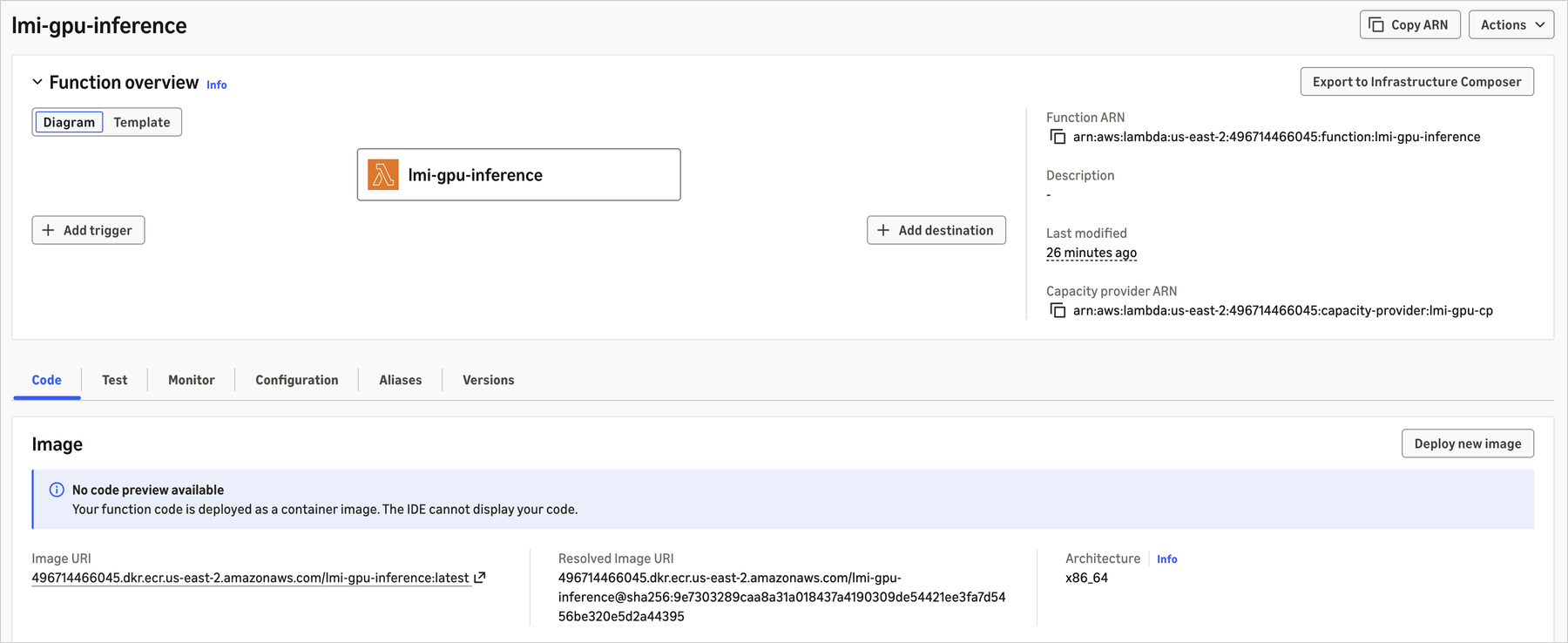
To evaluate the practical viability of this release, engineers and developers can deploy and configure a GPU-accelerated LLM endpoint in approximately ten minutes. The workflow follows a structured four-phase process:

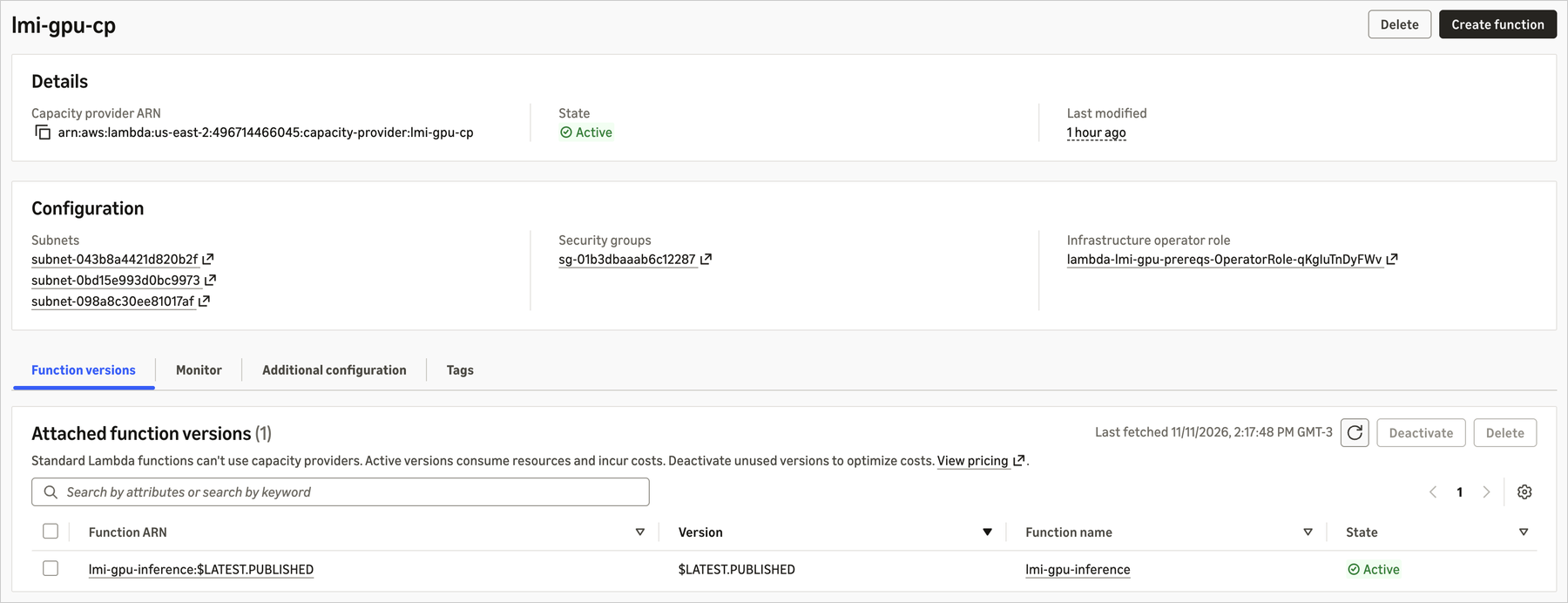
- Capacity Provider Configuration: The developer establishes a capacity provider (
lmi-gpu-cp) via the AWS Command Line Interface (CLI) or console, defining allowable instance types (such asg5.2xlarge,g6.2xlarge, andg6e.2xlarge), VPC subnets, security groups, and automated scaling thresholds. Listing multiple instance types ensures that Lambda can automatically select the most cost-effective and available hardware, minimizing the risk of Insufficient Capacity Errors (ICE). - Container Image Deployment: Utilizing AWS-curated vLLM base images (
public.ecr.aws/lambda/deep-learning-containers/vllm:cuda-v1), developers avoid writing custom inference server code. The base image incorporates PyTorch, the Transformers library, the CUDA toolkit, and a runtime interface client. The container is built, tagged, and pushed to Amazon Elastic Container Registry (ECR). - Function Creation and Parameter Tuning: The Lambda function is initialized using the pushed image URI. Essential parameters are defined: the
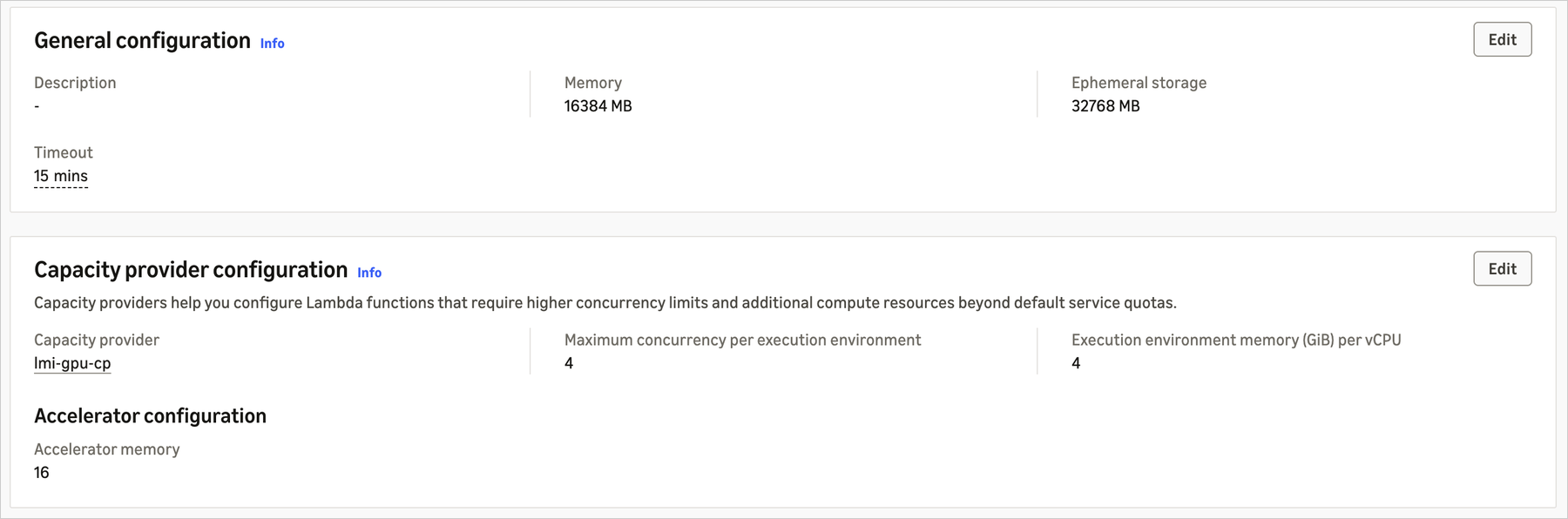
MODEL_IDenvironment variable points to a repository (such as a Hugging Face instruction-tuned model likeQwen/Qwen2.5-1.5B-Instruct),AcceleratorConfigspecifies the minimum required GPU memory, and concurrency parameters dictate how execution environments share underlying hardware. - Publishing and Invocation: Publishing a version triggers the initial cold start, during which execution environments are provisioned, model weights are downloaded, and the inference engine warms up. Subsequent invocations query the live endpoint using standard payloads, executing requests efficiently on the underlying physical hardware.
Supporting Context & Metrics
The economic and technical advantages of serverless GPU execution become clear through a detailed examination of resource utilization metrics, technical specifications, and workload economics.
Solving the GPU Utilization Dilemma
In traditional cloud architectures, provisioning a dedicated GPU instance for unpredictable or sporadic inference tasks often results in severe economic waste. A typical small inference task may saturate only a fraction of a GPU’s memory and compute capacity, yet the organization is billed for 100% of the instance.
AWS Lambda Managed Instances resolve this mismatch through intelligent container consolidation and execution environment sharing. By setting the PerExecutionEnvironmentMaxConcurrency parameter, multiple concurrent requests are batched by the underlying inference server (such as vLLM) against a single, shared copy of the model residing in GPU memory. This maximizes the utilization of every accelerator dollar spent, driving throughput up while keeping operational costs proportional to actual workload demand.
Architectural Limits and Technical Specifications
GPU-accelerated functions on Lambda Managed Instances inherit robust operational boundaries designed to support demanding enterprise workflows:
- Timeouts: Extended function timeouts of up to 90 minutes are supported for asynchronous and event source mapping invocations, accommodating heavy batch processing, multi-step inference, and complex media transcoding.
- Storage & Memory: Functions support container image sizes up to 32 GB (with a 10 GB per-file limit), up to 32 GB of NVMe ephemeral storage in
/tmpfor model weights, and 2,048 to 32,768 MB of general memory. Accelerator memory allocations range from 3 to 48 GB. - Concurrency: Up to 48 concurrent requests can be processed per execution environment, backed by up to 15,000 vCPUs per capacity provider.
- Lazy Loading: Seekable OCI (SOCI) lazy loading technology allows functions to begin execution before container images are fully downloaded, reducing startup latency by up to 70%.
Comprehensive Observability via Amazon CloudWatch
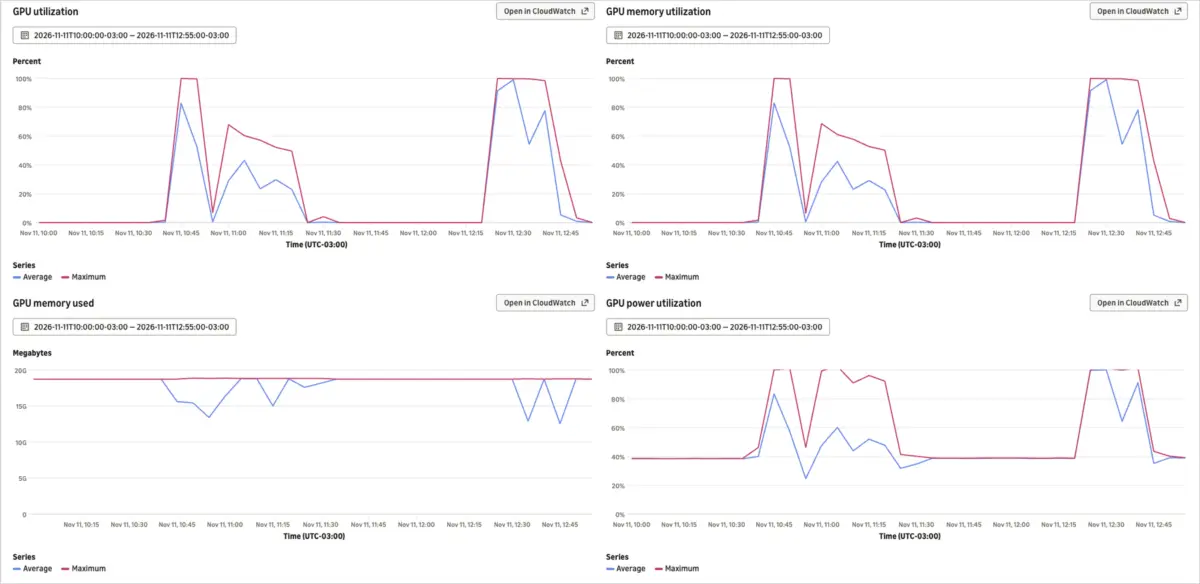
Monitoring high-performance workloads requires deep visibility into hardware telemetry. AWS has integrated granular GPU metrics directly into Amazon CloudWatch and the AWS Lambda console. Administrators can track four critical performance indicators alongside standard execution metrics:
- GPU Utilization: Measures the percentage of time over the past sample period during which the GPU kernels were actively processing.
- GPU Memory Utilization: Tracks the proportion of total available accelerator memory currently consumed by model weights, KV caches, and runtime allocations.
- GPU Memory Used: Provides absolute numerical data regarding megabytes consumed within the accelerator.
- GPU Power Utilization: Monitors electrical draw, serving as a reliable proxy for compute intensity and thermal load under heavy concurrent traffic.
Official Statements
While direct quotes from individual executives highlight the strategic vision behind this launch, the overarching technical philosophy of the engineering team emphasizes the elimination of undifferentiated heavy lifting.
Industry analysts and AWS product managers have underscored that serverless computing has matured past the point of being merely a CPU-centric paradigm. By extending the serverless model to hardware accelerators, AWS is directly addressing customer demands for infrastructure simplification.
An AWS spokesperson noted during the rollout: "Customers have continually pushed us to deliver the scalability, event-driven agility, and zero-administration benefits of serverless computing to specialized hardware. By abstracting away driver reconciliation, CUDA version matching, and cluster orchestration, we are empowering developers to treat GPUs not as complex infrastructure projects, but as simple, callable functions capable of powering the next generation of intelligent applications."
Furthermore, technical documentation emphasizes that this capability is optimized for custom model inference and specialized computational tasks rather than massive foundation model training or pre-trained models already natively serviced by managed platforms like Amazon Bedrock. This positioning ensures that organizations retaining proprietary, fine-tuned, or open-source models can integrate them seamlessly into existing event-driven architectures without incurring the friction of self-managed container fleets.
Future Outlook
The introduction of GPU support for Lambda Managed Instances signals a fundamental shift in how cloud-native applications will be engineered over the coming decade. As artificial intelligence, machine learning, and data-intensive rendering techniques become standard across virtually every industry vertical, the demand for agile, responsive, and cost-effective acceleration will only intensify.
Integration with Modern Application Patterns
Looking forward, these GPU-accelerated functions are expected to serve as foundational building blocks within advanced architectural patterns, particularly agentic workflows and multi-step orchestration. By combining Lambda Durable Functions with Lambda MicroVMs, developers can construct sophisticated autonomous systems. For instance, a lightweight CPU-based MicroVM can execute complex tool-use logic and decision trees, instantly invoking a GPU-accelerated function for heavy inference tasks when complex semantic processing is required.
Expanding Hardware Ecosystems and Regional Availability
At launch, support spans the Amazon EC2 G-series families (including G4dn, G5, G6, G6f, Gr6, Gr6f, and G6e). However, industry observers anticipate rapid expansion into other specialized accelerator families as AWS continues to scale the underlying Lambda Managed Instances infrastructure. This modularity ensures that as new generations of silicon emerge—offering higher tensor throughput, improved energy efficiency, and denser memory configurations—developers will be able to adopt them simply by updating their capacity provider configurations without rewriting core application code.
Ultimately, this release closes the historical divide between high-performance computing hardware and serverless software design. By streamlining deployment pipelines, reducing operational overhead, and introducing precise economic controls, AWS has established a new benchmark for how modern, AI-driven applications will be built, scaled, and operated in the cloud.