May 3, 2018
By Investigative Desk
Executive Overview
In the wake of a cultural reckoning that has toppled powerful figures across Hollywood, media, and politics, the national conversation surrounding workplace sexual misconduct is increasingly shifting away from the executive suites and elite boardrooms. Instead, it is illuminating the often-overlooked vulnerabilities of blue-collar and frontline service environments.
Nowhere is this stark reality more apparent than at telecommunications giant Comcast. Following months of mounting public pressure, former call center and dispatch employees have stepped forward to expose what they describe as a deeply entrenched corporate culture of harassment and systemic retaliation.
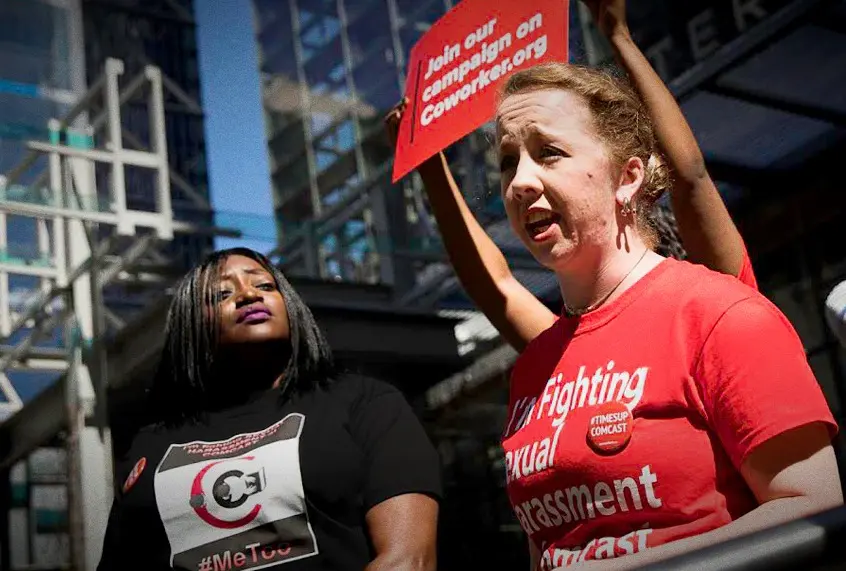
At the center of this movement are women like Laterrica Perry and Rylinda Rhodes—former frontline workers who claim their careers and mental health were systematically dismantled after they reported inappropriate sexual advances and physical misconduct by supervisors. On Wednesday, May 2, 2018, these women and their allies traveled to Comcast’s corporate headquarters in Philadelphia to deliver a petition via Coworker.org. Signed by more than 4,000 individuals—including dozens of current and former Comcast employees—the petition demands that CEO Brian Roberts take decisive action to address workplace harassment and overhaul the company’s internal reporting mechanisms.
Despite corporate denials and executive refusal to meet with the petitioners, these workers are determined to dismantle a system they argue has consistently protected perpetrators at the expense of victims.
Detailed Chronology: The Ordeals of Laterrica Perry and Rylinda Rhodes
The public confrontation at Comcast’s headquarters is the culmination of years of alleged institutional apathy, personal trauma, and retaliation. The experiences of Perry and Rhodes highlight a recurring pattern: victims of workplace harassment facing professional isolation, denial of benefits, and eventual termination after stepping forward.
Laterrica Perry: The Memphis Call Center Case
In July 2017, 30-year-old Laterrica Perry, then a sales representative at a Comcast center in Memphis, Tennessee, made the difficult decision to file an anonymous report with the company’s Human Resources department. Armed with text message logs, phone records, and other evidence, Perry detailed months of relentless inappropriate behavior by her direct supervisor, which included unwanted sexual advances and explicit comments.
Rather than receiving immediate protection, Perry alleges that her supervisor began a campaign of retaliation after she repeatedly rejected his passes. He allegedly denied her rightful sick time and withheld a critical letter of recommendation necessary for her career progression.
While Perry submitted comprehensive evidence, she states that Human Resources dragged its feet, taking until October 2017 to finally terminate the supervisor. By that point, however, the damage to her professional reputation within the company had already been done.
The psychological toll was severe. Perry was diagnosed with Post-Traumatic Stress Disorder (PTSD) resulting directly from the hostile work environment she endured. She was placed on disability leave through March 2018, causing a devastating drop in her income that forced her to take a financial hardship withdrawal from her 401(k) retirement account to stay afloat.
"I’ve been having regular therapy sessions, my psychiatrist helps, and being medically regulated has helped me for the most part," Perry shared in an interview with Salon.
Her nightmare did not end with her medical leave. On April 30, 2018, while waiting for formal separation paperwork to process, Perry discovered through an unexpected email that Comcast had quietly finalized her termination.
"The only information I got was via email saying that they had proceeded with the actual separation, but I didn’t get the actual package that showed why I was separated," Perry explained. "I received everything, as far as my COBRA coverage, my 401(k) information. The only thing that I had not received is the explanation for my termination. I kind of felt like that was something suspicious."
Rylinda Rhodes: The Philadelphia Dispatch Center Case
Perry’s battle mirrors the struggles of Rylinda Rhodes, a former dispatch representative who worked across four different Comcast call centers between 2007 and 2012. Rhodes alleges she experienced verbal and physical sexual harassment at nearly every facility where she was employed.
The harassment culminated on August 1, 2012, when Rhodes was fired after reporting that a coworker had entered her office and physically groped her breasts. During the company’s internal investigation, Rhodes was told to apply for alternative roles within the company while she was on short-term medical leave, seeking talk therapy for trauma induced by the workplace environment. Ultimately, she received a termination letter citing health reasons—a justification she fiercely disputes. Rhodes has since filed an ongoing lawsuit against Comcast.
Reflecting on her ordeal, Rhodes noted that the hardest part of the process was overcoming the psychological manipulation and self-doubt engineered by management.
"The shame and embarrassment came from feeling powerless that this happened," Rhodes recalled. "I listened to what my supervisors and managers said, like, ‘Hey, you’re sensitive,’ and I started believing that I was the problem. That was one of the hardest things to go through. Then I realized, ‘No, you are not too sensitive,’ ‘No, you’re not a prude.’… There are rules set in place to prevent this, and they did not follow the rules."
Supporting Context and Metrics: Beyond the White-Collar Reckoning
While the #MeToo movement has successfully dismantled the careers of powerful men in high-profile industries like journalism, entertainment, and politics, labor experts point out that the daily reality for millions of blue-collar and service-sector workers has received far less scrutiny.
Data from the U.S. Equal Employment Opportunity Commission (EEOC) highlights the hidden scale of the issue. Between 2005 and 2015, approximately 1,200 complaints of sexual harassment were filed within the information sector alone—an industry encompassing telecommunications giants like Comcast. Because frontline workers often lack the job security, union protection, or legal resources of their corporate counterparts, reporting misconduct frequently acts as a career-ending gamble.
Furthermore, Comcast’s broader corporate family, NBCUniversal, has faced intense public scrutiny regarding a series of high-profile #MeToo scandals. These include multiple allegations of sexual misconduct against former Today show host Matt Lauer, as well as subsequent accusations levied against veteran NBC News anchor Tom Brokaw. Against this corporate backdrop, the grievances raised by call center representatives in Memphis and Philadelphia underscore a disconnect between executive-level crises and the lived experiences of everyday employees on the ground.
Official Statements and Corporate Response
Faced with mounting pressure from the Coworker.org petition—which garnered signatures from more than 4,000 supporters, including over 100 current and former Comcast employees and customers—corporate executives chose not to meet with Perry, Rhodes, and their supporters when they arrived in Philadelphia on May 2.
Nevertheless, representatives from Comcast have previously defended the company’s anti-harassment protocols. In a statement provided to Jezebel in February 2018 regarding the initial wave of allegations, Jenni Moyer, Senior Director of Corporate Communications at Comcast, stated:
"Sexual harassment, or harassment of any kind, is not tolerated at Comcast. The company was founded on a foundation of respect, integrity and trust. We have strong policies against sexual and other forms of harassment and encourage employees to report any harassing behavior. Any allegation of harassment is taken very seriously."
Activists, however, argue that these corporate policies exist merely on paper and fail to protect workers from localized retaliation by middle management. Rhodes pointed out that despite executive refusal to engage with the petitioners on Wednesday, the public delivery of the petition remains a significant milestone.
"It’s still a win. It lets them know people are watching and coming forth," Rhodes said. "It’s also for the ones that are still suffering. To know they are not alone. We are just getting started. All women should have the freedom to be their authentic self and not a scared version because of sexual harassment."
Future Outlook: A Voice for the Voiceless
As the campaign moves forward, the outlook of its two primary figures diverges regarding corporate reform, but remains unified in the mission of peer empowerment.
Rhodes remains cautiously optimistic that public pressure will eventually force Comcast to evaluate and overhaul its internal procedures. "I feel like that they can actually make some changes. I feel like they can improve," she noted, fondly recalling her early, positive experiences at her very first Comcast location.
Conversely, Perry expresses deep skepticism that Comcast leadership is genuinely open to structural change or reconciliation with victims. "I have doubts that Comcast will be open to meeting with us and be open to resolving the issue that they have with sexual harassment," Perry admitted.
Despite their different expectations of corporate repentance, neither woman expresses regret for breaking her silence. By shining a light on the dark corners of the telecommunications industry, Perry and Rhodes view their struggles as part of a larger, necessary cultural shift.
"What I’m doing is giving a voice to the voiceless. I’m also empowering people to step forward and say if something happens to them, whether it be at Comcast or any other corporation," Perry reflected. "That’s my silver lining." She plans to dedicate her future efforts to building support networks and resources for women navigating the treacherous aftermath of reporting workplace misconduct.
For Rhodes, the ultimate measure of success is simple: reaching even one isolated individual who believes they are alone in their suffering.
"The most important thing about this is sharing this to give hope to whoever is out there that feels lost, that feels like it was their fault, that feels shame and blame," Rhodes concluded. "I want them to know it is not their fault and that there are things that they could do to feel better and to be better. This does not have to define the rest of their lives."