Executive Overview
In the fast-paced ecosystem of artificial intelligence and digital content creation, few brand resurrections have been as unexpected—or as strategically ambitious—as that of LimeWire. Once internationally recognized in the mid-2000s as a notorious peer-to-peer (P2P) file-sharing client synonymous with the digital music piracy debates of the era, the platform has completely shed its legacy infrastructure. Today, LimeWire has re-engineered itself as a cutting-edge, generative AI-powered content publishing and monetization ecosystem known as LimeWire Studio.
This comprehensive transformation represents a significant shift in how digital creators leverage artificial intelligence. Unlike standalone text-to-image generators that function merely as tools for isolated artistic output, LimeWire bridges the gap between AI generation, decentralized web hosting, non-fungible token (NFT) minting, and robust ad-revenue-sharing models. By integrating sophisticated AI models—such as Stable Diffusion 2.1, Stable Diffusion XL, and DALL-E 2—alongside an upcoming suite for AI music and video production, LimeWire positions itself as a multifaceted economic engine for digital artists, designers, and musicians.
This report provides an exhaustive examination of LimeWire’s current platform architecture, its underlying Web3 integration via the Polygon and Algorand blockchains, its native cryptocurrency (LMWR), its tiered subscription pricing models, and its strategic outlook in an increasingly crowded generative AI marketplace.
Detailed Chronology & Platform Evolution
To fully understand the current iteration of LimeWire, it is necessary to trace its trajectory from a decentralized file-sharing application to a regulated, creator-focused Web3 platform.
The 2000s: The P2P Pioneer
Founded in 2000, LimeWire operated as a Java-based file-sharing client that utilized the Gnutella network. At its peak, it was one of the most downloaded pieces of software globally, fundamentally altering how consumers discovered and shared music. However, persistent legal battles with the Recording Industry Association of America (RIAA) culminated in a landmark 2010 federal court ruling that forced the shutdown of the original P2P client due to copyright infringement facilitation. For over a decade, the brand lay dormant, remembered primarily as a relic of early internet culture.
The 2022–2023 Rebirth: Entering the Creator Economy
The brand was acquired by new ownership with a vision to repurpose the trusted household-name recognition for the modern creator economy. In 2022, LimeWire re-emerged not as a file-sharing network, but as a digital collectibles marketplace. By early 2023, as generative AI captured global attention, the platform pivoted aggressively toward AI content creation.
This pivot allowed the platform to capitalize on the explosive growth of tools like Midjourney and DALL-E, while addressing a critical gap in the market: creator monetization. Rather than just offering image generation, LimeWire built an infrastructure where generated assets could instantly be published, monetized, and traded.
Mainstream Adoption and Web3 Integration
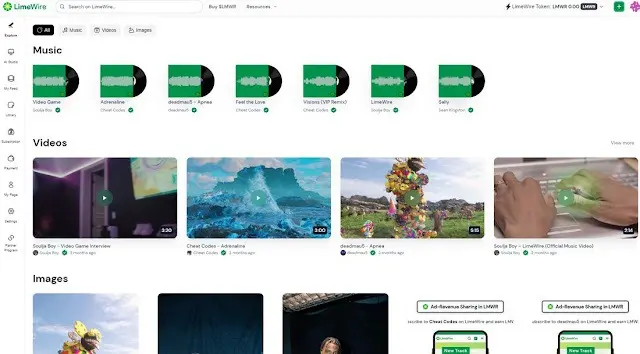
As LimeWire Studio matured, it successfully attracted notable mainstream and electronic music artists—including high-profile figures such as Deadmau5, Soulja Boy, and Sean Kingston. These artists began leveraging the platform to publish exclusive digital content, multimedia art, and NFT music drops directly to their fanbases, proving that the revamped platform could attract professional talent alongside amateur digital designers.
AI Image Generation Tools & Technical Capabilities
At its operational core, LimeWire Studio functions as an advanced, multi-model generative AI platform. Rather than relying on a single proprietary engine, the platform offers users access to several industry-standard and cutting-edge machine learning frameworks.
Supported AI Models and Artistic Flexibility
LimeWire currently supports a robust suite of generative models, including:
- Stable Diffusion 2.1
- Stable Diffusion XL (SDXL)
- DALL-E 2
This multi-model integration ensures that users are not locked into a single stylistic output. Creators can easily transition between different foundational models to achieve specific artistic goals. Furthermore, LimeWire offers granular control over design styles, enabling users to generate content across diverse aesthetic categories:
- Cinematic: High-contrast, dramatic lighting suitable for conceptual storytelling.
- Digital Art: Clean, vector- or raster-based illustrations optimized for digital displays.
- Pixel Art: Retro-styled graphics catering to indie gaming and nostalgic niches.
- Anime: Distinct Japanese animation-inspired visual rendering.
- Analog Film: Textured imagery mimicking vintage photographic grain and color grading.
Granular Controls and Future Proprietary Models
Beyond style selection, the platform incorporates advanced sampling techniques and prompt-guidance settings. These tools allow both novice and professional creators to fine-tune the structural integrity, fidelity, and detail levels of their outputs.
Significantly, platform developers have confirmed that LimeWire is actively engineering its own proprietary AI model. This move will reduce reliance on third-party frameworks, protect users from external licensing shifts, and position LimeWire as a primary developer of generative AI technology rather than merely a distributor.
Monetization Infrastructure: NFTs, Ad-Revenue, and LMWR Tokens
The defining characteristic that separates LimeWire from consumer-grade AI tools like ChatGPT or standard versions of DALL-E is its comprehensive financial infrastructure. The platform treats every user-generated asset as a potential financial instrument.
+-----------------------------------------------------------------+
|                       LIMEWIRE ECOSYSTEM                        |
+-----------------------------------------------------------------+
         |                                                 |
         v                                                 v
+------------------+                             +-----------------+
|  AI Generation   |                             |  Monetization   |
+------------------+                             +-----------------+
  - SDXL, DALL-E 2                                 - Ad Revenue (70%)
  - Multi-style                                    - NFT Royalties
  - Custom Prompts                                 - LMWR Token Payouts
         |                                                 |
         +------------------------+------------------------+
                                  |
                                  v
                   +-----------------------------+
                   |    LimeWire Studio Hub      |
                   |  (Public & Subscriber-Only) |
                   +-----------------------------+
Automated NFT Minting via Polygon and Algorand
Once a creator finalizes an image, music track, or video within LimeWire Studio and chooses to publish it, the platform initiates an automated smart contract execution. Without requiring deep technical knowledge of blockchain development, the user’s creation is automatically minted as an NFT on either the Polygon or Algorand blockchain.
This automated minting process accomplishes two critical functions:
- Provenance and Authenticity: It establishes an immutable digital signature on the blockchain, verifying the creator’s ownership.
- Tradeability: It transforms the digital art piece into a liquid asset that can be bought, sold, or collected within the LimeWire community marketplace.
Flexible Publishing: Public vs. Exclusive Content
Creators retain total sovereignty over how their minted assets are distributed:
- Public Release: Content is made discoverable across the entire LimeWire ecosystem. Anyone can view, engage with, and trade these NFTs, maximizing community visibility and secondary-market velocity.
- Subscriber-Only Exclusivity: Creators can restrict access to their high-tier followers. Fans subscribe directly to a creator’s page, fostering a direct-to-consumer economic model.
The 2.5% Secondary Trading Royalty
To ensure sustainable long-term income for artists, LimeWire implements an automatic royalty structure. Whenever a creator’s digital asset is traded on the secondary market within the platform, the original creator receives a 2.5% royalty fee on the transaction. This mirrors the revenue models of top-tier NFT marketplaces while remaining fully automated.
Ad-Revenue Sharing and the LMWR Token Economy
In addition to NFT sales and subscriptions, LimeWire introduces a groundbreaking ad-revenue-sharing mechanism for digital designers and multimedia creators.
- The 70% Rev-Share Model: When users consume content (images, music, or videos) hosted on a creator’s profile, advertisements served alongside that content generate revenue. LimeWire distributes up to 70% of this ad revenue directly back to the content creator.
- LMWR Cryptocurrency: Creator earnings are disbursed monthly in LMWR, LimeWire’s native utility token. These tokens can be liquidated on major international cryptocurrency exchanges—including Kraken, ByBit, and Uniswap—or reinvested directly back into the platform to purchase additional prompt credits for AI generation.
Supporting Context & Platform Metrics: Pricing Tiers
LimeWire employs a freemium business model designed to lower the barrier to entry while offering high-capacity professional resources for power users, agencies, and enterprise-level digital artists.
| Tier Name / Cost | Monthly Credits | Est. Image Generations | Ad Revenue Share | Key Pro Perks |
|---|---|---|---|---|
| Free Tier ($0) | 10 credits | Up to 20 images/day | 50% | Basic community access |
| Basic Plan ($9.99/mo) | 1,000 credits | Up to 2,000 images | 50% | Pro badge, creation history, ad-free |
| Plus Plan ($29.00/mo) | 3,750 credits | Up to 7,500 images | 60% | Early access to new AI models |
| Advanced Plan ($49.00/mo) | 5,000 credits | Up to 10,000 images | 70% | Faster generation speeds |
| Pro Plan ($99.00/mo) | 11,250 credits | Up to 22,500 images | 70% | Maximum allocation & priority |
All paid tiers remove native platform advertisements, grant a verified Pro profile badge, maintain a comprehensive generation history log, and provide priority queue placement during peak server usage times.
Future Outlook & Strategic Roadmap
As the generative AI landscape matures, LimeWire’s roadmap indicates a clear intent to move beyond static imagery. The platform’s strategic expansion centers on two major technological verticals: AI Music Generation and AI Video Generation.
Expanding into Audio and Video
While image generation remains the primary engine of LimeWire Studio, the integration of AI-driven audio and video production tools represents a natural evolution for a brand historically rooted in the music industry. By allowing creators to generate original soundscapes, tracks, and short-form video content using simple text prompts—and subsequently minting them as multimedia NFTs—LimeWire aims to capture a larger share of the multi-billion-dollar creator economy.
Democratizing Digital Art vs. Regulatory Realities
LimeWire’s ultimate value proposition lies in its capacity to democratize advanced technology. By removing the technical complexities associated with smart contract deployment, cryptocurrency wallet management, and machine learning prompt engineering, the platform provides a unified interface for artistic expression and financial remuneration.
However, the platform will need to navigate ongoing industry challenges, including evolving copyright regulations surrounding AI-generated art, blockchain market volatility affecting LMWR token valuations, and intense competition from specialized tools like Midjourney, Runway, and Suno.
Conclusion
LimeWire’s reinvention from a controversial P2P file-sharing protocol into a sophisticated Web3 AI studio is one of the most fascinating corporate pivots of the digital age. By harmonizing state-of-the-art generative AI models with automated NFT minting, generous ad-revenue-sharing splits, and a functional token-based economy, LimeWire has built a compelling ecosystem. For designers, musicians, and digital creators seeking not only to create art but to monetize it effectively, LimeWire Studio stands out as a formidable and evolving force in the modern creative landscape.