EXECUTIVE OVERVIEW
In the fast-moving landscape of enterprise software, public markets frequently punish companies that miss their traditional growth metrics, even when overall financials remain superficially robust. Yet, rare is the instance where a board of directors executes a dramatic leadership upheaval while a company is pulling in $3.7 billion in revenue, beating consensus Wall Street expectations, and posting healthy earnings per share.
On November 12, 2026, HubSpot’s board of directors shocked the Software-as-a-Service (SaaS) sector by engineering a sweeping executive transition. Co-founder Brian Halligan stepped back into the captain’s chair as President and CEO, replacing Yamini Rangan, who resigned from both the chief executive role and the board of directors. Simultaneously, a financial changing of the guard was announced: Karen Burgess, formerly of Adobe, was tapped as EVP of Finance to succeed long-standing CFO Kate Bueker in early 2027.
The immediate backdrop to this executive coup d’état was not a catastrophic earnings miss—HubSpot’s Q3 2026 print delivered $3.81 EPS on $947.57 million in revenue, comfortably besting consensus estimates of $3.30 on $924.53 million. Rather, the board was responding to a profound structural tectonic shift beneath the surface: net-new customer additions had cratered by 50% over two quarters, Net Revenue Retention (NRR) had slipped to a precarious 101%, and the company’s pioneering seat-based go-to-market model was violently colliding with the economic realities of artificial intelligence and outcome-based pricing.
Halligan has framed his return not as a routine management succession, but as a "re-founding." His mandate is to tear down the traditional "Hub" architecture that built a multi-billion-dollar enterprise and transform HubSpot into what he terms a "Customer Harness Company"—an infrastructure layer designed not just for human users, but for autonomous AI agents.
DETAILED CHRONOLOGY: THE ANATOMY OF A LEADERSHIP SHAKE-UP
The timeline leading up to Halligan’s return reveals a mounting tension between traditional SaaS operating metrics and the disruptive demands of the generative AI era.
The Leadership Hand-Off
- November 12, 2026: The HubSpot board officially appoints co-founder Brian Halligan as President and CEO. Yamini Rangan steps down as CEO and board member, agreeing to stay on as an employee through December 1 to ensure a brief transition.
- November 30, 2026: Karen Burgess joins HubSpot as EVP of Finance, transitioning from her role as SVP and CFO of Adobe’s Creativity & Productivity unit.
- February 11, 2027: Burgess formally takes over the CFO reins from outgoing Chief Financial Officer Kate Bueker.
The Financial Disconnect
Just eight days prior to Halligan’s reinstatement, HubSpot reported stellar top-line and bottom-line figures for the third quarter of 2026. Under Rangan’s stewardship, the company’s scale had expanded exponentially: total customers surged from approximately 135,000 in September 2021 to over 311,000 by late 2026, while annual revenue scaled from $1.3 billion toward an expected $3.7 billion.
Yet, beneath this multi-year triumph of scale lay an alarming deceleration. Growth rates had dropped from 23.4% in Q1 2026 to 17.1% in Q3, with Q4 guidance signaling a further cool-down to 12% (projected revenue of $945M to $947M, effectively flat sequentially in what is historically HubSpot’s strongest quarter).
Faced with compressed expansion metrics and rapidly evolving market conditions, the board concluded that Rangan’s go-to-market playbook—optimized for seat-based expansion and traditional inbound marketing—was ill-equipped to navigate the next decade of AI-driven disruption. Only a co-founder with deep institutional equity and zero hesitation to cannibalize legacy products could push through the necessary structural violence.
SUPPORTING CONTEXT & METRICS: FIVE PILLARS OF THE HUBSPOT SHIFT
A deep dive into HubSpot’s Q3 2026 earnings report and SEC 10-Q filings illuminates the precise operational pressures that forced the board’s hand.
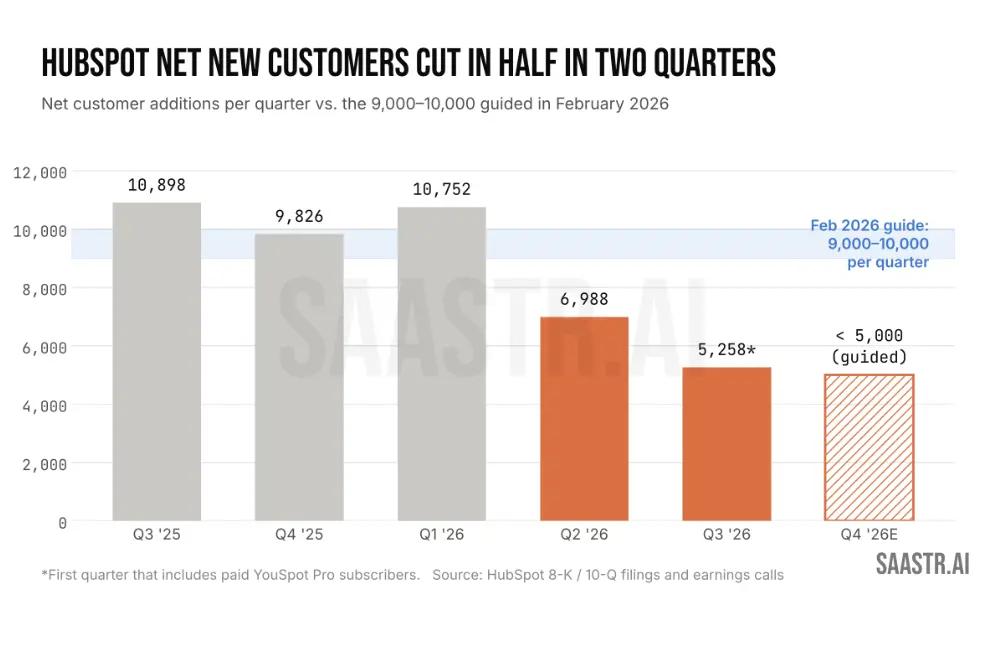
NET NEW CUSTOMER ADDITIONS (Q3 2025 – Q3 2026)
Q3 '25:  ■■■■■■■■■■ 10,898
Q4 '25:  ■■■■■■■■■  9,826
Q1 '26:  ■■■■■■■■■■ 10,752
Q2 '26:  ■■■■■■     6,988
Q3 '26:  ■■■■       5,258
1. The Net-New Customer Collapse
Net-new customer additions fell off a cliff, dropping from 10,752 in Q1 2026 to 6,988 in Q2, and sliding further to 5,258 in Q3—representing a 50% compression over two quarters. Furthermore, management guided Q4 net additions to land below 5,000.
In February 2026, outgoing CFO Bueker projected quarterly net additions of 9,000 to 10,000 customers. With actual Q1–Q3 additions hitting roughly 23,000 and Q4 tracking under 5,000, HubSpot is poised to land at least 8,000 customers short of the absolute floor of its initial annual plan.
Compounding this issue is a structural shift in the customer mix and organic top-of-funnel decay. HubSpot’s Q3 customer count included paid "YouSpot Pro" subscribers—a personal CRM for individual professionals—though the 10-Q offered no granular metrics on its exact impact. More critically, HubSpot’s own internal data revealed a 27% year-over-year decline in customers’ organic web traffic. As the very inventor of "inbound marketing," HubSpot found its own clients experiencing less inbound demand, reducing their immediate need for inbound tooling while simultaneously drying up the small-business arrivals at the top of HubSpot’s freemium funnel.
2. The Toll of Outcome-Based Pricing and AI Costs
HubSpot was an aggressive early mover in AI monetization, shifting products like the Breeze Customer Agent ($0.50 per resolved conversation) and Breeze Prospecting Agent ($1.00 per lead) toward pay-per-result pricing.
While strategically visionary, this transition inflicted immediate friction on the P&L. Risk factor language in the Q3 10-Q explicitly noted that pricing changes—including credit-based and outcome-based models—"have lengthened, and may continue to lengthen, sales cycles and resulted in lower initial contract values." Additionally, credit spend began cannibalizing traditional seat and hub spend.
International pilots in EMEA utilizing hybrid seat-and-credit models validated higher overall customer acquisition and credit consumption, but delivered lower initial revenue per customer. Simultaneously, AI inference and hosting costs bit into gross margins: non-GAAP subscription margins contracted from 86.7% to 85.4% as subscription and hosting expenses jumped by $23.2 million. HubSpot has effectively become the first $3B+ B2B software incumbent to publicly expose the harsh transitional P&L shape of outcome-based AI pricing.
3. Net Revenue Retention (NRR) Reversal
HubSpot’s Net Revenue Retention trajectory mirrored its slowing growth. After ticking up to 103.5% for the full year 2025 (up from 101.8% in 2024), NRR degraded steadily through 2026:
- Q1 2026: 103%
- Q2 2026: 102%
- Q3 2026: 101%
With customer dollar retention holding steady in the high 80s, an NRR of 101% means that upsell and expansion are barely offsetting natural churn and account downgrades. The seat-expansion flywheel that reliably drove 2025 revenue expansion stalled out under the weight of enterprise budget optimization and AI experimentation.
4. Margin Expansion, R&D Retrenchment, and Aggressive Buybacks
Faced with slowing top-line growth, management aggressively optimized the P&L for profitability. Non-GAAP operating income hit $214.2 million (a 22.6% margin), while operating margins expanded to 7.6% from 1.4% a year prior.
However, this margin leverage was achieved largely by squeezing R&D investment: R&D intensity dropped from 28.1% of revenue in Q3 2025 to 23.6% in Q3 2026, an almost 5-percentage-point cut during the most intense product architecture overhaul in company history.
Concurrently, HubSpot engaged in aggressive shareholder capital allocation. The company deployed roughly $980 million in share buybacks across the first three quarters of 2026 ($211M in Q1, $531.9M in Q2, and $237.2M in Q3), even as full-year free cash flow guidance was trimmed to $720 million. This capital return strategy occurred against a backdrop of severe stock depreciation; following the Q3 earnings print, HubSpot shares traded at $196.33, valuing the company at an enterprise market cap of $10.8 billion—a roughly 60% drawdown over 14 months for a business growing at 17% with 22%+ non-GAAP operating margins.
In October, the board authorized a restructuring plan resulting in the layoff of approximately 660 employees (7% of the workforce) and setting up $65 million to $75 million in restructuring charges slated primarily for Q4 2026.
5. Replacing a High-Performing CEO for a Paradigm Shift
Viewing Yamini Rangan’s departure as a penalty for poor execution is fundamentally incorrect. Rangan’s tenure was a masterclass in scaling execution: she successfully expanded customer counts, drove revenues toward $3.7 billion, expanded margins, and maintained operational discipline.
The board’s calculus was forward-looking rather than punitive. Rangan herself noted on the Q3 earnings call that enterprise buyers increasingly demand to test AI capabilities using their own data prior to purchase, while upmarket deals involve complex buying groups (CEOs, boards) that lengthen sales cycles and strain resources.
The board wagered that only a co-founder possesses the unique political capital required to break sacred product cows—such as the rigid "Hub" structure—and absorb multiple quarters of messy financial transitions without needing to appease short-term Wall Street consensus.
OFFICIAL STATEMENTS & INDUSTRY REACTION
The leadership shift prompted an outpouring of commentary across tech leadership circles, highlighting the parallels between HubSpot’s reboot and other iconic founder reinstatements.
In a widely discussed post on X (formerly Twitter), Dev Ittycheria—who successfully ran MongoDB for 11 years and took it from $35 million to over $2 billion in revenue before returning to the CEO seat elsewhere—drew sharp parallels to Halligan’s return.
Brian Halligan himself took to social media to characterize the move as a foundational reset:
"I just returned to @HubSpot as CEO… HubSpot is now a ‘Customer Harness Company.’"
Co-founder Dharmesh Shah echoed this sentiment, emphasizing that HubSpot is actively "rethinking and reimagining" its identity for the autonomous AI era. The core vision centers on moving beyond isolated software hubs toward an intelligent orchestration layer—manifesting in initiatives like Agent Hub, Breeze Assistant, a self-updating Smart CRM, and native CRM connectors for external AI models like OpenAI’s ChatGPT and Anthropic’s Claude.
FUTURE OUTLOOK: WHAT BRIAN HALLIGAN MUST DECIDE
As Brian Halligan reclaims the helm, his immediate strategic decisions ahead of the February 2027 guidance call will define the next decade of HubSpot’s existence. Three pivotal choices lie before him:
- re-evaluating Metric Disclosures: In an outcome-based pricing model, traditional net-new customer additions and Average Selling Price per Customer (ASRPC) are increasingly obsolete. Halligan must decide whether to stop guiding to net adds entirely and pivot investor disclosures toward API resolutions, credit consumption, and agent-driven transaction volumes.
- Restoring R&D Intensity: To execute a genuine re-founding rather than a superficial patch-job, R&D spend as a percentage of revenue must likely climb back toward the 30% threshold, accepting near-term margin dilution to fund core architectural reconstruction.
- Reallocating Capital: Continuing to funnel nearly a billion dollars annually into share buybacks while the core platform undergoes an AI-driven revolution makes little strategic sense. Capital must be redirected away from paper-value defense and directly into product engineering and aggressive market positioning.
What Do AI Agents Want in a CRM?
Ultimately, the existential question facing HubSpot—and the broader SaaS ecosystem—is deceptively simple: What do autonomous AI agents actually require from a CRM?
The answer breaks cleanly away from legacy SaaS paradigms. AI agents have zero use for human-designed UI/UX wrappers, drag-and-drop dashboards, or bloated multi-hub navigation menus. Instead, agents demand clean, highly structured data readable and writable via deterministic APIs; granular, unassailable security permissions; and immutable audit trails for every automated action taken.
HubSpot’s historic pivot signals a recognition that the future of enterprise software belongs not to those who sell seats to human workers, but to those who build the ultimate operational harness for autonomous intelligence. How Halligan navigates this uncharted transition will serve as the definitive bellwether for every legacy B2B software giant facing the AI cliff.