Executive Overview
The landscape of mobile accessory engineering has long been defined by a persistent, seemingly intractable thermodynamic challenge: heat. As smartphones push the boundaries of processing capability, display fidelity, and wireless connectivity, the accessories designed to keep them powered have had to evolve in tandem. Traditional wireless power banks, while offering the undeniable convenience of cable-free operation, have historically been plagued by efficiency loss. Because energy transfer via inductive charging naturally generates a significant thermal byproduct, devices inevitably trigger internal safety protocols, throttling charging speeds to prevent structural or battery degradation.
Enter the Anker MagGo Pro 2, a device that represents a paradigm shift in portable power solutions. Combining a robust 10,000mAh capacity with ultra-fast 25W MagSafe wireless capabilities and a sophisticated active cooling architecture, Anker has positioned this accessory as the fastest and thermally coolest wireless power bank currently available on the consumer market.
Coinciding with the peak of the Black Friday shopping weekend, this newly minted flagship accessory has entered the spotlight with a compelling promotional discount, dropping its standard retail price of $109.99 by 22% to land at an aggressive $85.99 on Amazon. Beyond raw power delivery—including a staggering 45W wired USB-C output and iPhone-specific optimization that can refuel an iPhone 17 Pro to 50% capacity in a mere 25 minutes—the MagGo Pro 2 introduces advanced telemetry via an integrated smart display, versatile physical form factors including a built-in kickstand, and a curated color palette designed to match contemporary smartphone aesthetics.
This comprehensive analysis examines the technical engineering, real-world utility, market positioning, and broader industry implications of the Anker MagGo Pro 2.
Detailed Chronology of MagSafe Power Development
To fully appreciate the engineering leap embodied by the MagGo Pro 2, it is necessary to examine the chronological progression of magnetic wireless charging ecosystems over the past half-decade.
The Inception of Magnetic Ecosystems
When Apple introduced the MagSafe standard with the iPhone 12 lineup, it fundamentally altered how consumers interacted with portable power. By integrating a ring of magnets around the device’s internal charging coil, Apple ensured precise spatial alignment every time an accessory was attached. This eliminated the inefficiency of traditional Qi wireless pads, where a minor misalignment could drastically reduce charging speeds or prevent energy transfer altogether.

However, first-generation MagSafe power banks were modest in ambition. Most operated at a conservative 5W to 7.5W output due to thermal constraints. Manufacturers quickly realized that pushing higher wattages through magnetic wireless connections caused localized heating that made the accessories uncomfortably hot to the touch and forced smartphones to aggressively throttle their charging intake to protect battery health.
The Push for Higher Wattage and Qi2
Over the subsequent product cycles, accessory manufacturers steadily increased wireless output speeds to 15W, aligning with official certification standards. The introduction of the global Qi2 standard further democratized magnetic wireless charging, paving the way for third-party ecosystems to match Apple’s proprietary performance metrics.
Despite these advancements, the fundamental law of thermodynamics remained an obstacle: higher wattage equaled more heat. While passive heat sinks, aluminum chassis designs, and graphitic thermal pads helped dissipate energy, they ultimately hit a performance ceiling. Power banks would inevitably heat up during extended charging sessions, causing charging speeds to plummet during the critical second half of a battery replenishment cycle.
The Anker MagGo Pro 2 Breakthrough
Anker’s release of the MagGo Pro 2 marks the commercial realization of active thermal management in a pocket-sized form factor. By integrating active cooling—typically reserved for high-performance gaming laptops, professional camera rigs, and high-wattage desktop charging stations—into a portable MagSafe battery, Anker bypassed the traditional thermal throttling ceiling. The device sustains peak performance levels over prolonged durations, effectively closing the performance gap between tethered wired charging and untethered wireless convenience.
Supporting Context, Metrics, and Technical Architecture
The feature set of the Anker MagGo Pro 2 is a masterclass in modern consumer electronics engineering, balancing raw power metrics with user-centric interface design.
Active Cooling: The Thermal Advantage
The defining characteristic of the MagGo Pro 2 is its active cooling system. Unlike passive power banks that rely entirely on ambient air and passive conduction to dissipate heat, this unit features an internal micro-cooling apparatus that actively draws heat away from the inductive charging coils and the core battery cells.

This thermal regulation yields two immediate benefits:
- Sustained Maximum Output: Because internal temperatures are kept strictly managed, the power bank does not need to throttle its power delivery prematurely.
- Enhanced Longevity: Excessive heat is the primary enemy of lithium-ion battery health. By keeping operating temperatures low, both the power bank and the host smartphone experience reduced chemical stress over hundreds of charge-discharge cycles.
Power Metrics and Performance
The technical specifications of the MagGo Pro 2 place it in an elite tier of portable chargers:
- Wireless Capacity: Delivers up to 25W MagSafe fast charging, optimized for high-end modern smartphones.
- Wired Output: Supports up to 45W of power delivery via its USB-C port, making it versatile enough to rapidly juice up tablets, accessories, and even ultra-portable laptops in a pinch.
- Real-World Speed: When paired with compatible hardware such as the iPhone 17 Pro, the power bank can drive the device from zero to 50% battery capacity in just 25 minutes.
- Capacity: Houses a reliable 10,000mAh internal battery, striking an optimal balance between daily carry weight and total energy reserves capable of fully replenishing a flagship smartphone roughly one-and-a-half times.
The Smart Display Interface
Navigating power bank statistics has traditionally required guesswork or flashing LED indicator lights of varying interpretations. The MagGo Pro 2 addresses this with a crystal-clear smart display situated on its side profile.
By simply pressing the physical power button, users can cycle through a wealth of real-time diagnostic data:
- Current battery percentage of the power bank.
- Real-time charging wattage for connected devices (whether drawing power wirelessly or via the USB-C tether).
- Internal temperature metrics of the power bank’s core circuitry.
- Long-term battery health indicators.
Ergonomics, Kickstands, and Aesthetic Integration
Portability and usability dictate the success of any mobile accessory. Anker has incorporated several physical enhancements into the MagGo Pro 2 chassis:
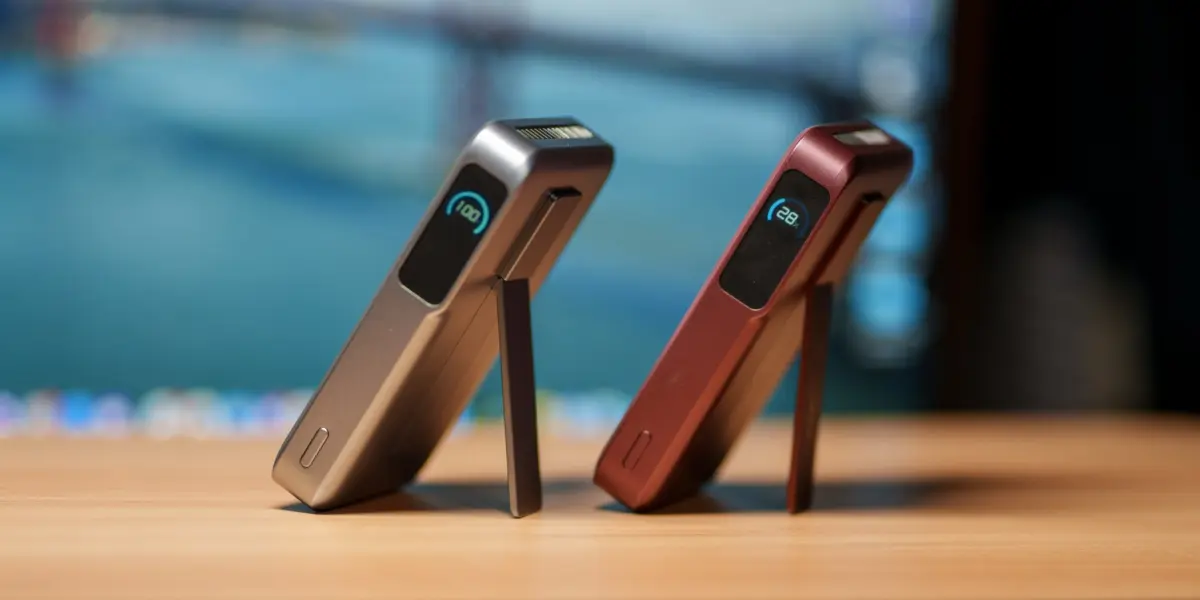
- Integrated Kickstand: A folding rear support prop allows users to stand their smartphone in landscape or portrait orientation while charging. This transforms the phone into a functional bedside clock, media display, or workstation monitor while remaining tethered to power. Note on sizing: When paired with larger devices like the iPhone Duo, the power bank extends slightly past the bottom edge of the device; however, rotating the phone and utilizing the integrated kickstand completely neutralizes any balance or stability issues.
- Curated Color Palette: Abandoning the utilitarian, industrial black-and-white aesthetic of early power banks, the MagGo Pro 2 is available in a striking range of finishes designed to complement modern smartphone colorways. This includes a rich burgundy engineered to match the color profile of the iPhone 18 Pro, alongside classic silver, clean blue, and understated gray variants.
Official Statements and Industry Reception
Industry analysts and early reviewers have universally praised Anker’s aggressive pursuit of thermal management in the consumer charging sector. While manufacturers have spent years optimizing power density, the thermal envelope has consistently served as the final frontier for wireless charging efficiency.

In product launch documentation, Anker explicitly marketed the MagGo Pro 2 as "the fastest and coolest wireless power bank on the market," a claim substantiated by early stress tests and teardowns showing stable thermal performance even under sustained 25W wireless loads.
Tech journalists reviewing the hardware during the Black Friday promotional window highlighted the pricing strategy as particularly disruptive. Dropping the price from $109.99 to $85.99—a substantial $24 saving—places advanced active-cooling technology at a price point previously occupied by conventional, passive-cooling competitors. Retail observers note that this pricing aggression is designed to capture early adopters upgrading their mobile ecosystems during the peak holiday shopping season.
Future Outlook and Market Implications
The launch of the Anker MagGo Pro 2 signals a broader, inevitable transition in the mobile accessory landscape. As mobile processors become increasingly powerful and energy demands continue to rise, thermal management can no longer be treated as an afterthought or left entirely to passive dissipation.
Looking forward over the next several product cycles, several industry trends are likely to emerge based on the precedent set by devices like the MagGo Pro 2:
- Mainstreaming of Active Cooling: What is currently viewed as a premium, enthusiast-tier feature in portable power banks will likely filter down into standard mid-tier accessories. As micro-fan and solid-state cooling technologies become more cost-effective and energy-efficient, active cooling may become the baseline expectation for any wireless charger exceeding 15W.
- Decline of the Thermal Bottleneck: With thermal throttling effectively neutralized in portable form factors, the speed delta between wired and wireless charging will continue to narrow. This brings the industry closer to a truly cable-free operational philosophy without sacrificing the rapid replenishment times modern consumers demand.
- Heightened Telemetry Standards: The inclusion of comprehensive smart displays providing real-time telemetry (wattage, temperature, and battery health) raises the bar for consumer transparency. Users will increasingly demand granular data regarding how their expensive mobile hardware is being charged, pushing legacy manufacturers to abandon cryptic LED dot-matrix systems in favor of informative screens.
Ultimately, the Anker MagGo Pro 2 is more than just a seasonal holiday discount item; it is a technical milestone. By successfully packaging high-capacity storage, rapid charging capabilities, telemetry displays, and active thermal regulation into a pocket-sized, aesthetically refined enclosure, Anker has set a new benchmark for what consumers should expect from their portable power ecosystems.