Executive Overview
Seventy years ago, in the shadow of a nuclear reactor at the Savannah River Plant in South Carolina, two physicists undertook an experiment designed to catch a ghost. Armed with a custom-built, 10-ton detector encased in thick lead walls and heavy sandbags, Clyde Cowan and Frederick Reines set out to capture physical evidence of a particle that theoretical physics said should be fundamentally uncatchable.
What began as an audacious gamble in 1956 launched one of the most transformative eras in modern physics. The particle they hunted—the neutrino—possesses nearly zero mass and no electrical charge. It is a subatomic phantom capable of passing unimpeded through planets, stars, and human bodies by the trillions every second.
Today, the quest to understand neutrinos has evolved from a desperate attempt to salvage broken mathematical models into a multi-billion-dollar global endeavor. Modern scientists deploy colossal detectors buried deep beneath Antarctic ice, submerged on the dark floors of the Mediterranean Sea, and carved deep into subterranean mines. These instruments are no longer just confirming the existence of a theoretical anomaly; they are mapping the universe in an entirely new light. By capturing cosmic neutrinos, researchers are tracing high-energy particles back to supermassive black holes, probing the internal engines of stars, and searching for the answers to fundamental questions about why matter dominates antimatter in our universe.
From Wolfgang Pauli’s reluctant scratch of a pen in 1930 to the ultra-precise measurements emerging from state-of-the-art detectors today, the history of neutrino astronomy is a testament to human ingenuity. It proves that to unlock the deepest secrets of the cosmos, science must think big, go deep, and summon infinite patience.
Detailed Chronology: From Theoretical Despair to Subterranean Triumphs
The 1930s: Pauli’s Desperate Postulate
The story of the neutrino begins with a crisis in theoretical physics. During the late 1920s, physicists studying beta decay—a type of radioactive decay where a beta particle (an electron) is emitted from an atomic nucleus—encountered an alarming mathematical problem. According to the foundational laws of physics, energy should be conserved during this process. Yet, measurements showed that the emitted electrons possessed a continuous range of energies, appearing to fall short of what the laws demanded. Energy seemed to be vanishing into thin air.
Faced with the terrifying prospect that the law of conservation of energy might be fundamentally flawed, Austrian physicist Wolfgang Pauli proposed a radical, almost heretical fix. In an open letter to a group of radioactive researchers attending a conference in Tübingen, Germany, Pauli suggested that a third, hitherto unnoticed particle was being emitted alongside the electron. This particle, he argued, was silently carrying away the missing energy.
Pauli, however, was acutely aware of how untestable his idea was. "I have done a terrible thing today," he famously confessed to a friend. "I have postulated a particle that cannot be detected." For decades, this elusive entity—later dubbed the "neutrino" (Italian for "little neutral one") by Enrico Fermi—remained purely a mathematical ghost, invoked to balance equations but deemed forever beyond the reach of experimental science.
1956: Project Poltergeist and the First Catch
By the early 1950s, experimental techniques had advanced to the point where capturing the uncapturable seemed just barely within reach. Clyde Cowan and Frederick Reines realized that the newly developed nuclear fission reactors offered a staggering flux of particles, specifically anti-electron neutrinos, spewing from uranium fission products.
In 1956, Cowan and Reines launched "Project Poltergeist" at the Savannah River Plant. Their apparatus was a marvel of bespoke engineering: a 10-ton detector shielded from cosmic rays and ambient radiation by thick lead walls and wet sandbags. The principle behind the experiment relied on inverse beta decay, where a neutrino colliding with a proton would yield a neutron and a positron, producing a distinctive double-flash of light.
In June 1956, the gamble paid off. Cowan and Reines sent a telegram to Wolfgang Pauli that read: "We are happy to inform you that we have definitely detected neutrinos." Pauli, by then an older man, famously replied to the news: "Everything comes to him who knows how to wait."
The 1960s–1990s: The Solar Neutrino Problem
With neutrinos finally caught in the laboratory, attention shifted upward. If nuclear reactions inside atomic reactors produced neutrinos, then the ultimate nuclear furnace—our sun—should be spewing them by the septillions.
However, detecting neutrinos originating from distant stars presented a staggering logistical hurdle. Because these particles interact so rarely with matter, capturing them required a vast target volume of material, shielded meticulously from the incessant noise of cosmic radiation raining down on Earth’s surface.
In the late 1960s, Raymond Davis Jr. and his colleagues at Brookhaven National Laboratory devised an ingenious, if unorthodox, solution. They placed a massive steel tank 1.5 kilometers underground inside the Homestake gold mine in Lead, South Dakota. They filled the tank with nearly 400,000 liters of perchloroethylene—a common chlorine-based dry-cleaning fluid.
The logic was simple yet profound: on the exceedingly rare occasion that a solar neutrino collided with a chlorine nucleus, it would transform that nucleus into a radioactive isotope of argon, which could subsequently be extracted and counted.
When the Homestake experiment began producing long-term data, it triggered a decades-long crisis in astrophysics. The detector found only one-third of the solar neutrinos predicted by standard theoretical models of the sun. Dubbed the "solar neutrino problem," this glaring discrepancy suggested either our understanding of stellar interiors was fundamentally flawed, or our understanding of particle physics was incomplete.
The Turn of the Millennium: Flavors, Oscillations, and Mass
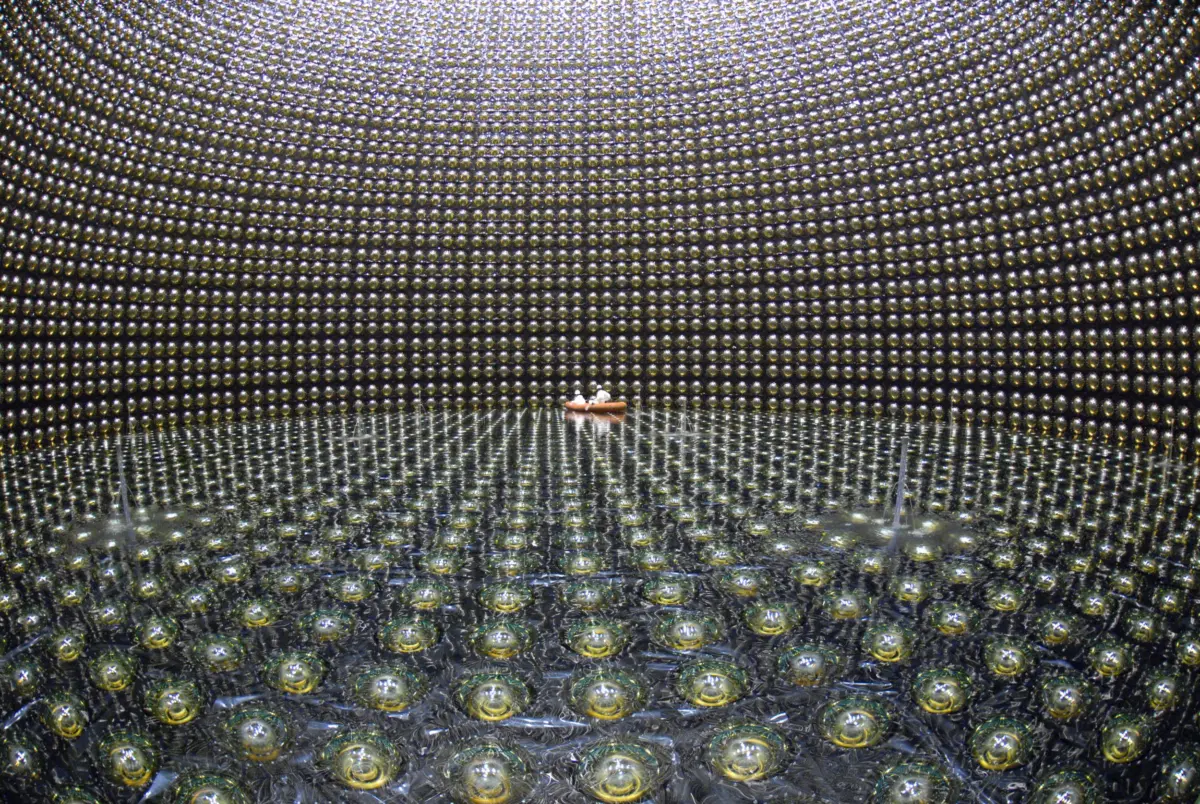
The resolution to the solar neutrino problem required detectors of unprecedented scale and sensitivity. In the 1980s and 1990s, deep beneath the Japanese Alps in the Kamioka mine, physicist Masatoshi Koshiba constructed the Kamiokande detector—a cavernous cylindrical tank filled with 3 million liters of ultrapure water, surrounded by thousands of ultra-sensitive photomultiplier tubes.
When a neutrino occasionally interacted with an atomic nucleus in the water, it produced an energetic electron that moved faster than the local speed of light in water, generating a faint, cone-shaped blue flash known as Cherenkov light. Kamiokande, and its gargantuan successor Super-Kamiokande, definitively confirmed Davis’s missing neutrino shortfall.
Shortly thereafter, Canada’s Sudbury Neutrino Observatory (SNO) solved the mystery entirely. SNO utilized heavy water (deuterium oxide) in a deep nickel mine, allowing scientists to measure all types of neutrinos simultaneously.
The breakthrough discovery was that neutrinos come in three distinct "flavors"—electron, muon, and tau—and possess the bizarre quantum mechanical ability to "oscillate," or morph from one flavor into another as they travel through space. Because the Standard Model of particle physics dictated that neutrinos must be massless, this oscillation phenomenon provided definitive proof that neutrinos possess a tiny, non-zero mass, rewriting the textbooks on fundamental physics.
Supporting Context & Metrics: The Scale of Modern Detection
To appreciate the ongoing revolution in neutrino astronomy, one must examine the staggering scale of the instruments required to study them.
| Detector Name | Location | Primary Medium | Volume / Mass | Key Milestone / Objective |
|---|---|---|---|---|
| Cowan-Reines Detector | Savannah River, USA (1956) | Cadmium chloride solution & water | 10 Tons | First experimental detection of the neutrino. |
| Homestake Experiment | South Dakota, USA (1960s) | Perchloroethylene (Cleaning fluid) | ~400,000 Liters | Discovered the "Solar Neutrino Problem." |
| Super-Kamiokande | Kamioka, Japan | Ultrapure Water | 50,000 Tons | Confirmed neutrino oscillations and atmospheric neutrino deficits. |
| IceCube Observatory | South Pole, Antarctica | Antarctic Ice | 1 Cubic Kilometer | Mapped the Milky Way using cosmic neutrinos; traced high-energy sources. |
| KM3NeT | Mediterranean Sea | Seawater | Multi-Cubic Kilometer | Detected the highest-energy cosmic neutrino on record. |
| JUNO | Jiangmen, China (Launched 2025) | Liquid Scintillator | 20,000 Tons | Most precise measurements of neutrino mass hierarchy to date. |
The IceCube Neutrino Observatory, embedded deep within the crystal-clear glacial ice at the Amundsen-Scott South Pole Station, transforms a full cubic kilometer of ice into a massive particle detector. By deploying strings of digital optical modules thousands of meters down into the frozen Antarctic expanse, IceCube listens for the faint Cherenkov flashes generated by ultra-high-energy cosmic neutrinos originating from outside our solar system. In recent years, IceCube successfully generated the first neutrino map of the Milky Way, opening an entirely new multi-messenger window onto the cosmos.
Similarly, deep on the floor of the Mediterranean Sea, the Cubic Kilometer Neutrino Telescope (KM3NeT) uses the dark, abyssal waters to catch high-energy cosmic events, continually pushing the boundaries of what is observable.
Official Statements and Expert Perspectives
The transition of neutrino physics from a niche theoretical curiosity to a cornerstone of modern multi-messenger astronomy has been heralded by leading physicists worldwide.
Reflecting on the historic nature of Pauli’s initial reluctance and the subsequent decades of experimental validation, theoretical particle physicists emphasize the unique role neutrinos play in probing the universe’s most extreme environments.
"Neutrinos are the ultimate cosmic messengers," notes Dr. Elena Rostova, an astrophysicist specializing in high-energy particle interactions. "Unlike photons, which can be scattered, absorbed, or blocked by dense clouds of cosmic dust and magnetic fields, neutrinos travel in straight lines directly from the hearts of supernovae, active galactic nuclei, and the early universe. When we catch one, we are holding a direct telegram from the most violent regions of space."
The operational success of next-generation facilities has likewise inspired widespread optimism across international research collaborations. Commenting on the unprecedented precision achieved by the Jiangmen Underground Neutrino Observatory (JUNO) following its initial data releases, lead project engineers underscored the collaborative nature of modern science.
"For decades, we chased a particle that refused to leave a footprint," stated Dr. Kenji Takahashi during a recent symposium on neutrino anomalies. "Today, with facilities like JUNO, Hyper-Kamiokande, and DUNE coming online, we are no longer just counting flashes in the dark. We are mapping the quantum architecture of the universe with an accuracy that Wolfgang Pauli could not have imagined in his wildest dreams."
Future Outlook: The Next Wave of Subterranean Discovery
As the scientific community enters the late 2020s, the neutrino frontier is expanding at an exponential rate, driven by a new generation of hyper-scale detectors designed to resolve remaining mysteries, such as the exact mass hierarchy of neutrinos and the possibility of charge-parity (CP) violation in the lepton sector—which could help explain why the universe is made almost entirely of matter rather than antimatter.
In China, the Jiangmen Underground Neutrino Observatory (JUNO), which officially launched in 2025, published groundbreaking initial data in mid-2026. JUNO has provided the most precise measurements of neutrino oscillation parameters to date, utilizing an ultra-pure liquid scintillator contained within a massive acrylic sphere suspended in a deep subterranean cavern.
Meanwhile, preparations are well underway for two more colossal facilities expected to begin operations later this decade:
- Hyper-Kamiokande (Hyper-K) in Japan: Serving as the massive successor to Super-Kamiokande, Hyper-K will feature a water tank roughly eight times larger than its predecessor, dramatically increasing the sensitivity to solar neutrinos, atmospheric neutrinos, and proton decay searches.
- The Deep Underground Neutrino Experiment (DUNE) in the United States: Spanning a baseline of 1,300 kilometers from Fermi National Accelerator Laboratory in Illinois to the Sanford Underground Research Facility in South Dakota, DUNE will fire an intense beam of neutrinos through the Earth’s crust to study their oscillations with unprecedented precision.
Seventy years after Cowan and Reines huddled around their makeshift detector at the Savannah River Plant, the golden age of neutrino astronomy is fully underway. The foundational rule of discovery in this field has remained steadfast across generations: to catch the universe’s most elusive ghost, scientists must continue to think big, go deep, and summon limitless patience.