Executive Overview
The modern household is a complex logistical enterprise. As families navigate the chaotic convergence of professional commitments, school schedules, extracurricular activities, meal prep, and domestic chores, traditional methods of organization are proving increasingly obsolete. The analog paper calendar, once a staple of the kitchen refrigerator, lacks the dynamic updates required for real-time coordination. Conversely, personal smartphone calendars often lead to siloed information, where family members remain unaware of conflicting commitments.
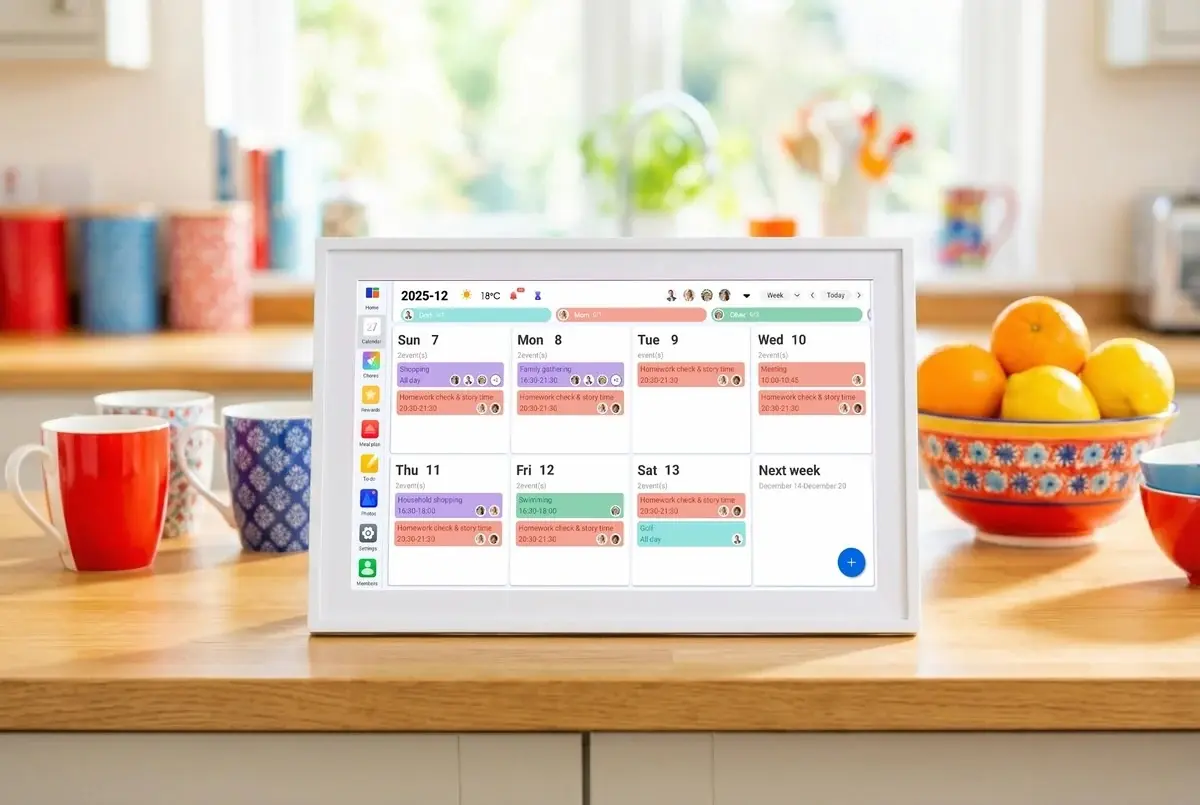
Enter Linkdaze, a dedicated smart digital calendar and touchscreen tablet engineered specifically to serve as a centralized operating system for the home. Launched to address the fragmentation of family scheduling, Linkdaze consolidates disparate digital ecosystems—including Google Calendar, Apple iCloud, Microsoft Outlook, Yahoo, and specialized family apps like Cozi—into a single, color-coded, wall-mounted or tabletop interactive hub.
By offering both 10.1-inch and 15.6-inch models, Linkdaze directly challenges established smart-display incumbents such as Amazon Echo Show and Skylight. Crucially, Linkdaze is positioning itself as a consumer-friendly alternative by eschewing the monthly subscription fees that have become ubiquitous—and increasingly unpopular—across the smart home hardware industry. Boasting an innovative, AI-powered "Snap-to-Sync" meal-planning feature and an aggressive entry-level price point of $119.99, Linkdaze represents a significant shift in how hardware manufacturers balance value, utility, and recurring revenue.
The Evolution of Household Coordination: A Detailed Chronology
To understand Linkdaze’s market positioning, one must examine the historical trajectory of domestic organization tools over the past two decades.
+-----------------------------------------------------------------------------+
|                                 CHRONOLOGY                                  |
+-----------------------------------------------------------------------------+
|                                                                             |
|  [ Late 1990s - 2000s ]  ------------------------------------------------>  |
|  The Analog Era: Dominance of paper kitchen calendars and magnetic whiteboards. |
|  Information was highly localized and prone to human error or omission.     |
|                                                                             |
|  [ 2010s ]  ------------------------------------------------------------->  |
|  The Smartphone Boom: Rise of individual digital calendars (Google, iCloud). |
|  Introduced mobile convenience but created "scheduling silos" within        |
|  households, as family members used incompatible platforms.                 |
|                                                                             |
|  [ 2018 - 2022 ]  ------------------------------------------------------->  |
|  First-Gen Smart Displays: Skylight and Hearth pioneer dedicated family      |
|  hardware. However, these systems relied heavily on costly, recurring       |
|  software subscriptions to unlock core functionalities.                      |
|                                                                             |
|  [ December 2025 ]  ----------------------------------------------------->  |
|  Linkdaze Launch: Enters the market with 10.1" and 15.6" models.             |
|  Introduces a subscription-free core platform, multi-ecosystem syncing,      |
|  and AI-driven offline-to-online data ingestion.                            |
|                                                                             |
|  [ Present Day ]  ------------------------------------------------------->  |
|  Market Disruption: High-demand back-to-school seasons establish Linkdaze    |
|  as a key alternative to legacy smart displays and high-priced competitors.  |
|                                                                             |
+-----------------------------------------------------------------------------+
This chronological shift highlights a persistent pain point: while software-based calendars solved the problem of mobile access, they failed to provide a shared, passive-viewing experience in the home. Linkdaze bridges this gap by physicalizing digital organization, transforming abstract personal agendas into a collaborative domestic dashboard.
Supporting Context & Market Metrics
The smart home display market is projected to grow significantly over the next five years, driven by consumer demand for ambient computing—devices that integrate seamlessly into the background of daily life. However, consumer sentiment has shifted sharply against the "SaaSification" of physical goods. Hardware buyers are increasingly fatigued by purchases that require ongoing subscriptions to remain useful.
Comparative Market Analysis
To understand the competitive landscape, we can contrast Linkdaze with its primary market competitor, Skylight:
| Metric / Feature | Linkdaze (10.1-inch) | Skylight Calendar (10-inch) |
|---|---|---|
| Upfront Hardware Cost | $119.99 | $159.99 |
| Subscription Fee | $0.00 (Core Features) | $39.00 – $79.00 / year (Plus Tier) |
| Platform Compatibility | Google, iCloud, Outlook, Yahoo, Cozi | Google, iCloud, Outlook, Yahoo |
| Color-Coded Profiles | Included | Included |
| AI Meal Planning | Yes (Snap-to-Sync OCR) | Manual Entry / Basic Integration |
| Form Factors Available | 10.1" and 15.6" | 10" and 15" |
Financial & Strategic Implications
Linkdaze’s pricing strategy represents an aggressive customer-acquisition play. By pricing its 10.1-inch unit at $119.99—exactly $40 cheaper than Skylight’s equivalent model—and eliminating the subscription requirement for core organizational features, Linkdaze lowers the barrier to entry for middle-class families.
For a hardware startup, this model places a heavy emphasis on manufacturing efficiency and hardware margins. While competitors rely on the high-margin, recurring revenue of software subscriptions to offset hardware development costs, Linkdaze is betting that volume sales, brand loyalty, and potential future premium add-ons will secure its financial viability.
Deep-Dive: Core Features and Technical Capabilities
Linkdaze is not merely a generic tablet locked to a calendar application; it is a purpose-built appliance running a customized, lightweight operating system optimized for low power consumption, high visibility, and intuitive touch interaction.
                    +---------------------------------------+
                    |        LINKDAZE SMART PLATFORM        |
                    +---------------------------------------+
                                        |
      +--------------------+------------+------------+--------------------+
      |                    |                         |                    |
+-----------+        +------------+            +------------+       +-----------+
| Multi-Sync|        |  Chore &   |            | AI Meal    |       | Digital   |
| Engine    |        |  Rewards   |            | Planner    |       | Photo     |
| (iCloud,  |        |  Dashboard |            | (Snap-to-  |       | Frame     |
| Google,   |        |            |            | Sync OCR)  |       | Mode      |
| Outlook)  |        |            |            |            |       |           |
+-----------+        +------------+            +------------+       +-----------+
1. The Multi-Sync Engine
The primary technical hurdle for any family calendar is interoperability. In a typical four-person household, parents may use Microsoft Outlook for work, Google Calendar for personal use, and Apple iCloud for their children’s iOS devices. Linkdaze resolves this fragmentation through its proprietary Multi-Sync Engine.

- Universal Aggregation: The device pulls data APIs from Google, iCloud, Outlook, Yahoo, and Cozi simultaneously.
- Bi-Directional Syncing: Changes made on the Linkdaze tablet reflect back to the source calendars in real-time, and vice versa.
- Visual Hierarchy: Individual family members are assigned distinct colors. This allows users to ascertain who needs to be where within seconds of looking at the display.
2. The AI Meal Planner with "Snap-to-Sync"
Manual data entry is the primary reason consumers abandon digital organization tools. Linkdaze addresses this friction point with its standout software feature: Snap-to-Sync AI.
Using an integrated camera or a companion mobile application, users can take a photo of unstructured physical text—such as a handwritten family recipe, a printed school lunch menu, or a clipping from a food magazine.
- Optical Character Recognition (OCR): The system’s AI parses the image to identify dates, meal names, and ingredient lists.
- Automated Scheduling: The meals are automatically populated into the household’s digital meal planner on the designated days.
- Intelligent Shopping List Generation: The AI cross-references the scheduled meals to compile a categorized shopping list, which can be synced directly to family members’ smartphones for use at the grocery store.
3. Domestic Gamification: Chores and Rewards
To engage younger family members, Linkdaze features an interactive chore and reward tracking system. Parents can assign daily or weekly tasks (e.g., "walk the dog," "empty the dishwasher") directly from the interface.
- Progress Tracking: Children can physically check off completed tasks on the touchscreen.
- Gamified Incentives: The system tracks accumulated points that can be redeemed for parent-defined rewards, fostering accountability and reducing the cognitive load on parents to constantly remind their children of their responsibilities.
Industry Analysis: The Subscription Fatigue Factor
Linkdaze’s decision to launch without a mandatory subscription fee for its core features is a calculated critique of current consumer electronics trends. Over the past decade, the tech industry has embraced the "Software-as-a-Service" (SaaS) model, applying it to everything from security cameras to fitness equipment. While this provides companies with predictable, recurring revenue streams, it has led to acute consumer backlash.
Industry analysts note that consumers are increasingly reluctant to purchase hardware that becomes a "brick" (useless plastic) without an active monthly fee. By marketing a fully functional, high-quality hardware device with no strings attached, Linkdaze appeals directly to budget-conscious households.
However, this strategy carries inherent risks. Software updates, cloud hosting for calendar synchronization, and AI processing all incur ongoing server costs. To maintain long-term profitability without subscription fees, Linkdaze must rely on:
- Upfront Hardware Margins: Achieving economies of scale to keep production costs significantly below the retail price.
- Ecosystem Expansion: Introducing optional, non-essential premium features, accessories (such as custom frames or mounting brackets), or hardware upgrades.
- B2B Partnerships: Potential future integrations with grocery delivery services (e.g., Instacart) where Linkdaze earns an affiliate fee when users order ingredients directly from their generated shopping lists.
Future Outlook: The Ambient Smart Home
As we look toward the future of smart home technology, devices like Linkdaze are paving the way for a transition from active smart devices (which require constant direct input) to ambient smart devices (which assist passively).
The ultimate goal of the smart kitchen dashboard is to act as an autonomous coordinator. Future software iterations of the Linkdaze platform are expected to integrate deeper with smart home ecosystems like Apple HomeKit, Google Home, and Home Assistant. This would allow the calendar to trigger automation routines—such as flashing kitchen lights when it is time for a child to leave for soccer practice, or adjusting the home’s thermostat based on who is scheduled to be home.
Furthermore, as generative AI models become more localized and efficient, we can expect on-device processing to handle complex scheduling conflicts automatically. For instance, if a rescheduled dentist appointment conflicts with a school play, the device could flag the issue and suggest optimal times to reschedule based on historical traffic patterns and family habits.
Conclusion
The Linkdaze smart digital calendar is a timely response to the logistical challenges of modern family life. By combining wide-ranging calendar compatibility, innovative AI utilities like Snap-to-Sync, and an affordable, subscription-free pricing model, it positions itself as a highly attractive alternative to more expensive, rent-seeking competitors. Whether deployed in a busy family kitchen, a shared college apartment, or the home office of a busy professional, Linkdaze demonstrates that the best smart home technology is that which simplifies our lives without complicating our monthly bank statements.