EXECUTIVE OVERVIEW
In the modern landscape of remote-first and hybrid software development, a dangerous illusion has taken root: the belief that healthy output equals a healthy team. For engineering managers, CTOs, and tech leads accustomed to managing through dashboards, pull requests (PRs), and sprint velocity charts, silence has increasingly been misinterpreted as stability.
However, beneath the veneer of green CI/CD pipelines, closed Jira tickets, and calm daily standups, a pervasive crisis is unfolding. It is a crisis of invisible overwork.
The signs of software engineering burnout have evolved. Gone are the days when a manager could casually walk past a desk at 8:00 PM to notice an employee burning the midnight oil. In the remote era, overwork happens in the shadows, mediated by screens, asynchronous communications, and the intoxicating, dangerous allure of deep technical "flow states."
This investigation explores how organizational blindness to remote burnout is eroding engineering teams from the inside out. Drawing on insights from industry patterns, the hidden limitations of traditional HR check-ins, and the accidental discovery of systemic fatigue through version control histories, we examine why standard management frameworks fail to catch burnout before it turns into resignation. Finally, we look at the rising movement toward ethical, pattern-based visibility tools—such as TrackDots—that aim to flag workload creep before human capital is quietly exhausted.
DETAILED CHRONOLOGY: THE ANATOMY OF AN ACCIDENTAL DISCOVERY
To understand how engineering burnout evades traditional management oversight, it is helpful to examine how it is typically uncovered. Rarely does it arrive via a dramatic confrontation or an emotional plea for help. More often, it is unmasked by happenstance.
The Midnight Commits
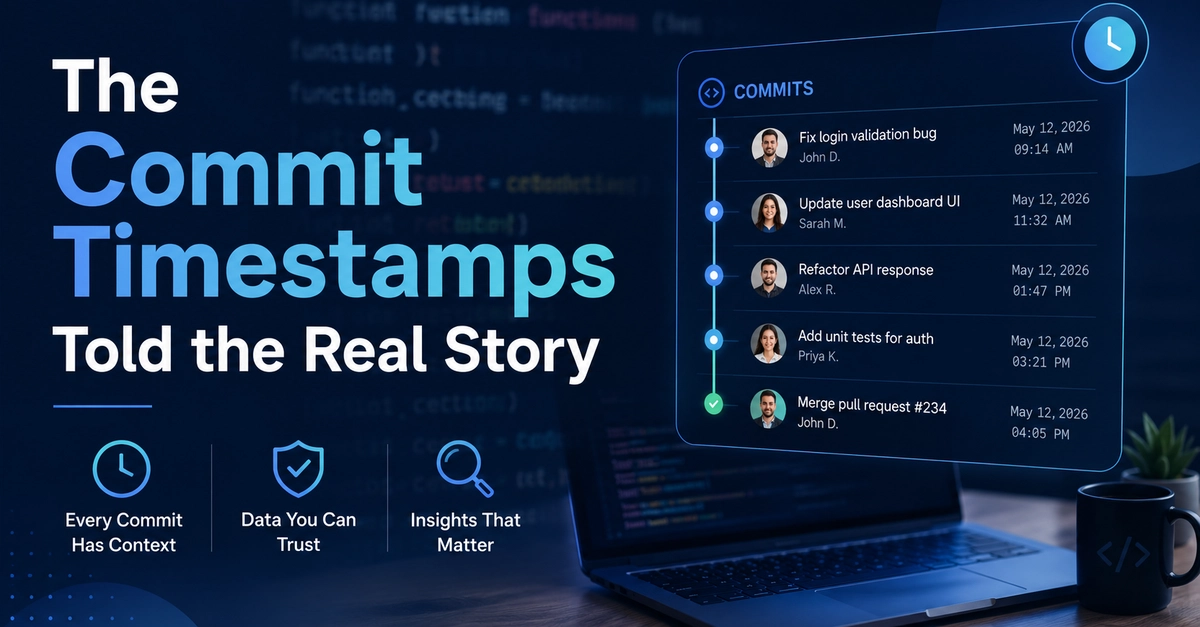
Consider the experience of one engineering leader who recently noticed a troubling trend entirely by accident. While scrolling through a repository’s activity graph for an unrelated code review, a jarring visual pattern emerged.
At first, it was an idle observation: commits timestamped at 11:00 PM. Then, a few days later, 1:00 AM. Then, entries began appearing on Sunday afternoons—a time when the codebase was supposed to be completely untouched, preserved for rest and personal recharge.
What made the discovery alarming was not that a single erratic developer was burning the midnight oil. It was that the pattern belonged to most of the team.
The Illusion of Normalcy
A retrospective audit of the team’s operational rhythm revealed a chilling disconnect between data and reality:
- The Daily Standup: Normal, upbeat, or routine. Blockers were addressed quickly; technical updates were delivered with professional calm.
- Sprint Velocity: Completely fine. In fact, velocity numbers looked exceptionally strong, hovering near record highs for the quarter.
- Asynchronous Communications: Slack messages and code reviews maintained standard, polite cadences, often scheduled or masked to appear within normal working hours.
Yet, the raw metadata of the software development lifecycle—the commit timestamps, the late-night merge approvals, the weekend CI/CD pipeline triggers—told a vastly different story. The team was quietly working a second, unregistered shift. By the time the pattern became undeniable, it had been active for weeks, if not months.
SUPPORTING CONTEXT & METRICS: THE REMOTE ENGINEERING TRAP
Why are remote and distributed engineering teams uniquely vulnerable to this creeping exhaustion? The answer lies at the intersection of modern software engineering culture, psychological defense mechanisms, and the mechanics of remote work.
1. The Death of Ambient Visibility
In a traditional collocated office environment, managers and peers rely on peripheral vision. You notice when a colleague’s desk light stays on late. You observe the slumped shoulders, the heavy sighs, or the sudden silence from the office joker during lunch.
In a remote environment, these ambient biological and social signals are entirely stripped away. Management is mediated by asynchronous artifacts:
- PRs merged.
- Tickets closed.
- Slack messages dispatched at reasonable-looking times.
When output is the only telemetry a manager receives, high output is naturally interpreted as high well-being. But in knowledge work, output is a lagging indicator of health. An engineer can produce pristine code while their cognitive reserves are completely depleted.
2. The Double-Edged Sword of "Flow State"
Software engineering is unique among white-collar professions because of its reliance on "flow state"—deep, uninterrupted cognitive immersion where complex architectural problems are solved.
For developers, flow state is the promised land. It is deeply satisfying, highly productive, and fiercely guarded. However, it is also a psychological trapdoor:
- Loss of Temporal Awareness: When an engineer is deep in a gnarly debugging session at 6:00 PM, the instinct is rarely, “I should stop working now.” It is almost universally, “I’m so close; if I just trace this stack trace one step further, I’ll find the bug.”
- The Slippery Slope of Overtime: That virtuous persistence easily morphs into an unmanaged habit. An hour of overtime becomes three hours. Three hours become a nightly ritual. Because the work is mentally engaging, the exhaustion doesn’t feel like traditional manual labor fatigue until it manifests as sudden, acute burnout.
3. Why "Just Ask People How They’re Doing" Fails
A common refrain from executive leadership when discussing mental health and burnout is deceptively simple: “Just ask people how they are doing.”
While well-intentioned, relying solely on direct check-ins is fundamentally insufficient in engineering cultures for several systemic reasons:
- The "I’m Fine" Reflex: Software engineers are professional problem-solvers. Culturally, they are conditioned to handle friction, debug broken systems, and carry heavy technical debt. Admitting that a workload is unmanageable often carries an unspoken, internalized stigma—the fear that it signals professional inadequacy or an inability to keep up.
- The Paradox of the High Performer: The individuals most susceptible to burnout are rarely underperformers. They are the bedrock of the engineering organization: the senior devs who refuse to let a release fail, the compassionate teammates who quietly absorb scope creep rather than push back, and the perfectionists who view the need to rest as a personal failing.
- Lagging vs. Leading Indicators: By the time an engineer explicitly states in a 1:1 meeting that they are overwhelmed, the burnout is usually in an advanced stage. Early-stage burnout does not manifest as complaints; it manifests as subtle cynicism, gradual disengagement, or—most destructively—a sudden, unannounced resignation letter that catches the executive team entirely by surprise.
OFFICIAL PERSPECTIVES: DATA-DRIVEN INSIGHTS VS. SURVEILLANCE CULTURE
As the tech industry grapples with the fallout of remote work fatigue, the debate over how to monitor team health has intensified. Organizations find themselves walking a delicate ethical tightrope between proactive support and invasive surveillance.
The Backlash Against Big Brother Tooling
Historically, attempts to quantify remote productivity led to draconian measures: keystroke loggers, active-window trackers, random webcam snapshots, and minute-by-minute activity metrics.
Developers rightly despise these tools. Not only do they erode trust and psychological safety, but they are also fundamentally inept at measuring software engineering. In a raw activity log, a senior architect deep in meditative contemplation, reading a whitepaper, or debugging a complex memory leak looks identical to someone idly scrolling through social media. "Gotcha" surveillance measures fail to capture the nuances of deep knowledge work and breed an adversarial relationship between management and developers.
The Shift Toward Pattern-Based Visibility
Recognizing the failure of both total-blindness ("just trust the output") and toxic-surveillance ("track every keystroke"), modern engineering leadership is turning toward rolling behavioral patterns.
Rather than policing individuals in real-time, forward-thinking organizations are looking at aggregated, macro-level work trends that signal systemic distress. This paradigm shift has sparked interest in developer-centric wellness platforms designed to surface workload anomalies early.
For instance, emerging tools in this space—such as TrackDots—focus on analyzing historical activity patterns (like sustained after-hours coding sessions or chronic weekend deployments) not as a mechanism for punitive oversight, but as an early-warning radar system.
An industry insider noted the distinction:
"The goal shouldn’t be to watch over your engineers’ shoulders; it should be to notice when the architecture of their work schedules is quietly crushing them. If a tool flags that your core team has worked past 9 PM for three consecutive weeks, that isn’t an invitation to micromanage—it’s a data-driven prompt to have a human conversation before someone hands in their notice."
FUTURE OUTLOOK: REDEFINING ENGINEERING LEADERSHIP FOR THE REMOTE ERA
As remote and hybrid models cement themselves as permanent fixtures of the global tech economy, engineering management must evolve. Relying on accidental discoveries—like stumbling upon a midnight commit graph—is no longer a sustainable management strategy.
To build resilient, long-lasting engineering organizations in the years ahead, leaders must adopt a new playbook:
- De-stigmatize Pacing: Leadership must actively model boundaries. When CTOs and VPs of Engineering send emails at midnight or merge code on Saturdays, they send a silent, powerful signal that after-hours work is the baseline expectation, regardless of what they say in all-hands meetings.
- Treat Workload as Code: Just as teams monitor CPU spikes and memory leaks in production infrastructure, engineering managers must learn to monitor operational load and team pacing metrics. Protecting the team from invisible scope creep must become as rigorous a discipline as code reviews and security audits.
- Embrace Proactive Telemetry: Moving away from invasive surveillance while rejecting blind optimism means adopting metadata-driven guardrails. Utilizing ethical pattern-detection tools allows organizations to catch workload creep when it is still easily reversible—transforming a potential resignation debrief into a routine recalibration of sprint goals.
Conclusion
Burnout on a remote engineering team rarely announces itself with fanfare. It does not raise its hand in a standup meeting or send an urgent ticket to HR. Instead, it quietly writes itself into the timestamps of late-night commits and weekend pull requests, waiting patiently in the dark for someone to scroll back far enough to notice.
For the modern engineering leader, the challenge of the next decade is clear: learn to read the silent code of your team’s habits before the system crashes for good.