Executive Overview
For any developer who has spent time architecting backend services in Go, the boilerplate validation ritual is an all-too-familiar rite of passage. It usually begins innocently enough: a couple of simple HTTP handlers checking incoming JSON payloads for rudimentary constraints—ensuring a user’s name isn’t an empty string, verifying an email address contains the ubiquitous @ symbol, or checking that a password and its confirmation match.
However, as applications scale and business requirements inevitably mutate, these small checks compound. A new field is introduced. A cross-field conditional rule is bolted on. A product manager requests a nicer, more descriptive error message. Then comes the demand for internationalization—that same error message needs to be returned in Spanish, German, or Japanese. Within months, a clean, elegant HTTP handler degrades into a sprawling 200-line labyrinth of nested if statements that engineers actively avoid refactoring out of sheer dread.
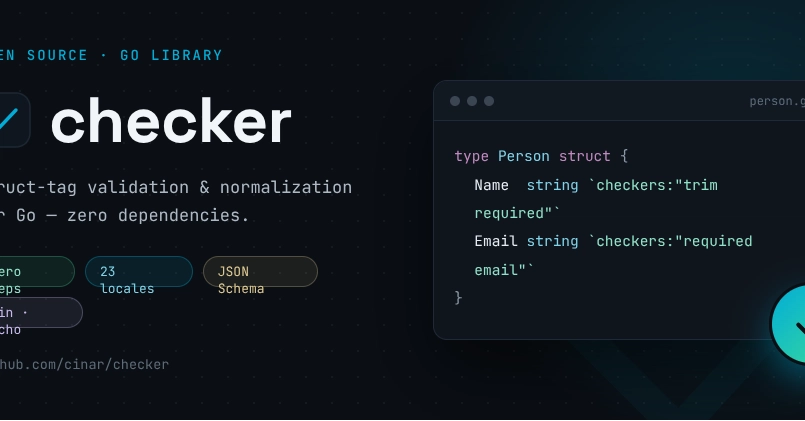
Enter Checker (github.com/cinar/checker), a zero-dependency, declarative Go library designed explicitly to banish sprawling conditional validation logic from codebases. By leveraging declarative struct tags, a unified validation and normalization pipeline, built-in multi-language support, and native JSON Schema generation, Checker aims to reshape how Go developers approach input validation. This deep dive explores the mechanics, design philosophy, and ecosystem impact of a library that promises to reclaim sanity for Go backend engineers.
Detailed Chronology: The Evolution of Go Validation and the Birth of Checker
The Era of Manual Imperative Checks
In the early days of Go’s enterprise adoption, developers relied primarily on standard library primitives and custom imperative logic. Validation was scattered across services, domain layers, and transport handlers. Writing explicit loops, regular expressions, and type assertions for every incoming payload resulted in high code duplication and inconsistent error responses across APIs.
The Rise of Reflection-Based Validators
As the ecosystem matured, community-driven reflection-based validation libraries—most notably go-playground/validator—became the de facto standard. While these libraries drastically reduced boilerplate by introducing struct-tag-based validation, they often brought heavy dependency trees, complex internal reflection overhead, and verbose setup code for advanced features like localization and customized error formatting. Furthermore, developers frequently found themselves maintaining separate layers for sanitization (normalizing inputs) and validation, leading to fragmented processing pipelines.
The Conception of Checker: Zero Dependencies and Unified Pipelines
Recognizing the friction points in existing solutions, the creators of Checker set out to build a modern, high-performance alternative from the ground up. The core design principles were uncompromising:
- Absolute Zero Dependencies: The core module must rely strictly on the Go standard library to minimize supply-chain risk and compile-time bloat.
- Unified Checkers and Normalizers: Input transformation (such as trimming whitespace or title-casing) and validation must coexist within the exact same execution pipeline.
- First-Class JSON Schema Generation: Struct tags should serve as a single source of truth, effortlessly generating client-ready JSON Schemas without external tooling.
- Strict Quality Assurance: 100% test coverage enforced natively to eliminate runtime surprises in production environments.
Supporting Context & Metrics: Under the Hood of Checker
To appreciate why Checker is generating buzz within the Go community, one must examine its architectural features and performance characteristics under practical conditions.
The One-Line Paradigm Shift
Consider a typical registration payload. Traditionally, validating this struct would require writing custom validation functions or configuring verbose rule engines. With Checker, the rules live directly alongside the data they govern:
type Registration struct
Name string `checkers:"trim required"`
Email string `checkers:"required email"`
Password string `checkers:"required min-len:8"`
ConfirmPassword string `checkers:"eq-field:Password"`
errors, valid := checker.CheckStruct(®istration)
if !valid
// errors is a map[string]error, keyed by field name
This clean syntax trims whitespace, enforces presence, validates email formatting, sets a strict minimum password length, and confirms password equality—all executed via a single invocation of checker.CheckStruct.
Zero Dependencies, Zero Compromises
In modern software supply chain security, every imported third-party package represents an expanded attack surface, potential vulnerability vectors, and longer compilation times. The core checker module imports nothing outside the Go standard library. There are no bloated YAML parsers or transitive forks of reflection utilities. Running go get github.com/cinar/checker/v2 pulls in precisely one package: Checker itself. This architectural discipline makes security reviews trivial and keeps binaries lean.
Harmonizing Normalization and Validation
A common architectural anti-pattern in web services is splitting sanitization and validation into distinct lifecycle phases. Developers often sanitize inputs (stripping whitespace, lowercasing emails, escaping HTML) in one middleware and validate them in another.
Checker unifies these operations into a singular pipeline. Normalizers like trim, lower, upper, title, and HTML/URL escaping share the exact same structural syntax as validators like required or email:
type Person struct
    Name string `checkers:"trim title required"`
In this pipeline, the string is first stripped of leading and trailing whitespace, transformed into title case, and finally evaluated to ensure a non-empty value remains. No separate passes required.
Complex Cross-Field and Conditional Validation
Real-world business logic rarely operates on isolated fields. Applications frequently require cross-field validations—such as ensuring a confirmation password matches its predecessor, confirming that a return date occurs chronologically after a departure date, or enforcing that a State field is strictly required only if the Country field evaluates to "US".
Traditionally, developers had to abandon struct tags entirely when encountering these scenarios, falling back to imperative code blocks. Checker solves this elegantly via inline declarative tags:
type Trip struct
    Country  string `checkers:"required"`
    State    string `checkers:"required-if:Country:US"`
    DepartAt string `checkers:"required"`
    ReturnAt string `checkers:"required after-field:DateOnly:DepartAt"`
Using built-in operators like eq-field, required-if, required-unless, before-field, and after-field, complex relational business rules become immediately readable at a glance.
Deep Container Inspection: Slices and Maps
Many validation libraries struggle with deep nesting, limiting their scope to top-level primitive struct fields. Checker handles complex data structures—including nested structs, pointers, slices, and maps—at multiple levels simultaneously.
By utilizing the @ prefix, developers can apply container-level rules while concurrently governing individual items within the collection:
type Person struct
    Emails map[string]string `checkers:"@max-len:2 trim max-len:64"`
Here, @max-len:2 restricts the map to a maximum of two entries, while trim max-len:64 automatically processes and bounds every individual value stored within it.
Global Readiness via Opt-In Localization
For organizations building Software-as-a-Service (SaaS) products geared toward international markets, hardcoded English error messages ("Not a valid email address.") quickly become a scaling bottleneck.
Checker ships with 23 translated locales out of the box—matching the comprehensive locale set supported by go-playground/validator. Critically, localization in Checker is strictly opt-in. Only the default en-US locale is loaded by default, ensuring that importing the library never silently bloats your compiled binary with unused translation data.
checker.RegisterLocale(locales.DeDE, locales.DeDEMessages)

_, err := checker.IsEmail("abcd")
fmt.Println(err.ErrorWithLocale(locales.DeDE))
// Keine gültige E-Mail-Adresse.
API-Ready Structured Errors
When building REST or GraphQL APIs, raw error strings are insufficient. Clients require structured, machine-readable payloads to render contextual form errors accurately.
CheckStruct returns CheckErrors, a map[string]error indexed by field name that implements the standard error interface. Serializing validation failures into a JSON response is accomplished with a single method call:
errs, valid := checker.CheckStruct(®istration)
if !valid
data, _ := errs.JSON()
w.WriteHeader(http.StatusBadRequest)
w.Write(data)
// Produces: "Name":"code":"REQUIRED","message":"Required value is missing."
return
Automatic JSON Schema Generation
One of Checker’s standout architectural innovations is its ability to generate valid JSON Schema documents directly from Go struct definitions and validation tags:
type Person struct
    Name  string `json:"name" checkers:"trim required"`
    Email string `json:"email" checkers:"required email"`


schema := checker.JSONSchema(&Person)
This functionality bridges the traditional gap between backend validation logic and frontend specifications. Struct tags like required automatically translate to JSON Schema required arrays; min-len and max-len map cleanly to minLength, maxLength, minItems, or maxItems; and format specifiers like email or ipv4 translate into formal JSON Schema format attributes. Unrecognized custom checkers are safely preserved within vendor extensions (x-checker), ensuring zero loss of metadata. Your Go validation rules effectively become your living API documentation and frontend validation schema.
Seamless Framework Adapters: Gin and Echo
While Checker operates wonderfully as a standalone package, it provides dedicated, separately-versioned modules for popular Go web frameworks like Gin and Echo. Because these adapters are decoupled into separate modules, web frameworks only enter your dependency tree if explicitly imported:
import checkergin "github.com/cinar/checker/v2/gin"
router.POST("/register", func(c *gin.Context)
var registration Registration
if !checkergin.Bind(c, ®istration)
return // HTTP 400 Bad Request automatically handled and written
c.JSON(http.StatusOK, registration)
)Extensibility Through Custom Makers
Out of the box, Checker provides over 30 built-in rules covering email addresses, URLs, IP/IPv4/IPv6 blocks, CIDR notations, MAC addresses, credit card formats, cryptographic hashes, ISO country and language codes, and even Ethereum blockchain addresses.
However, domain-specific requirements inevitably demand custom validation rules. Extending Checker is straightforward via custom maker registration:
checker.RegisterMaker("is-fruit", func(params string) checker.CheckFunc[reflect.Value]
    return func(value reflect.Value) (reflect.Value, error)
)
Once registered, the is-fruit tag behaves identically to any built-in validator, and developers can even map its corresponding representation in generated JSON Schemas via RegisterSchemaMaker.
Official Statements and Architectural Philosophy
The development team behind Checker emphasizes a philosophy of quiet discipline in software engineering. Maintaining robust open-source infrastructure requires rigorous internal standards.
A prime example of this philosophy is the project’s enforcement of strict 100% test coverage. Every single checker, normalizer, and conditional branch contains a dedicated, automated unit test. Furthermore, the test suite includes automated validation scripts (such as locales_test.go) that intentionally fail the build process if any supported locale is missing an error message translation or if a placeholder mismatches the baseline en-US implementation.
This meticulous approach ensures that developers adopting Checker in high-throughput production environments can trust the library not to yield silent regressions, false positives, or unexpected panics.
Future Outlook
As Go continues to cement its dominance in cloud-native infrastructure, microservices, and high-performance web APIs, the demand for lightweight, transparent, and developer-friendly tooling will only intensify. Heavy, monolithic validation frameworks are gradually giving way to modular, zero-dependency alternatives that prioritize developer ergonomics and pipeline transparency.
Libraries like Checker signal a broader shift in the Go ecosystem toward declarative programming patterns that reduce boilerplate without sacrificing runtime performance or compile-time safety. By unifying sanitization, validation, multi-language localization, and API documentation (via automatic JSON Schema generation) under a single struct-tag umbrella, Checker establishes a high benchmark for modern Go library design.
For teams currently drowning in imperative validation logic or maintaining redundant validation rules across backend services and frontend clients, exploring Checker offers an immediate path toward cleaner, more maintainable codebases.
Getting Started
To integrate Checker into your existing Go project, run:
go get github.com/cinar/checker/v2Explore the complete source code, documentation, and contribution guidelines on the official GitHub repository: github.com/cinar/checker. Pull requests, custom checker contributions, and locale refinements from the global community are actively welcomed.