In the sprawling, hyper-accelerated ecosystem of internet culture, few phenomena capture the absurdism of modern digital humor quite like a well-crafted, dark-comedy catchphrase. Over the past several years, social media users have witnessed the birth of countless memes, but few have achieved the specific phrasal longevity and versatile adaptability of the internet meme known as "Killing Myself In Front Of You To Forever Change Your Bond And The Trajectory Of Your Lives."
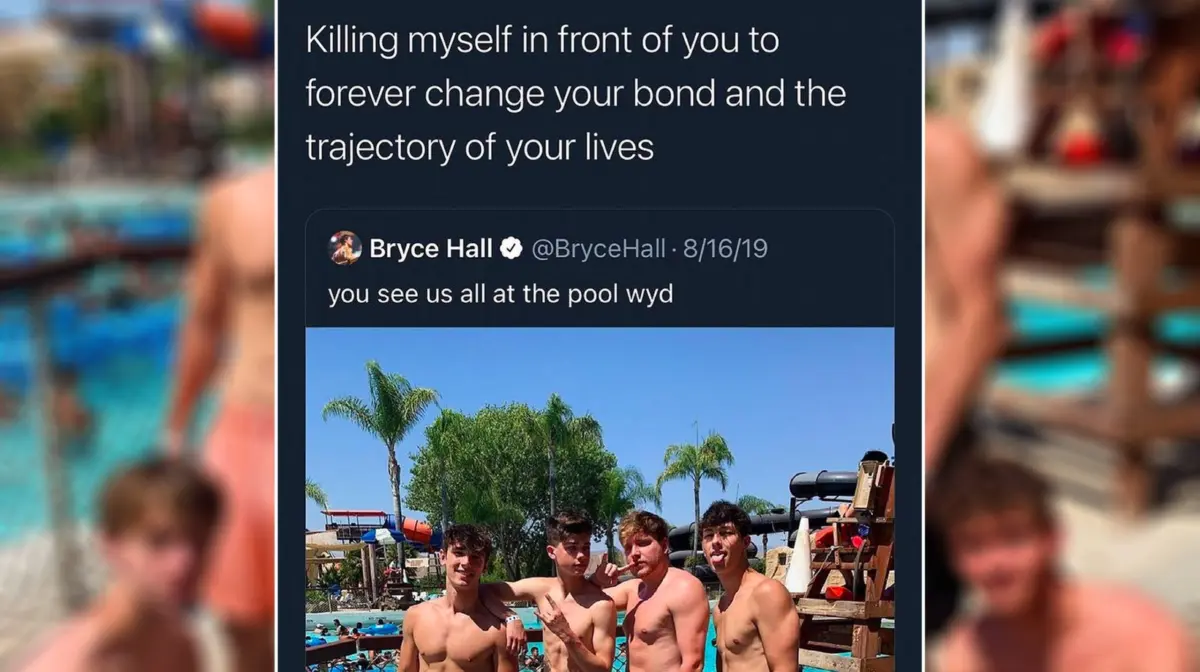
What began as an innocuous, run-of-the-mill query posted by TikTok influencer Bryce Hall in August 2019 rapidly transformed into a masterclass in hyper-specific, melodramatic internet surrealism. Triggered by a quote retweet from a now-suspended Twitter user, the phrase brilliantly juxtaposed the superficial, lifestyle-centric posturing of early-generation content houses—specifically the infamous Sway House—against a backdrop of intense, almost Shakespearean psychological trauma.
This retrospective examines the origins, trajectory, and cultural footprint of a phrasal template that evolved from an obscure Twitter reply into a cross-platform phenomenon. Spanning multiple social media networks, including Twitter (now X), Instagram, and Facebook, the meme has morphed from a direct jab at LA influencer culture into a generalized snowclone template. Today, it is utilized across varied subcultures—from gaming communities like Genshin Impact to independent music fandoms—demonstrating how digital natives weaponize hyperbole to express exasperation with the modern attention economy.
Detailed Chronology
The Catalyst: August 2019 and the Sway House Era
To understand the genesis of the meme, one must look back at the late-2010s zenith of content house culture, particularly in Los Angeles. During this era, groups of young, rapidly monetized TikTokers and YouTubers lived communally in sprawling mansions, churning out daily lifestyle content. Among the most prominent of these collectives was the Sway House, which featured personalities such as Bryce Hall, Josh Richards, and Griffin Johnson.
On August 16th, 2019, Bryce Hall posted a quintessential piece of influencer bait to his Twitter account. Accompanied by a photograph displaying several members of the Sway House posing casually by a swimming pool, Hall captioned the post:
"you see us all at the pool wyd"
The post was designed to elicit standard engagement—either enthusiastic validation from teenage fans or lighthearted mockery from detractors. For several days, the tweet sat in relative obscurity, accumulating a modest 2,500 likes over a multi-year span. However, it served as the canvas for an entirely unanticipated cultural artifact.
The Turning Point: The Birth of the Copypasta
On August 22nd, 2019, Twitter user @fictionaljake (whose account has since been suspended) encountered Hall’s pool photograph. Rather than offering a conventional cynical remark, the user delivered a response of such disproportionate, melodramatic intensity that it instantly transcended standard platform banter. Quoting Hall’s tweet, @fictionaljake wrote:
"Killing myself in front of you to forever change your bond and the trajectory of your lives"
The brilliance of the reply lay in its stark subversion of tone. While Hall’s prompt invited a playful or participatory answer to an idealized social scenario, the response injected an element of profound, catastrophic existential disruption. It framed an ordinary encounter with internet celebrities not as an opportunity for fandom, but as a catalyst for a lifelong psychological trauma pact that would forever bind the influencers together in shared guilt and horror.
The Virality Wave: 2021–2022 Resurgence
While the original interaction occurred in late 2019, the true distribution and viral maturation of the meme took place between 2021 and 2022. As screenshots of the exchange began circulating beyond Twitter into alternative digital hubs, the quote transformed from a singular witty retort into an adaptable snowclone and catchphrase.
June 12th, 2021: Twitter user @ChuuMeal reposted a screenshot of the exchange, driving fresh engagement and introducing the joke to new algorithmic timelines, crossing the threshold of 1,000 likes within a short period.
November 1st, 2021: The Facebook page Coven of Hoes shared the image macro, resulting in widespread cross-generational sharing—accumulating roughly 2,400 shares over the subsequent six months and proving that the humor resonated outside of youth-dominated Twitter circles.
July 8th, 2021: Instagram page waldorfcomplex adapted the format into an image macro referencing indie-pop musician Clairo, demonstrating the template’s versatility as an expression of extreme annoyance toward recurring internet talking points.
April 17th, 2022: The Twitter page tumblrimpact posted an exploitable variant incorporating characters and tropes from the massively popular role-playing game Genshin Impact. This iteration struck a major chord with gaming subcultures, pulling in roughly 37,000 likes in a single month and solidifying the phrase’s status as a top-tier digital snowclone.
Supporting Context & Metrics
The proliferation of the "Killing Myself In Front Of You" meme highlights several key developments in modern digital communication:
The Rise of "Anti-Humor" and Absurdist Hyperbole: Gen Z and millennial internet culture frequently employs extreme, morbid, or hyper-dramatic phrasing to communicate minor inconveniences or social exhaustion. Where previous generations might have expressed annoyance with a simple eye-roll, contemporary internet users lean into catastrophic scenarios for comedic effect.
The Satire of Influencer Ubiquity: The meme functions as an implicit critique of the inescapable nature of modern influencers. By imagining an extreme disruption of a content creator’s pristine, curated reality, the audience asserts psychological agency over figures who otherwise dominate algorithmic attention spaces.
Template Adaptability (The Snowclone Effect): Because the structure of the punchline—“Killing myself in front of you to forever change your bond and the trajectory of your lives”—remains rhythmic and grammatically distinct, it can be easily grafted onto virtually any target of annoyance. Whether directed at indie musicians, video game fandoms, or annoying peer groups, the template retains its core comedic punch: introducing severe existential weight into trivial settings.
Date
Platform
Key Account / Page
Engagement / Impact
August 16, 2019
Twitter
Bryce Hall (@BryceHall)
Original pool photo post (~2,500 likes over years).
August 22, 2019
Twitter
@fictionaljake
Coining of the viral quote retweet.
June 12, 2021
Twitter
@ChuuMeal
Mainstream resurgence on Twitter (~1,000 likes).
November 1, 2021
Facebook
Coven of Hoes
Cross-platform migration (~2,400 shares).
July 8, 2021
Instagram
waldorfcomplex
Niche adaptation targeting music culture (Clairo).
April 17, 2022
Twitter
tumblrimpact
Major viral peak via Genshin Impact exploitation (~37,000 likes).
Official Statements & Community Reception
Because this phenomenon originated organically within grassroots social media circles rather than through corporate marketing campaigns, there have been no formal executive statements or public relations press releases issued regarding its cultural impact. Neither Bryce Hall nor representatives of the defunct Sway House have formally acknowledged the specific psychological framing of the meme, likely viewing it as part of the standard, unpredictable crosscurrents of internet mockery that face lifestyle influencers daily.
However, community reception across digital forums indicates a profound appreciation for the phrase’s literary cadence. Users on Reddit and Twitter have frequently praised the original author (@fictionaljake) for achieving what many describe as "peak poetic absurdity." The sentence structure itself—combining a dark, disruptive act with a clinical, almost sociological analysis of its aftermath ("to forever change your bond and the trajectory of your lives")—has been analyzed by digital culture commentators as a prime example of spontaneous internet poetry.
Future Outlook
As social media algorithms continue to evolve and content house culture recedes further into the rearview mirror of 2010s nostalgia, specific historical artifacts like Bryce Hall’s pool photo risk fading from immediate public memory. Yet, the phrasal template born from that moment appears entirely immune to institutional decay.
The phrase has achieved true "copypasta" status, embedding itself into the lexicon of digital natives. Even as original references to the Sway House become increasingly historical, the snowclone format—deploying extreme, disproportionate interventions to disrupt mundane social groupings—will likely remain a staple of internet satire.
Ultimately, the meme stands as a testament to the creative potential of user-generated content: a moment where passive consumption of influencer media was forcefully, hilariously hijacked by an anonymous user demanding absolute narrative control over the lives of people they had never met.