Executive Overview
In the high-stakes world of B2B software-as-a-service (SaaS) and technology startups, a persistent myth continues to misguide founders, hiring managers, and investors: the belief that a truly great sales representative can sell any product, to any market, at any price point.
The conventional wisdom often romanticizes the elite Account Executive (AE) as a magical revenue-generating machine. Proponents of this view argue that if a salesperson possesses enough charisma, hustle, and foundational persuasion skills, the underlying technical nuances of a product matter very little. According to this school of thought, a closer is a closer, whether they are selling $5,000 developer tools or $500,000 enterprise data infrastructure platforms.
However, industry reality—backed by decades of collective leadership insights from communities like SaaStr—tells a vastly different story. No, a great sales rep cannot sell any B2B product. At least, not well, and rarely in software. While an exceptionally small, elite echelon of highly curious, adaptable sales professionals can cross product boundaries effectively, they represent a microscopic fraction of the broader talent pool.
For the vast majority of sales professionals, success is profoundly contextual. It is bound to company stage, deal complexity, buyer personas, pricing architecture, and domain expertise. When founders assume that an AE who was successful at a previous company will automatically replicate that success in a new environment, they frequently step into a costly hiring trap.
This deep-dive investigative analysis explores the anatomy of B2B software sales capability, deconstructs the classic interviewing fallacies, examines how to effectively evaluate talent using specific variable controls, and provides a framework for scaling sales organizations without falling victim to the "universal closer" illusion.
Detailed Chronology: The Evolution of B2B Sales Hiring and the "Universal Closer" Fallacy
To understand how the myth of the universal closer took root in the technology sector, we must examine the historical evolution of modern B2B sales methodologies.
Era 1: The Outbound Hustle and the "Sell Me This Pen" Archetype
For decades, traditional sales culture was heavily influenced by transactional environments. Concepts popularized in mid-to-late 20th-century commerce—exemplified by the classic "Sell Me This Pen" interview prompt—championed the idea that sales is purely an exercise in psychological manipulation, urgency creation, and verbal dexterity.
In this era, a good salesperson was defined by their sheer force of will. They could take a commodity item, fabricate an acute emotional need, and close the deal on the spot. While this mindset has largely gone out of fashion in modern, consultative B2B software environments, remnants of it stubbornly persist.
Even today, hiring managers sometimes lean on the "Sell Me This Pen" test. While the test lacks a singular "correct" answer, seasoned leaders argue it still holds modest diagnostic value: it reveals a candidate’s cognitive agility, enthusiasm, and baseline ability to articulate a fundamental value proposition. Yet, relying on it as a proxy for complex enterprise software acumen is a recipe for disaster.
Era 2: The SaaS Boom and the Rise of Specialized Roles
As cloud computing and SaaS business models matured throughout the 2010s, software products shifted from on-premise hardware installations requiring massive capital expenditures to subscription-based services with rapid deployment times. This shift fractured the sales org chart into specialized roles:
- Sales Development Representatives (SDRs): Focused strictly on top-of-funnel outbound prospecting.
- Account Executives (AEs): Focused on mid-funnel demos, discovery, and closing.
- Customer Success Managers (CSMs): Focused on retention, expansion, and renewals.
With this specialization came an explosion of venture capital funding. Startups raced to scale revenue teams, often engaging in fierce bidding wars for talent. In the frantic rush to hit hyper-growth milestones, founders began treating sales reps like interchangeable software modules. If Company A was growing at 100% year-over-year, surely poaching an AE from Company A meant they could plug them into Company B and achieve identical results.
Era 3: The Reality Check and Post-ZIRP Corrections
The macroeconomic cooling period following the era of Zero Interest-Rate Policy (ZIRP) forced a radical reckoning across the tech sector. Burn rates tightened, growth-at-all-costs metrics fell out of favor, and capital efficiency became paramount.
Startups could no longer afford to hire expensive enterprise AEs on high base salaries, cross their fingers, and wait nine months to discover the rep couldn’t close deals outside their previous comfort zone. Leaders began waking up to a hard truth: domain ignorance, mismatch in deal sizes, and cultural friction between startup stages were quietly sabotaging pipeline conversion rates. The myth of the universal closer began to unravel under rigorous financial scrutiny.
Supporting Context & Metrics: Why Context Dictates SaaS Sales Success
Why do brilliant sales reps frequently flame out when transitioning to a new B2B software company? The answer lies in the deeply specialized nature of modern enterprise technology. Software is not a tangible consumer good; it is an abstract solution to deeply technical, operational, or financial bottlenecks.
1. The Ultra-Rare Exception: The Deeply Curious Generalist
It is important to acknowledge the exception to the rule. In every sales ecosystem, there exists a tiny percentage of the talent pool—the "best of the best"—who possess extraordinary cognitive curiosity. These rare individuals do not merely memorize feature lists; they deeply understand systems architecture, business financial models, and buyer psychologies.

A world-class SaaS seller of this caliber can pivot from selling cybersecurity infrastructure to marketing automation software because they invest the intellectual capital required to master new domains. However, mistaking this micro-segment of top performers for the baseline sales population is a strategic error. For every one of these hyper-adaptable closers, there are dozens of average-to-good AEs who require precise environmental conditions to succeed.
2. The Variable Matrix: Stage and Price Point
When evaluating sales talent, two primary variables consistently dictate whether a rep will succeed or fail in a new organization:
- Company Stage ($X$): Selling in a Seed-stage startup with zero brand recognition, buggy early-stage product iterations, and no documented playbooks requires an entirely different psychological profile than selling inside a mature Series C scale-up with established reference customers, robust marketing leads, and dedicated legal teams.
- Price Point ($Y$): A salesperson accustomed to closing $2,500 velocity deals with high-volume inbound leads will almost certainly falter when thrust into a 12-month enterprise sales cycle involving multi-stakeholder committees, security reviews, and $250,000 annual contract values (ACVs). Conversely, a heavyweight enterprise closer may grow deeply frustrated and impatient when forced to grind through transactional, low-touch mid-market sales cycles.
3. The Danger of Resume Halo Effects
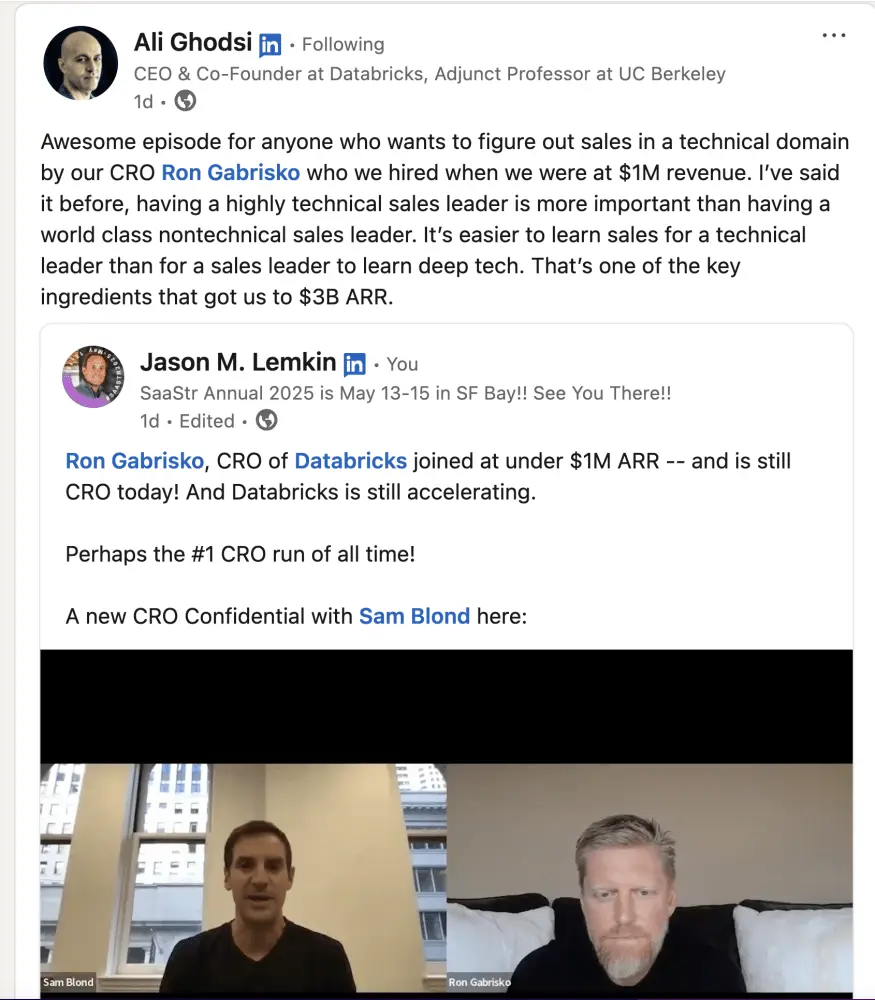
Founders often fall victim to the "halo effect"—the cognitive bias where an impressive logo on a candidate’s resume (e.g., Salesforce, Snowflake, Databricks) blinds the interviewer to underlying performance indicators.
An AE might look exceptional on paper because they hit quota at a dominant tech giant. But how much of that quota achievement was driven by brand equity, inbound inbound marketing machines, and existing account expansion, rather than true outbound hunting and enterprise deal orchestration? When that same rep is dropped into an early-stage startup where they must build pipeline entirely from scratch, their performance often plummets.
Official Industry Perspectives: Leadership and Revenue Operations Insights
Navigating the complexities of sales hiring requires balancing founder intuition with executive leadership frameworks. Industry veterans emphasize that while founders must maintain oversight, certain functions must be delegated to seasoned revenue leaders.
The Role of the CRO and RevOps
When a startup brings on a world-class Chief Revenue Officer (CRO) or VP of Sales—alongside a sophisticated Revenue Operations (RevOps) team—the hiring dynamic shifts. A proven sales leader brings pattern recognition developed across multiple organizations. They understand how to build training frameworks, implement rigorous qualification methodologies (like MEDDPICC), and establish repeatable playbooks.
According to prominent tech community insights, once you hire a top-tier VP of Sales, you have to let them operate. A great sales leader will frequently hire candidates that the founder might personally pass on during an interview. Why? Because executive leaders understand the specific mechanical competencies required for their exact go-to-market motion, even if a candidate lacks traditional polish or an elite pedigree.
However, this delegation comes with a vital caveat: Up to a point. Founders must trust their sales leadership, but they must also maintain visibility into hiring quality to ensure cultural alignment and execution capability.
The Modern Checklist for Evaluating AEs
Instead of assuming past performance guarantees future results, hiring managers must dig deeper into a candidate’s operational history. Industry consensus points to a functional evaluation checklist:
- Deal Complexity Match: Has the candidate previously sold products with similar technical depth and implementation timelines?
- ACV Alignment: Does their historical average deal size match the target price point of your current product offering?
- Motion Synchronization: Are they experienced in outbound prospecting, partner-led sales, or inbound conversion—whichever matches your current go-to-market reality?
- Resource Dependency: Can they build pipeline independently, or do they rely heavily on pre-existing enterprise brand equity and marketing support?
Future Outlook: The Next Generation of B2B Sales Talent and AI Integration
As the B2B technology landscape continues to evolve, the definition of a "great sales rep" is undergoing a profound structural transformation driven by artificial intelligence and shifting buyer behaviors.
The Impact of AI on Transactional Sales
The rise of generative AI tools, automated outbound sequencing, and AI-driven buyer enablement platforms is rapidly eliminating low-value, transactional sales tasks. Buyers are increasingly resistant to traditional cold outreach, demanding deeper technical fluency, personalized business insights, and frictionless digital buying experiences.
In this automated future, the "universal closer" myth will face even greater headwinds. AI can easily handle surface-level product pitches, objection handling scripts, and basic demo scheduling. Therefore, human sales professionals must provide value far beyond what an algorithm can generate. This elevates the need for deep domain expertise, strategic advisory capabilities, and complex stakeholder consensus building.
Strategic Recommendations for Founders and Hiring Managers
Looking ahead, startups and scale-ups must adopt a disciplined, scientific approach to building revenue teams:
- Control for Stage and Price: Never hire an AE purely based on industry reputation. Always map their past success directly against your current company stage and target Average Contract Value.
- Empower Sales Leadership Wisely: Vet your VP of Sales or CRO exhaustively. Once hired, give them the autonomy to construct their team, but hold them accountable to data-driven ramp times and quota attainment metrics.
- Reject the Magic Bullet Fallacy: Accept that sales excellence is contextual. Building a predictable revenue engine is not about finding a mythical superstar who can sell anything to anyone; it is about assembling a disciplined, well-trained team whose individual skills precisely match the unique demands of your product and market.
By abandoning the illusion of the universal closer and embracing a rigorous, variable-controlled approach to talent acquisition, B2B software companies can build resilient, high-performing sales organizations capable of sustainable growth in any economic climate.