Executive Overview
The enterprise productivity landscape is undergoing a massive consolidation. For years, specialized SaaS platforms carved out profitable niches by mastering single, discrete tasks: Calendly owned scheduling; Otter and Fathom dominated transcription; and CRM platforms handled post-meeting data entry. However, the rapid democratization of generative artificial intelligence has dissolved these boundaries, igniting a fierce platform war where software suites are racing to become the all-in-one operating system for knowledge workers.
In a major strategic move, Calendly—the scheduling giant valued at over $3 billion—has officially entered the AI meeting assistant and note-taking market. Long recognized as the default infrastructure for booking meetings, Calendly is expanding its product ecosystem to capture the entire lifecycle of a meeting: from the initial calendar invite to the live conversation, and ultimately to the post-meeting action items.
By introducing a native AI note-taker alongside a sophisticated scheduling assistant named "Callie," Calendly is positioning itself to disrupt a crowded market of well-funded startups. This move directly challenges dedicated transcription tools like Granola, Fireflies.ai, Read AI, and Fathom, as well as broader productivity suites like Notion and ClickUp.
Calendly’s expansion highlights a key shift in enterprise software: scheduling alone is no longer a defensible moat. The real value now lies in what happens after the meeting is booked—transcribing the conversation, extracting intelligence, automating follow-up emails, and seamlessly updating downstream databases.
Detailed Chronology: Feature Breakdown and Technical Capabilities
Calendly’s entry into the AI note-taking space is not merely a superficial feature release; it represents a fundamental expansion of its product architecture. The company is rolling out a multi-pronged AI suite designed to handle transcription, context retrieval, and automated post-meeting workflows.
[Pre-Meeting] ──────────────────► [In-Meeting] ──────────────────► [Post-Meeting]
• Scheduling via Calendly        • Video/Audio Recording          • Summary & Action Items
• Automated Consent Alerts       • Real-Time Transcription        • Drafted Follow-up Emails
• Callie AI Context Retrieval    • System Audio Capture (Testing) • CRM & Workflow Updates
1. The Core AI Note-Taker
At its launch, Calendly’s note-taker operates similarly to established players in the space. The assistant joins video conferencing platforms (such as Zoom, Microsoft Teams, and Google Meet) as a virtual participant. Once inside the call, it performs several key functions:
- High-Fidelity Recording & Transcription: The tool captures both audio and video, converting speech to text in real-time.
- Structured Summarization: Rather than delivering a raw transcript, the AI processes the dialogue to generate structured summaries, identifying key discussion topics, decisions made, and sentiment.
- Automated Action Items: The system extracts explicit tasks and assignments from the conversation, attributing them to specific participants.
- Drafted Follow-Ups: Immediately following a call, the tool drafts contextual follow-up emails based on the meeting’s outcomes, allowing users to review, edit, and send them with a single click.
2. Bot-Less "System Audio" Capture
A common complaint among enterprise users is "bot fatigue"—the awkwardness of having external transcription bots join confidential meetings. To address this friction point, Calendly has confirmed it is actively testing a system-audio capture feature.
Modeled after the architecture used by startups like Granola, this feature allows the software to record and transcribe meetings directly from the user’s computer audio output and microphone. This eliminates the need for a visible bot to join the call, offering a more discreet, seamless, and privacy-conscious alternative for sensitive enterprise discussions.
3. "Callie": The Autonomous Scheduling Agent
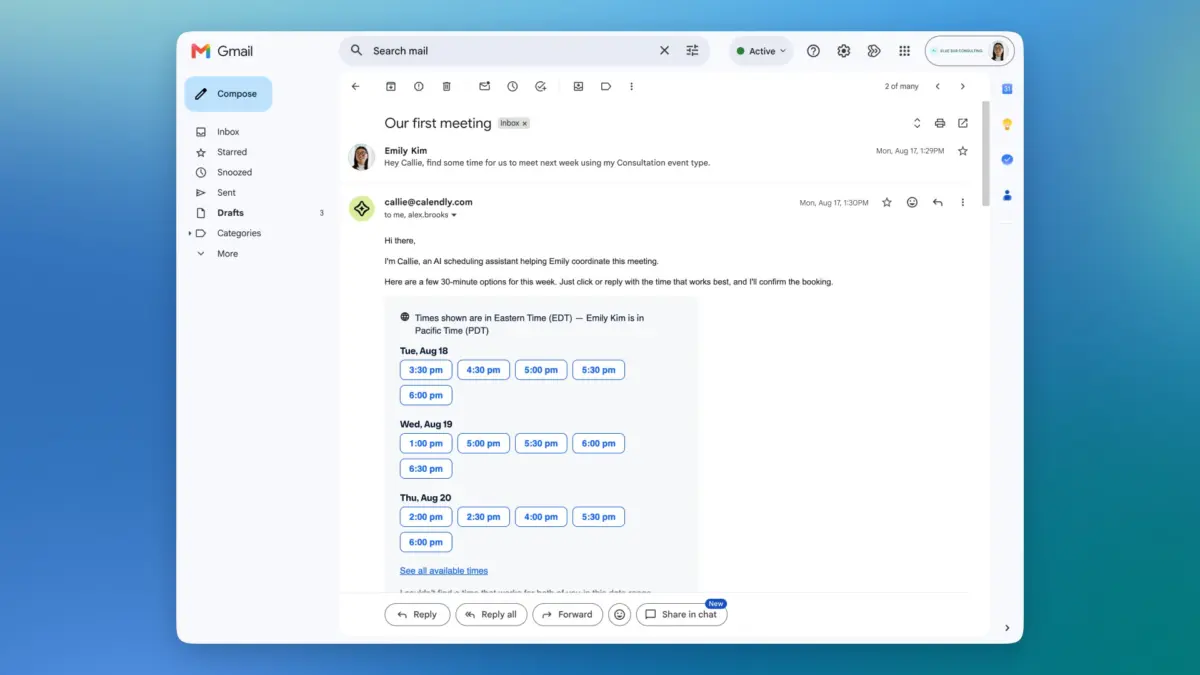
Alongside the note-taker, Calendly is preparing to launch Callie, an advanced AI assistant designed to leverage the company’s core scheduling infrastructure. Callie is built to operate as an executive assistant, executing complex scheduling and administrative tasks via natural language commands.
Unlike basic scheduling links, Callie can:
- Analyze Historical Context: Retrieve summaries and action items from prior meetings to brief users before their next call.
- Coordinate Multi-Party Availability: Scan calendars across internal and external participants to find optimal meeting windows.
- Automate Outreach: Draft and send email invites, follow-ups, and scheduling confirmations on behalf of the user.
This feature set closely mirrors the "digital twin" technology launched by competitors like Read AI, pointing to a future where AI agents negotiate schedules and exchange context on behalf of their human counterparts.
Supporting Context & Metrics: The Crowded AI Meeting Landscape
Calendly’s expansion comes at a time of unprecedented venture capital activity and intense competition within the meeting intelligence sector. To understand the stakes of Calendly’s entry, one must analyze the massive valuations and aggressive feature expansions of its direct competitors.
| Company / Tool | Key Value Proposition | Notable Funding & Valuation | Unique Selling Point |
|---|---|---|---|
| Granola | Bot-less, system-audio note-taker for Mac | Raised $125M; $1.5B valuation | Local-first processing, highly customizable templates |
| Read AI | Email & calendar "digital twin" assistants | Rapidly expanding enterprise suite | Cross-platform intelligence (Slack, Email, Meetings) |
| Fireflies.ai | Multi-platform meeting recorder and app ecosystem | Well-established enterprise integration stack | "Ask Fred" AI search, custom workflow apps |
| Fathom | Bot-less meeting recorder and AI summarizer | High adoption among sales teams | Zero-cost tier, robust CRM auto-sync |
| Otter.ai | Real-time transcription and enterprise search | Pioneer in voice-to-text | Cross-meeting search engines for entire enterprises |
| Notion / ClickUp | Horizontal workspace suites | Multi-billion dollar valuations | AI notes integrated directly into project management wikis |
The astronomical $1.5 billion valuation achieved by Granola after a $125 million funding round highlights the massive market demand for meeting intelligence. Investors are betting heavily that the meeting recorder is not just a utility, but the ultimate entry point for enterprise AI.
However, Calendly holds a massive structural advantage over pure-play note-taking startups: distribution. While startups like Fathom or Granola must acquire users from scratch, Calendly boasts a massive, deeply loyal global user base of tens of millions of professionals who already rely on its software daily. By bundling a highly capable AI note-taker directly into its existing subscription tiers, Calendly can bypass traditional customer acquisition costs, posing an immediate threat to standalone players.
Official Statements: Leadership Strategy and the "Post-Meeting" Imperative
In discussing the launch, Calendly CEO Tope Awotona laid out a clear, pragmatic philosophy. Rather than viewing the note-taker as a standalone product, Awotona frames it as the natural evolution of workflow automation for meeting-heavy professionals.
"There’s a litany of note-takers, and all of them do a great job of recording and transcribing notes. But a lot of work happens after the meetings. And we think that really that’s where the opportunity for our note-takers to be efficient."
— Tope Awotona, CEO of Calendly
Awotona’s comments pinpoint the primary bottleneck in modern knowledge work. Transcription has quickly become a commodity; any standard LLM API can convert audio to text with high accuracy. The true differentiator is workflow integration—taking the raw output of a meeting and automatically triggering actions across an organization’s software stack, such as updating Salesforce opportunities, assigning Jira tickets, or drafting personalized follow-up emails in Outlook.
By focusing on outward-facing professionals—such as sales executives, account managers, and recruiters—Calendly is targeting users whose entire livelihood revolves around meetings. For these professionals, saving 15 minutes of administrative work per meeting across five to eight meetings a day translates directly to hours of reclaimed productivity every week.
The Privacy and Compliance Battleground
As AI note-takers proliferate, they are facing intense scrutiny from IT administrators, legal departments, and privacy advocates. Startups in this space have increasingly found themselves in legal and public relations trouble over consent and data retention policies.
For instance, Otter.ai has faced class-action litigation and privacy complaints regarding how it handles meeting transcriptions and user data. Similarly, other AI tools have faced backlash for secretly joining calls without explicit permission from all participants, raising serious legal questions around wiretapping laws in two-party consent jurisdictions.
To bypass these hurdles, Calendly is leaning heavily into transparent consent architectures, leveraging its scheduling engine to handle compliance before the meeting even starts.
[Calendly Booking Page]
       │
       ▼
[Pre-Meeting Opt-In Notification]
  "This meeting will be recorded by Calendly AI"
       │
       ├─► Guest Approves ──► AI Note-Taker Joins Call
       │                               │
       │                               ▼
       │                       In-Chat Notification Sent
       │                       ("I am recording. Ask me to leave at any time.")
       │
       └─► Guest Declines ──► AI Note-Taker Blocked Automatically
This proactive notification system gives Calendly a distinct advantage. Because Calendly owns the scheduling invite, it can inform participants that the meeting will be recorded before they even join the call.
Additionally, when the note-taker enters a meeting, it automatically drops a clear message in the chat explaining its presence and purpose. Any participant can easily dismiss the bot with a simple chat command, ensuring that privacy remains in the hands of the users.
Future Outlook: The Evolution of Enterprise Scheduling
Calendly’s expansion into AI note-taking is part of a broader trend: the death of the single-feature SaaS tool. As enterprises look to consolidate their software budgets, they are increasingly choosing unified platforms over fragmented, single-use applications.
Looking ahead, the scheduling market will likely split into two distinct layers:
- The Infrastructure Layer: Basic, commoditized scheduling links built directly into email clients like Google Workspace and Microsoft 365.
- The Intelligence Layer: Advanced workflow engines—like Calendly—that manage the entire lifecycle of a meeting, acting as an autonomous coordinator, scribe, and project manager.
As AI assistants like Callie grow more advanced, the dynamic of booking meetings will shift from manual calendar coordination to agent-to-agent negotiation. In this future, a sales representative’s AI agent will coordinate directly with a prospect’s AI agent to schedule a call, share relevant pre-meeting documents, record the discussion, and update the respective CRMs—all without human intervention.
By building the foundational tools for this transition today, Calendly is ensuring it remains an essential player in the enterprise software ecosystem. The battle is no longer just about owning the calendar invite; it is about owning the valuable business intelligence generated during the meeting itself.