For the first time in more than a century, the skies above Spain offered a breathtaking celestial spectacle as a total solar eclipse carved a path of complete darkness across the Iberian Peninsula. Marking a monumental milestone for European astronomy, the historic event drew millions of spectators out into the open air—from the coastal shores of Mallorca and Tarragona to the vibrant urban parks of Madrid—while simultaneously launching an international fleet of researchers, high-altitude aircraft, and student-led balloon teams into action.
While parts of northern North America, western Africa, and much of Europe experienced a partial view of the phenomenon, the true crown jewel of the event unfolded along its narrow path of totality. Beginning its dramatic journey in the frigid waters of the Arctic Ocean north of Greenland, the lunar shadow swept west of Iceland, crossed the tumultuous North Atlantic, and made landfall on the Iberian Peninsula precisely at 8:30 PM Central European Summer Time (CEST).

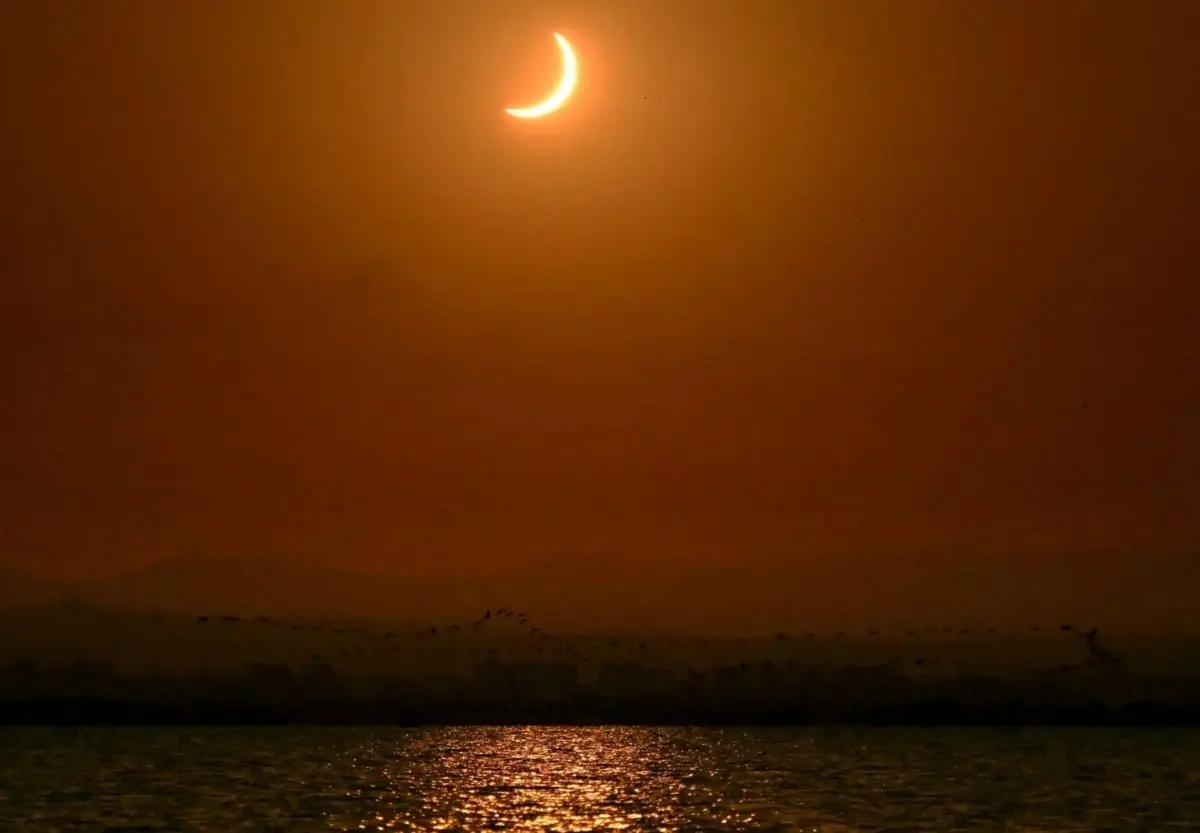
Because the sun hung low near the horizon during its peak over Spain, the eclipse presented an unusually dramatic, photogenic composition. The glowing, ethereal tendrils of the solar corona blazed brilliantly around the silhouette of the moon, casting a surreal, twilight-like glow over ancient cityscapes, sun-drenched beaches, and packed sports stadiums alike. Though the grand cosmic alignment lasted roughly four and a half hours from start to finish, the precious window of absolute totality—when the moon completely obliterated the solar disk—lasted just under two minutes.
Yet, within that fleeting window, the scientific community unlocked a treasure trove of observational data. Space agencies, independent institutions, and aerospace organizations leveraged the unprecedented alignment to study the innermost secrets of our star, probing the complex dynamics of the solar corona and measuring the immediate atmospheric impacts of sudden, localized solar occlusion. As the celestial dust settles on this historic milestone, the astronomical community is already looking ahead to the next horizon, even as millions of skywatchers continue to marvel at the striking imagery left in the wake of Wednesday’s unforgettable cosmic event.

Detailed Chronology: A Journey Across Land and Sea
To understand the magnitude of Wednesday’s solar eclipse, one must trace its vast trajectory across the northern hemisphere. The shadow of totality did not materialize over Spain alone; it was the final, triumphant continental act of a multi-thousand-mile celestial journey orchestrated by orbital mechanics.
The Arctic Genesis and Atlantic Crossing
The event began in the remote, icy expanses of the Arctic Ocean, far north of Greenland. Here, the Moon’s umbral shadow first made contact with Earth, setting a relentless eastward and southward vector. Moving at supersonic speeds across the globe, the shadow grazed the western coast of Iceland, sending scientists and local populations scrambling to safe viewing vantage points amidst chilly sub-arctic winds.

From Iceland, the shadow hurtled across the vast, open expanses of the North Atlantic Ocean. For several hours, the path of totality traversed open waters, largely unseen by human eyes save for a few specialized maritime expeditions and automated weather buoys, building momentum for its grand terrestrial finale.
Landfall on the Iberian Peninsula
At precisely 8:30 PM CEST, the moon’s shadow made its long-awaited landfall on the Iberian Peninsula. For Spain, this moment marked the end of a century-long drought of total solar eclipses—a generational gap that ensured immense public anticipation.

The path of totality swept across a vast swath of Spanish geography, blanketing regions such as Galicia, Asturias, Castile and León, Madrid, Aragon, Catalonia, the Valencian Community, and the Balearic Islands in sudden, eerie darkness. Meanwhile, the remainder of the country—and surrounding regions across western Europe and parts of northern North America—participated in the event as witnesses to a striking partial eclipse.
The Low-Sun Phenomenon and Totality
One of the most remarkable characteristics of the eclipse over Spain was its timing relative to the diurnal cycle. Because the sun was positioned just above the western horizon as the shadow arrived, the geometry of the viewing angle created an intensely dramatic visual landscape.

Unlike eclipses that peak at the zenith—where the sky darkens overhead while the horizon retains a distant 360-degree sunset glow—this evening eclipse plunged the low-hanging sun directly into a rich tapestry of twilight colors. As the moon’s disk slid completely over the sun, the solar corona erupted into view, painting the evening sky with pearlescent streamers of superheated plasma.
Across beaches in Llucmajor, Mallorca, and bustling urban green spaces like El Cerro del Tío Pío Park in Madrid, crowds fell into a hushed silence. Beachgoers, families, and even football fans gathered at stadiums—such as Riazor Stadium during the Teresa Herrera Trophy match between RC Deportivo A Coruña and Real Madrid—donned specialized solar viewing glasses to catch glimpses of the phenomenon before totality enveloped the landscape. In places like San Asensio in La Rioja, Palencia, Tarragona, and San Sebastián, the transition from blinding daylight to absolute shadow took mere seconds, leaving an indelible impression on everyone fortunate enough to stand within the path of totality.

Supporting Context & Metrics
The 2026 total solar eclipse was not merely an aesthetic marvel; it was an intricately choreographed cosmic event defined by precise astronomical metrics and extensive logistical preparation.
Temporal Breakdown
- Total Duration of the Event: Approximately 4.5 hours from the initial partial phase (first contact) to the final departure of the lunar disk (fourth contact).
- Duration of Totality: Ranged between 1 minute and 45 seconds to just under 2 minutes, depending on the observer’s exact geographic coordinates along the central line of the shadow path.
- Landfall Time: Precisely 8:30 PM CEST as the umbra touched the Iberian Peninsula.
Geographic Reach of Totality in Spain
The narrow corridor of totality cut through some of Spain’s most economically, culturally, and geographically diverse territories:

- Northwestern & Northern Spain: Galicia, Asturias, and Castile and León experienced deep, prolonged darkness as the shadow swept eastward from the Atlantic.
- Central & Eastern Spain: The capital region of Madrid, along with Aragon and Catalonia, saw massive public gatherings in city squares, parks, and historic plazas.
- Mediterranean Coast & Islands: The Valencian Community and the Balearic Islands (including Mallorca) provided stunning coastal backdrops, with spectators watching from sandy shores and fishing ports like Tarragona and Segur de Calafell.
The Scientific Stakes: Why This Eclipse Mattered
While casual observers reveled in the beauty of the corona, the scientific community viewed the eclipse as a rare, time-sensitive laboratory. Total solar eclipses provide the only natural opportunity to study the sun’s outermost atmosphere—the corona—in high resolution. Under normal conditions, the photosphere (the sun’s bright surface) outshines the corona by a factor of millions, rendering the faint outer atmosphere invisible to standard ground-based instrumentation without specialized coronagraphs.
During totality, however, the moon acts as an absolute occulting disk, blocking the blinding light of the solar surface and allowing researchers to observe the intricate magnetic loops, coronal mass ejections, and plasma waves that extend millions of kilometers into space. Understanding these dynamics is critical not only for stellar physics but also for predicting "space weather," which can disrupt satellite communications, GPS networks, and terrestrial power grids on Earth.

Official Statements and Research Initiatives
The rarity of a total solar eclipse over a densely populated, technologically advanced European nation triggered an unprecedented mobilization of space agencies and research institutions. NASA, the European Space Agency (ESA), and numerous academic partners deployed high-tech instruments to capture data that cannot be replicated by orbiting satellites alone.
NASA’s High-Altitude WB-57 Mission
Among the most ambitious scientific endeavors was a dedicated NASA mission tracking the moon’s shadow from the stratosphere. Utilizing a specialized WB-57 high-altitude research aircraft cruising at an altitude of 50,000 feet, a team of scientists soared above the dense, distorting layers of Earth’s lower atmosphere.

Flying well above typical commercial air traffic routes, the WB-57 aircraft used advanced optical tracking systems and high-resolution spectrometers to capture unhindered imagery of the solar corona. By maintaining pace with the supersonic shadow for longer than ground-based observers could manage, the mission aimed to gather unprecedented data on the rapid thermodynamic shifts occurring within the sun’s outer atmosphere.
Student-Led Atmospheric Balloon Campaigns
In addition to airborne astronomy, NASA and its academic collaborators empowered the next generation of scientists. University students from across the United States traveled to staging grounds in Iceland and Spain to participate in coordinated atmospheric research campaigns.

Before, during, and after the eclipse, these student teams launched a series of high-altitude scientific balloons equipped with environmental sensors. Their primary objective was to analyze how the sudden, localized drop in solar radiation and temperature alters the chemistry and dynamics of Earth’s stratosphere and troposphere. By measuring shifts in atmospheric pressure, humidity, wind patterns, and ozone concentrations during the occlusion, researchers hope to refine global climate and atmospheric circulation models.
Future Outlook
As the celestial alignment dissolves and researchers begin the painstaking process of analyzing petabytes of telemetry, photographic data, and atmospheric measurements, the astronomical community is already casting its gaze toward the horizon.

Wednesday’s solar spectacle serves as a powerful reminder of the dynamic, clockwork nature of our solar system. Yet, the cosmic calendar offers little downtime for space enthusiasts. Later this month, the celestial stage will shift from the sun to the Earth-Moon system as a partial lunar eclipse graces the skies across the Americas, providing yet another window for public engagement and specialized lunar research.
For Spain and the millions of residents and tourists who crowded beaches, hilltops, and city streets on that unforgettable August evening, the 2026 eclipse will undoubtedly be remembered as a defining cultural and scientific event of the decade. As images of the diamond ring effect and the pearlescent solar corona continue to circulate globally, they leave behind a renewed public fascination with the cosmos—proving once again that few experiences on Earth can rival the humbling, transformative power of day turning momentarily into night.