
Executive Overview
In the modern digital landscape, few phenomena are as unsettling as the uncanny precision of social media advertising. Users frequently report an eerie experience: browsing for a product on an independent e-commerce website, only to find a targeted advertisement for that exact item appearing within their Instagram feed mere minutes later. This phenomenon often prompts a common, albeit conspiratorial, suspicion: Is the app listening through my phone’s microphone?
According to Meta, the parent company of Instagram, the answer is a definitive no. The platform does not covertly record private conversations to serve commercial interests. Instead, the mechanism behind this hyper-personalized targeting is far more pervasive and systemic. Retailers, third-party applications, and web services routinely transmit data regarding user visits, purchases, and digital interactions back to major technology conglomerates like Meta. Combined with an exhaustive web of in-app activity tracking, machine learning models, and cross-platform profile linking, this harvested information creates a granular psychological and behavioral profile of every user.
For years, digital privacy advocates have argued that users are trapped in an asymmetric data ecosystem, where opting out of surveillance requires navigating a labyrinth of obfuscated settings. However, recent regulatory pressures and updates to Meta’s architecture have introduced new controls that empower users to reclaim a degree of autonomy.
This guide provides an exhaustive, authoritative breakdown of how Instagram utilizes external data, in-app actions, and artificial intelligence to shape your user experience. Furthermore, it details step-by-step methodologies to systematically restrict data harvesting, limit AI profiling, and mitigate cross-app tracking across both iOS and Android ecosystems.
Detailed Chronology of Meta’s Data Harvesting Evolution
To understand how to protect your privacy, it is essential to trace how Meta has evolved its data collection mechanisms over the past decade. The architecture of modern digital advertising relies heavily on continuous tracking, shifting from basic demographic targeting to predictive, AI-driven behavioral profiling.
The Shift Toward Cross-Platform and External Tracking
In the early days of social media advertising, targeting was largely restricted to self-reported data: age, location, declared interests, and immediate in-app behavior. However, as the digital economy shifted toward programmatic advertising, Meta expanded its tentacles outward.

Through the implementation of tracking tools like the Meta Pixel (formerly Facebook Pixel) embedded in millions of external websites, the company bridged the gap between off-platform browsing and on-platform advertising. When a user browsed an online storefront, the pixel registered that intent and fed it directly into Meta’s ad auction engine.
The Regulatory Crackdown and the Introduction of "Accounts Center"
As global data privacy laws—most notably the European Union’s General Data Protection Regulation (GDPR) and the California Consumer Privacy Act (CCPA)—took effect, tech companies were forced to restructure how data flows between disparate services. Meta responded by consolidating its account ecosystems under a centralized dashboard known as the Accounts Center.
While framed as a tool to streamline user management across Facebook, Instagram, and Messenger, the Accounts Center simultaneously consolidated data-sharing pathways. It allowed Meta to merge data points from various platforms, ensuring that a user’s behavior on Instagram could seamlessly inform advertising parameters on Facebook, and vice versa.
The Rise of AI-Driven Personalization (2025–2026)
A significant paradigm shift occurred on December 16, 2025, when Meta formally integrated user interactions with its generative AI features into its broader advertising and content recommendation engines. Conversations with Meta AI—ranging from travel inquiries to casual brainstorming—began serving as behavioral signals for ad targeting.
This integration was quickly followed in July 2026 by the rollout of a modernized privacy control: the Activity from other businesses setting. Designed to replace legacy controls such as "Your activity off Meta technologies" and "Activity information from ad partners," this framework was engineered to give users granular—though still limited—control over how external commercial partners feed data into Meta’s recommendation algorithms.
Supporting Context & Metrics: How Instagram Tracks You
There is currently no single "master switch" capable of completely halting Instagram’s data collection apparatus. Meta’s infrastructure is deliberately decentralized, capturing data across multiple vectors simultaneously. To effectively limit tracking, users must understand the distinct categories of data collection:

1. In-App Behavioral Signals
Meta retains the absolute right to analyze everything you do natively within Instagram and its sister platforms. This includes:
- Search queries and hashtags explored.
- Content consumption duration (how long you linger on a specific Reel or post).
- Accounts you follow, like, comment on, or share.
- Direct message interactions and engagement patterns.
- Device and network specifications, along with location-related metadata.
2. Off-Platform and Business Data
Through the aforementioned "Activity from other businesses" control, external merchants, applications, and service providers transmit interaction data back to Meta. Even if you do not have a Facebook account, if an online retailer utilizes Meta’s business tools, your purchase history and browsing habits on that retailer’s site can be associated with your broader digital identity.
3. Generative AI Interactions
Conversations hosted within Meta AI chat interfaces are systematically evaluated. While these interactions do not grant Meta permission to listen to your physical surroundings, they do index your intellectual interests, questions, and personal curiosities to refine commercial profiling.
4. Contact Syncing and Cross-Account Linking
When users permit Instagram to sync their mobile device’s address book, Meta absorbs contact lists to map social graphs and suggest new connections. Furthermore, linking multiple accounts within a single Accounts Center enables the cross-pollination of data points between separate profiles, multiplying the vectors through which advertisements can be personalized.
Step-by-Step Mitigation: How to Restrict Instagram’s Data Access
Securing your privacy requires a multi-layered approach, addressing external business tracking, operating system permissions, and artificial intelligence memory features.
Step 1: Turn Off Personalization from Other Businesses
To prevent external entities from feeding your web browsing and purchasing habits into Meta’s ad engine:
- Open the Instagram application and navigate to your profile page.
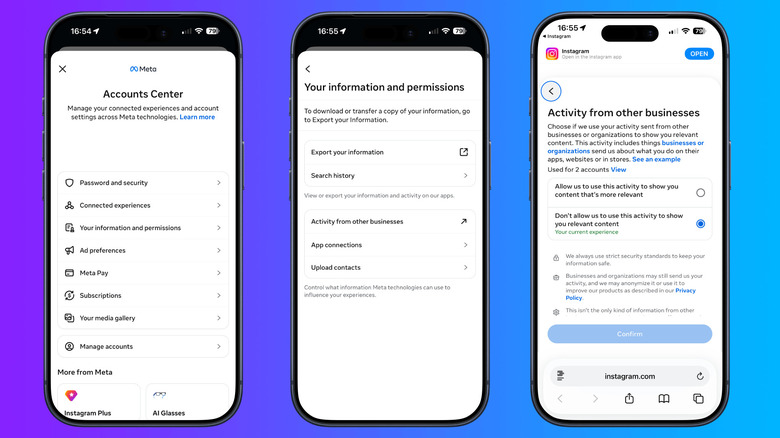
- Tap the three-line menu icon in the upper right-hand corner and select Accounts Center.
- Locate and tap Your information and permissions, then select Activity from other businesses.
- Disable the personalization setting. (Note: Depending on your geographic region and whether Meta has completed rolling out the updated control, you may need to navigate via Ad preferences > Ad settings > Activity information from ad partners).
Crucial Caveat: Disabling this setting does not stop businesses from sending data to Meta, nor does it halt tracking within Instagram itself. It merely prevents off-platform activity from dictating your ad experience.
Step 2: Restrict Operating System Tracking and Permissions
Mobile operating systems offer robust system-level controls that can heavily stifle third-party surveillance.
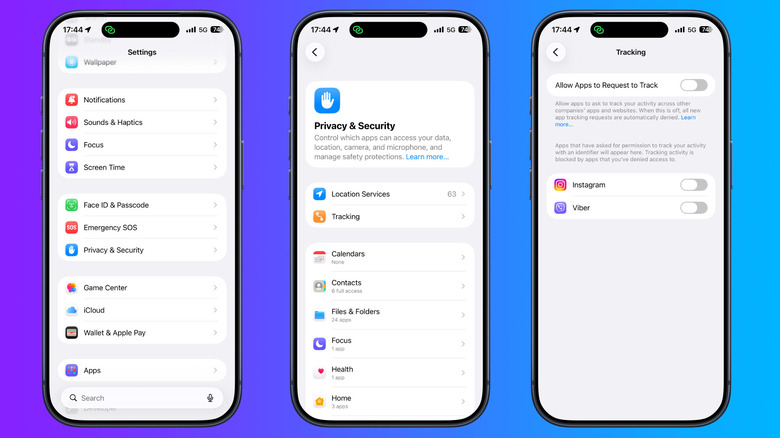
- On iOS (iPhone): Navigate to Settings > Privacy & Security > Tracking and toggle off permission for Instagram. Apple’s "Ask App Not to Track" framework legally and technically blocks applications from tracking your activity across other companies’ apps and websites. While it does not stop Instagram from recording your actions inside its own interface, it starves the app of external telemetry.
- On Android: Navigate to Settings > Apps > Instagram > Permissions. Systematically review and deny access to unnecessary permissions, specifically location services, contacts, camera, and microphone. (Note: Revoking location permissions prevents direct GPS tracking, though Meta may still approximate your location via IP addresses and network signals).
Step 3: Purge Contact Syncing and Unlink Accounts
To cut off the transmission of your personal social graph:
- Within the Accounts Center, navigate to Your information and permissions > Upload contacts.
- Select your Instagram account and toggle off Connect contacts.
- To delete previously uploaded contact data, use a desktop browser to navigate to Instagram.com, access the Accounts Center, and utilize the Manage contacts utility. (Be advised: Meta notes that complete deletion of synced contact data can take up to 90 days).
- Review your linked profiles under Accounts Center > Accounts. Removing secondary accounts from a shared center detaches their data-sharing loops, though it may disable shared login credentials.
Step 4: Mitigate AI Tracking and Clear Chat History
Because Meta utilizes AI chat interactions as behavioral signals for advertising, managing your AI history is critical. While there is no setting to permanently exempt AI chats from personalization while continuing to use the feature, users can manually scrub their data:
- Within an active Meta AI chat on Instagram, type the command /reset-ai to delete the AI’s copy of that specific conversation and its associated memory markers.
- Type the command /reset-all-ais to purge every saved AI conversation across the application.
- Avoid sharing sensitive personal information—such as financial details, home addresses, or confidential medical notes—within Meta AI chat interfaces.
- Users residing in the European Union and the United Kingdom should utilize Meta’s formal Privacy Center objection forms to opt out of generative AI model training where legally mandated.
Official Statements and Regulatory Perspectives
Meta maintains that its data collection practices are essential for sustaining a free, ad-supported internet ecosystem. In various compliance disclosures, the tech giant asserts that personalization benefits consumers by delivering relevant commercial suggestions rather than generalized, arbitrary advertisements.
However, privacy regulators worldwide view these practices with increasing hostility. European data protection authorities have consistently challenged Meta’s legal basis for behavioral advertising, forcing the company to introduce alternative pathways—such as paid ad-free subscriptions or reduced-data advertising models within the European Region. Regulators argue that default opt-in models violate the core tenets of informed consent, pushing technology companies toward more transparent, granular user controls globally.
Future Outlook
The tug-of-war between digital surveillance and user privacy is entering a critical phase. As artificial intelligence models become increasingly integrated into social media infrastructure, the volume and depth of data required to feed these systems will expand exponentially.
In response, privacy advocates anticipate a surge in regulatory frameworks designed to curb predatory data harvesting. Future iterations of mobile operating systems are expected to introduce even stricter compartmentalization, potentially walling off in-app activity from external ad networks entirely.
For the everyday user, total digital anonymity on ad-supported platforms remains an elusive goal. However, by actively utilizing tools like the updated Activity from other businesses controls, system-level tracking blocks, and AI reset commands, individuals can reclaim significant control over their digital footprints, striking a pragmatic balance between connectivity and personal privacy.