Executive Overview
In a significant expansion of its serverless ecosystem, Amazon Web Services (AWS) has announced the general availability of AWS Lambda MicroVMs. This breakthrough serverless compute primitive is engineered to address a notoriously complex engineering paradox: how to deliver rigorous, virtual-machine-level security isolation for untrusted code, while maintaining the near-instantaneous startup times characteristic of modern serverless functions.
Powered by Firecracker—the ultra-lightweight open-source virtual machine monitor (VMM) that already anchors trillions of monthly AWS Lambda function invocations—Lambda MicroVMs offer developers an unprecedented capability. They allow applications to instantly provision, manage, and scale dedicated, stateful, and fully isolated execution environments for individual users, interactive sessions, or AI-generated scripts.
Historically, developers building multi-tenant applications faced an agonizing triage of architectural compromises. Standard virtual machines (VMs) offered rock-solid security isolation through hardware-level virtualization, but suffered from boot times stretching into minutes. Containers slashed startup latency to seconds, yet relied on a shared host kernel that demanded heavy custom hardening to prevent cross-tenant escape vulnerabilities. Traditional Functions-as-a-Service (FaaS) platforms perfected event-driven, ephemeral, request-response execution, but proved inherently hostile to long-running, stateful interactive sessions.
Lambda MicroVMs effectively obliterates this trilemma. By combining Firecracker’s micro-virtualization architecture with pre-initialized snapshot-based booting, persistent disk and memory states, and automatic idle suspension policies, AWS has built a purpose-driven primitive. It abstracts away the heavy lifting of custom hypervisor management, fleet orchestration, and security sandboxing. This enables engineering teams to redirect their focus entirely toward building product value rather than provisioning infrastructure plumbing.
Detailed Chronology & Technical Implementation
The genesis of Lambda MicroVMs stems from years of operational telemetry collected across AWS’s massive serverless footprint. Observing the rapid rise of generative artificial intelligence (AI) coding assistants, interactive cloud-based development environments, collaborative data analytics workbenches, automated vulnerability scanners, and user-scriptable game servers, AWS engineers identified a glaring market gap. All of these modern workloads share a common denominator: the absolute necessity of handing an end-user or an AI agent a dedicated, isolated execution sandbox to safely run arbitrary, non-developer-vetted code.

1. Image Creation and Packaging
The journey of deploying a workload on Lambda MicroVMs begins within the AWS Lambda console or via the AWS Command Line Interface (CLI). Developers package their application code—whether it is a Python Flask API, a Node.js analytics script, or a complex machine learning runtime—alongside a custom Dockerfile into a standard deployment archive (.zip).
For example, a standard Flask web application layout can be encapsulated for the MicroVM architecture using specialized base images provided by AWS:
FROM public.ecr.aws/lambda/microvms:al2023-minimal
RUN dnf install -y python3 python3-pip && dnf clean all

WORKDIR /app

COPY requirements.txt .
RUN pip install --no-cache-dir -r requirements.txt

COPY app.py .

EXPOSE 5000

CMD ["gunicorn", "--bind", "0.0.0.0:5000", "app:app"]
Once uploaded to an Amazon Simple Storage Service (Amazon S3) bucket, developers invoke the CLI to generate a production-ready MicroVM Image:
aws lambda-microvms create-microvm-image
--code-artifact uri=<path/to/s3/artifact.zip> --name <VM_image_name>
--base-image-arn arn:aws:lambda:us-east-1:aws:microvm-image:al2023-1
--build-role-arn <IAM role ARN>
Behind the scenes, AWS Lambda retrieves the artifact, executes the Dockerfile within an isolated build sandbox, initializes the application runtime, and takes a precise Firecracker snapshot of the running disk and memory state. Real-time build logs stream directly into Amazon CloudWatch under /aws/lambda/microvms/<image-name>, ensuring absolute observability throughout the pipeline.
2. Execution and Lifecycle Management
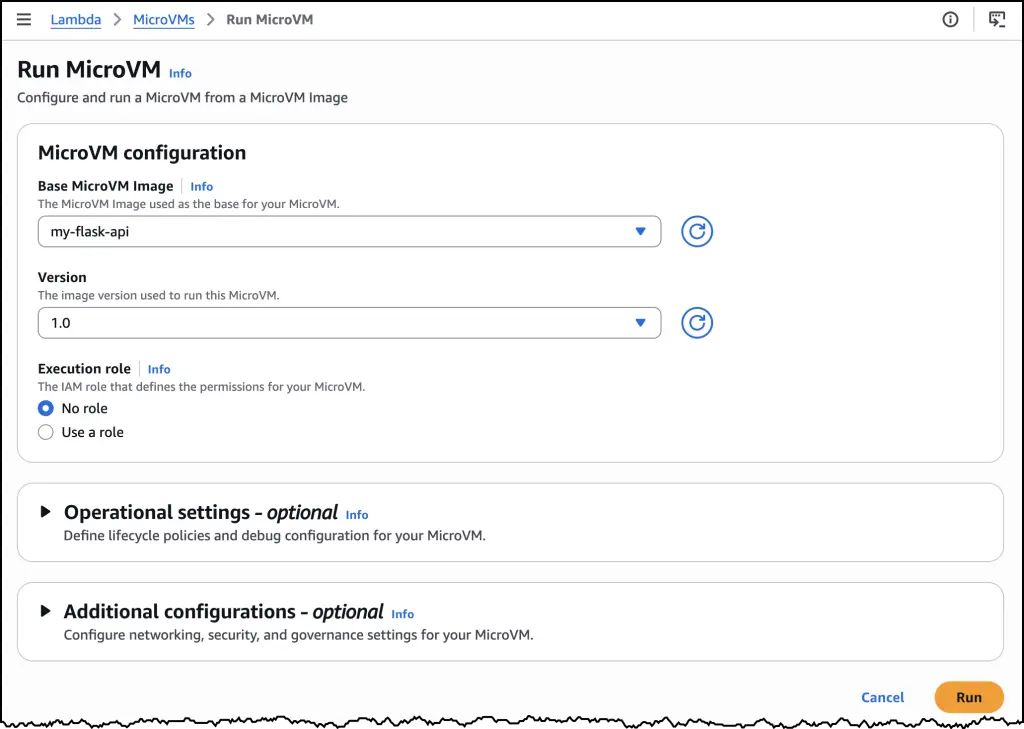
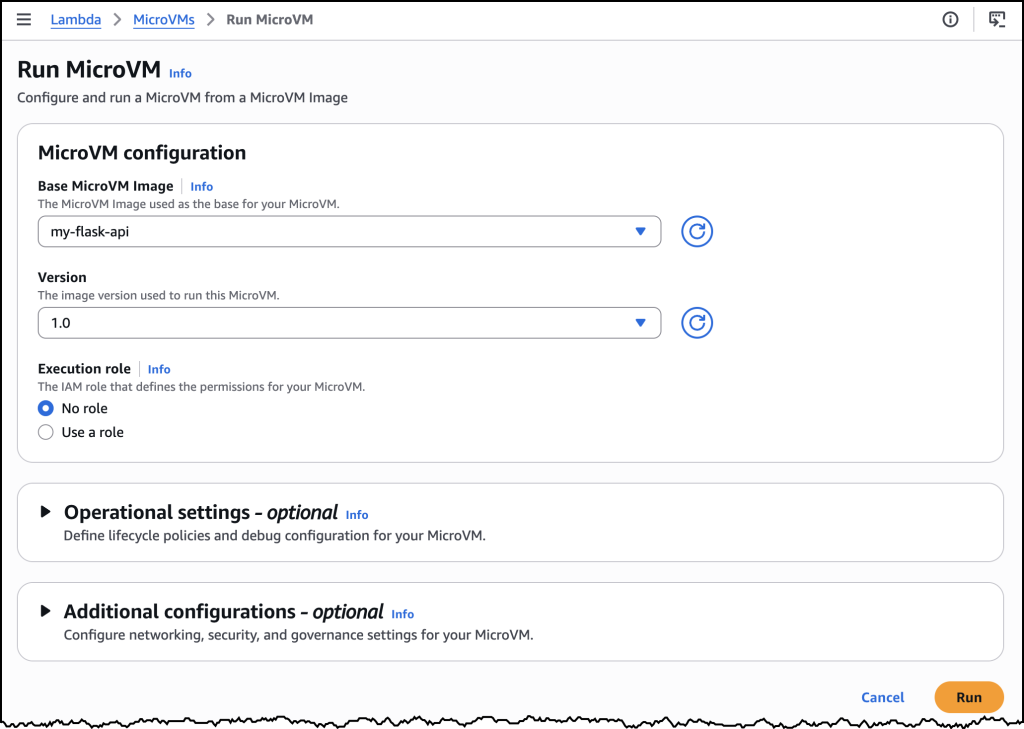
Once the MicroVM Image is registered and assigned an Amazon Resource Name (ARN), launching an instance requires a simple CLI command or an API call:

aws lambda-microvms run-microvm
--image-identifier arn:aws:lambda:<region>:<acct>:microvm-image:my-image
--execution-role-arn arn:aws:iam::<acct>:role/MicroVMExecutionRole
--idle-policy '"maxIdleDurationSeconds":900,"suspendedDurationSeconds":300,"autoResumeEnabled":true'
In this architecture, traditional networking setup friction is entirely eliminated. Lambda automatically assigns each MicroVM a unique identifier, provisions a dedicated endpoint URL, and spins up the instance by instantly restoring it from the pre-initialized Firecracker snapshot. The application is completely bootstrapped and warm the exact millisecond the launch call completes.
3. Stateful Execution and Intelligent Suspension
Unlike stateless FaaS functions that flush memory upon completion, Lambda MicroVMs preserve memory, disk state, and running processes across the lifecycle of a user session. To optimize cost efficiency without sacrificing responsiveness, the service introduces intelligent idle policies.
When a user steps away from their interactive session and traffic drops to zero for a configured window (e.g., 15 minutes), the MicroVM automatically suspends. Its exact memory and disk state are cleanly snapshotted and persisted to durable storage, driving the idle operational cost down to negligible levels. The moment a subsequent request arrives, the MicroVM resumes instantly from its suspended state, restoring all loaded packages, active filesets, and ML models. To the end client, the pause is entirely imperceptible.
Supporting Context & Metrics
To appreciate the architectural leap represented by Lambda MicroVMs, it is instructive to examine the quantitative and structural boundaries of the underlying infrastructure:
- Hardware Specs: At launch, Lambda MicroVMs are available on the high-performance ARM64 architecture, supporting configurations of up to 16 vCPUs, 32 GB of memory, and 32 GB of persistent disk per individual MicroVM.
- Runtime Longevity: Supporting up to 8 hours of continuous runtime per session, the service effortlessly bridges the gap between quick, fleeting tasks and prolonged data analytics or interactive coding workloads.
- Geographic Availability: The service is immediately available across major global AWS regions, including US East (N. Virginia, Ohio), US West (Oregon), Europe (Ireland), and Asia Pacific (Tokyo).
- Isolation Mechanics: Leveraging Firecracker, each MicroVM runs on a dedicated virtual machine boundary with no shared kernel or shared memory spaces. This completely neutralizes "noisy neighbor" resource contention and mitigates container escape vectors common in multi-tenant environments running untrusted code.
| Compute Paradigm | Isolation Level | Startup Latency | State Retention | Primary Use Case |
|---|---|---|---|---|
| Traditional VMs | Hardware Virtualization | Minutes | Stateful | Enterprise workloads, monolithic apps |
| Containers (ECS/EKS) | Shared Kernel (OS-level) | Seconds | Ephemeral/Persistent via volumes | Microservices, web backends |
| AWS Lambda Functions | Micro-isolation / FaaS | Milliseconds | Ephemeral | Event-driven, request-response web APIs |
| AWS Lambda MicroVMs | Hardware-level (Firecracker) | Near-Instant (Snapshot) | Stateful (Memory + Disk) | AI sandboxes, interactive coding, multi-tenant execution |
Official Industry Analysis & Strategic Alignment
Industry analysts and cloud architects have been quick to praise the strategic positioning of Lambda MicroVMs. For years, companies building platforms powered by generative AI—such as automated code generators that execute Python snippets in real time—have had to construct sprawling, expensive Kubernetes clusters. These clusters required custom daemonsets, complex security sandboxing tools like gVisor or Kata Containers, and intricate pod autoscaling logic just to handle user-generated code safely.

By absorbing this undifferentiated heavy lifting into a managed AWS primitive, Amazon is effectively standardizing the infrastructure layer for the agentic AI era.
"Over the past few years, a massive class of multi-tenant applications has emerged where every end user expects their own dedicated, responsive execution environment," notes senior AWS serverless leadership. "By extending Firecracker outside of traditional Lambda functions and exposing it as a stateful, micro-virtualized primitive, we are giving developers the best of all worlds: uncompromising VM security, sub-second snapshot restoration, and zero infrastructure management."
Crucially, AWS has emphasized that Lambda MicroVMs are not designed to replace traditional AWS Lambda Functions. Instead, the two technologies are deeply complementary. An application can utilize standard event-driven Lambda functions for its asynchronous ingestion backbone, database triggers, and API routing, while dynamically orchestrating calls to Lambda MicroVMs whenever a specific subtask requires executing untrusted, long-running, or stateful user code in absolute isolation.
Future Outlook
The launch of AWS Lambda MicroVMs signals a profound maturation in the philosophy of serverless computing. As software engineering trends shift decisively toward AI agents capable of writing, testing, and executing code autonomously in production, the demand for secure, elastic, and ephemeral compute sandboxes will only accelerate.
Looking forward, we can anticipate several evolutionary trajectories for this technology:
- Ecosystem Integration: Deeper native integrations with third-party CI/CD pipelines, managed AI agent frameworks (such as LangChain and AutoGen), and real-time collaborative development platforms.
- Architectural Expansion: Potential future support for x86_64 architectures and expanded memory/disk thresholds to accommodate heavier enterprise data workloads and large language model (LLM) fine-tuning tasks at the edge.
- Advanced Lifecycle Orchestration: More granular, event-driven snapshot triggers that allow developers to programmatically fork running MicroVM sessions for parallel debugging, automated testing, or state rollback.
For enterprise engineering teams burdened with the operational overhead of managing custom virtualization fleets, Lambda MicroVMs represent a definitive turning point. By democratizing access to Firecracker-backed micro-virtualization through a clean, API-driven serverless interface, AWS has once again redefined the boundaries of what is possible in cloud architecture.