Executive Overview
For four decades, the letters “SVB” were synonymous with the rocket-fueled growth of the global startup economy. If you founded a technology company, launched a biotech firm, or secured a venture capital term sheet anywhere from San Francisco to London between 1983 and 2022, Silicon Valley Bank wasn’t just where you parked your money—it was where you built your business. It was the financial institution that dared to back companies with no revenue, negative cash flow, and an asset base consisting of little more than a dream and a slide deck.
Yet, in a breathtaking collapse that spanned a mere 48 hours in March 2023, the institution imploded, taking roughly half of the U.S. venture-backed technology ecosystem down with it into a terrifying weekend of existential dread.
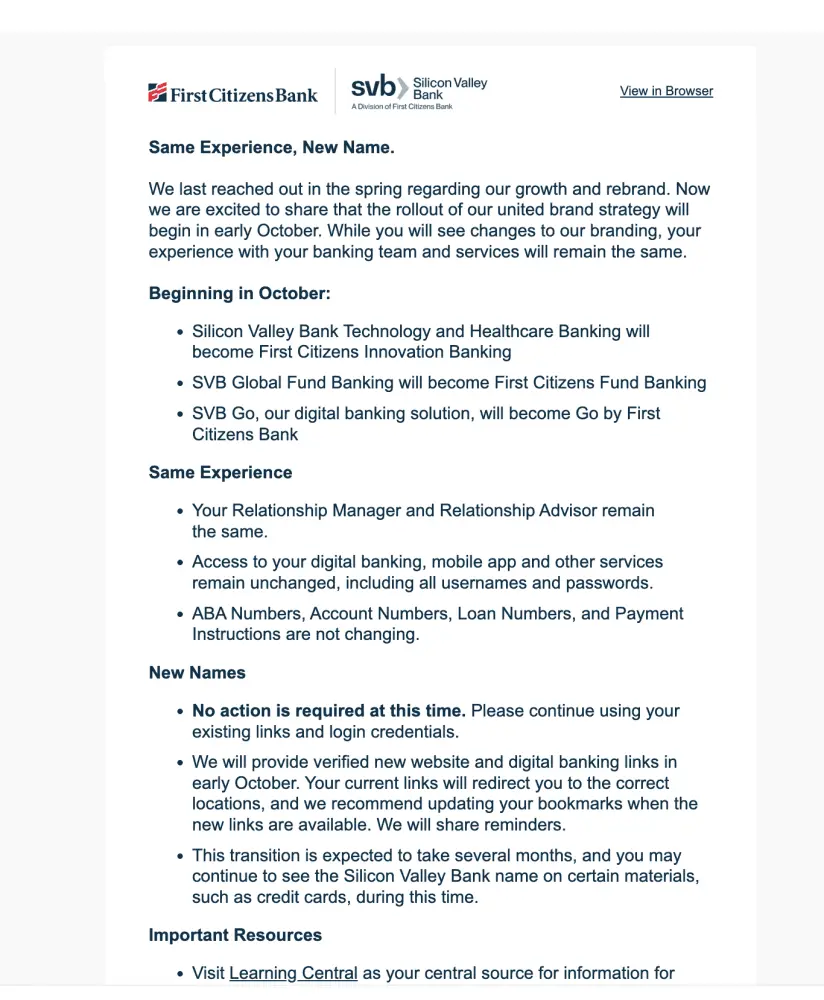
Now, the final chapter of this seismic financial saga is closing. First Citizens Bank, which acquired the remnants of the failed institution, has announced the definitive retirement of the Silicon Valley Bank brand. Beginning in October, monikers like SVB Technology and Healthcare Banking, SVB Global Fund Banking, and SVB Go will be permanently scrubbed, replaced by First Citizens Innovation Banking and Go by First Citizens Bank.
While everyday operations, account numbers, and routing details remain unchanged for clients, the psychological impact of losing the iconic name runs deep. This is the story of how an irreplaceable pillar of Silicon Valley’s architecture built an empire on risk, blew itself up on the most basic principle of commercial banking, and permanently transformed how startups manage their treasury.
Detailed Chronology: From Pajaro Dunes to the 48-Hour Collapse
1. The Genesis: 1983–2019
The story of Silicon Valley Bank began not in a gleaming corporate boardroom, but during a casual poker game at Pajaro Dunes in the early 1980s. Bill Biggerstaff, a Wells Fargo executive, and Robert Medearis, a Stanford professor, recognized a glaring gap in the market: the booming startup ecosystem blossoming up and down Sand Hill Road was being underserved by traditional banks that didn’t understand high-growth, pre-profit businesses.
On October 17, 1983, with Roger Smith serving as founding CEO, the first SVB office opened in San Jose.
The bank’s early years were treacherous. By the early 1990s, roughly half of its loan portfolio was tied up in commercial real estate. When the California real estate market cratered, SVB posted heavy losses in 1992. Recognizing the existential threat, leadership made a decisive pivot: they slashed real estate loans to under 10% of their portfolio within three years and went all-in on the innovation economy.
This pivot birthed modern venture debt. SVB developed a revolutionary underwriting model capable of evaluating companies with zero profits and zero revenues. They financed early versions of tech titans like Cisco and Bay Networks. As the tech boom globalized, SVB expanded aggressively—opening in Israel in 2008, establishing operations in the UK and a joint venture in China by 2012, and eventually pushing across Europe and Canada.
At its peak, SVB banked nearly half of all U.S. venture-backed tech and life sciences companies. In 2021 alone, it handled 55% of all venture-backed tech and healthcare IPOs. For generations of founders, SVB was the singular financial gateway.
2. The Unraveling: 2019–2023
The seeds of SVB’s destruction were sown during the pandemic-era liquidity deluge. Between 2019 and 2021, SVB’s total assets ballooned from approximately $71 billion to an astonishing $211 billion—tripling in just two years.
Deposits flooded in faster than the bank could deploy them into traditional loans. Seeking yield in a low-interest-rate environment, SVB plowed massive sums into long-duration, fixed-income securities at the exact bottom of the interest rate cycle. Then, the macroeconomic landscape shifted violently as the Federal Reserve raised interest rates nine times in a single year to combat inflation.
The subsequent post-mortem by the Federal Reserve detailed a textbook case of catastrophic risk mismanagement. With surging interest rates, the market value of SVB’s massive long-term bond portfolio plummeted. Concurrently, venture capital funding dried up, and tech startups began aggressively burning through their cash reserves, forcing continuous withdrawals from their SVB accounts.
The end came with dizzying speed:
- March 8, 2023: SVB announced it had sold roughly $21 billion of its securities portfolio at an after-tax loss of $1.8 billion, concurrently revealing plans to raise $2 billion in capital to shore up its balance sheet.
- March 9, 2023: Panic ensued across the startup community. Sparked by prominent venture capitalists warning of systemic contagion, clients attempted to pull an unprecedented $42 billion in a single day.
- March 10, 2023: The California Department of Financial Protection and Innovation officially closed the bank, appointing the Federal Deposit Insurance Corporation ( FDIC) as receiver.
In just 48 hours, four decades of financial institution-building vanished, triggering the second-largest bank failure in U.S. history.
Supporting Context & Metrics: The Anatomy of a Near-Miss
The collapse of SVB was not an abstract market correction; it was a visceral, terrifying event for the thousands of companies whose operational lifeblood was trapped inside its vaults.
Take SaaStr, for instance. At the time of the collapse, SaaStr had roughly $10,000,000 sitting in SVB—representing virtually all of its operating cash, payroll reserves, and vendor deposits for its annual conference.

"There was no clever treasury policy that saved us. There was a Thursday where the wire didn’t go through, a Friday where the bank was gone, and a Saturday and Sunday where a very large number of people who run real businesses did the math on whether they could make payroll on Monday with 15% of their cash."
Standard FDIC insurance covers up to $250,000 per depositor, per bank. Millions of dollars held by startups were completely uninsured. On paper, under the strict rules of the financial system, these companies had written their own exposure and would have been forced to take devastating haircuts on their capital.
The Federal Intervention
The catastrophe was averted not by market mechanics, but by extraordinary government intervention. On Sunday, March 12, 2023, the U.S. Treasury Department, the Federal Reserve Board, and the FDIC Board jointly invoked the statutory "systemic risk exception," guaranteeing every depositor—insured and uninsured alike—full access to their funds.
While not a direct taxpayer bailout of the bank itself (shareholders and certain bondholders were entirely wiped out), the rescue carried a massive price tag. Protecting uninsured depositors across SVB and Signature Bank cost the Deposit Insurance Fund an estimated $16.3 billion. To recoup these funds, the FDIC levied a special assessment on the 110 largest banking institutions holding more than $5 billion in uninsured deposits, spread out over eight quarters.
Without this intervention, the startup ecosystem would have suffered a cascading collapse of missed payrolls and bankruptcies on an unprecedented scale.
Official Statements and Institutional Shifts
The aftermath of the crisis permanently altered the competitive landscape of commercial banking. The days of a single institution maintaining a near-monopoly on startup cash are over.
The Multi-Bank Treasury Standard
Today, venture-backed companies uniformly reject single-bank dependency. Modern treasury policy dictates a diversified approach:
- Sweep Networks: Automated sweep products that distribute cash across dozens of partner banks to maximize FDIC coverage have become baseline requirements.
- Diversified Partners: Startups now routinely split their liquidity between traditional institutions, specialized fintech platforms (such as Mercury and Brex), and ultra-safe short-term instruments like Treasury bills.
The Competitive Vacuum
Major institutions rushed to fill the void left by SVB. JPMorgan Chase aggressively expanded its innovation economy banking team, adding hundreds of specialized bankers to capture displaced accounts. Fintech disruptors like Mercury and Brex captured massive cohorts of newly incorporated startups through superior digital user experiences and rapid account onboarding.
Meanwhile, First Citizens Bank—which acquired SVB in a government-backed transaction—inherited a massive book of business. By the second quarter of 2026, First Citizens reported $151.0 billion in loans and $173.4 billion in deposits, with its Global Fund Banking division driving robust growth.
However, the legacy of the collapse continues to cast a long shadow. First Citizens remains actively engaged in paying down the massive purchase-money note issued during the 2023 acquisition, retiring the historic financial debt of the failure quarter by quarter.
Future Outlook: Legal Battles and a New Era
As First Citizens prepares to finalize the transition in October, the ghost of SVB continues to fight in the courtroom.
In March 2025, SVB Financial Trust—the legal successor to the old holding company—filed a lawsuit against First Citizens. The trust argued that vital intellectual property, including historic trademarks, the iconic chevron logo, the svb.com domain, and the catchphrase "Make Next Happen Now," were never legally included in the assets sold by the FDIC. First Citizens maintains that it acquired the complete brand portfolio. A jury trial is scheduled for February 2027.
While First Citizens insists that the October rebrand is independent of the ongoing litigation, dropping the historic mark is a pragmatic move for an acquiring bank dealing with lingering brand friction and legal ambiguity. When JPMorgan Chase acquired First Republic and Washington Mutual, it rapidly retired those toxic names. First Citizens’ decision to retain the SVB banner for three years was a testament to the value of client continuity; its decision to finally drop it signals that those client relationships have fully matured under the new corporate umbrella.
Conclusion
Silicon Valley Bank earned its legendary status by taking calculated risks on visionaries that traditional finance dismissed. Ultimately, it fell victim to the most mundane and destructive risk in commercial banking: a liquidity run driven by rising interest rates and panicked digital communication.
For the startup ecosystem, the lesson was learned at a staggering psychological and systemic cost. Treasury management is no longer an afterthought; it is an active discipline. The SVB logo may be coming down, and the final installments of the FDIC rescue bill are still being paid, but the structural transformation of startup finance is permanent.
Goodnight, SVB, and thank you for the foundational four decades of partnership—even if the explosive finale required a multi-billion-dollar federal rescue to keep the innovation economy breathing.