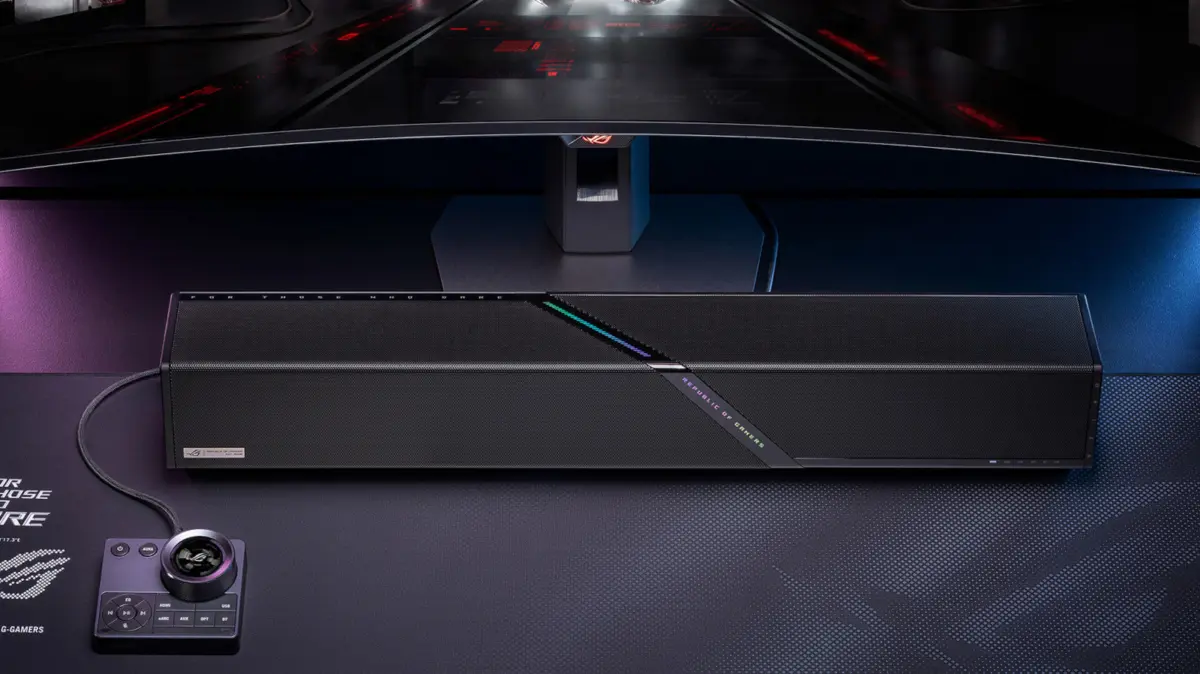
The audio landscape for competitive gaming has long been dictated by the headset. For decades, players seeking a competitive edge—precise directional audio cues, immediate mic clarity, and total immersion—have strapped bulky cups to their ears for hours on end. ASUS, a titan in the PC gaming hardware ecosystem through its Republic of Gamers (ROG) division, is challenging this paradigm. With the official United States launch of the ASUS ROG Gjallar soundbar, priced at $600, the company is making its boldest statement yet in desktop and living room audio.
First teased in early July before securing its commercial footprint stateside, the ROG Gjallar is not merely a downsized home theater soundbar slapped with an RGB logo. It is a purpose-built acoustic ecosystem engineered from the ground up for multiplayer gaming. Named after the legendary Gjallarhorn from Norse mythology—the horn whose blast signals the onset of Ragnarok—this hardware aims to shatter conventional audio barriers. At its core, the device introduces an innovative approach to voice communication: an integrated microphone array housed within a dedicated control hub, utilizing advanced software processing to deliver headset-free communication without sacrificing the pristine clarity required in high-stakes competitive matches.
Sporting a robust 5.1.2-channel configuration, comprehensive Dolby Atmos support, a dedicated wireless subwoofer, and an extensive suite of modern connectivity options including HDMI 2.1 and Bluetooth 5.3, the Gjallar bridges the gap between cinematic home theater performance and ultra-low-latency gaming peripherals. Available through premier retailers like Best Buy and the official ASUS US web store, this $600 investment represents a significant shift in how gamers might experience cooperative and competitive play moving forward. This report explores the technological innovations, structural design, market context, and potential future implications of ASUS’s entry into the gaming soundbar arena.
Detailed Chronology
To fully understand the arrival of the ROG Gjallar in the United States, it is crucial to trace the trajectory of its development and commercial rollout.
The Early-July Teaser
The initial murmurs of the ROG Gjallar surfaced in early July, when ASUS quietly lifted the curtain on its upcoming audio hardware portfolio. Within the enthusiast community, the announcement was met with a mixture of intrigue and skepticism. While soundbars had established a firm footing in living rooms and casual desktop setups, audiophiles and competitive gamers alike questioned whether a soundbar could ever truly replace the localized acoustic pinpointing of a high-end gaming headset. ASUS addressed these concerns head-on by detailing the hardware’s primary unique selling proposition: an integrated microphone and voice-filtering control hub designed specifically to eradicate the need for a headset during multiplayer sessions.
Late-Stage Refining and Ecosystem Integration
Throughout the summer months, ASUS refined the software ecosystem supporting the Gjallar. Because the soundbar relies heavily on advanced digital signal processing (DSP) to isolate user voices from ambient room noise and crashing in-game soundtracks, firmware optimization took center stage. The integration of the control hub’s LCD display—designed to offer real-time metrics, volume adjustments, and EQ profile switching—underwent rigorous beta testing to ensure seamless compatibility across disparate operating systems, ranging from Windows PCs and macOS environments to modern console architectures.
The US Commercial Launch
Fast-forward to the present, and the ROG Gjallar has officially landed on American soil with a definitive $600 price tag. Listed concurrently on Best Buy and the official ASUS US storefront, the hardware’s immediate market availability generated a wave of demand. Within hours of going live, initial inventory allocations faced heavy traffic, pushing many prospective buyers to utilize the "Notify Me" restock alerts. This swift initial reception underscores a latent, highly engaged market of gamers eager to shed traditional headsets in favor of a cleaner, more liberated desktop or entertainment setup.
Supporting Context & Metrics
The release of a $600 gaming soundbar does not occur in a vacuum. It represents the intersection of several concurrent trends in hardware design, consumer ergonomics, and audio engineering.
Acoustic Architecture: 5.1.2 Channels and Dolby Atmos
At the heart of the ROG Gjallar’s acoustic capability is its sophisticated 5.1.2-channel layout. This configuration incorporates traditional left, right, and center channels for dialogue and front-stage imaging, paired with dedicated side/surround channels and two upward-firing drivers. These upward-firing drivers bounce sound waves off the ceiling, creating the vertical dimension essential for true Dolby Atmos reproduction.
Whether tracking the trajectory of overhead aircraft in a flight simulator or listening for vertical footsteps in a multi-story tactical shooter, the spatial awareness provided by 5.1.2 channels elevates the sensory experience far beyond standard stereo or virtual surround solutions. Furthermore, the inclusion of a 6.5-inch, 65-watt wireless subwoofer anchors the low-end performance. Operating on a dedicated 5GHz wireless connection, the subwoofer decouples from the main soundbar chassis to eliminate audio lag and minimize physical desk vibrations—a common pain point for mechanical keyboards and high-precision optical mice sitting nearby.
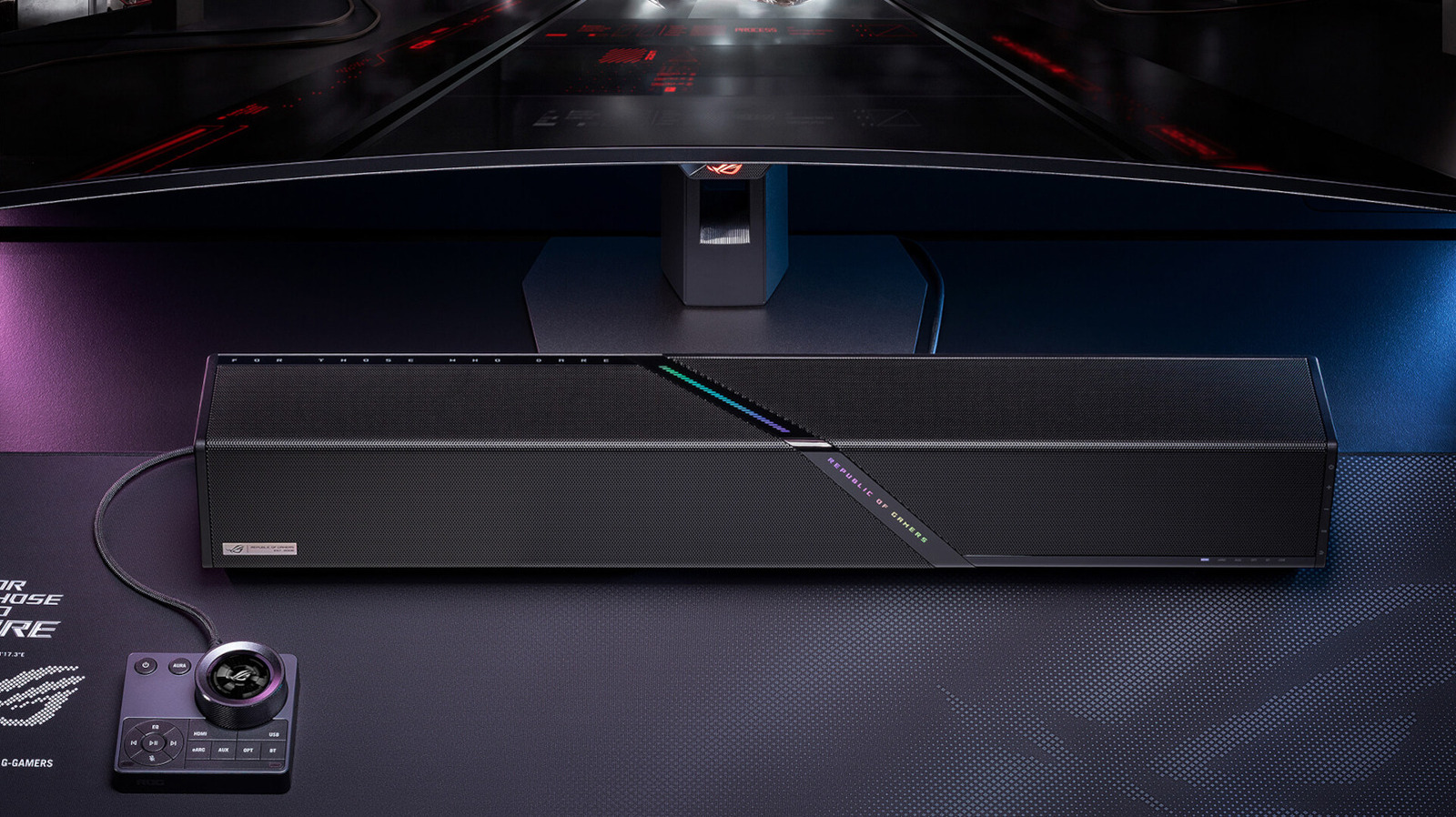
The Headset-Free Communication Conundrum
Perhaps the most technically ambitious feature of the Gjallar is its approach to voice chat. Traditionally, gamers have relied on boom microphones attached to headsets to isolate their voices from ambient room noise. Ambient noise can include anything from mechanical keyboard clacks and PC cooling fan whines to household disturbances.
ASUS solves this by embedding directional microphones directly into the dedicated audio control hub. Powered by sophisticated voice-filtering algorithms, the system is engineered to isolate the user’s vocal frequencies while actively suppressing background noise and the loud, chaotic audio bleeding out of the soundbar’s own drivers. This delicate acoustic balancing act—preventing the soundbar’s output from feeding back into its own microphones while keeping teammate voices crystal clear—represents a major engineering feat in digital signal processing.
Connectivity and Multi-Platform Versatility
Modern gaming setups rarely consist of a single device. A typical enthusiast might alternate between a high-end gaming rig, a PlayStation 5, an Xbox Series X, a Nintendo Switch, and a mobile device. Recognizing this fragmentation, ASUS loaded the Gjallar with a comprehensive array of physical and wireless inputs:
- USB-C: For direct, high-bandwidth connection to PCs and Macs.
- HDMI 2.1 with eARC: Allowing uncompressed audio transmission from modern consoles and smart TVs.
- Optical Input: For legacy systems and specialized audio equipment.
- 3.5mm AUX: For universal analog connectivity.
- Bluetooth 5.3: For seamless mobile pairing and casual media consumption.
Additionally, the soundbar features two USB Type-A ports built directly into the chassis. These ports serve as convenient hubs for wireless mouse, keyboard, or headset dongles, helping to keep cable management tidy and freeing up valuable motherboard I/O ports on the user’s primary machine.
Official Statements
ASUS ROG has positioned the Gjallar not merely as an alternative audio output, but as a lifestyle upgrade for the modern gamer. In official product briefings and launch announcements, company executives and acoustic engineers have emphasized the ergonomic and immersive benefits of the hardware.
"The ROG Gjallar was conceptualized out of a desire to liberate players from the physical constraints of traditional headsets without compromising the competitive edge that crystal-clear communication provides," noted an ASUS ROG hardware development representative during the initial product reveal. "By combining true 5.1.2 Dolby Atmos immersion with an intelligent, noise-suppressing control hub, we have created an audio solution that bridges the gap between casual comfort and hardcore competitive performance."
Further emphasizing the hardware’s versatility, ASUS marketing materials stress that the Gjallar is designed to seamlessly integrate into any digital ecosystem. "Whether you are orchestrating a complex raid with your guildmates on a high-end PC, diving into an immersive single-player campaign on a console, or simply streaming media from your mobile device, the Gjallar adapts effortlessly to your environment, offering uncompromised fidelity across every single platform."
Future Outlook
As the ROG Gjallar establishes its presence in American households, its market reception will likely serve as a litmus test for the future of desktop and living room gaming audio. For years, the gaming audio market has been heavily saturated with traditional over-ear headphones and basic stereo desktop speakers. By introducing a premium, feature-rich, multi-channel soundbar equipped with active voice-filtering technology, ASUS has carved out an entirely new product category.
Several trajectory markers will define the success and evolution of this hardware line moving forward:
- Adoption Rates Among Competitive Gamers: Will hardcore multiplayer enthusiasts be willing to trade the close-up isolation of a high-end headset for the spatial freedom of a soundbar equipped with smart mic suppression? Early indicators suggest strong curiosity, but long-term user reviews will dictate whether the technology can truly displace traditional headset dominance in fast-paced esports environments.
- Firmware and Software Enhancements: As users push the Gjallar to its limits across diverse software environments, the demand for continuous firmware updates—particularly regarding AI-driven noise suppression and customizable EQ profiles via ASUS Armoury Crate—will be paramount.
- Industry Response: Should the Gjallar prove to be a commercial success at its $600 price point, competitor brands in the gaming peripheral space (such as Razer, SteelSeries, and Logitech G) are almost certain to develop competing desktop soundbar ecosystems, accelerating innovation in spatial audio and near-field voice capture.
Ultimately, the ASUS ROG Gjallar represents a bold evolution in gaming audio engineering. By reimagining how sound is delivered to the player—and how the player’s voice is transmitted back into the digital ether—ASUS has proven that the traditional gaming audio blueprint is ripe for reinvention. Whether sitting beneath a multi-monitor battle station or anchored to a living room entertainment center, the Gjallar stands ready to define a new era of immersive, headset-free gaming.