Executive Overview
Artificial intelligence has officially crossed the threshold from novelty to infrastructure. For years, knowledge workers and business owners have treated tools like ChatGPT and Claude as sophisticated search engines or one-off copywriting assistants—chatting for an hour to build a proposal, only to start entirely from scratch the next time the task arises.
According to Callan Faulkner, co-founder of The Uncommon Business, this casual utilization misses the true power of modern language models. In a recent insights-driven discussion on the AI Explored podcast co-hosted by Michael Stelzner, Faulkner outlined a transformative paradigm: moving past basic prompting to build, train, and schedule AI employees.
Unlike a static chatbot session, an AI employee is a trained, reusable, context-rich digital asset designed to perform a specific business function as well as—or better than—a human counterpart. When implemented correctly, these systems move human teams away from repetitive, low-value chores and into high-level strategy, creative direction, and overarching business vision.
The operational impact of this strategy is monumental. Faulkner’s company is currently scaling toward $40 million in revenue supported by a lean team of roughly 50 human employees—a financial and operational efficiency ratio that would have been unimaginable just a few years ago. Crucially, this efficiency is not driven by workforce reduction; Faulkner notes she has never fired an employee because of AI. Instead, human team members are shifting their skill sets from creators to editors, leveraging automated systems to achieve a tenfold increase in daily output.
This comprehensive guide breaks down the framework for building your own autonomous workforce, detailing everything from self-audits and the "AI Interview Method" to persistent skill storage and autonomous scheduling via the Claude Co-Work desktop ecosystem.
Detailed Chronology: The Evolution from Casual Prompting to Autonomous Systems
The transition from standard AI usage to building an autonomous workforce requires a radical shift in mindset, methodology, and technical execution. Industry leaders who have successfully integrated AI employees into their daily operations typically follow a strict chronological roadmap.
Phase 1: Mindset Shift and the "Shortcut-Seeking" Philosophy
For decades, professional worth has been tied to manual exertion—the badge of honor worn by employees who spend hours drafting documents, designing carousels in graphic software, or manually researching competitors. Faulkner argues that this instinct is now a severe competitive liability.
In the modern enterprise, shortcut-seeking is the new work ethic. Finding the fastest, most efficient path to an "A-plus" output is paramount. However, shortcuts must never be confused with cutting corners.
- The Old Way: A marketing team spends days designing Instagram carousels in Canva from scratch.
- The New Way: By building a trained skill within Claude Design that references screenshots of historical top-performing posts, a team member can generate a polished carousel in eight minutes using a simple meeting transcript as input.
The quality of the output remains elite, but the operational friction, time expenditure, and energy costs collapse entirely.
Phase 2: Building the "Business Brain"
Before any AI system can execute tasks autonomously, it requires an institutional foundation—what Faulkner defines as the Business Brain.
Just as a newly hired human employee cannot perform effectively on their first Monday without access to core company documentation, an AI employee is strictly bounded by the quality of the data it can access. Messy Google Drives and fragmented local folders will no longer suffice.
The Business Brain must be built as a centralized, rigorously organized repository containing:
- Comprehensive pricing schedules and tier structures.
- Core operational processes and Standard Operating Procedures (SOPs).
- Established brand voice and messaging guidelines.
- Ideal client profiles (ICPs) and detailed buyer personas.
- Repositories of past wins, high-performing asset templates, and objection-handling frameworks.
Phase 3: Conducting the Self-Audit and AI Interview Method
Building an AI employee begins with an inward look. Professionals must audit their daily, weekly, and monthly calendars to identify repetitive tasks that generate revenue but fail to inspire creativity, or tasks that fall below a $50-per-hour value threshold.
Once a target task is selected—such as drafting sales proposals, generating executive summaries, or writing email newsletters—creators should utilize the AI Interview Method. Rather than giving a flat prompt, open a fresh chat in Claude and establish the context:
- Define who you are and what your company does.
- Specify the exact task you want the AI to handle.
- Explicitly instruct the model to interview you with a series of five high-impact questions designed to extract your proprietary process before executing the work.
To maximize this phase, experts strongly recommend utilizing voice-to-text input tools (such as Wispr Flow). Speaking naturally allows human experts to unpack nuanced insights, unconscious habits, and tactical details that are typically lost or self-edited during manual typing.
Supporting Context and Metrics: The Realities of AI Adoption
As enterprises scramble to integrate artificial intelligence, empirical data reveals a fascinating disconnect between individual experimentation and structured corporate training.
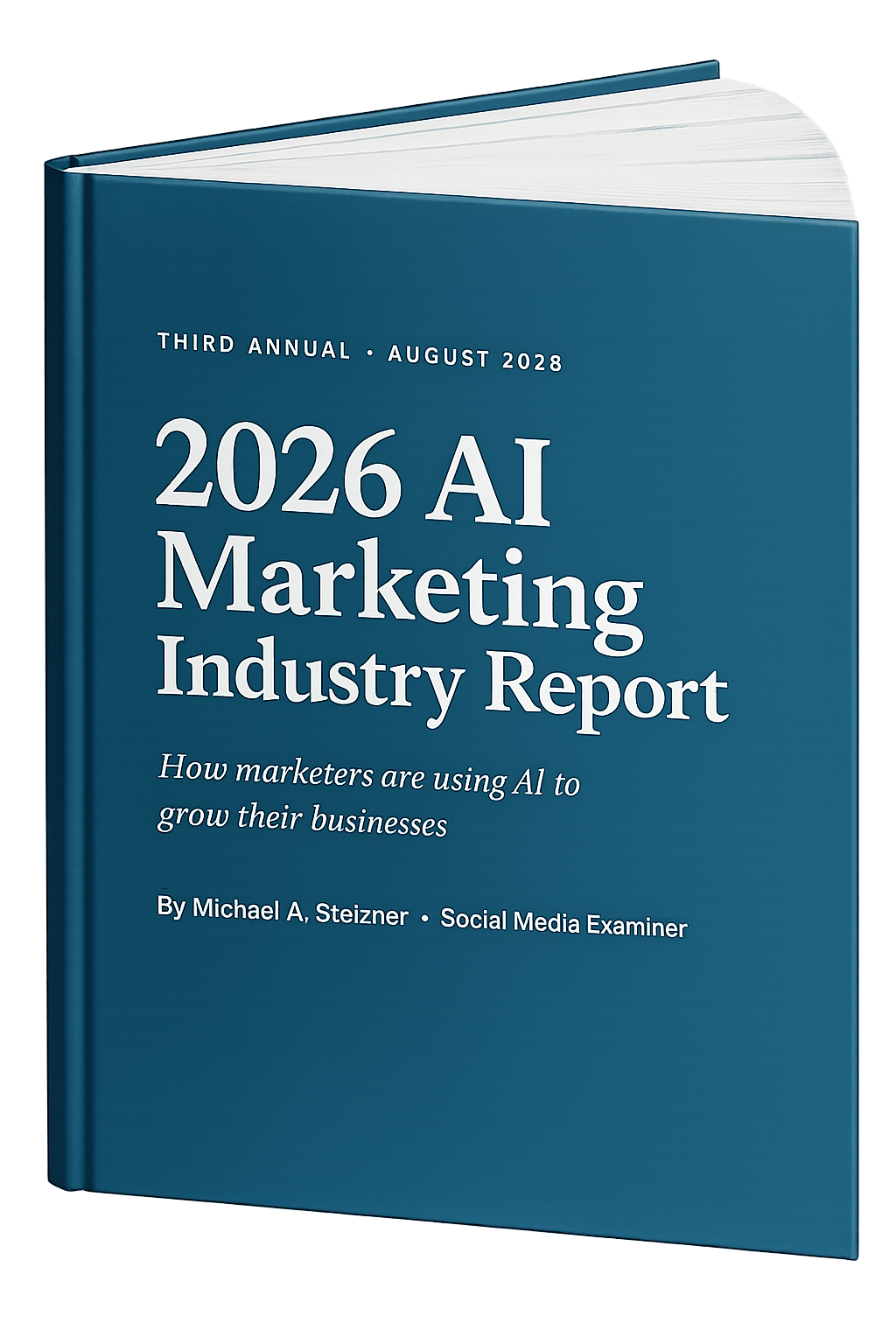
The 2026 AI Marketing Industry Report Insights
Recent data from comprehensive industry surveys—such as the third annual AI Marketing Industry Report, which surveyed hundreds of marketing professionals—highlights a glaring vulnerability in the modern workforce:
- 85% of marketers are forced to learn artificial intelligence entirely through independent, self-directed experimentation.
- Only 7% of professionals receive formal, structured AI training directly from their employers.
- More than 50% of workers out-of-pocket fund the AI software and tools they use to perform their daily jobs.
The Emerging Capability Gap
This lack of institutional training has created a stark performance divide in the contemporary hiring market. Companies are increasingly finding that the threat is not that AI will replace human workers, but that human workers who effectively direct AI will rapidly replace those who refuse to adopt it.
Consider a real-world scenario observed across multiple growing organizations: A company hires a marketer with zero prior AI training. When tasked with producing sales pages and promotional graphics, the traditional marketer takes weeks to deliver basic iterations. Meanwhile, AI-trained employees within the same organization are producing ten times that output volume in a single business day.
The resulting personnel decisions are rarely about eliminating roles; they are about demanding a higher tier of execution. Modern organizations still require human visionaries to steer the messaging and set strategic direction, but those humans must know how to command automated digital workers at speed.
Official Strategies & Frameworks: Crafting Reusable Skills and Projects
Moving from a casual chat window to a permanent AI employee requires converting conversational successes into permanent infrastructure.
Turning Chats into Reusable Claude Skills
When a chat session successfully produces an A-plus output, that workflow should be codified into a Claude skill. In practical terms, a skill acts as a prompt on steroids—a saved, reusable set of instructions tied directly to your workspace that triggers a complex, trained operational sequence via a single command.
To transform a successful chat into a robust skill, prompt the model directly:
"What information or data would you need to increase and improve the output of this skill? What files would you want in a perfect world?"
The resulting answers will guide you to construct a Claude Project—a dedicated workspace where knowledge files, instruction sets, and skills live together harmoniously. For instance, a sales proposal skill inside a dedicated Project would house past winning and losing proposals, pricing sheets, and the top 15 customer objections paired with exact rebuttal frameworks.
The Board of Directors Technique
For complex operational challenges or unfamiliar business domains—such as establishing executive compensation packages, performance bonus structures, or multi-tiered corporate KPIs—creators can invoke the Board of Directors Technique.
By prompting Claude to simulate a panel of specific industry thought leaders (e.g., drawing upon the historical philosophies of prominent entrepreneurs like Mark Cuban or Sara Blakely), the AI synthesizes multifaceted business frameworks rather than returning generic internet search results.
Rigorous Testing and Iteration
Achieving elite performance requires treating AI training with the same patience applied to human onboarding. While many professionals abandon AI integration after 45 minutes of mediocre results, building a world-class voice copywriter or strategic researcher can require hours of dedicated refinement.
When an AI output falls short of a pristine standard, do not accept a B-minus result. Push back forcefully:

"I know you can do better than this. Review my standards and try again as if your performance depended on it."
To lock in corrections permanently, use precise iterative feedback:
"Here is the paragraph you wrote [Insert Text]. This is how I would write it [Insert Text]. Update the underlying skill file to reflect this correction, and explain precisely what flaw in your previous instructions prevented the correct output."
Future Outlook: Autonomous Scheduling and the Next Frontier
The final evolution of the AI employee framework is total operational independence: scheduling AI workers to run autonomously without human initiation.
Autonomous Workflows via Claude Co-Work
Using desktop coordination environments like the Claude Co-Work application, users can assign specific days, times, and execution frequencies to their saved skills. While current local constraints require the host computer to remain powered on and logged into the corporate account, the resulting automation is staggering.
Practical implementations already transforming modern businesses include:
- Automated Market Research: Setting a skill to run every Monday at 6:00 AM to crawl competitor channels, evaluate viral content trends, analyze engagement angles, and deposit curated creative briefs directly into a team Notion database.
- Transcription Management: Scheduling hourly background tasks to pull meeting transcripts from platforms like Granola, process the summaries, and feed them directly into the corporate "Second Brain" repository.
Enterprise Governance and Maintenance
As organizations scale their fleets of digital workers, governance becomes vital. Leading companies now maintain centralized skill databases (using platforms like Notion) to track every active AI employee, recording its creator, version history, operational purpose, and primary department owner. Skill maintenance and auditing are officially integrated into standard quarterly employee reviews, ensuring that the corporate digital workforce evolves in lockstep with business growth.
By treating artificial intelligence not as a chat window, but as an expandable, trainable, and schedular workforce, modern entrepreneurs can scale their operational output to unprecedented heights—freeing human teams to focus exclusively on the high-level creativity and strategic vision that defines the future of enterprise.