Executive Overview
For over two decades, the per-seat software pricing model served as the undisputed bedrock of the B2B tech economy. By charging corporations based on headcount, vendors established a convenient proxy for the volume of work executed. If a company hired more employees, its software bill naturally scaled upward; if headcount shrank, spending contracted proportionally.
That structural equilibrium has completely shattered.
According to recent industry diagnoses—synthesized from dialogues involving ZoomInfo CEO Henry Schuck, leading high-priced enterprise consultants, and hundreds of major software buyers—the current consensus on the trajectory of B2B pricing can be summarized in three stark words: nobody knows. Neither industry experts nor software buyers possess a definitive playbook, and market conditions fluctuate wildly from week to week.
Yet, as enterprise tech leaders frequently note, standing still is no longer a viable preservation strategy; it has become a slow corporate death spiral. The pressure on legacy pricing architectures is escalating rapidly, driven by compounding price inflation, shifting budgetary allocations toward generative AI tokens, and a fundamental decoupling of software licensing units from tangible organizational value.
As autonomous AI agents increasingly dictate software procurement decisions, incumbents face a stark realization: the traditional seat model is dying, and the organizations failing to adapt to consumption, outcome, or resolution-based billing frameworks risk obsolescence.
Detailed Chronology: The Anatomy of a Pricing Crisis
The systematic breakdown of the B2B seat model did not happen overnight; it is the culmination of years of aggressive pricing adjustments colliding with a structural revolution in artificial intelligence.
Phase 1: Exhausting the Headroom (2022–2025)
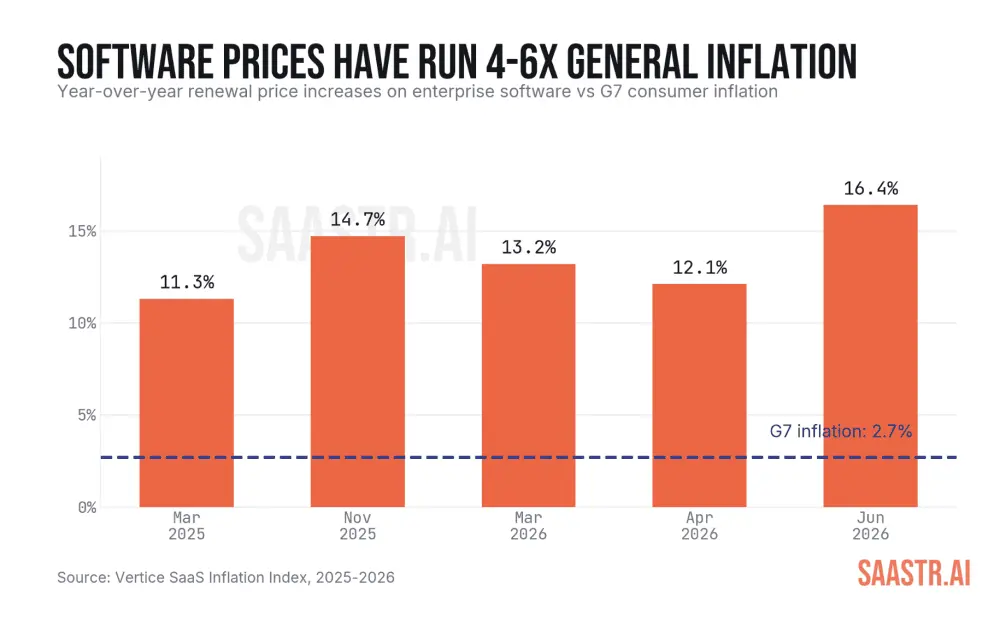
For four consecutive years, legacy B2B software vendors leaned heavily on per-seat pricing to carry the entire revenue burden of the sector. According to the Vertice SaaS Inflation Index—compiled from tens of billions of dollars in processed enterprise spend—software inflation consistently outpaced general economic inflation by massive margins. While G7 general inflation hovered around 2.7%, SaaS inflation ran between 12% and 16.4% through 2026, peaking at 14.7% in Q4 2025 and hitting 16.4% by June 2026.
Consequently, the average annual B2B software cost per employee surged from approximately $7,900 in 2023 to $9,100 by the end of 2025. Zylo’s 2026 SaaS Management Index, tracking over 40 million licenses and $75 billion in spend, reveals the crushing weight of this trajectory on enterprise buyers. The average enterprise now allocates a staggering $55.7 million annually to SaaS—an 8% year-over-year increase—despite the total application portfolio remaining entirely flat at roughly 305 applications.
Growth was not driven by acquiring new capabilities, but by relentless price hikes, packaging shifts, and tier expansions inside legacy contracts. With 79% of IT leaders reporting a price increase at renewal over a 12-month window, and 61% being forced to cut planned IT projects entirely to absorb these hikes, enterprise patience finally ran out.
Phase 2: The Token Budget Incursion (2025–2026)
The breaking point arrived as Chief Information Officers (CIOs) redirected capital away from traditional software to fund generative AI tokens and inference models. Redpoint’s benchmark CIO survey highlights a fundamental reallocation of enterprise budgets: roughly two-thirds of AI inference costs are being directly funded by stripping capital from existing software lines rather than carving out net-new IT budgets.
Major enterprises are openly executing this strategy. Publicis Sapient publicly announced plans to cut traditional SaaS licenses—including major suites like Adobe—by roughly half, substituting them with specialized AI solutions. When Fortune 500 giants cement these mandates in writing, global procurement departments rapidly follow suit. For any vendor selling purely per-seat licenses, their product abruptly became the primary funding source for the enterprise’s new token consumption bill.

Phase 3: The Decoupling of Headcount and Output (2026 and Beyond)
Compounding the budgetary squeeze is a foundational operational mismatch. Software automation has decoupled headcount from productivity. When an enterprise support team leverages AI agents to handle triple the historical inquiry volume using the exact same 40 human operators, legacy seat pricing bills the client identically despite tripling output. Conversely, if headcount drops from 40 to 25 because automated agents absorb tier-1 workloads, seat-based billing penalizes the vendor for delivering superior efficiency—punishing them for engineering a product that shrinks their own invoice.
This structural disconnect explains why overall software market spend continues to grow at 15%+, while traditional per-seat categories (such as CRM, sales automation, marketing, CX, and collaboration) languish in single-digit growth. The market did not contract; the billing unit simply broke.
Supporting Context & Metrics
To navigate this transitional era, enterprises and vendors alike are scrutinizing macro-level data points across spending, adoption, and emerging pricing paradigms.
- SaaS Portfolio Stagnation vs. Spend Expansion: Despite average enterprise SaaS spending climbing to $55.7 million annually, application footprints remain strictly capped at an average of 305 apps, proving that growth is entirely concentrated in inflationary pricing maneuvers.
- Unexpected Charges: Zylo indices indicate that 78% of enterprise buyers have encountered unexpected charges tied directly to AI features or consumption metrics during recent billing cycles.
- Projections for Alternative Pricing: Redpoint data emphasizes that 46% of CIOs explicitly expect usage- or outcome-based pricing models to dominate future enterprise agreements, while 29% anticipate seat-based models to decline outright.
Official Statements and Industry Insights
Industry titans are actively grappling with these operational seismic shifts, testing alternative billing models to capture remaining market share.
- Henry Schuck, CEO of ZoomInfo: Articulated the primary market sentiment after consulting with top-tier advisors and enterprise buyers: "Nobody knows [where pricing is going]. Not the experts, not the customers, and the answer keeps changing week to week." Schuck emphasizes that while consumption pricing can lead to severe cost overruns and bill shock if left unmonitored, modern AI agents can effectively establish automated spend guardrails (e.g., capping monthly outlays at $1,000 while maximizing high-value use cases) to protect enterprise buyers from runaway meters.
- Jason Lemkin, Investor and Founder of Saastr: Highlighted the unprecedented hyper-growth of modern outcome- and resolution-priced platforms like Palantir, noting: "Almost everyone’s growth rate decays at scale. Not Palantir. It just pulled off a quarter (and a year) like we’ve never seen… Revenue grew 93% year-over-year to $1.935 billion." Lemkin points out that Palantir’s forward-deployed engineering and value-anchored delivery model represents the pinnacle of enterprise outcome pricing.
Emerging Pricing Models: Consumption, Outcome, and Resolution
As the traditional per-seat model fades into obsolescence, three distinct structural alternatives have risen to prominence. However, they vary wildly in operational difficulty and viability.
Model 1: Consumption-Based Pricing
- The Mechanism: Customers pay precisely for what they consume—whether measured in credits, tokens, API lookups, or records processed (a model pioneered by infrastructure leaders like Snowflake, Databricks, MongoDB, Twilio, and Stripe).
- The Challenge: Unchecked consumption frequently leads to severe "bill shock" and budget forecasting nightmares for enterprise finance teams.
- The Solution: Vendors must couple usage-based billing with built-in governance tools: real-time anomaly alerts, automated hard and soft spending caps, transparent per-unit meter logs, and predictive forecasting algorithms.
Model 2: Outcome-Based Pricing
- The Mechanism: Customers pay strictly when a defined, high-level business result is successfully realized (e.g., a specific volume of revenue closed, or verified cost savings delivered).
- The Challenge: In complex categories like Go-To-Market (GTM) software, attributing a downstream financial outcome directly to a single software tool is notoriously difficult and prone to endless internal corporate debate. Furthermore, if a tool succeeds spectacularly, the resulting fee can dwarf standard subscription budgets.
- The Proof at Scale: Palantir exemplifies the ultimate enterprise implementation of this model. By anchoring every contract to a measurable dollar impact—supported by intense, upfront "AIP bootcamps" where engineers deploy live workflows at Palantir’s expense—they achieved staggering financial acceleration, boasting 93% YoY revenue growth to $1.935 billion in Q2 2026.
Model 3: Resolution-Based Pricing
- The Mechanism: A simplified derivative of outcome pricing, resolution billing focuses on a single, binary, countable event that either occurred or did not (e.g., a customer service ticket was fully resolved, or a data record was successfully verified).
- The Market Adoption: Support platforms have rapidly embraced this shift. Innovators like Sierra and Fin (acquired by Salesforce in June 2026 for approximately $3.6 billion) successfully bill per resolved support interaction, bypassing complex attribution arguments entirely.
Future Outlook: The Advantage of New Entrants vs. Incumbent Transformation
The deepest divide in modern enterprise software lies between greenfield startups and legacy incumbents.
New market entrants enjoy a massive structural advantage: they never had to convert an existing client base. Pioneers like Sierra structured their businesses around per-resolution billing from day one. They possess no legacy installed base to migrate, no internal sales compensation plans tied to license counts, no renewal motions built on employee headcounts, and no legacy accounting policies tied strictly to fixed software subscriptions.
For entrenched software giants, escaping the gravity of the seat model means simultaneously rewriting four load-bearing pillars of their business:
- Sales Compensation: Transitioning account executives from chasing headcount growth to selling usage, resolutions, or verified business outcomes.
- Revenue Recognition: Overfitting complex financial forecasting and GAAP reporting frameworks to variable meter flows.
- Customer Success (CS) Motions: Pivoting CS teams from driving login adoption and user engagement to proving direct financial ROI and automated efficiency.
- Product Packaging: Decoupling core platform access from consumption limits without sparking massive customer backlash.
While many legacy vendors attempt to solve this by slapping an AI add-on SKU onto existing seat contracts, this is merely a superficial pricing exercise. True transformation requires an entire operational overhaul.
Strategic Imperatives for Enterprise Software Leaders
As the industry marches deeper into the late 2020s, enterprise vendors and IT buyers must acknowledge a core reality: seats are dying because they measure the org chart rather than actual delivered value.
Incumbents must isolate specific product segments to run live pricing experiments immediately, decoupling their revenue growth from human headcount. Whether an organization ultimately pivots toward transparent consumption limits, tightly governed resolution metrics, or bold outcome-anchored partnerships, standing still is no longer an option. The market has spoken, the agents are selecting vendors based on unit economics, and the race to define the post-seat era is officially underway.