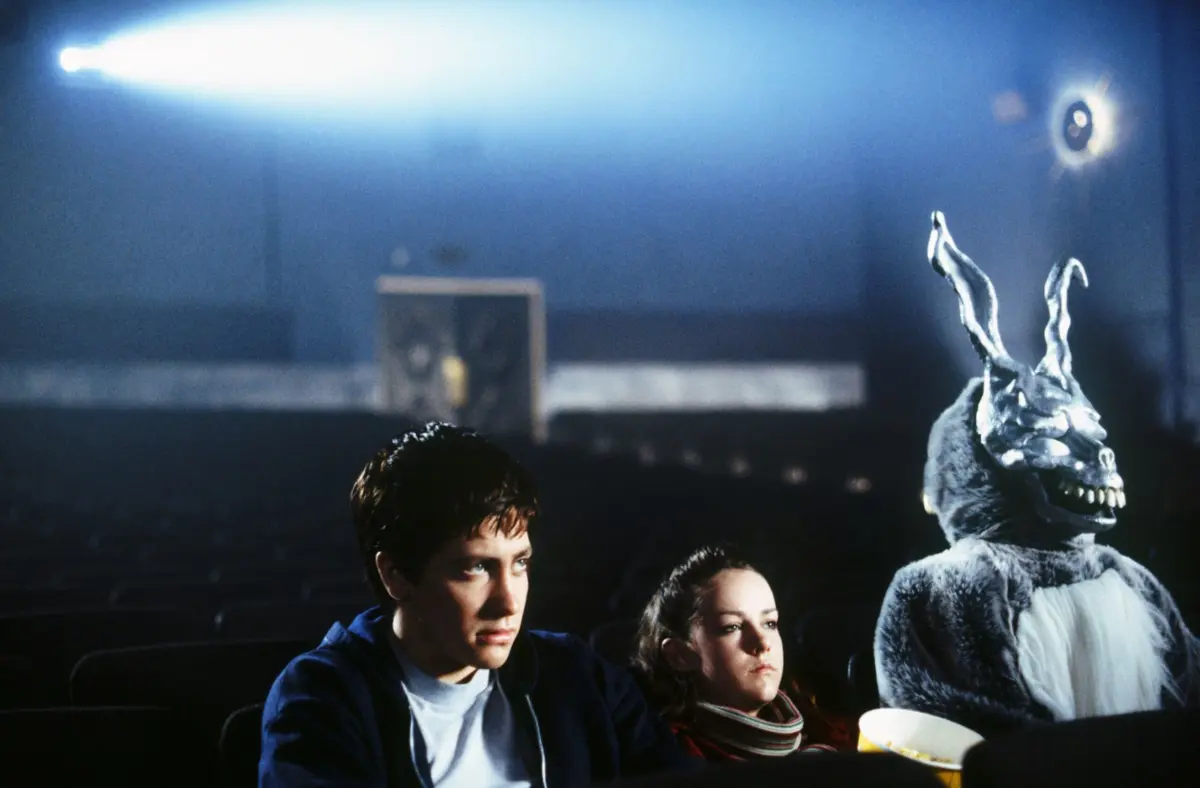
Twenty-five years after its initial theatrical release challenged audiences to decode its surreal, melancholy labyrinth of time travel and alternate realities, Richard Kelly’s Donnie Darko is officially expanding its universe. For over two decades, the 2001 psychological sci-fi cult classic has remained a lightning rod for late-night theorizing, Internet rabbit holes, and philosophical debates. Now, the enigmatic filmmaker behind the lens is finally opening the vault to provide answers—or perhaps deepen the mystery—with a massive new sequel project.
As reported by Variety, Kelly is slated to release an expansive 800-page sequel novel titled The Philosophy of Time Travel later this year. Published by Range Literary Publishing, the book is strategically scheduled to drop in the fourth quarter, aligning with the 25th-anniversary milestone of the original film’s release. Far from a standard cash-in or a quick cash-grab tie-in, this monumental literary work has been quietly gestating for a decade, representing the first major piece of official, creator-approved continuation since the film’s inception.
Set 14 months after the tragic death of the titular protagonist, The Philosophy of Time Travel utilizes an epistolary format—telling its story through "found documents," journals, and firsthand perspectives from Donnie’s grieving parents, Rose and Eddie Darko. Together, they attempt to piece together the shattered remnants of reality, the elusive tangent universe, and the inexplicable supernatural phenomena that irrevocably altered their family and community.
More than just a standalone literary experiment, Kelly envisions this massive publication as the opening salvo in a much grander multimedia renaissance for the Donnie Darko intellectual property. With ambitions stretching into animation, motion-capture adaptations, and a long-awaited live-action feature set nearly three decades after the original film, the return of Frank the Rabbit and the Darko family signals a major revival for one of modern cinema’s most revered cult milestones.
Detailed Chronology: From Box Office Flop to Cultural Touchstone
To understand the magnitude of The Philosophy of Time Travel, one must trace the rocky, improbable journey of Donnie Darko itself. The road from a troubled independent production to a universally recognized touchstone of early-2000s cinema is as twisty as the film’s time loops.

2001: The Inauspicious Beginning
Written and directed by a then-unknown Richard Kelly when he was just in his late twenties, Donnie Darko premiered at the Sundance Film Festival in January 2001. Featuring a haunting, melancholic atmosphere, a pitch-perfect indie-rock soundtrack (featuring Tears for Fears and Echo & the Bunnymen), and breakout performances from a young Jake Gyllenhaal and his sister Maggie Gyllenhaal, the film struggled immensely to find a traditional distribution path.
Fate dealt the film a cruel hand when it was released theatrically in October 2001—merely weeks after the tragic events of September 11. Given that the plot features a jet engine plummeting out of the sky to crush a suburban home, marketing efforts stalled, and the film unceremoniously bombed at the box office, grossing a paltry fraction of its $4.5 million budget during its initial run.
The Home Video Renaissance
Like many true cult classics, Donnie Darko found its true life away from the multiplex. When it hit DVD and VHS shelves, word of mouth exploded. College campuses, late-night midnight screenings, and nascent internet message boards transformed the movie into an obsessive puzzlebox. Fans analyzed the fictional in-universe textbook The Philosophy of Time Travel (written by the character Roberta Sparrow, aka "Grandma Death") frame by frame, trying to map out the complex mechanics of Primary Universes, Tangent Universes, Artifacts, and Manipulated Living.
The film’s longevity was further cemented in 2004 with the release of Kelly’s Director’s Cut, which leaned harder into the sci-fi mechanics by inserting explicit page excerpts from Roberta Sparrow’s book directly into the narrative.
The 2009 Misstep
The property’s enduring popularity prompted corporate attempts to capitalize on the IP without Kelly’s involvement. In 2009, S. Darko: A Donnie Darko Tale was rushed out as a direct-to-video sequel. Focusing on Donnie’s younger sister, Samantha, the film lacked Kelly’s philosophical nuance, stylistic direction, and emotional weight. It was universally panned by critics and fans alike, currently sitting at an abysmal 13% approval rating on Rotten Tomatoes. The failure of S. Darko proved that the universe could not simply be farmed out to hired guns; it required the precise, singular vision of its creator.

The Modern Revival: 2026 and Beyond
Now, exactly a quarter-century after audiences first met the brooding, nihilistic teenager in his skeleton onesie and his terrifying imaginary friend, Richard Kelly is stepping back into the director’s chair—or rather, behind the typewriter—to reclaim his creation and deliver a definitive continuation on his own terms.
Supporting Context & Metrics: By the Numbers
The cultural imprint of Donnie Darko can be measured not just in fan devotion, but through critical consensus, financial evolution, and production milestones:
- 25 Years: The span of time between the film’s original 2001 release and the upcoming 2026 launch of The Philosophy of Time Travel.
- 800 Pages: The substantial length of Kelly’s forthcoming novel, showcasing the immense depth of world-building and narrative complexity the filmmaker has spent the last decade constructing.
- 14 Months: The exact amount of time that has passed in-universe when the sequel novel begins, picking up over a year after Donnie’s sacrificial death.
- 88% Critical Score: Donnie Darko‘s robust standing on Rotten Tomatoes, reflecting its enduring critical reappraisal over the last two decades.
- 71 Metascore: Indicating generally favorable reviews among high-brow cinematic critics once the film achieved historical distance from its tragic release window.
- 13% vs. 88%: The stark quality divide separating the un-authorized, critically reviled 2009 spin-off S. Darko from Kelly’s original masterpiece—highlighting why fans are eagerly awaiting an authentic follow-up.
Official Statements & Creative Vision
Speaking exclusively to industry reporters regarding the development of the book and the broader multimedia strategy, Richard Kelly shed light on why it took twenty years to finally crack the code of a sequel.
According to Kelly, the primary hurdle was the sheer scale of the mythology. Over the past two decades, he attempted multiple times to write a traditional feature-film script continuing the narrative. However, the complex quantum physics, temporal paradoxes, and expanding character arcs ballooned the story into something too unwieldy for a standard feature-film runtime.
"The mythology grew too large and complicated to easily bring to the screen in a traditional format," Kelly noted, explaining his decision to pivot to prose. By spending the last ten years penning an 800-page novel, Kelly was able to fully flesh out the lore hinted at in the original film’s marginalia.

Crucially, Kelly views the publication of The Philosophy of Time Travel as a foundational building block for a much larger, multi-tiered franchise rollout. His long-term blueprint involves a phased expansion:
- Literary Launch: Establish the canon and expand the psychological aftermath in prose.
- Animation/Motion-Capture Adaptation: Translate the dense time-travel mechanics and surreal visual elements into an animated or motion-capture cinematic format capable of handling the story’s impossible physics.
- Live-Action Legacy Sequel: Culminate the multi-part plan with a live-action feature film set precisely 28 years after the events of the original 2001 film.
Furthermore, Kelly has expressed active interest in bringing back the original ensemble cast—including Jake Gyllenhaal, Jena Malone, Drew Barrymore, and Maggie Gyllenhaal—should the live-action phase successfully materialize. Bringing the surviving actors back to portray older versions of their characters grappling with the legacy of a dead teenager who altered the timeline adds a poignant, meta-textual layer of aging and nostalgia to the project.
Future Outlook: What the Sequel Means for Fans
For a generation of cinephiles who spent their formative years arguing over the mechanics of Jet Engines, Tangent Universes, and the tragic fate of Frank the Rabbit, the announcement of The Philosophy of Time Travel is nothing short of a cultural event.
For years, the ambiguity of Donnie Darko‘s ending was its greatest strength. The film left viewers suspended in a state of beautiful confusion, questioning whether Donnie’s journey was an act of genuine cosmic heroism, a schizophrenic delusion, or a deterministic loop. By returning to this world 14 months after Donnie’s death—focusing heavily on the grief and confusion of his parents, Rose and Eddie—Kelly is smartly avoiding a cheap "resurrection" trope. Instead, he is exploring the emotional and psychological fallout of a community touched by an anomaly they can neither explain nor forget.
As the book heads toward its Q4 release window, anticipation will undoubtedly reach a fever pitch. Will The Philosophy of Time Travel demystify the cult classic once and for all, or will it pile new layers of philosophical madness onto an already dizzying mythos? If Richard Kelly’s track record is any indication, readers should prepare for a mind-bending journey back into the dark heart of Middlesex, Virginia—where the world might just end in 28 days all over again.