
In the contemporary landscape of visual art and documentary photography, longevity is a rare currency. While many modern creators chase ephemeral digital trends, photographer Nick Haymes has spent a quarter of a century refining an entirely different methodology: total, unblinking immersion. Known historically for his sweeping, long-term visual studies—ranging from underground skateboarding subcultures to multi-year deep dives into sudden youthful fame and the shifting identity of queer artist Love Bailey—Haymes has finally turned his lens toward his most intimate and challenging subject yet: his own flesh and blood.
Published by SPBH Editions, an imprint of the prestigious publishing house MACK, Haymes’s upcoming monograph, Chronograph, represents a monumental achievement in domestic documentary. Spanning 448 pages and comprising nearly 1,000 photographs captured between 2001 and 2026, the book charts 25 years of family life across the geographic and cultural axis of New York and Los Angeles. It documents his partner, Lina Kutsovskaya, and their sons, Philipp and Lawrence, as they navigate the chaotic, beautiful, and often abrasive reality of growing up together.
Rather than presenting a sanitized, highly curated family album, Chronograph captures the messy fabric of daily existence. It features nosebleeds, domestic spats, teenage rebellions, moments of profound grief, and uproarious laughter. The book is simultaneously a coming-of-age chronicle for his sons and an unflinching autopsy of modern fatherhood. In an age dominated by hyper-curated digital feeds and algorithmic perfectionism, Chronograph emerges as an antidote: a raw, poetic meditation on time, presence, and the quiet dignity found within life’s most ordinary moments.
Detailed Chronology: 25 Years Behind the Lens
The genesis of Chronograph spans a quarter-century of sweeping global and personal shifts. Born in Stratford-upon-Avon, Haymes relocated to New York City at the turn of the millennium in 2000. During the early 2000s, he operated as a prominent editorial photographer, shooting for vanguard style publications including Dazed, i-D, Vogue, and The Face. However, as the digital revolution upended traditional media landscapes, Haymes found his commitment to analog film stalling his commercial trajectory.
Concurrently, as his wife’s career flourished, Haymes transitioned into the role of a stay-at-home father—a domestic shift that would fundamentally alter his artistic output. Confined for long stretches within the intimate boundaries of an 800-square-foot, open-plan New York apartment, Haymes had nowhere to retreat from his family. Cameras became permanent fixtures of the household inventory, littering countertops, sliding into coat pockets, and hanging effortlessly from his shoulder.
"The cameras were just there," Haymes reflects. "If it was a point-and-shoot camera, it was in my pocket. I was just continually snapping. It became—that’s just what dad did."

As the boys matured into their early teens, they developed an acute awareness of their father’s persistent lens. This realization bred a playful, communicative resistance. Whenever Haymes raised his camera, Philipp and Lawrence would often flash ironic grins and theatrical thumbs-up gestures, actively attempting to disrupt the framing.
This dynamic produced scenes of striking honesty. In one notable instance, Lawrence stood streaming with blood from a severe nosebleed in the shower while his father documented the event. When Lawrence later remarked that most parents would drop the camera to offer immediate comfort, Haymes didn’t disagree. Yet, it is precisely this refusal to flinch from vulnerability that grants Chronograph its gripping authenticity.
The narrative arc of the book mirrors the macrocosmic shifts of contemporary history. Edited down from an initial archive of roughly 40,000 frames, Chronograph is sequenced in a strictly chronological flow. The book opens in the immediate aftermath of September 11, with the collapsing Twin Towers serving as a heavy, tragic backdrop for the dawn of the century. From this monumental historical trauma, the narrative abruptly narrows, tunneling inward toward the microscopic domesticity that followed: small hands stacking a Jenga tower on a battered kitchen table, the harsh amber flash reflecting off wooden blocks, and Philipp submerged in bathwater with his hair fanned across the surface.
This intentional juxtaposition underscores a central thesis of the work: while historical milestones dictate the geopolitical climate, it is the seemingly insignificant, microscopic details of family life that truly shape human consciousness.
Supporting Context & Metrics: The Architecture of Memory
Analyzing the physical and structural parameters of Chronograph reveals the scale of Haymes’s archival undertaking:
- Publication Date: 2026 (SPBH Editions / MACK)
- Page Count: 448 pages
- Image Count: Approximately 1,000 photographs
- Temporal Span: 25 years (2001–2026)
- Geographic Scope: New York City and Los Angeles
- Initial Archive Size: ~40,000 raw frames edited down to the final monograph selection
The structural sequencing of the book was heavily shaped by its publisher, Bruno Ceschel, who first approached Haymes about the project a decade prior. At the time, Haymes felt the archive was incomplete. It was only after a series of profound life events—specifically the passing of Lina Kutsovskaya’s parents, which required Philipp and Lawrence to deliver eulogies—that the archive achieved emotional closure. Witnessing his sons display profound maturity and resilience in the face of deep grief provided the definitive boundary line for the project.

The book’s cover design further emphasizes its sweeping thematic arc. Eschewing a nostalgic "scrapbook wall" of thumbnail images, the publisher’s designer selected a striking, cropped dual-portrait pairing the boys as small children alongside an image of them fully grown. For Haymes, the book must function as a cinematic slideshow—a continuous, unbroken stream of evolution and physical transformation.
Official Statements & Artistic Philosophy
Despite the deep emotional resonance of the monograph, Haymes resists the temptation to sentimentalize his domestic role. Parenting, he notes, was frequently exhausting, riddled with daily anxieties, and marked by a complex interplay of affection and friction.
"At some point, it was painful being a parent. You go through love and hate, and I didn’t enjoy it," Haymes admits candidly. "There are those anxieties that you have when you’re dealing with it daily. I would think a lot of people would say that, but in hindsight, it was pretty fantastic. I don’t regret anything."
Crucially, Haymes ensured his sons reviewed the archive prior to publication, paying particular attention to frames involving nudity. The process yielded unexpected discoveries, as his sons often reinterpreted the captured moments through entirely different psychological lenses.
"Sometimes you explain the photos to them, or it prompts a completely different response and memory to the one that you had," Haymes says. "Which is quite nice because you hear their take. Ultimately… it’s not really a book about kids. It’s more of a book about life."
Reflecting on the overarching lessons of the 25-year project, Haymes emphasizes the importance of unvarnished presence over the pursuit of grand, monumental achievements.
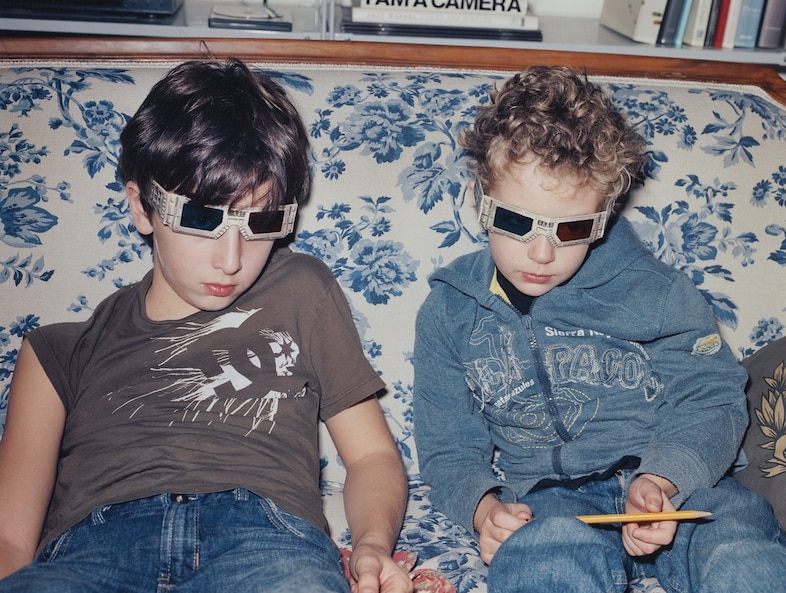
"Time is actually quite short, and you do have to make the most of whatever you have," he reflects. "How present are you as a person in the company of others? I think that’s the most important thing. The insignificant things do become the most poetic and beautiful at some point, other than searching for this monumental thing."
Future Outlook
Even as Chronograph enters the public sphere and his sons transition into independence—having officially moved out to navigate the world as "big kids"—Haymes shows no signs of slowing his relentless documentary pace. True to form, he is already five years deep into a new youth culture project designed to capture the pulse of contemporary subcultures.
With characteristic self-deprecation, Haymes jokes about the inevitable temporal lag inherent to long-term photography: "By the time I’m finished with it, everybody’s going to be adults. So, another fail."
Yet, this perpetual attraction to youth remains the beating heart of Haymes’s artistic identity. It is an affinity driven by the desire to witness transformation, rebellion, and the radical optimism that defines early life. By continuing to immerse himself in the company of the young, Haymes defies stagnation, proving that true documentary photography is not merely about preserving the past, but about remaining radically, painfully awake to the present.