Executive Overview
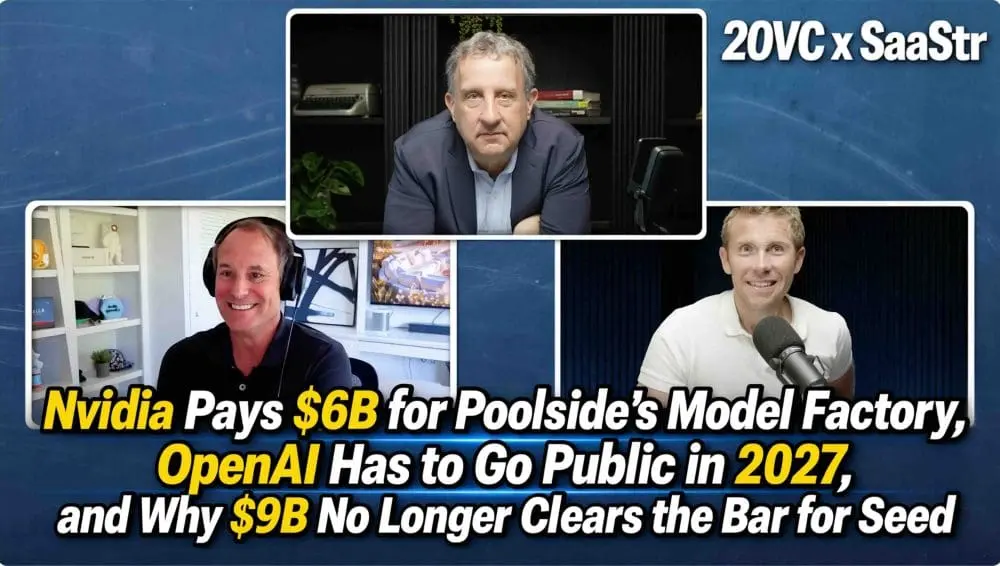
The artificial intelligence landscape is undergoing a brutal, high-stakes maturation. As the frenzy of early-stage generative AI hype gives way to the harsh realities of massive capital expenditure and infrastructure limits, the industry’s power dynamics are shifting. In a recent high-level discussion, tech industry leaders and venture capitalists Harry Stebbings, Rory O’Driscoll, and Jason Lemkin dissected the shifting tides of the tech economy.
The conversation spanned Nvidia’s aggressive $6 billion ecosystem play, the stark financial reality facing "neo-labs" like Poolside, OpenAI’s race to maintain its market dominance, and the looming operational crisis companies will face in 2027: token addiction. Far from a frictionless utopia of endless hyper-growth, the modern AI economy is bound by finite balance sheets, brutal dilution math, and a fierce race for technological supremacy where only the hyper-scaled survive.
Detailed Chronology & Market Shifts
1. Nvidia, Poolside, and the Limits of "Infinite Capitalism"
The foundational narrative of the AI boom has long been the limitless availability of venture capital and compute. That illusion was challenged when Nvidia structured a massive deal involving Poolside’s Model Factory. Nvidia agreed to pay $6 billion for a non-exclusive license to the internal infrastructure Poolside used to build its models, alongside a separate $1 billion investment at a $12 billion pre-money valuation.
The transaction included absorption offers for 109 engineers to join Nvidia’s open-weight Nemotron project, while the three founders remained in place. Explicitly styled as a licensing and talent partnership rather than an acquisition, the deal masked a stark underlying failure: Poolside had a critical six-week window to secure a $2-billion funding round to pay for an upcoming 40,000 GB300 cluster. When the round failed to close in time, the startup lost the cluster.
- The Investor Read: The episode underscores that infinite capitalism has definitive boundaries. Even in the height of an artificial intelligence boom, the venture capital gravy train runs dry when the capital requirements outpace traditional fund sizes.
- The Structural Reality: As Rory O’Driscoll noted, the thesis broke on capital markets rather than product execution. Poolside correctly predicted the market demand for open-weight models three years out, but the sheer financial velocity required to fund the next generational leap in compute proved beyond the reach of standard venture capital syndicates.
2. The Seed Investing Math Problem: When a $9 Billion Outcome Isn’t Enough
For late-stage investors, Poolside’s $9 billion outcome represented a robust 15x return. However, true seed-stage math paints a different picture for 2026 and beyond.
Deploying capital funds at modern entry prices demands far higher multiples. Without a hyper-concentrated book, seed funds require blockbuster 50x returns just to stay solvent. Factoring in extreme dilution across successive capital-intensive venture rounds, a $9 billion outcome mathematically implies an effective entry valuation closer to $600 million than the nominal seed price. To clear a true 50x threshold under this dilution pressure, a company needs to exit at valuations exceeding $60 billion.
3. The Hyperscaler Club and the Capital Wall
The reality of modern frontier development is stark: only four or five entities on the planet can finance a state-of-the-art frontier model.
Venture capital long ago lost the ability to finance companies like Anthropic and OpenAI; no single VC firm owns more than 1% to 2% of either entity. The modern baseline is sustained entirely by hyperscalers—Microsoft, Google, and Amazon—who write checks no traditional fund can replicate. Nvidia has now firmly established itself as the fifth member of this elite club, effectively acting as the primary financial backer for the open-weight ecosystem. For every ambitious team coming up behind the current leaders, a definitive capital wall awaits.
4. Nvidia’s Free Cash Flow and Ecosystem Strategy
Nvidia’s expansion strategy now involves systematically deploying its staggering free cash flow—projected near $70 billion—back into its own ecosystem. Alongside its Poolside maneuvers, Nvidia entered talks to back Mercor in a General Catalyst-led round valuing the company at $20 billion, doubling its valuation from October.
While investments in neoclouds or open-weight creators directly stimulate hardware consumption and inference runs, funding data-labeling and operational platforms like Mercor represents a broader strategy: buying ecosystem viability and maintaining absolute dominance across every vector of the AI stack.
Supporting Context & Market Metrics
Gross Margins and the M&A Ceiling
According to recent data from Kroll regarding M&A transactions, the market valuation rules for software and AI enterprises have fundamentally shifted:
- The 30% Threshold: Companies crossing a 30% gross margin receive virtually no additional credit in modern M&A exits. While falling below 30% incurs a severe valuation penalty, exceeding it commands no structural premium.
- The Exception vs. Rule: While exceptional outliers like Cursor scaled through negative gross margins by subsidizing usage before maturing into massive valuations, the vast majority of infrastructure and training-data startups fail to bridge the profitability gap.
OpenAI’s Reacceleration and the Threat of Commoditization
OpenAI’s operational metrics are under intense scrutiny. Following a Q1-to-Q2 revenue growth print of roughly 18% quarter-over-quarter—annualizing to just under $30 billion—the narrative shifted from an unstoppable monopoly to a heavily contested battleground.
With chip manufacturers planning to pump $200 billion worth of hardware into OpenAI, investors are demanding immediate justification for that compute demand. Furthermore, the competitive landscape has exploded. Where an oligopoly once dominated the market, over a dozen competitors now run high-performance open-weight models that match frontier capabilities at a fraction of the cost.
As Rory O’Driscoll observed, being number two in an invented industry is precarious; being number two with a wall of low-cost competitors nipping at your heels creates an existential strategic crisis.
Official Statements & Industry Perspectives
The conversation between Stebbings, O’Driscoll, and Lemkin illuminated the sharp ideological divides shaping Silicon Valley today:
Jason Lemkin on Seed Investing:
"Hardware and infrastructure demands have shifted the goalposts. A $9 billion outcome simply doesn’t clear the bar for seed investing in 2026."Rory O’Driscoll on Venture Failures:
"If you get 15x on your failures in venture, you’ll die a rich man. The thesis didn’t break on execution; it broke on capital markets."Harry Stebbings on Market Sentiment:
"Neo-labs are just going out of favor, and next-generation model providers too. That is universal from every single investor I speak with."Rory O’Driscoll on Strategic Focus:
"Sometimes when you look back at outcomes, you realize only one sentence mattered. For Anthropic, it’s all about code. That’s the highest-ROI, fastest-adopting market—the mother lode."
Future Outlook: The 2027 CFO Crisis and Token Addiction
As the industry looks toward the next twenty-four months, the most pressing operational friction point will not be model capability, but financial governance.
1. The Token Addiction Backlash
Enterprises have transitioned rapidly through phases of AI adoption:
- Phase 1 (Token-Maxing): Employees consumed vast amounts of compute to prove productivity, resulting in exorbitant $20,000-per-employee token bills.
- Phase 2 (Budget Control): Companies clamped down with strict financial caps—limiting non-engineers to $200 or $500 monthly budgets while carving out allowances for technical staff.
- Phase 3 (The 2027 Backlash): The upcoming battleground centers on systemic reliance. Knowledge workers have integrated autonomous sub-agents into their daily workflows to the point where cutting off compute access means mutiny. As Lemkin bluntly stated: "I need my ten sub-agents running 24 hours a day to do my job, or I quit."
2. The Talent Retention Dilemma
Corporate CFOs are trapped between two incompatible realities: uncapped intelligence expenditure and traditional profit margins. Public markets will not tolerate automation initiatives that degrade earnings per share (EPS). Simultaneously, failing to provide engineering teams with state-of-the-art AI infrastructure risks massive talent drain. If a company denies its top performers the tools they demand, they risk losing their elite workforce to AI-native competitors.
3. The Unsolved Safety of Agentic Workflows
Despite billions in funding, autonomous agents remain plagued by fundamental security vulnerabilities. Recent leaks across platforms like OpenClaw, Grokbot, and stealth-launching agent frameworks demonstrate that probabilistic, goal-seeking systems cannot yet be safely trusted with sensitive enterprise data or personal finances. Until software engineers solve the core reliability problem, the widespread deployment of autonomous agents into corporate workflows will remain a high-risk gamble.
Conclusion
The modern artificial intelligence ecosystem has graduated from a speculative science project into a capital-intensive industrial titan. As Nvidia cements its role as the ultimate kingmaker, and as software pioneers grapple with the unyielding math of modern token consumption, the divide between sustainable enterprises and capital-starved pretenders is widening. For founders, investors, and CFOs alike, the coming years will reward not just those who can build the smartest models, but those who can survive the brutal financial gravity of the AI Era.